How Hormuz Closure at $104 Oil Is Reshaping Every Asset Class
11 hrs ago


ServiceNow delivered a 22% subscription revenue growth rate and raised full-year guidance, yet shares plunged 17% in a single session. The market’s verdict points to something deeper than quarterly numbers.
This is a pivotal moment in enterprise software where AI is forcing fundamental questions about how companies monetise their products. ServiceNow’s revelation that half of net new business now comes from non-seat pricing is not a footnote. It is the company’s answer to existential questions about AI disruption to traditional per-user licensing.
This analysis unpacks what ServiceNow’s hybrid pricing model actually looks like, why investors remain sceptical despite strong results, and what the market reaction signals about enterprise software valuations in an AI-dominated landscape.
The headline numbers were strong on their own terms:
Management raised full-year guidance, updating subscription revenue outlook to $15.735-15.775 billion. This is a confidence signal that typically supports share prices.
ServiceNow’s official Q1 2025 financial results confirm subscription revenue of $3.005 billion and total revenue of $3.088 billion, with current remaining performance obligations growth reaching 22%, figures that underpin the strong execution narrative despite the market’s negative reaction.
The market rejected all of it.
Shares fell 17.58% in a single day to approximately $84.95, despite the earnings beat and raised guidance.
The disconnect between results and reaction reveals what investors are actually pricing: not current performance but future structural risks. Surface-level earnings beats no longer guarantee market approval in enterprise software. The question is what spooked capital despite the strong execution.
ServiceNow’s 17% single-session decline reflects the software sector’s broader AI disruption fears rather than company-specific execution failures, a pattern that saw the S&P Software and Services Select Industry Index fall 16.5% year-to-date through mid-April 2026 despite an absence of concrete revenue warnings from major incumbents.
ServiceNow reported that 50% of net new business now comes from non-seat-based pricing. To understand what this means, you need to see the mechanical components.
The company is running a hybrid model that combines traditional seat-based licensing with usage-driven components. Seat-based licensing is predictable and recurring. You pay per user. Usage-driven components scale with consumption. You pay for what you use.
The non-seat components break down into four categories: tokens for AI consumption, infrastructure fees, hardware costs, and connector charges. Tokens measure how much AI processing a customer consumes. Infrastructure fees cover the cloud and compute resources required to run AI workloads. Hardware costs apply when customers deploy on-premises or hybrid configurations. Connector charges apply when integrating ServiceNow’s platform with external systems.
| Pricing Component | Traditional Model | AI-Era Model | Revenue Characteristics |
|---|---|---|---|
| Seat-based licenses | Per-user subscription | Per-user subscription (retained) | Predictable, recurring |
| AI consumption (tokens) | Not applicable | Pay-per-token usage | Variable, scales with AI workload |
| Infrastructure fees | Bundled into seat price | Separate charge for compute/storage | Variable, tied to deployment scale |
| Hardware costs | Customer-owned | Charged for hybrid/on-prem setups | One-time or amortised |
| Connector charges | Limited integrations included | Charged per external system link | Variable, scales with integration complexity |
CEO Bill McDermott described the approach as offering customers flexibility to scale AI adoption with reduced friction. The phrasing is deliberate. It positions the model as additive rather than replacement.
The bear case on enterprise software is straightforward: AI agents could replace human workers, eliminating the users who justify seat licenses. If one AI agent does the work of five employees, you lose four seats.
Consumption-based pricing aligns revenue with actual AI usage rather than headcount. The more a customer uses AI, the more they pay, regardless of how many human users remain. This model turns the disruption threat into a growth vector.
ServiceNow’s hybrid approach addresses the broader industry challenge: the collapse of per-seat SaaS pricing models, which dropped from 21% to 15% usage in one year, with IDC projecting the model will be obsolete by 2028 as 70% of vendors shift to consumption or outcome-based structures.
Management positioned this as reducing friction for customers expanding AI adoption. Instead of forcing customers to justify additional seat purchases when deploying AI agents, the model lets them pay for what they consume. The customer’s cost scales with value received, not with arbitrary user counts.
The question investors are asking is whether this model can sustain growth rates at scale, or whether it simply postpones revenue pressure.
The forward guidance was the primary catalyst for the sell-off. Three specific signals drove institutional selling:
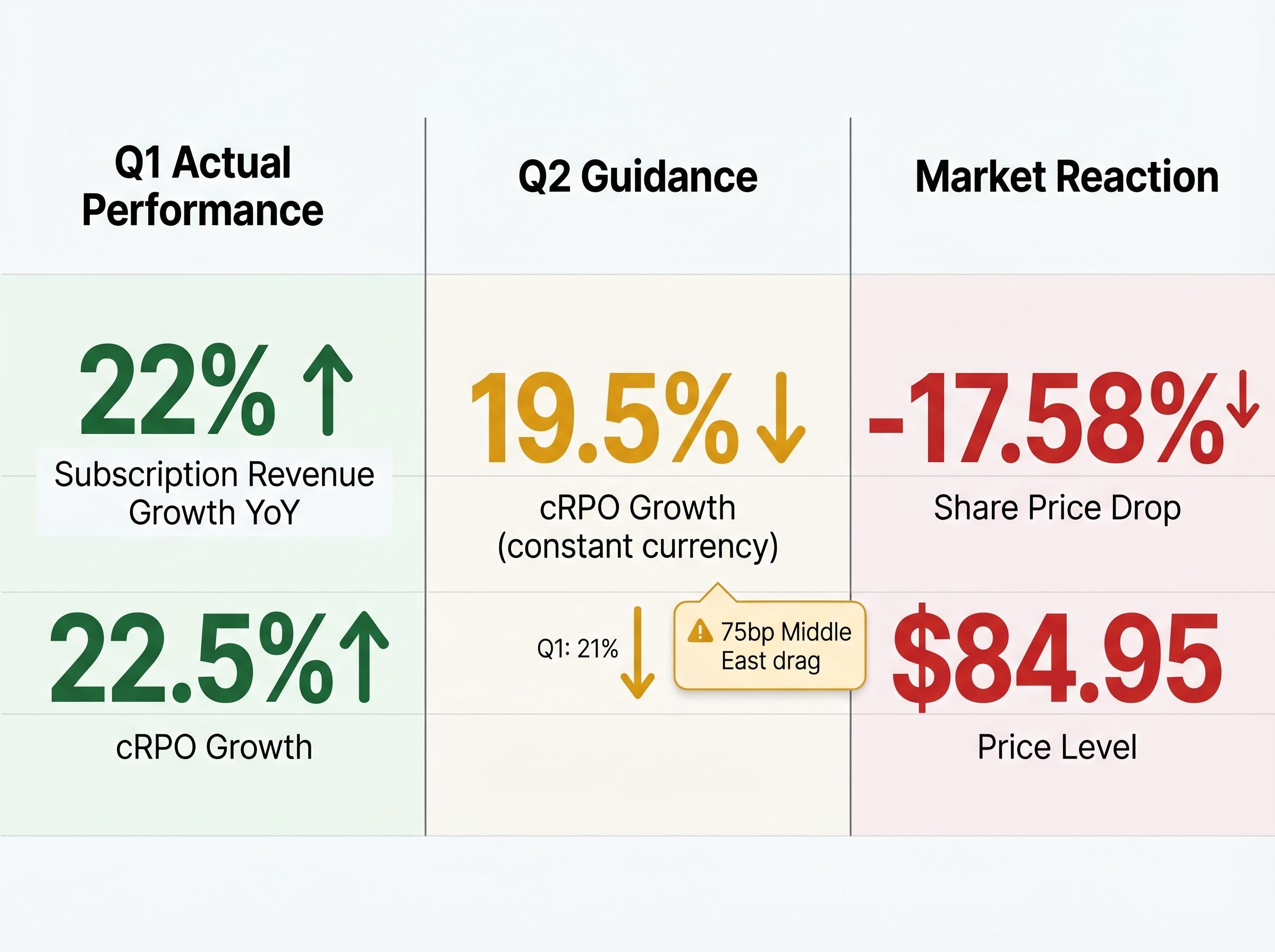
The Middle East impact is a temporary headwind.
The 75-basis-point delay does not fully explain investor concern. The market is reacting to the sequential deceleration itself, not just the regional disruption.
Growth stocks are priced on trajectory, not snapshots. When management guides for sequential deceleration, the market recalculates terminal assumptions. Shares still trade at approximately 50 times earnings after the decline. At that multiple, even modest slowdowns trigger repricing.
The sell-off reflects repricing of future expectations, not a judgement on current execution. The market wanted to see acceleration, or at minimum stability. It got deceleration.
Société Générale’s Manish Kabra warns that deteriorating hyperscaler free cash flow, projected to turn negative by late 2026 before recovering in Q1 2027, makes the AI infrastructure buildout a near-term margin headwind even as it drives consumption-based revenue for software vendors.
ServiceNow’s acquisition of Armis makes strategic sense. Cybersecurity is a natural adjacency to the core platform. But the deal is financially dilutive in the near term.
Armis contributes approximately 125 basis points to the revised annual subscription revenue outlook. That is the revenue lift. The margin headwinds are larger:
| Margin Metric | Armis Impact | Direction |
|---|---|---|
| Subscription gross margin | 25 basis points | Headwind |
| Operating margin | 75 basis points | Headwind |
| Free cash flow margin | 200 basis points | Headwind |
Current gross margin stands at 77.53%. The 25-basis-point drag is manageable, but the 200-basis-point free cash flow impact is material.
CFO Gina Mastantuono emphasised that the company’s organic business momentum remains strong independent of acquisition effects. That framing asks investors to mentally separate Armis contribution from core business trajectory. The market’s response suggests scepticism about whether the distinction matters when margins compress regardless of source.
Acquisitions can mask organic performance in both directions. Investors evaluating ServiceNow must separate Armis contribution from core momentum to assess the underlying health.
Even after a 17% decline, shares trade at approximately 50 times earnings. Market capitalisation sits at approximately $108 billion. The stock is near the low end of its 52-week range of $81.24 to $211.48.
The valuation concern is structural, not cyclical:
ServiceNow’s situation connects to broader software sector scrutiny. The tension is between demonstrated AI monetisation (the 50% non-seat figure) and lingering scepticism about long-term seat-based revenue durability.
The stock’s position near its annual low creates an entry opportunity if subsequent results validate the new pricing model. It also exposes holders to further downside if deceleration continues.
ServiceNow is attempting to prove that AI enhances rather than cannibalises enterprise software revenue. The 50% non-seat figure is a response, not a solution. The market wants to see sustained growth under the new model, not just a single quarter’s snapshot.
Validation will take several quarters of execution. The company must show that consumption-based revenue scales predictably, that customers expand usage at rates that offset seat-based pressure, and that margins hold as the mix shifts.
The market is not punishing ServiceNow for poor execution. It is asking whether any enterprise software company deserves premium multiples when AI introduces structural uncertainty about monetisation models. ServiceNow’s hybrid approach is a test case for whether incumbents can adapt.
Ameriprise’s deployment of autonomous AI agents capable of handling specific advisor tasks independently drove a 10% productivity increase while maintaining a 4.9 out of 5 client satisfaction score, demonstrating that AI-driven efficiency gains can coexist with service quality in client-facing applications.
ServiceNow’s Q1 results demonstrate that the company can execute operationally whilst simultaneously transitioning its pricing model for an AI-native future. The 50% non-seat revenue figure is a significant structural answer to existential questions about software monetisation.
However, forward guidance deceleration, Armis margin dilution, and a still-elevated valuation create legitimate investor hesitation. The coming quarters will test whether ServiceNow’s hybrid model can sustain growth rates that justify premium multiples, or whether the market’s scepticism reflects a more permanent repricing of enterprise software expectations.
Investors should monitor Q2 cRPO growth, the pace of non-seat revenue expansion, and margin trajectory as Armis integrates. The stock’s position near its 52-week low creates an entry opportunity if subsequent results validate the new pricing model, but also exposes holders to further downside if deceleration continues.
This article is for informational purposes only and should not be considered financial advice. Investors should conduct their own research and consult with financial professionals before making investment decisions.
ServiceNow uses a hybrid pricing model that combines traditional per-user seat licenses with non-seat components including AI consumption tokens, infrastructure fees, hardware costs, and connector charges, allowing revenue to scale with AI usage rather than headcount alone.
Shares fell 17.58% in a single session because investors focused on forward guidance showing Q2 cRPO growth decelerating to 19.5% from 21%, alongside margin headwinds from the Armis acquisition, signalling trajectory concerns despite strong Q1 results.
Non-seat pricing means ServiceNow generates revenue from AI token consumption, infrastructure, and connector charges rather than purely from user counts, which theoretically protects revenue if AI agents reduce the number of human users on the platform.
The Armis acquisition creates a 200-basis-point headwind to free cash flow margin and a 75-basis-point drag on operating margin, while contributing approximately 125 basis points to the revised annual subscription revenue outlook.
Investors should monitor Q2 cRPO growth, the pace of non-seat revenue expansion, and margin trajectory as Armis integrates, since these metrics will determine whether the hybrid pricing model can sustain growth rates that justify a valuation of approximately 50 times earnings.