How Hormuz Closure at $104 Oil Is Reshaping Every Asset Class
12 hrs ago


Ameriprise Financial earned recognition as one of Fortune’s most innovative companies for 2026, a distinction amplified by specific guidance from the firm’s Q1 2026 earnings call. Management revealed that AI agents will soon handle certain advisor tasks previously requiring dedicated support staff. This announcement signals a qualitative shift in how wealth management firms deploy technology, moving beyond augmentation tools toward autonomous execution.
The development arrives as the wealth management industry confronts mounting pressure to expand margins whilst maintaining service quality. Ameriprise’s approach differs from competitors deploying AI as standalone applications. The firm has embedded artificial intelligence directly into its unified technology platform, connecting client relationship management, meeting tools, advice generation, and practice management into a single ecosystem. This architecture creates compounding productivity gains across multiple advisor touchpoints rather than isolated efficiency improvements.
Readers evaluating wealth management firms will understand how integrated AI deployment reshapes competitive dynamics, which specific functions are being automated, and why embedded architecture may generate more durable advantages than bolt-on tools.
Ameriprise has constructed a unified technology platform that connects client relationship management, the eMeeting tool, advice insights, and practice management systems into a single operational ecosystem. AI operates within this integrated architecture rather than as a separate application requiring advisors to switch contexts or manually transfer data between systems.
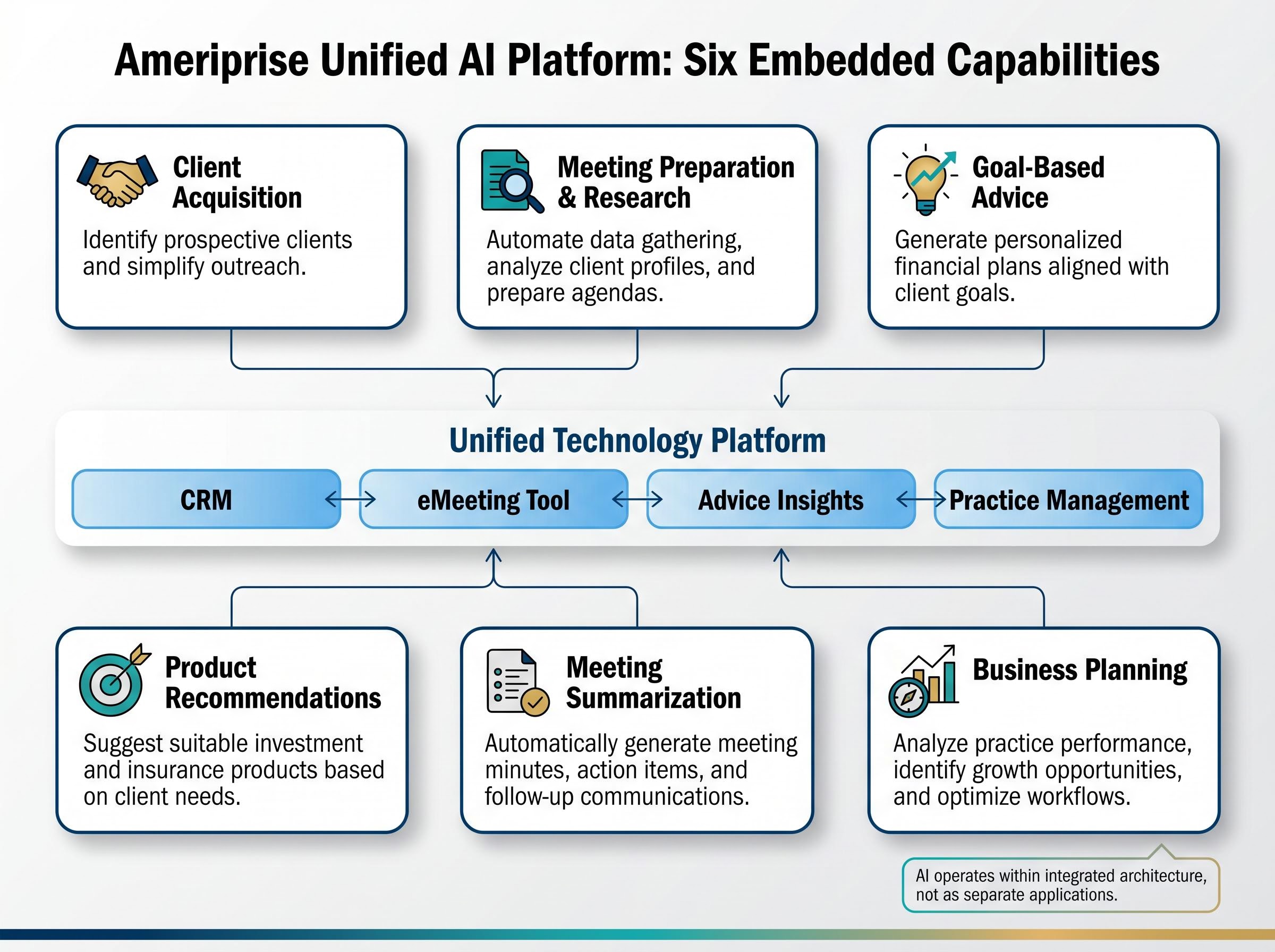
The firm has woven artificial intelligence into six specific workflow areas:
The eMeeting tool reportedly eliminates hours of manual work weekly for each advisor practice. This time compression allows advisors to redirect effort toward relationship building and complex problem solving rather than administrative documentation. The strategic philosophy emphasises enhancing human advisors rather than replacing them, positioning AI as infrastructure that amplifies professional judgment rather than substituting for it.
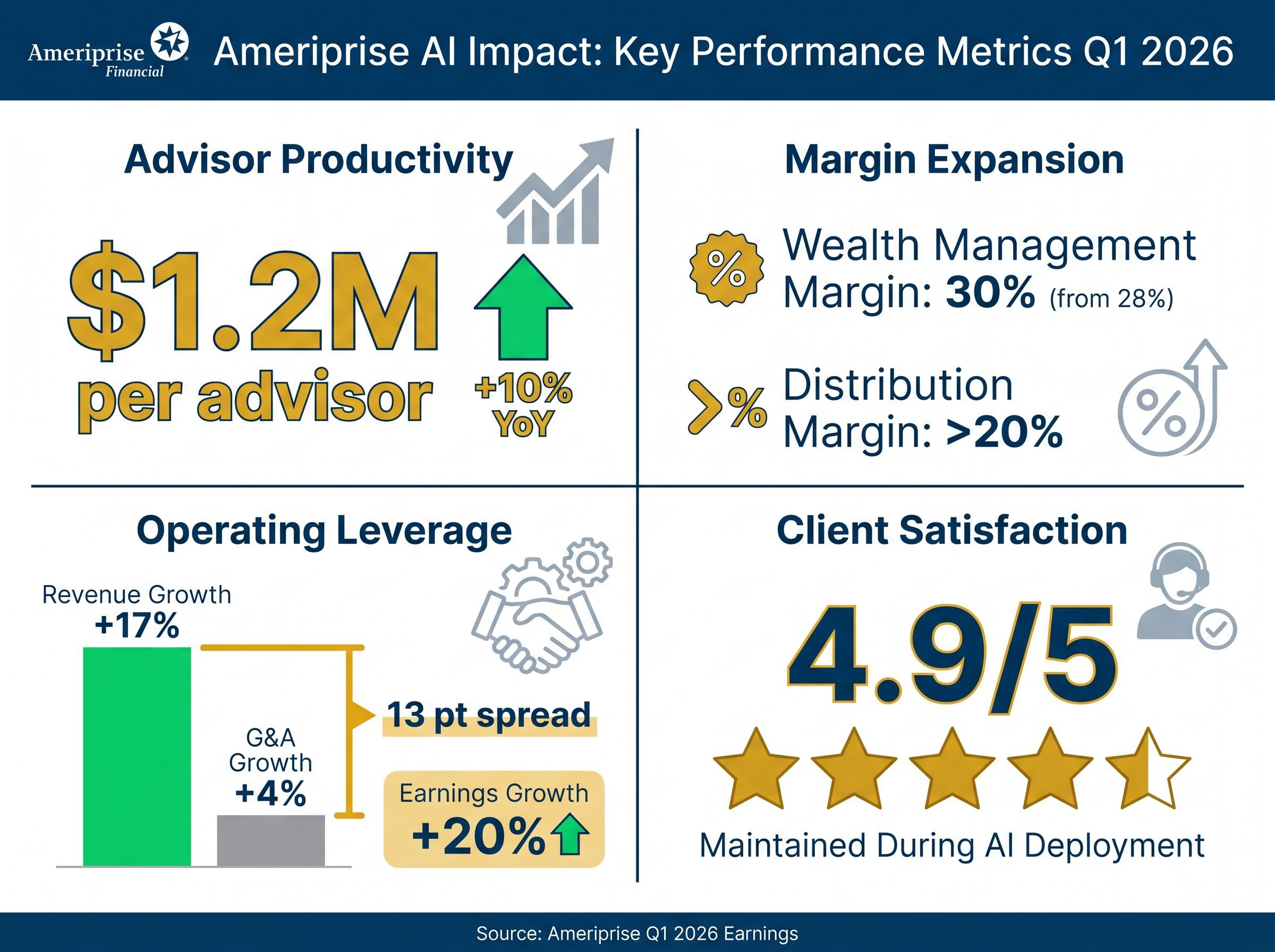
Advisor productivity reached a record $1.2 million per advisor during the most recent reporting period, representing a 10% annual increase.
NBER research on AI productivity effects in high-skill services finds the largest productivity gains concentrated in finance and professional services sectors, consistent with Ameriprise’s 10% advisor productivity increase and the broader industry pattern where integrated AI deployment generates measurable output gains rather than isolated efficiency improvements.
Productivity Milestone Advisor productivity hit $1.2 million per advisor, a 10% year-over-year increase, demonstrating how embedded AI architecture translates into measurable output gains.
This architecture matters because embedded AI compounds productivity gains across multiple touchpoints rather than creating isolated efficiency pockets. For investors evaluating wealth management firms, understanding whether AI is bolted on or built in reveals sustainability of margin expansion. Standalone tools generate one-time efficiency improvements. Integrated platforms create compounding effects as each workflow enhancement reinforces adjacent processes.
The abstract concept of AI in wealth management translates into specific changes in how advisors prepare for client meetings, deliver recommendations during conversations, and document outcomes afterward. Meeting preparation that previously required manual research across multiple systems now happens automatically through AI-driven consolidation of client data, market conditions, and portfolio positioning.
Client satisfaction scores remained at 4.9 out of 5 during this technology deployment period. Ameriprise ranked third amongst 23 firms in the 2026 J.D. Power U.S. Investor Satisfaction Study. Transactional activity grew 10% year-over-year, suggesting clients are acting on advice rather than experiencing service degradation from increased automation.
AI handles pre-meeting research by aggregating client account data, recent market movements affecting portfolio holdings, and upcoming financial planning milestones. During meetings, the system generates real-time product recommendations aligned to the client’s stated goals and risk parameters. After conversations conclude, AI produces meeting summaries and action item documentation that previously required advisor time to complete manually.
This sequence eliminates the hours of weekly manual work referenced in the eMeeting tool deployment. The time compression allows advisors to increase client contact frequency or deepen engagement during existing meetings.
Understanding the practical application helps readers assess whether AI deployment translates into measurable service quality improvements or remains primarily a cost reduction exercise. The high satisfaction scores alongside rising productivity suggest the technology is enhancing rather than degrading the advice experience. Clients receive faster responses, more comprehensive recommendations, and more frequent touchpoints whilst the firm captures margin expansion from improved advisor economics.
Ameriprise’s core distribution margin exceeded 20% in the most recent quarter. The overall Wealth Management segment margin improved to 30%, up from 28% a year earlier. Pre-tax adjusted operating earnings grew 20% to $951 million.
For readers wanting to understand how wealth management firms structure revenue streams and what drives profitability across different business models, our detailed coverage of wealth management revenue models examines fund management fees, advisory services, workplace retirement platforms, and the strategic shift from trading commissions to asset-based fee structures that align firm revenue with client portfolio performance.
These margin improvements occurred whilst fee-based and transaction revenues rose 17%. General and administrative spending increased only 4%, driven primarily by volume-related costs rather than structural expense growth. The widening gap between revenue growth and expense growth reveals operating leverage flowing through to profitability.
| Metric | Growth Rate | Direction |
|---|---|---|
| Fee-based & transaction revenues | 17% | Up |
| G&A spending | 4% | Up (volume-driven) |
| Pre-tax adjusted operating earnings | 20% | Up |
| Wealth Management segment margin | 30% (from 28%) | Up 200 basis points |
Distribution earnings are growing at a mid-30% pace, a trajectory connected to technology-enabled advisor productivity gains. The firm is achieving revenue growth through higher productivity per advisor rather than aggressive headcount expansion, a strategy that produces different margin dynamics than competitors relying primarily on recruiting to drive growth.
The margin trajectory reveals whether AI investment is generating returns or merely representing another expense line. The 13 percentage point gap between revenue growth (17%) and G&A growth (4%) suggests technology is creating operating leverage that flows through to profitability. This spread indicates AI deployment is functioning as infrastructure investment rather than consumptive spending.
Ameriprise’s current AI deployment represents augmentation, where technology assists advisors in completing tasks faster. The firm’s announced plans involve introducing AI agents capable of handling certain advisor tasks autonomously, a qualitative shift from assistance to independent execution.
Next Phase: Autonomous AI Agents Management indicated plans to introduce AI agents that will handle specific advisor tasks independently, potentially reducing the need for additional support staff as business volumes grow.
This transition means certain workflows will move from human execution with AI support to AI execution with human oversight. Management stated this capability could reduce the need for additional support staff, signalling the firm expects to absorb volume growth without proportional headcount increases.
FINRA’s regulatory notice on AI applications in member firms clarifies that existing securities laws and FINRA rules apply to artificial intelligence deployments, meaning wealth management firms deploying AI agents must maintain the same supervisory controls, recordkeeping standards, and suitability obligations that govern human-executed workflows.
The distinction between augmentation and autonomous agents matters for cost structure:
Ameriprise is also applying advanced analytics and technology to investment research within its asset management division. Columbia Threadneedle placed in Barron’s top 10 Best Fund Families across all time periods, with over 70% of funds performing above peer median across one, three, and five year periods.
The transition from AI assistance to AI agents represents a qualitative shift in how wealth management firms will operate. Readers should understand that firms moving toward agent-based models may achieve structurally different cost profiles than competitors still in the augmentation phase. The technology creates the potential for non-linear operating leverage, where revenue can scale faster than expenses once agent-based workflows reach production.
For readers wanting to understand how AI agents will connect across enterprise systems to create compounding productivity effects, our comprehensive walkthrough of enterprise agentic AI coordination frameworks examines the orchestration layer infrastructure enabling AI coordination at scale, network effects from interoperable workflows, and the strategic thesis that coordination infrastructure may prove more defensible than underlying AI models.
Ameriprise’s competitive philosophy emphasises organic productivity growth over aggressive advisor recruiting. The firm targets 4% to 5% annual organic growth, a measured pace that relies on existing advisors serving more clients or deepening existing relationships rather than acquiring practices from competitors.
The industry is witnessing a shift toward capital-light wealth management consolidation models, where firms acquire advisor practices through joint ventures and revenue-sharing arrangements rather than traditional acquisition premiums. This approach reduces execution risk whilst accelerating earnings contributions from day one.
The integrated platform approach contrasts with standalone AI tool deployment. Competitors offering disconnected applications force advisors to toggle between systems, manually transferring data and context. Ameriprise’s unified architecture eliminates these friction points, creating workflow continuity that compounds time savings across the client lifecycle.
Huntington Bank selected Ameriprise after conducting over a year of evaluation, choosing the firm based on stated factors including leadership in advice delivery, cultural alignment, and technological capabilities. The extended selection process signals institutional clients are conducting serious capability assessments rather than simply comparing fee schedules.
Technology differentiation increasingly drives partnership and client acquisition decisions. The Huntington evaluation timeframe suggests the bank conducted thorough due diligence on platform architecture, data security, client experience tools, and integration capabilities. Firms unable to demonstrate mature technology infrastructure may find themselves excluded from institutional partnership opportunities regardless of pricing competitiveness.
Ameriprise’s asset management performance supports the technology-enabled advice positioning. Columbia Threadneedle’s consistent placement in top fund family rankings and peer-beating performance across multiple time horizons demonstrates the firm can deliver investment outcomes alongside operational efficiency. Technology alone does not create competitive advantage if underlying investment performance disappoints.
Three specific metrics reveal whether AI investment in wealth management firms is generating sustainable returns:
Ameriprise’s results show 10% advisor productivity growth, a 13 percentage point spread between revenue growth and G&A growth, and maintained 4.9 out of 5 satisfaction scores. These metrics triangulate to suggest the AI deployment is creating value rather than simply redistributing it from service quality to margins.
Monitoring Framework Investors evaluating wealth management AI strategies should track advisor productivity trends, the revenue growth to expense growth spread, and client satisfaction metrics during technology rollouts. These indicators reveal whether AI creates durable competitive advantages or temporary efficiency gains.
Risks remain that could disrupt the technology trajectory. Market volatility affects client behaviour and asset accumulation patterns. Interest rate movements influence client cash allocation decisions, with approximately $48 billion remaining in third-party money market funds representing future deployment opportunity. Economic uncertainty and volatile markets can cause clients to delay investment decisions or reduce trading activity, pressuring revenue growth regardless of operational efficiency improvements.
The broader industry implication centres on whether embedded AI strategies create more defensible advantages than bolted-on tools. Firms building integrated platforms face higher upfront development costs but may achieve compounding productivity gains. Competitors deploying standalone tools benefit from faster implementation but may encounter ceiling effects where efficiency improvements plateau. Investors should assess which model generates more durable margins over multi-year periods.
Ameriprise Financial’s embedded AI approach differs fundamentally from standalone tool deployment. The firm has constructed a unified technology platform connecting client relationship management, meeting tools, advice generation, and practice management into a single ecosystem. This architecture creates compounding productivity gains visible in margin expansion and maintained client satisfaction scores.
Advisor productivity reached $1.2 million per advisor with a 10% annual increase. The Wealth Management segment margin improved to 30%, up from 28% a year earlier. These improvements occurred whilst client satisfaction remained at 4.9 out of 5, suggesting technology is enhancing rather than degrading the advice experience.
The announced transition to AI agents handling autonomous tasks represents the next competitive frontier. This shift moves certain workflows from human execution with AI support to AI execution with human oversight, with implications for operating leverage across the wealth management industry. Firms successfully deploying agent-based models may achieve structurally different cost profiles than competitors remaining in the augmentation phase.
Investors evaluating wealth management firms should monitor advisor productivity metrics, margin progression relative to revenue growth, and institutional partnership announcements as indicators of AI strategy success. The Huntington Bank selection after over a year of evaluation demonstrates that technology capabilities increasingly influence partnership decisions alongside traditional factors such as fees and investment performance.
This article is for informational purposes only and should not be considered financial advice. Investors should conduct their own research and consult with financial professionals before making investment decisions.
AI in wealth management refers to artificial intelligence tools embedded into advisor workflows to automate tasks such as meeting preparation, client documentation, product recommendations, and practice management, allowing advisors to serve more clients more efficiently.
Ameriprise has embedded AI into a unified platform connecting client relationship management, meeting tools, advice generation, and practice management, helping advisors reach a record $1.2 million in revenue per advisor, a 10% year-over-year increase.
AI agents go beyond assisting advisors by completing specific tasks end-to-end autonomously, requiring human involvement only for oversight or exception handling, whereas standard AI tools accelerate human completion of tasks but still require a person at each step.
Investors should track three metrics: advisor productivity growth over time, the spread between revenue growth and general and administrative expense growth, and client satisfaction scores during technology deployment periods to assess whether AI is creating durable value.
No, Ameriprise maintained a client satisfaction score of 4.9 out of 5 during its AI deployment period and ranked third among 23 firms in the 2026 J.D. Power U.S. Investor Satisfaction Study, suggesting the technology enhanced rather than degraded the client experience.