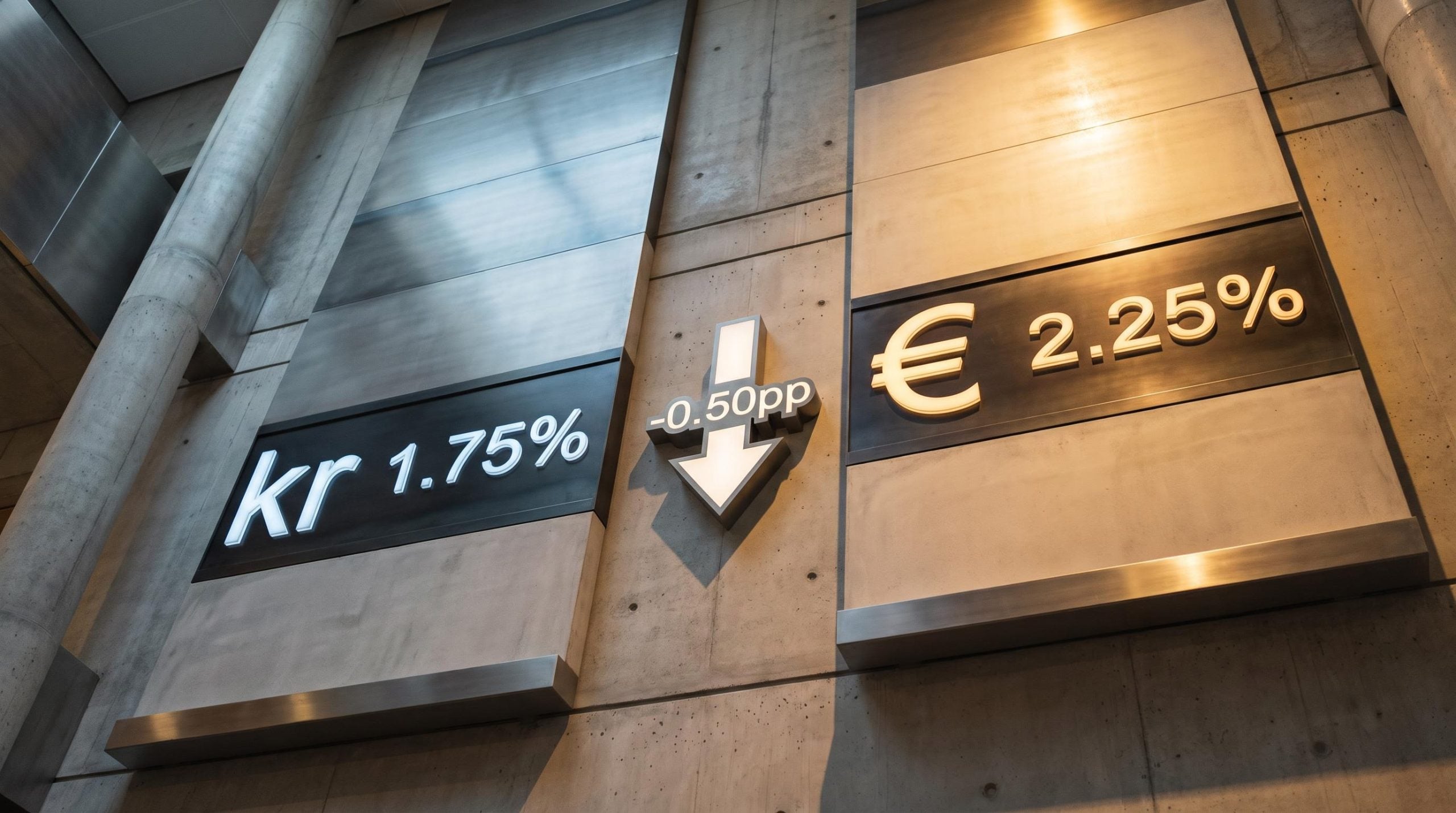
For most of the past two decades, Sweden’s central bank set its policy rate above the European Central Bank’s. That relationship has now flipped. The Riksbank currently sits 50 basis points below the ECB, and Nomura’s strategists expect it to stay there through 2027.
That is the puzzle worth unpicking. This is not a small technical gap, and it is not a quirk of timing. It reflects a genuine divergence in economic conditions, household debt sensitivity, and neutral rate estimates that Nomura believes will persist well into the next two years.
The context sharpens the point. The ECB raised its deposit facility rate in June 2026 and surveys now point to a further hike to 2.50% in September 2026. The Riksbank, meanwhile, has held at 1.75% across both its March and August 2026 meetings, showing no urgency to move.
What follows here is not a reminder that central bank policy matters. It is a framework for reading what this specific rate gap means for currency positioning and Scandinavian fixed income. By the time you finish, you will know which variables to track and what Nomura’s forecast implies for how you position around the divergence.
Sweden at 1.75%, the ECB at 2.25%: what the gap actually looks like right now
Start with the numbers, because they carry the argument before any interpretation does.
The Riksbank’s policy rate stands at 1.75%, effective 26 August 2026, unchanged since at least its March 2026 meeting and confirmed again at the 20 August 2026 decision. The ECB’s deposit facility rate sits at 2.25%, effective 17 June 2026 following a 25 basis point hike, and held unchanged at the 23 July 2026 meeting.
The ECB monetary policy tools that matter most for EUR direction extend beyond the deposit facility rate itself; the sequencing of QT relative to rate decisions and the gap between futures-priced expectations and actual delivery are the variables that produce the sharpest currency moves around each Governing Council meeting.
The Riksbank’s August 2026 monetary policy decision confirmed the policy rate hold at 1.75%, with the Riksbank’s own statement noting subdued inflation and labour market slack as the primary rationale for maintaining its cautious stance.
That leaves a rate differential of -0.50 percentage points, with Sweden below the euro area. Both institutions are currently on hold, but they are sending different forward signals. The Riksbank’s next decision is scheduled for 24 September 2026.
Here is where the forecast matters. Nomura expects the Riksbank to hold through the rest of 2026 before delivering a single 25 basis point hike to 2.00% in early 2027. Over the same horizon, the ECB’s survey median points to a further hike to 2.50% in September 2026, then a hold through mid-2027.
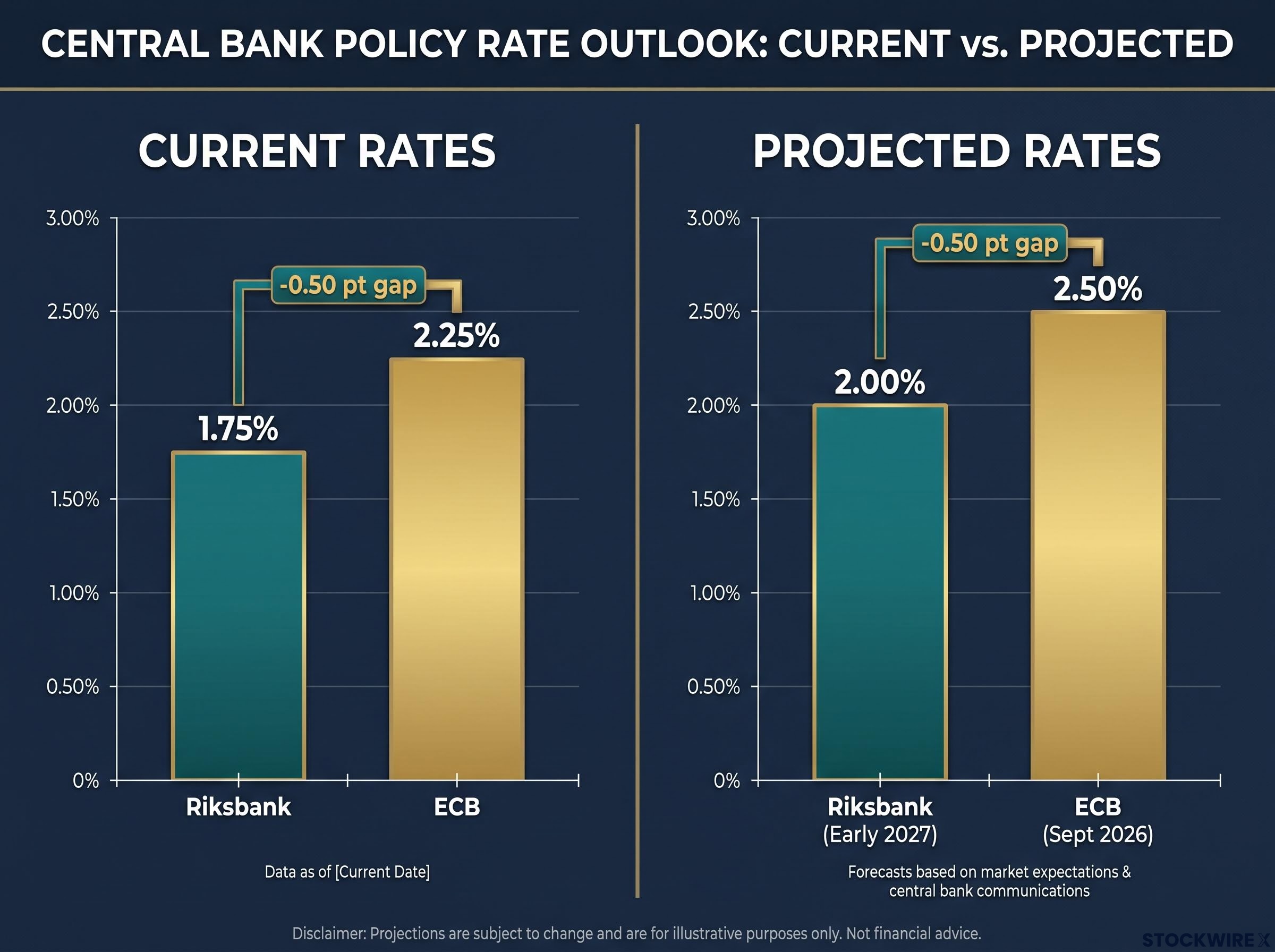
Nomura’s base case is a hold through the remainder of 2026, followed by just one 25 basis point increase to 2.00% in early 2027. That is the entire projected tightening cycle: one move.
Do the arithmetic and the implication becomes clear. Even after Sweden’s one expected hike, the gap does not close. A Riksbank at 2.00% against an ECB at 2.50% still leaves the same -0.50 percentage point differential.
| Institution | Current Policy Rate | Effective Date | Next Expected Move | Projected Rate End-2027 |
|---|---|---|---|---|
| Riksbank (Sweden) | 1.75% | 26 August 2026 | +25bps to 2.00% (early 2027) | 2.00% |
| ECB (Deposit Facility) | 2.25% | 17 June 2026 | +25bps to 2.50% (Sept 2026) | 2.50%, easing toward 2.0% long-run |
The read for your positioning is that this differential is not a temporary blip you should expect to fade. On Nomura’s numbers, it is a projected feature of the rate landscape through at least mid-2027, holding firm even after Sweden tightens once.
When big ASX news breaks, our subscribers know first
Why Sweden’s recovery is more fragile than the headline GDP number suggests
If you looked only at Sweden’s growth print, you would reach the wrong conclusion about the Riksbank.
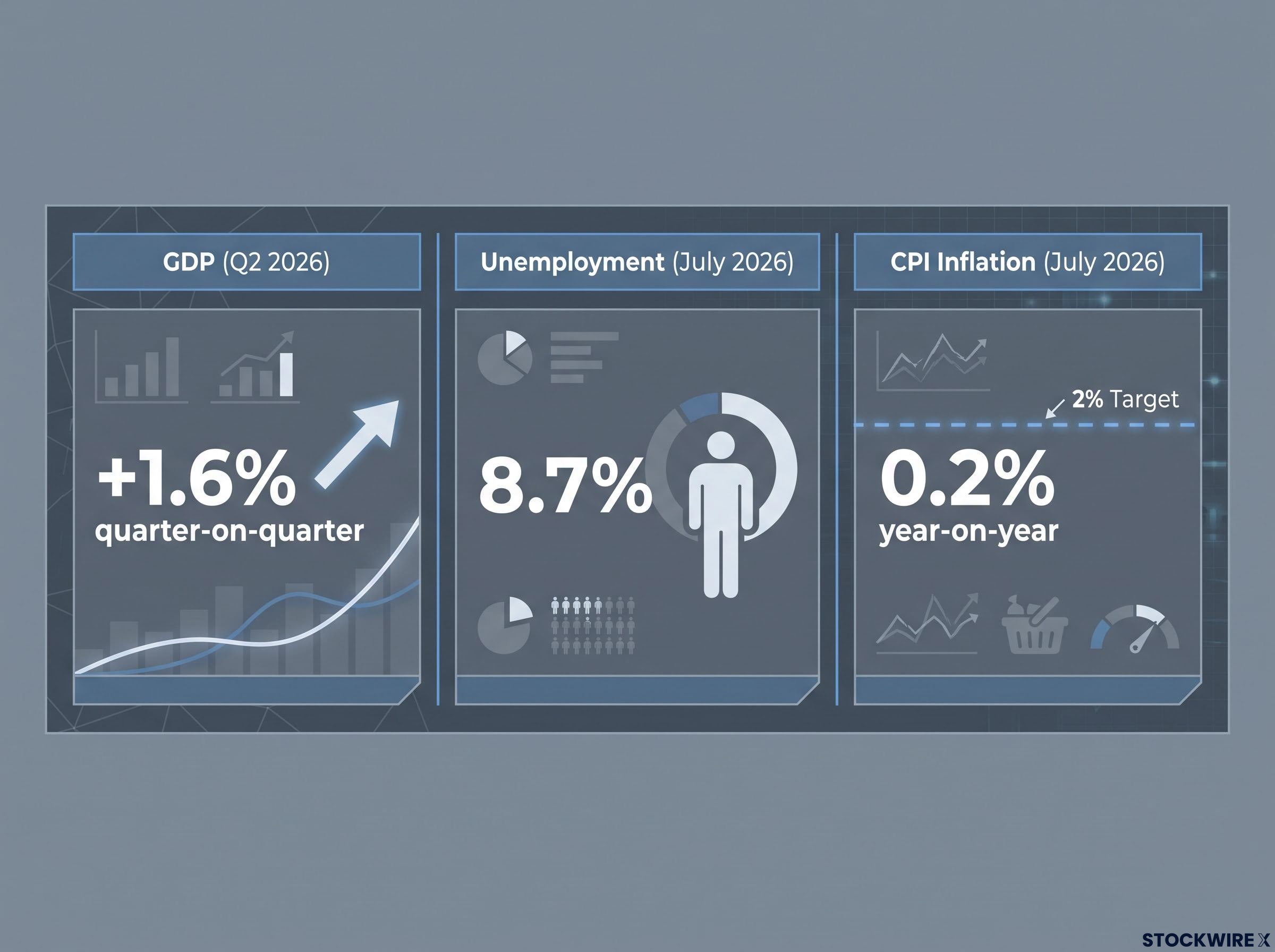
Swedish GDP expanded 1.6% quarter-on-quarter on a seasonally adjusted basis in Q2 2026, according to Statistics Sweden data updated 8 September 2026. On the surface, that is a strong result, the kind of number that might argue for a central bank preparing to normalise rates.
Statistics Sweden’s Q2 2026 national accounts release puts the 1.6% quarter-on-quarter expansion in its full context, showing which expenditure components drove the headline figure and where the underlying demand picture remains softer than the aggregate suggests.
Then the rest of the data arrives and the picture changes.
The labour market and inflation tell a different story
Sweden’s unemployment rate sat at 8.7% in July 2026 on a smoothed, seasonally adjusted basis. That is meaningful economic slack, and it is the indicator the Riksbank cannot look past regardless of one strong growth quarter.
Inflation makes the case even more forcefully. Swedish CPI rose just 0.2% year-on-year in July 2026, down from 0.7% in June, against a Riksbank target of 2%. Near-zero inflation is not the profile of an economy demanding tighter policy.
Here are the three indicators that shape the Riksbank’s reaction function:
- Unemployment: 8.7% (July 2026). Elevated slack means the labour market is nowhere near the pressure that would force the Riksbank’s hand.
- CPI: 0.2% year-on-year (July 2026). Inflation sits far below the 2% target, removing any urgency to tighten.
- GDP: +1.6% quarter-on-quarter (Q2 2026). Strong on the surface, but Nomura treats the broader recovery as fragile rather than durable.
The read for you is that the GDP figure gives a misleading impression of policy readiness. The unemployment rate and near-zero inflation tell you the Riksbank has no reason to hurry, and Nomura’s one-hike forecast reflects exactly that reading of the data.
What the 2023 tightening episode revealed about Swedish rate sensitivity
There is a mechanism underneath the caution. During the 2023 tightening cycle, rate increases hit Swedish household disposable income faster and harder than they did in the eurozone.
That transmission speed reflects the structure of Swedish household debt, which carries a high proportion of variable-rate mortgages. When the policy rate rises, the pain reaches household budgets almost immediately rather than being cushioned by fixed-rate terms.
Nomura explicitly identifies this sensitivity as a reason the Riksbank treats future hikes with greater caution than the ECB. For your purposes, it means the macro conditions structurally support a lower Swedish rate path, not a temporary pause that reverses once growth firms up.
The neutral rate shift: the structural reason Sweden is expected to stay lower for longer
To understand why this divergence has staying power, you need one concept: the neutral rate.
The neutral rate is the policy rate at which monetary policy is neither stimulating nor restraining the economy. It is the setting where the central bank is neither pressing the accelerator nor the brake. Both the Riksbank and the ECB maintain internal estimates of this level for their own jurisdictions.
The estimate matters because it defines what “accommodative” and “restrictive” actually mean. A 1.75% rate is only loose or tight relative to where the neutral level sits.
Nomura identifies a declining neutral rate estimate for Sweden as a core structural driver of the current divergence. That decline changes the whole comparison, because it means Sweden’s 1.75% may be closer to neutral than the raw gap with the ECB suggests.
Neutral rate estimates are the conceptual anchor for every central bank divergence trade; when two institutions diverge on where neutral sits, they will set structurally different policy paths even if their inflation targets are identical, which is precisely the dynamic Nomura identifies as driving the persistent Sweden-ECB gap.
How this reverses a long-standing pattern in Scandinavian monetary policy
Historically, the relationship ran the other way. Central bank research put neutral rate estimates for the Riksbank and Norges Bank above the ECB’s equivalent, which is precisely why Scandinavian policy rates typically sat higher than euro area rates.
That asymmetry explained decades of higher Swedish rates. Sweden ran hotter, its neutral rate sat higher, and its policy rate followed.
The current situation reverses that pattern. Nomura frames the divergence as a genuine structural reversal, with Sweden’s neutral rate estimate moving toward or potentially below the euro area’s, driven by subdued inflation, below-trend growth relative to the eurozone, and the household sensitivity described above.
The European Parliament Research Service’s Survey of Monetary Analysts implies a long-run ECB deposit facility rate of approximately 2.0%. Given Sweden’s much lower inflation and higher unemployment, the Riksbank’s effective neutral rate appears to sit at or below that level.
The read for you is that Sweden’s 1.75% is not as accommodative as it looks when placed next to the ECB’s 2.25%. If you are assuming the Riksbank will eventually converge upward toward ECB levels, the neutral rate framework says you may be assuming a move that has no structural basis. Convergence optimists need a reason the neutral rate rebounds, not just a belief that rates “should” line up.
Currency and fixed income positioning in a divergent rate environment
A rate forecast only matters insofar as it changes how you position. Here the divergence translates into two concrete implications and one honest caveat.
The interest rate differential is the mechanism. When one central bank holds rates below another and is expected to keep doing so, the currency of the lower-rate economy tends to face downward pressure, because capital is drawn toward the higher yield.
Euro valuation fundamentals, particularly the role of rate differentials between major central banks over multi-month horizons, provide the mechanism for translating the Riksbank-ECB gap into EUR/SEK direction, and the 2022 hiking cycle demonstrated that the faster-moving central bank tends to dominate currency outcomes even when both are tightening.
Consider the three positioning takeaways:
- EUR/SEK direction. A Riksbank rate that stays below the ECB’s through 2027 structurally supports a weaker krona against the euro over the forecast horizon, all else equal, as the rate differential works against the SEK.
- Swedish duration. If Nomura’s one-hike forecast holds, short-end Swedish government bonds face limited upward pressure on yields relative to euro area equivalents, which may favour duration positioning in Swedish fixed income for investors willing to accept the currency risk.
- Caveat on consensus. The available research does not include competing institutional forecasts arguing for faster Riksbank normalisation, so treat Nomura’s view as the available framing rather than a confirmed market consensus.
That third point deserves emphasis. The research gap is real, and it should shape how much conviction you attach to the trade.
It is also worth grounding the ECB side of the equation in its own uncertainty. Forecasts are point estimates surrounded by wide distributions, and the ECB’s own path is far from settled.
Convex projects the ECB deposit facility rate at 2.23% by 31 December 2026, essentially flat against the current level, but with a 68% confidence band spanning 0.93% to 3.54%. The width of that band tells you how much genuine uncertainty sits around even the anchor leg of this divergence.
The read for you is that if the differential persists as Nomura projects, it creates a structural headwind for the SEK and a relative yield advantage in euro area fixed income over Swedish equivalents. Be explicit about which side of that differential your positioning assumes, because the entire logic depends on the gap holding.
What changes the forecast, and what to watch through the rest of 2026
No forecast holds unconditionally, so the useful exercise is identifying what would break this one.
The immediate test arrives this month. The Riksbank decides on 24 September 2026, and the ECB is widely expected to hike to 2.50% at its September meeting per the Survey of Monetary Analysts median. Between them, those two decisions will either confirm the divergence thesis or start to complicate it.
ECB September decision signals embedded in the July statement, particularly Lagarde’s framing of energy pass-through and any reference to second-round effects, are the highest-frequency inputs for updating the rate differential thesis before the Riksbank’s 24 September meeting lands.
Beyond the September meetings, watch these Swedish variables:
- CPI inflation. Current reading 0.2% year-on-year (July 2026). A sustained move toward the 2% target would be the clearest signal the Riksbank might tighten faster than one hike.
- Unemployment. Current reading 8.7% (July 2026). A meaningful decline would reduce the labour market slack that currently anchors the Riksbank’s caution.
- GDP durability. Q2 2026 grew 1.6% quarter-on-quarter. Evidence that this represents durable momentum, rather than a one-quarter spike, would strengthen the case for normalisation.
The read for you is straightforward. If Swedish CPI does not move materially toward 2% and unemployment stays elevated through the September and Q4 2026 releases, Nomura’s forecast retains its credibility and the divergence trade keeps its logic.
The ECB-side scenario: what eurozone disinflation would mean for the spread
There is a risk that runs the other way, and it comes from the euro area rather than Sweden.
If the ECB’s tightening cycle stalls, or if eurozone inflation recedes faster than the Survey of Monetary Analysts expects, the differential could narrow from the ECB side. In that scenario, ECB rates ease back toward their long-run 2.0% level sooner, and the gap closes from above rather than from below.
That distinction matters for your positioning. A spread that narrows because the ECB eases has different currency and fixed income implications than one that narrows because the Riksbank tightens, even if the headline gap ends up the same.
This article is for informational purposes only and should not be considered financial advice. Investors should conduct their own research and consult with financial professionals before making investment decisions. Past performance does not guarantee future results, and financial projections are subject to market conditions and various risk factors.
A structural divergence, not a temporary gap
Pull the threads together and the conclusion is clear: this rate gap is the product of compounding structural factors, not a cyclical accident you should expect to fade.
Four drivers hold it in place:
- A fragile recovery with genuine macro slack, evident in 8.7% unemployment and 0.2% inflation despite strong Q2 growth.
- Household rate sensitivity, exposed during the 2023 tightening episode by Sweden’s heavy variable-rate mortgage debt.
- A declining neutral rate estimate for Sweden that changes what its 1.75% rate actually signals.
- The inversion of the historical Riksbank-ECB relationship, which historically ran the opposite way.
On Nomura’s base case, the 1.75% versus 2.25% gap holds at roughly -0.50 percentage points through 2027, with Sweden’s single hike to 2.00% offset by the ECB’s move to 2.50%. That is the analytical anchor, though the absence of competing institutional views means you should hold it with appropriate humility.
The decision point is this. If you carry EUR/SEK or Scandinavian fixed income exposure, be explicit about whether your positioning reflects the divergence, or whether you are quietly assuming convergence without a basis for it. On the current evidence, convergence is the assumption that needs defending.