
Most retail forex traders can tell you that an ECB decision “moved the euro.” Fewer can tell you which specific tool caused the move, or why the same type of decision sometimes strengthens the currency and sometimes weakens it. That gap between knowing something happened and understanding the mechanism behind it is where most positioning errors start.
The European Central Bank (ECB) governs monetary policy for the eurozone, a currency bloc whose decisions ripple into every EUR pair traded globally. Its toolkit is not a single lever. It is a set of instruments that interact, and understanding each one separately is the prerequisite for reading any ECB decision clearly.
Here is what this guide gives you: after working through each tool and its transmission channel, you will be able to look at any ECB announcement and map the specific instrument being used to a directional bias for the euro. Not general awareness, but a framework you can apply before the next meeting.
The ECB’s mandate and the one number that drives everything
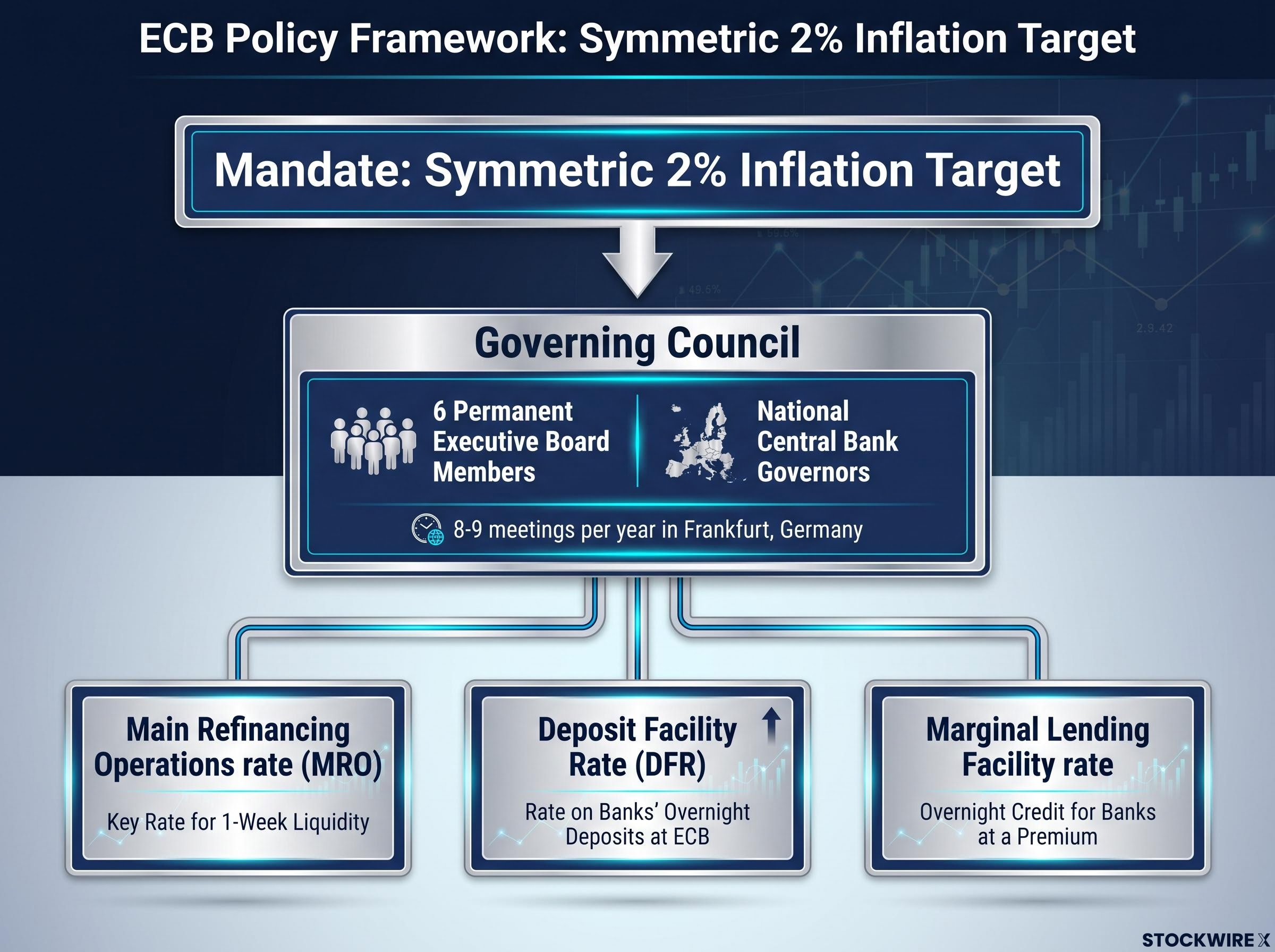
Every tool the ECB deploys exists in service of a single objective: price stability, defined as a symmetric 2% inflation target over the medium term. Symmetric means the ECB treats persistent undershooting as seriously as persistent overshooting. Deflation risk triggers just as much policy action as inflation risk, and either direction can move the euro sharply.
The Governing Council operates within a broader system of central bank rate mechanics that simultaneously reprice currencies, bonds, gold, and equity valuations the moment a policy committee speaks, making the ECB’s decisions inseparable from movements across your entire portfolio.
The Governing Council is the body responsible for setting policy. It brings together the six permanent Executive Board members (a group that includes the President and Vice-President) and the governors of each national central bank across the euro area. Scheduled sessions take place roughly every six weeks, giving the Council around eight to nine meetings per year, all convened at the ECB’s base in Frankfurt, Germany.
For you as a currency investor, the mandate is the filter. Every ECB tool is selected based on how far inflation sits from 2% and in which direction. That makes incoming inflation data something more than economic noise: it is a direct input into which tool the ECB will reach for next, and how aggressively.
The ECB operates with three main policy rates:
- Main Refinancing Operations rate (MRO): the anchor rate for short-term money market pricing
- Deposit Facility Rate (DFR): the rate banks earn on overnight excess reserves held at the ECB
- Marginal Lending Facility rate: the overnight borrowing rate for banks that need emergency liquidity
Why the Deposit Facility Rate is the rate markets watch most
While the ECB publishes all three rates, the Deposit Facility Rate is the effective anchor for money market pricing in normal conditions. When market commentary or analyst reports reference “the ECB rate,” they are almost always referring to the DFR. For your purposes, this is the rate to track.
When big ASX news breaks, our subscribers know first
Interest rate decisions and how they move the euro
The chain of consequences from an ECB rate decision to a move in EUR works like this: a rate change shifts short-term yields, which changes the rate differential between the eurozone and other major economies. That differential is what moves money.
What drives EUR pairs is not the absolute level of ECB rates. It is the gap between ECB rates and those set by peers, particularly the Federal Reserve, the Bank of England (BoE), and the Swiss National Bank (SNB). Higher relative rates raise the expected return on euro-denominated assets, pulling capital toward the euro.
In a rate hike scenario, the ECB pushes short-term yields higher, widening the differential if other central banks are less hawkish. Hawkish guidance alongside the hike amplifies the effect. The typical result is a bullish EUR bias, especially if the hike surprises the market.
In a rate cut scenario, the opposite applies. Lower short-term yields compress the differential, and dovish guidance reinforces the bearish EUR signal. The magnitude of the FX reaction is linked to how much the decision deviates from what Euribor and Overnight Index Swap (OIS) curves, the market’s real-time measure of the expected ECB rate path, have already priced in.
Rate differential pricing works through expectations, not current official levels: a US inflation print missing consensus by 0.1% can move EUR/USD by more than a fully priced-in ECB decision, which is why the futures curve is as important a monitoring tool as the meeting calendar itself.
The ECB explicitly stresses a data-dependent approach. In practice, this means the macro data calendar carries independent trading significance. The key inputs the ECB watches include headline and core HICP (the eurozone’s primary inflation measure, formally the Harmonised Index of Consumer Prices), negotiated wages, Purchasing Managers’ Indices (PMIs), credit conditions, and energy prices. A single stronger-than-expected HICP print can reprice the expected rate path and move EUR before the ECB has said a word. If you only watch meeting dates, you are working with incomplete information.
FX moves are largest when ECB action deviates from what the curve has already priced, not when the ECB delivers what consensus expects.
| ECB Action / Signal | Typical EUR Bias | Key Reason |
|---|---|---|
| Surprise rate hike | Bullish | Wider rate differentials, tighter stance |
| Surprise rate cut | Bearish | Narrower differentials, easier stance |
| Hawkish guidance with no action | Mildly bullish | Reprices expected path higher, signalling future tightening |
| Dovish guidance with no action | Mildly bearish | Reprices expected path lower, signalling future easing |
The question to ask before any ECB meeting is not “what will the ECB do?” but “how does what the ECB does compare with what the Fed and BoE are expected to do?” That relative question is what determines your directional bias.
QE mechanics: how ECB asset purchases transmit to the euro
Rate decisions are the ECB’s first instrument. When rates alone cannot do the job, particularly when they approach their effective lower bound, the ECB reaches for quantitative easing (QE): creating central bank reserves to purchase assets from financial institutions, expanding its balance sheet and injecting liquidity into the system.
QE in the eurozone has run through two main programmes:
- Asset Purchase Programme (APP): an umbrella programme covering four sub-categories of securities
- Pandemic Emergency Purchase Programme (PEPP): a temporary, highly flexible programme launched in 2020 in response to COVID-19, with looser constraints on country and maturity allocations that made it structurally more powerful as a crisis instrument
The four APP sub-programmes cover distinct asset classes:
- PSPP: public sector bonds (sovereign and supranational debt)
- CSPP: corporate bonds issued by non-bank corporations
- CBPP: covered bonds issued by credit institutions
- ABSPP: asset-backed securities
The FX logic of QE runs through three channels. First, it increases the supply of euro liquidity, reducing the scarcity premium on euro assets. Second, it compresses yields across the curve by pushing bond prices higher, which narrows the euro’s rate advantage versus other currencies. Third, the decision to launch or expand QE signals that the ECB sees serious downside risks to inflation or growth. The net effect is typically bearish for EUR.
ECB Working Paper 2075 on APP transmission provides empirical evidence for the exchange rate channel discussed here, finding that expanded asset purchases reduced the euro’s scarcity premium and compressed yield differentials versus peer currencies in measurable ways.
The qualification matters. QE can fail to weaken the euro if other central banks are easing more aggressively at the same time, or if QE credibly improves eurozone growth prospects relative to peers. The right question is always: compared with what other central banks are doing, does this ECB action change relative monetary conditions enough to matter?
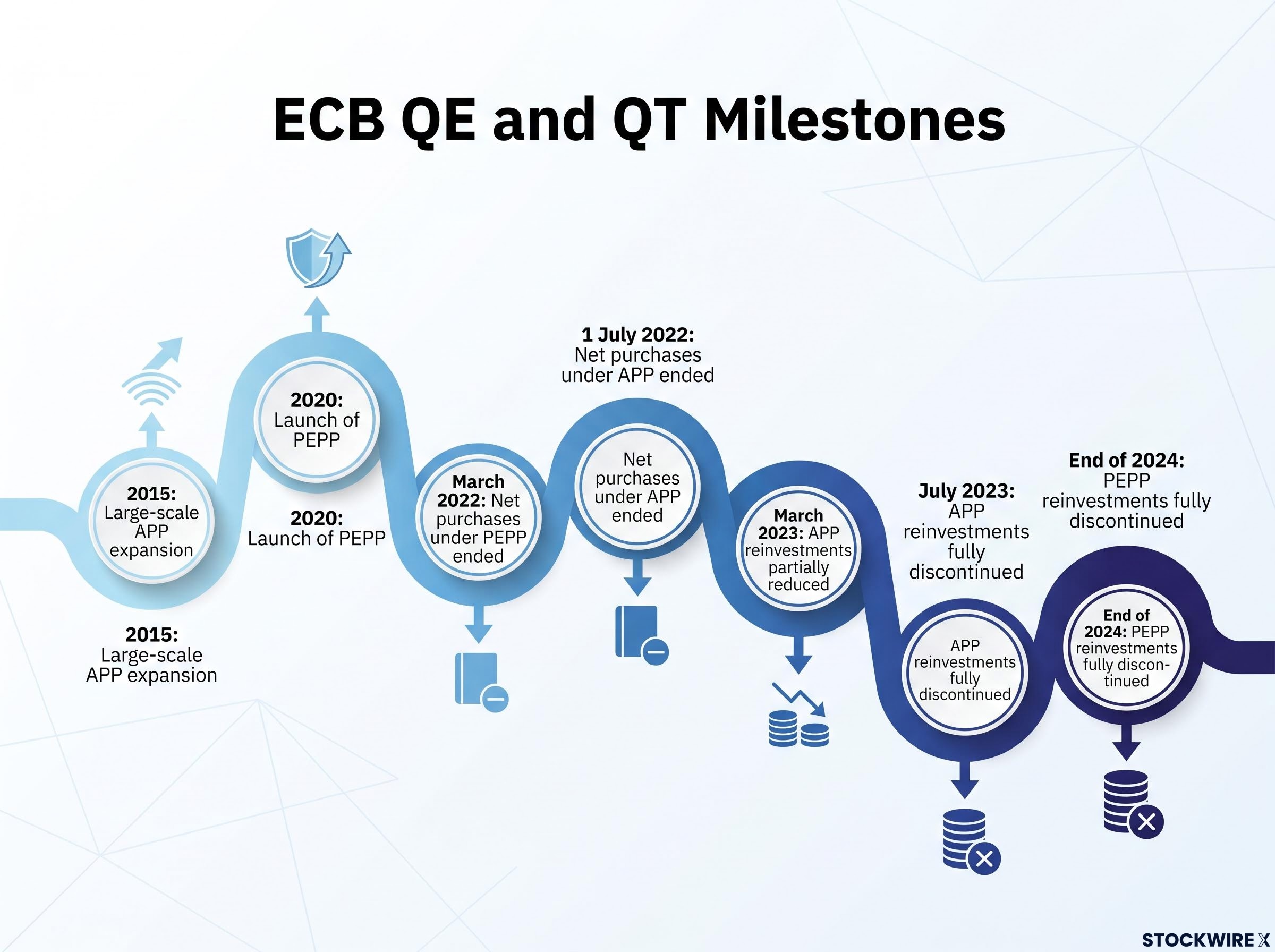
Key ECB QE milestones: 2015 to 2024
- 2015 onward: Large-scale APP expansion with public and private bond purchases to combat very low inflation and deflation risk
- 2020: Launch of PEPP, providing exceptional flexibility during the COVID-19 shock
- March 2022: Net purchases under PEPP ended
- 1 July 2022: Net purchases under APP ended after a phased reduction
- July 2023: APP reinvestments fully discontinued
- End of 2024: PEPP reinvestments fully discontinued
QT in practice: the staged withdrawal of ECB liquidity and its EUR impact
Quantitative tightening (QT) is the mirror image of QE: the deliberate shrinking of the ECB’s balance sheet after a period of expansion. What makes the ECB’s approach distinct is that it has been entirely passive. Rather than actively selling bonds into the market, the ECB allows its holdings to shrink by simply not reinvesting the proceeds when bonds mature. That choice was deliberate, designed to avoid large one-off sales that could disrupt sovereign bond markets.
The sequencing followed a staged logic:
- End net purchases: PEPP net purchases ended March 2022; APP net purchases ended 1 July 2022
- Limit then stop reinvestments: From March 2023, APP reinvestments were partially reduced; fully discontinued from July 2023. PEPP reinvestments fully discontinued at end of 2024
- Shrink other liquidity operations: Targeted Longer-Term Refinancing Operations (TLTROs, a type of cheap multi-year loan the ECB provides to banks) have been repaid or modified, reducing excess liquidity further
- Ongoing passive run-off: Both APP and PEPP portfolios continue to decline at a measured, predictable pace as securities mature without replacement
The FX logic of QT works in reverse to QE. The supply of ECB-created euro liquidity falls, raising the scarcity value of euro reserves. Official demand for bonds fades, which can push long-end yields higher. Both effects tend to be supportive or mildly bullish for EUR.
ECB liquidity operations extend beyond rates and bond purchases: the structural LTRO framework being designed for post-QE deployment around 2027 will function as a permanent banking system backstop, with design choices made now already shaping EUR term funding costs across the next business cycle.
Because the ECB chose passive QT over active sales, the balance-sheet reduction happens at a measured, predictable pace. For you as a currency investor, this means QT is rarely a single sharp catalyst. Instead, it operates as a persistent background tailwind for EUR that matters most when it diverges from what peer central banks are doing. If the Fed or BoE are also doing QT, markets focus on who is tightening more in net terms.
A pause in rate cuts with ongoing QT is still a net-restrictive stance, not a neutral one.
Recognising QT as a distinct, ongoing policy variable, separate from rate decisions, means you avoid the mistake of thinking ECB policy is “done” once rates stop moving. A rate pause combined with continued QT is a different posture than a rate pause with reinvestments still running, and that distinction has real implications for your EUR positioning.
How to read any ECB decision through four transmission channels
The three tools, rates, QE, and QT, do not operate in isolation. They transmit to the euro through four channels that you can track simultaneously, and the interaction between them is where the real signal sits.
| Channel | What Changes | Typical EUR Direction | Key Signal to Watch |
|---|---|---|---|
| Rate differentials | Expected ECB path vs Fed/BoE/SNB | Hawkish surprise = bullish; dovish surprise = bearish | Euribor/OIS vs SOFR futures pricing |
| Balance sheet / term premium | Long-term yield levels and liquidity supply | QE = bearish; QT = bullish | Balance-sheet trajectory and reinvestment policy changes |
| Inflation expectations and credibility | Market confidence in ECB hitting 2% | Anchored expectations = stable EUR; persistent misses = bearish | 5y5y inflation swaps, HICP trend vs target |
| Forward guidance / signalling | Market pricing of future path before any action | Depends on direction of repricing | Press conference Q&A, inter-meeting speeches, Governing Council divergences |
The communication channel deserves particular attention. EUR often reacts most during the press conference Q&A and in speeches between meetings, not at the moment of the formal rate decision itself. Divergences among Governing Council members can foreshadow policy pivots and create trading opportunities before the shift is officially announced. Communication is an independent trading variable, not a footnote to the rate decision.
Forward guidance analysis between meetings, particularly parsing whether phrases like ‘inflation extending beyond energy sectors’ appear in a statement or press conference, can reprice the expected path before the next formal decision and generate directional EUR signals weeks ahead of the official meeting.
Four principles for applying ECB analysis to EUR positioning
- Track the same data the ECB watches. Headline and core HICP, negotiated wages, PMIs, credit conditions, and energy prices. Map data surprises into changes in the expected ECB path by watching Euribor and OIS curve repricing in real time.
- Watch the sequencing of tools. A rate hike combined with continued reinvestments is less tight than a rate hike combined with accelerated QT. The combination matters as much as the individual instrument.
- Measure relative stance versus peers. Compare Euribor/OIS pricing against SOFR futures (the market’s measure of the expected Fed path) to assess which central bank is expected to cut first and by how much. EUR tends to strengthen when the ECB is seen as later to ease or maintaining a more restrictive posture than peers.
- Treat communication as an independent driver. Hawkish or dovish shifts in speeches ahead of meetings often reprice EUR before the formal decision. Governing Council divergences, where some members publicly push for a different direction, can signal pivots weeks in advance.
Putting the toolkit together: what changes when the ECB shifts gears
The three tools interact in combinations that change the overall policy posture. A rate pause combined with continued QT is still a net-tightening stance. A rate pause with reinvestments still running is closer to neutral. A rate cut with accelerated QT sends mixed signals that the market will resolve through the relative channel, comparing the net stance against what the Fed and BoE are doing.
The concept of dual tightening, rate hikes and QT running simultaneously, versus sequential tightening, hikes first with QT following later, matters for how aggressively you should position. Dual tightening represents a stronger overall restrictive stance and tends to be more supportive for EUR than either instrument alone.
FX moves remain largest when ECB action or communication deviates from what Euribor and OIS curves have already priced. Following the futures curve is as important as following the ECB itself. The macro data calendar, HICP, PMIs, negotiated wages, carries independent FX significance alongside formal meeting dates and can reprice the expected path between meetings.
Before each ECB meeting, ask yourself three questions:
- What is already priced into the curve? (Check Euribor/OIS positioning to know what the market expects.)
- How does the ECB’s likely action compare with what peer central banks are expected to do? (The relative question determines directional bias.)
- What communication signals have already emerged between meetings? (Speeches, interviews, and reported Governing Council disagreements often tell you where the decision is heading before it arrives.)
The ECB’s toolkit is most useful to you not as a list of instruments, but as a system whose combined stance relative to peers determines the direction of the euro.
This article is for informational purposes only and should not be considered financial advice. Investors should conduct their own research and consult with financial professionals before making investment decisions. Past performance does not guarantee future results, and financial projections are subject to market conditions and various risk factors.