A 5.2% annual jump in prices sounds like it should settle the matter. With inflation running well above target, an October rate hike from the Reserve Bank of New Zealand (RBNZ) looks automatic.
Then you see the other number released the same day. Seasonally adjusted card spending fell 0.4% in September, and core spending fell further still. Prices are running hot while households are pulling back.
The timing matters because the decision is close. Stats NZ publishes the full Q3 Consumers Price Index (CPI) on 22 October, and the RBNZ announces its next Official Cash Rate (OCR) decision on 28 October. The OCR, the Bank’s benchmark interest rate, sits at 2.75% after a hike on 2 September 2026. Markets price an October move at roughly 80% or higher, yet RBNZ chief economist Paul Conway said yesterday that the decision is “completely open”.
If you have a mortgage coming up for refixing, savings earning interest, or exposure to the New Zealand dollar (NZD), the outcome affects you. Here is a way to judge whether this inflation is a one-off energy shock or something the RBNZ has to lean against.
Is 5.2% inflation really the whole story? What September’s price data shows
The headline is alarming. Stats NZ‘s Selected Price Indexes, released today, show prices up 5.2% over the year to September.
Fuel accounts for much of the shock. Diesel is up more than half on a year ago, and petrol has risen by almost a quarter, as the table shows.
| Measure | Monthly change | Annual change |
|---|---|---|
| Headline prices | Not specified | 5.2% |
| Excluding petrol and diesel | Not specified | 3.6% (from 3.2% in August) |
| Petrol | +6.4% | +24.3% |
| Diesel | +7.8% | +55.8% |
| Food | 0.0% | +2.4% |
Peel back the first layer and the picture shifts. Fuel makes up only about 4% of the CPI basket, so even moves this large cannot produce a 5.2% headline on their own. Food was flat for the month.
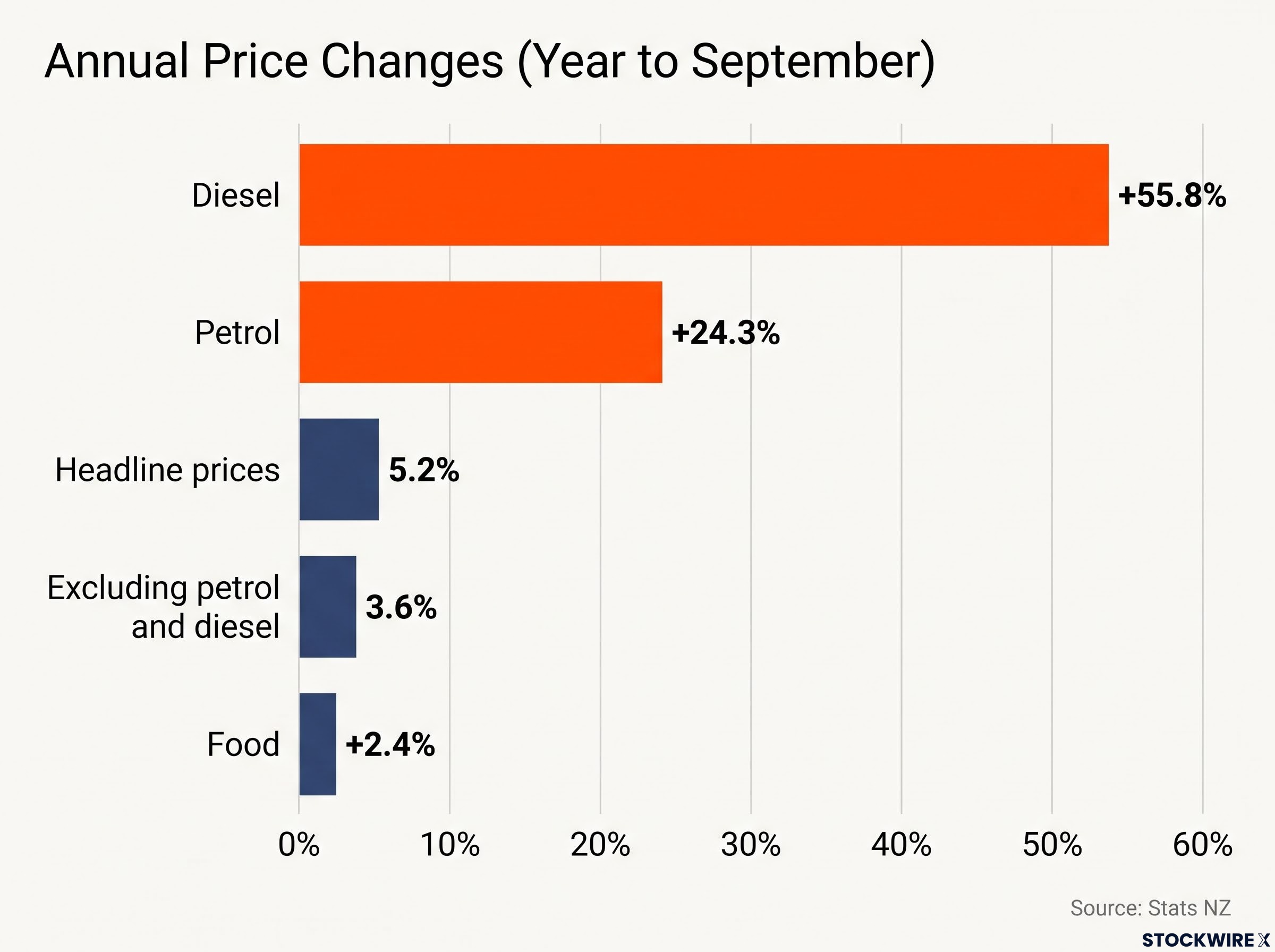
The second layer is the uncomfortable one. Inflation excluding petrol and diesel climbed from 3.2% in August to 3.6% in September, and that is the figure hawks point to when they argue inflation is broadening into other prices.
That ex-fuel pick-up tells you this is not purely a petrol-pump story. A hold is not a risk-free choice for the RBNZ.
The OCR now sits at 2.75%, and the projected rate path from here points to a terminal rate near 3.30% by early 2027, which is why the December meeting carries as much weight as October.
Why a weaker kiwi dollar adds to the pressure
New Zealand imports its fuel and many of its goods, and they are priced in foreign currencies. When the NZD falls, each barrel of oil and each imported item costs more in New Zealand dollars, even if the world price has not moved.
Conway named NZD weakness as an added short-term pressure, on top of higher global energy prices and renewed geopolitical strain on oil supply.
When big ASX news breaks, our subscribers know first
Three concepts that decide how you read this debate
Over the next two weeks you will see plenty of headlines about prices and spending. Three distinctions will help you test each one.
Monthly vs quarterly CPI
The common misreading is that the monthly index is the whole inflation picture. It is not. The monthly index covers about half the components in the full quarterly CPI, so it gives an early signal without the complete basket or its full weighting.
That is why the RBNZ and the banks put so much weight on the 22 October release.
What to watch: whether the quarterly figure confirms the monthly ex-fuel rise.
Nominal vs real spending
Card spending rose 0.9% year on year in actual terms, which looks steady. But these figures are nominal, meaning they are not adjusted for price changes. Real spending strips out price changes to show the volume of goods actually bought.
Fuel is the clearest example. Fuel spending rose 2.9% in September, which softened the overall fall, while core spending dropped 0.7% for the month and is up only about 0.1% over the year. Once you account for higher prices, real consumption is likely clearly negative year on year.
Why the headline flatters the data Fuel inflation can make weak spending look stable. People pay more at the pump without buying more of anything.
Card data also cover only card transactions, not all household consumption.
What to watch: core spending, not the total.
Second-round inflation effects
First-round effects are the direct hit: fuel and import prices go up. Second-round effects come later, when that shock spreads into wages, rents, services and inflation expectations. At that point a one-off rise becomes persistent, because firms keep passing on costs and workers seek compensation.
Energy costs can reach prices well outside the fuel category, which is why second-round inflation effects often hide inside airfares, delivery charges and imported goods long before they show up as broad domestic pressure.
This distinction drives the caution of Commerzbank’s Volkmar Baur, who sees no visible second-round effects yet.
What to watch: services and wage-linked prices in the quarterly data.
Knowing these three distinctions means you will not take 5.2% or +0.9% at face value.
Why Commerzbank’s Baur is wary of a hike while the market is not
The market looks confident. Bloomberg-style pricing aside, the odds cited in reporting have swung from about 80% in late September to about 58% on 6 October, as traders absorbed the RBNZ’s cautious September guidance, then back to about 86% today. The OCR has not changed through any of this; the pricing has.
That volatility sets the stage for Baur’s view, reported by FXStreet. Weak activity and the absence of visible second-round effects make him wary of hiking, despite odds near 80%.
“Completely open.” Paul Conway, RBNZ chief economist, on the choice between holding at 2.75% and a 25 basis point hike, 15 October 2026
Conway still said the next move is more likely up. Governor Anna Breman warned that persistently higher oil prices are likely to push near-term inflation above the September assumptions. The RBNZ expects inflation to return to its 1-3% target band during 2027.
Breman’s warning fits a pattern: the RBNZ has already flagged the oil risk to the inflation forecast, noting that fuel drove roughly two-thirds of the June quarter overshoot while CPI excluding fuel sat inside the target band.
| Institution | October call | Q3 CPI forecast | Key reasoning |
|---|---|---|---|
| ANZ | Hike firmly on the table | 0.8% q/q | Weaker NZD and higher oil since September |
| Westpac | Hold, then hike in December | 0.7% q/q | Whether inflation is broadening beyond energy |
| BNZ | Shifted toward RBNZ having little choice but to hike | 3.7% y/y | Moved from an October hold expectation |
| ASB and CBA | Not specified | 4.2% y/y | Not specified |
| RBNZ (September) | Further hikes likely, timing uncertain | 0.8% q/q, 3.9% y/y | Expects inflation back in target during 2027 |
The split is about timing and persistence, not whether inflation is too high. Everyone agrees it is.
The case for caution
Card spending is falling, and earlier hikes are still working through mortgages, housing and jobs. Households remain sensitive to refinancing, so more tightening lifts repayments as fixed loans roll over. If this is mainly an energy shock, a hike could deepen the downturn without lowering world oil prices by a cent.
The case for hiking now
Waiting for confirmation risks leaving the RBNZ behind the curve if oil stays high and the NZD stays weak. Expectations and wage-setting could drift upward even with soft demand. The 2021-23 tightening cycle showed the Bank will tolerate demand weakness when it believes inflation is broadening, although today’s impulse is far more energy-heavy.
The spread of forecasts, from 3.7% to 4.2% annually, tells you the result hinges on the composition of the CPI print. A hike is likely, not certain, and you should not assume it is fully priced.
What each outcome could mean for the New Zealand dollar and your finances
The calendar is short: Q3 CPI on 22 October, the decision on 28 October. NZD/USD sat near 0.5650 today, after recovering as Conway kept a hike on the table and the US dollar weakened.
Much of the recent weakness reflects US dollar strength rather than New Zealand data, as Fed hike bets and rising oil prices have pushed NZD/USD through a six-week slide toward its 2026 lows.
The currency reaction is likely to be asymmetric, because a hike is already largely priced.
| Scenario | Likely NZD reaction | What would change it |
|---|---|---|
| 25 bp hike | Initially supportive, especially against the Australian dollar | Strongly dovish guidance could still push it lower |
| Hold with December hike signal | Limited fall | A softer CPI print could weaken the signal |
| Hold with dovish tone | Initially negative, as a priced hike unwinds | Inflation described as temporary would deepen the move |
The decision alone will not tell the full story. Watch three signals in the Q3 CPI:
- Non-tradable inflation, the domestically driven prices that the RBNZ controls more directly. Later commentary put the annual rate near 3.5%.
- Services and rents, where second-round effects would show first.
- Ex-fuel measures, to see whether September’s broadening holds over the quarter.
For you as a borrower, saver or holder of NZD assets, the guidance and the CPI breakdown could move rates and the currency more than the 25 basis point move itself. Mortgage pricing tends to follow where the RBNZ signals it is heading.
These scenarios are speculative and subject to change based on market developments and incoming data.
What the data can and cannot settle before 28 October
The evidence leans toward a hike. Inflation is well above target, and the ex-fuel rise gives the hawks a real argument.
It does not make the move a done deal. The shock is energy-heavy, real spending is likely shrinking, and second-round effects have yet to appear in the data.
The deciding variables are the composition of the Q3 CPI and what the RBNZ says about second-round effects. Those will shape mortgage rates and the NZD more than the headline decision.
Before 28 October, review your mortgage fixing timeline and any NZD exposure against both outcomes, so neither a hike nor a hold catches you unprepared.
This article is for informational purposes only and should not be considered financial advice. Investors should conduct their own research and consult with financial professionals before making investment decisions. Past performance does not guarantee future results. Financial projections are subject to market conditions and various risk factors.