
The RBA held the cash rate at 4.35% at its August 2026 meeting, and not a single forecaster was surprised. What did surprise, or should have, is what happened next in money markets: interest-rate swaps scarcely moved, with traders continuing to assign roughly a 60% chance of a further hike by December 2026. The hold was expected. The market’s refusal to treat it as the end of the cycle was not.
That 60% figure sits at the centre of the current investment debate. The Board has now paused twice, in June and August, after delivering three consecutive 25-basis-point hikes across February, March, and May, a cumulative 75 basis points of tightening that pushed the cash rate to its highest level since late 2024. Through both pauses, the RBA has retained explicit language warning it remains “prepared to increase the cash rate target further if required.” This is not a central bank signalling relief. It is a central bank buying time.
Here is what the rate environment actually means for your portfolio positioning, and the specific data releases worth watching before the RBA’s next decision in September.
Why the RBA held again, and what it is signalling by doing so
The decision itself was the least interesting part of the day. Every major bank forecast a hold. The June decision was unanimous, and there was no credible case for a surprise move in August.
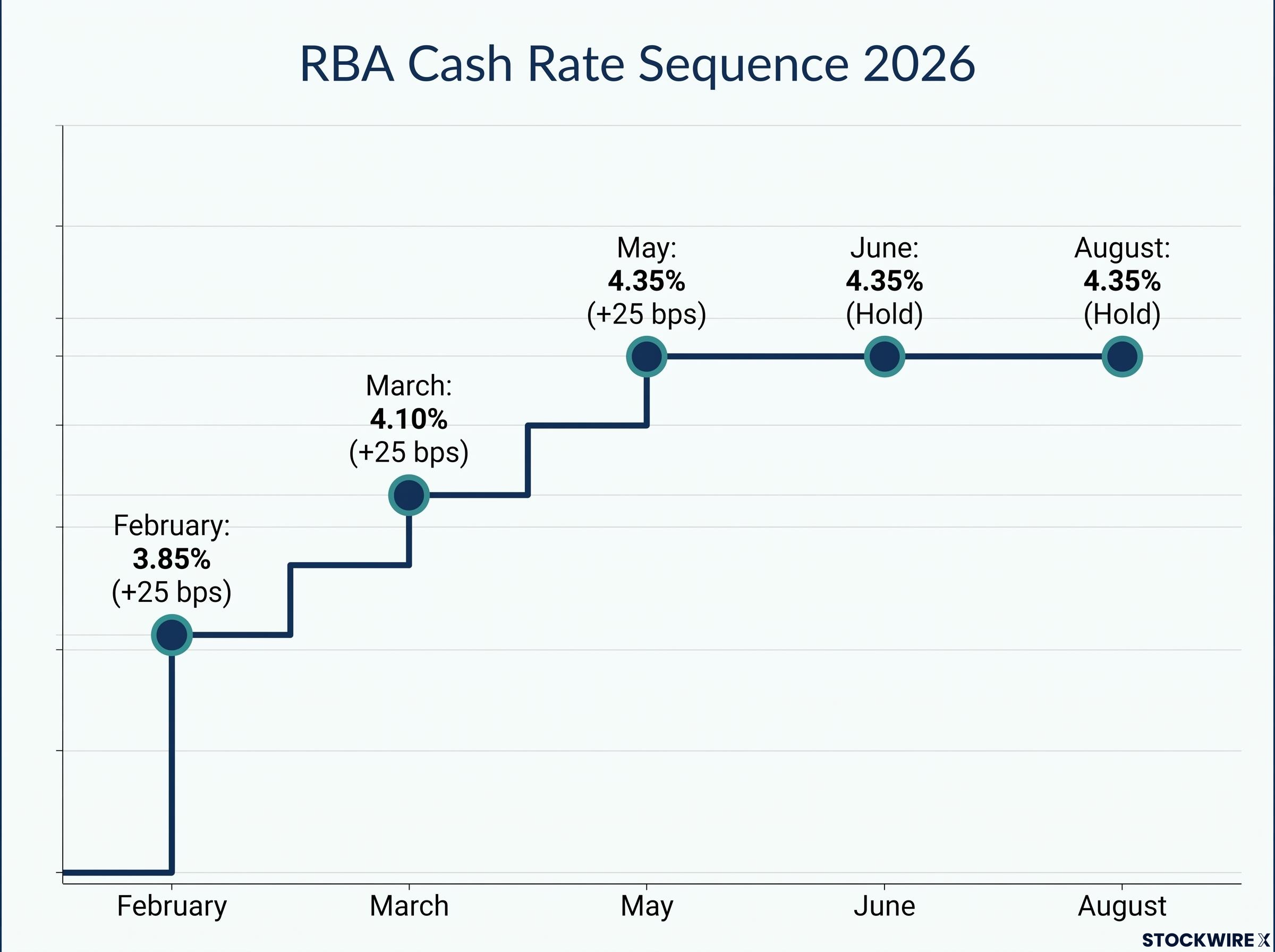
The sequence so far in 2026:
The May 2026 rate hike that pushed the cash rate to 4.35% came as the Fed, ECB, and Bank of England all held steady in the same week, creating a divergence of up to 235 basis points and positioning the RBA as the most aggressive major central bank in the developed world at that point in the cycle.
- February: 25-basis-point hike to 3.85%
- March: 25-basis-point hike to 4.10%
- May: 25-basis-point hike to 4.35%
- June: Unanimous hold at 4.35%
- August: Hold at 4.35%, widely expected
What matters is the language. The RBA retained its conditional tightening bias in June, keeping the phrase “increasing the cash rate target further if required” in its statement. The August quarterly forecasts, released alongside this decision, were the focal point for markets looking for evidence of whether the hiking door is narrowing or still wide open.
The distinction is not academic. A hold with a tightening bias is a fundamentally different rate environment from a hold with a neutral lean. The first tells you duration risk is still live. The second tells you it is fading. Right now, the RBA is sending the first signal, not the second.
The RBA monetary policy statement released at each decision meeting carries the Board’s conditional language verbatim, making it the primary reference for interpreting whether a tightening bias has been softened, retained, or removed.
When big ASX news breaks, our subscribers know first
The inflation problem the RBA still cannot declare solved
Headline inflation has eased. The consumer price index rose 3.8% in the year to June 2026, a lower number than the peaks that triggered the hiking cycle. On the surface, that looks like progress.
Underneath, the picture is less reassuring. Trimmed mean inflation, the RBA’s preferred measure of underlying price pressure (it strips out the most volatile items to reveal the trend), has held above the 2-3% target band’s midpoint continuously since late 2021, placing Australia’s core inflation among the highest readings across major developed economies. That is nearly five years of core inflation running hotter than the Bank wants.
The June 2026 trimmed mean reading of 3.6% came in below the RBA’s own May forecast of 3.8%, giving markets modest comfort ahead of the August decision, but the quarterly CPI measure held at 4.0%, confirming the deceleration is recent and still far from the sustained evidence the Board has said it needs.
The RBA describes both headline and underlying inflation as “still too high,” and projects inflation will remain above target for an extended period.
The concern that keeps the Board’s finger near the trigger is what economists call embedded inflation: the risk that businesses and wage-setters begin treating above-target price growth as normal, building it into contracts, pricing, and expectations. If that happens, bringing inflation back to target later requires sharper rate rises and a deeper economic cost. The oil shock linked to Middle East conflict, which pushed inflation materially higher in the second half of 2025, added fuel to a fire that was already burning.
For your portfolio, sticky core inflation means each incoming CPI print genuinely has the power to shift the rate outlook. This is not a market where you can set your duration positioning and forget it.
What money markets and economists are actually pricing
A 60% probability sounds abstract until you translate it into positioning risk. If you are investing as though the tightening cycle is definitively over, you are taking a bet that the market itself is not comfortable making.
That probability has moved sharply through 2026. After the May hike, interest-rate swaps nearly fully priced a September rate increase, reflecting how quickly incoming data can shift expectations. A Reuters poll conducted in early May found that more than a third of surveyed economists expected the cash rate to reach 4.60% or higher in 2026, up from zero in the March survey. AMP’s Shane Oliver, for one, has flagged the prospect of a further move before the calendar turns.
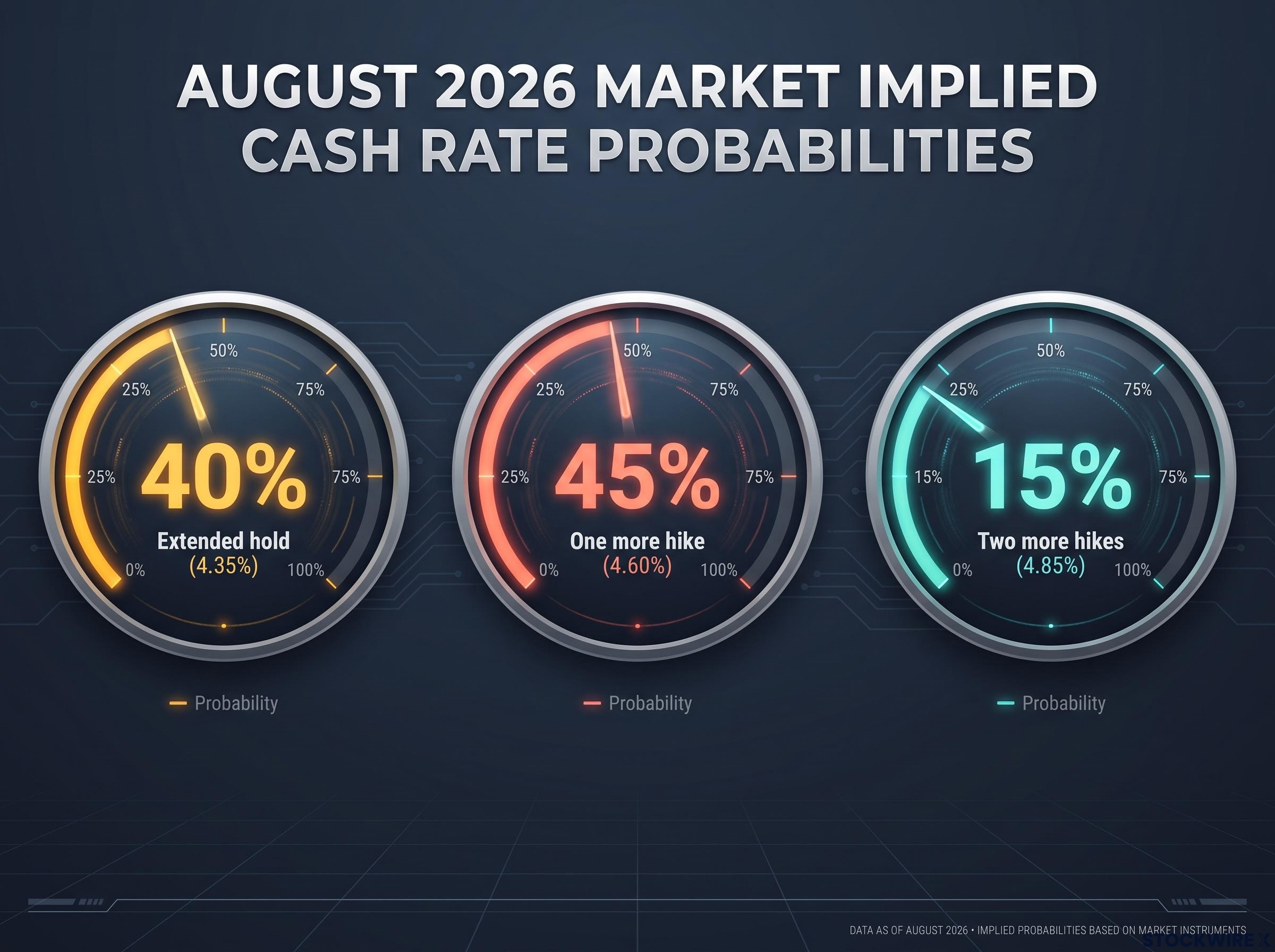
| Scenario | Implied Cash Rate | Market Probability (August 2026) | Key Condition |
|---|---|---|---|
| Extended hold | 4.35% | ~40% | Trimmed mean CPI eases; labour market softens further |
| One more hike | 4.60% | ~45% | Core inflation stays sticky; wages growth remains elevated |
| Two more hikes | 4.85% | ~15% | Upside CPI surprise combined with persistent services inflation |
The point is not to predict which row plays out. It is to recognise that the distribution of outcomes is still wide enough to demand active positioning rather than passive conviction.
A genuinely neutral signal from the RBA, one that steps back from the RBA’s tightening conditionality explicitly retained since May, could compress short-end yields, rally rate-sensitive equities in real estate and utilities, and weaken the AUD within the same trading session, making the precise wording of the statement the defining market event of the day.
How a higher-for-longer rate environment reshapes Australian portfolios
Fixed income and cash positioning
With the cash rate at 4.35%, high-quality short-duration instruments, term deposits, money-market funds, and short-dated government securities, offer meaningful income by recent historical standards. That yield comes with relatively low price risk, which matters when the RBA has not ruled out further tightening.
Longer-dated bonds and investment-grade credit sit on the other side of the equation. If the RBA hikes again, or if swap markets price more tightening, yields on longer-dated securities rise and prices fall. The duration risk the RBA has explicitly kept alive makes shorter-duration positioning the more defensive choice for capital preservation and income visibility.
Managing duration exposure in a higher-for-longer environment follows the same principle that BlackRock, PIMCO, Vanguard, and J.P. Morgan Asset Management have all converged on: the 1-5 year segment of the curve offers yields comparable to long-dated bonds with materially lower rate sensitivity, a trade-off that is directly relevant while the RBA retains an explicit tightening bias.
Equities, currency, and property
Consumer discretionary is the equity sector most directly exposed. Australian households carry significant variable-rate mortgage debt, which means rate increases transmit quickly into disposable incomes and then into spending. Retailers, leisure, and discretionary services face structural earnings headwinds while rates remain elevated.
The Australian dollar adds another layer. A hawkish RBA relative to easing developed-market peers tends to support the AUD, creating hedging considerations for investors with offshore positions and a margin headwind for AUD-reporting exporters.
Residential property has remained relatively resilient so far, supported by population growth and constrained supply, but leveraged buyers are increasingly sensitive to further rate increases and tighter credit conditions.
| Asset Class | Rate Sensitivity | Direction of Risk | Positioning Consideration |
|---|---|---|---|
| Long-duration bonds | High | Price falls if rates rise further | Reduce duration; favour shorter maturities |
| Short-duration instruments | Low | Income benefit from elevated cash rate | Attractive for capital preservation and yield |
| Consumer discretionary equities | High | Earnings and valuation pressure | Caution warranted while rates stay elevated |
| AUD and offshore assets | Moderate | AUD supported by hawkish RBA stance | Review currency hedging on offshore positions |
| Residential property | Moderate-High | Leveraged buyers most exposed | Stress-test refinancing costs under a further hike scenario |
If you are running long-duration fixed income or sitting overweight consumer discretionary, you are carrying risk that the RBA has explicitly told the market it has not retired.
The data releases that will decide whether another hike happens
The RBA is data-dependent in practice, not just in rhetoric. Each of the following releases is a binary moment for the rate outlook: upside surprises reactivate the tightening bias, while softer readings build the case for a genuine hold through year-end.
- Trimmed mean CPI: The single most important input. An upside surprise here is the fastest path to another hike being priced in. The RBA is watching how the oil shock and capacity pressures feed through to broader prices.
- Wages growth and services inflation: Persistent wage and services-sector cost pressures would argue for the Board to act on its tightening bias. This is where the embedding risk the RBA has flagged becomes visible in the data.
- Unemployment trajectory: The jobless rate of 4.4% came in above the 4.2% the RBA pencilled in for the period in its May 2026 forecasts. The gap is an active area of scrutiny. A continued drift higher supports holding; a reversal reopens the hiking conversation.
- RBA statements and Statement on Monetary Policy (SoMP): The SoMP, the RBA’s quarterly publication updating its forecasts for growth, inflation, and unemployment, can shift market expectations quickly. Meeting minutes, released two weeks after each decision, reveal the Board’s internal direction-of-travel discussion.
Knowing this calendar and understanding what each release means turns passive observation into active risk management.
What the hold tells you, and what still needs to prove itself before this cycle ends
The RBA has paused, but it has not stopped. The Board’s own language makes that explicit.
“The Board is prepared to increase the cash rate target further if required.”
That sentence is not boilerplate. It is the policy anchor that should shape your positioning until the data or the language changes. Swap markets reflect the same view: with traders pricing roughly a 60% chance of another move by December, the prevailing consensus is not that 4.35% represents a confirmed ceiling.
The investor frame from here is straightforward. If incoming inflation and wages data surprise to the upside, markets will rapidly reprice toward another hike and rate-sensitive assets will feel it. If data softens, the probability shifts toward a genuine peak and the conversation turns to how long rates stay at this level before any easing.
Until the evidence arrives, the practical positioning principle is to favour shorter duration and quality income, maintain caution in rate-sensitive sectors, and treat each major data release as a potential inflection point rather than background noise. The investor who understands that this pause is data-dependent, not conviction-based, is better positioned than the one who reads the hold as the destination.
This article is for informational purposes only and should not be considered financial advice. Investors should conduct their own research and consult with financial professionals before making investment decisions. Past performance does not guarantee future results. Financial projections are subject to market conditions and various risk factors.