
The Reserve Bank of Australia (RBA) has just raised rates for the fourth time this year, taking the cash rate to 4.60%. Inflation sits at 4.0%. Even so, two fund managers are already telling investors to start building lists of rate cut stocks, because by the time the cuts arrive on the ASX, the best entry prices may be gone.
The logic is real. Rate-sensitive shares tend to move months before the central bank does, so waiting for the first cut can mean missing the early buying.
The danger is just as real. Buy too early and a false pivot, where inflation forces yet another hike, can punish cyclical positions quickly. The next test arrives on 3 November 2026, when the RBA board meets again.
Here is where Ben Clark of TMS Private Wealth and Julia Lee of Shoren Partners Asset Management want to buy and sell. You will also see why timing matters more than the picks themselves, and how a staged approach lets you act without betting on a single date.
Is the market too early to bet on RBA cuts?
The case for moving now has instinctive appeal. Four hikes in under 12 months have squeezed households, and history says rate-sensitive stocks rally before policy actually turns. The forecasts and the macro data, however, pull hard in the other direction.
What the forecasters expect
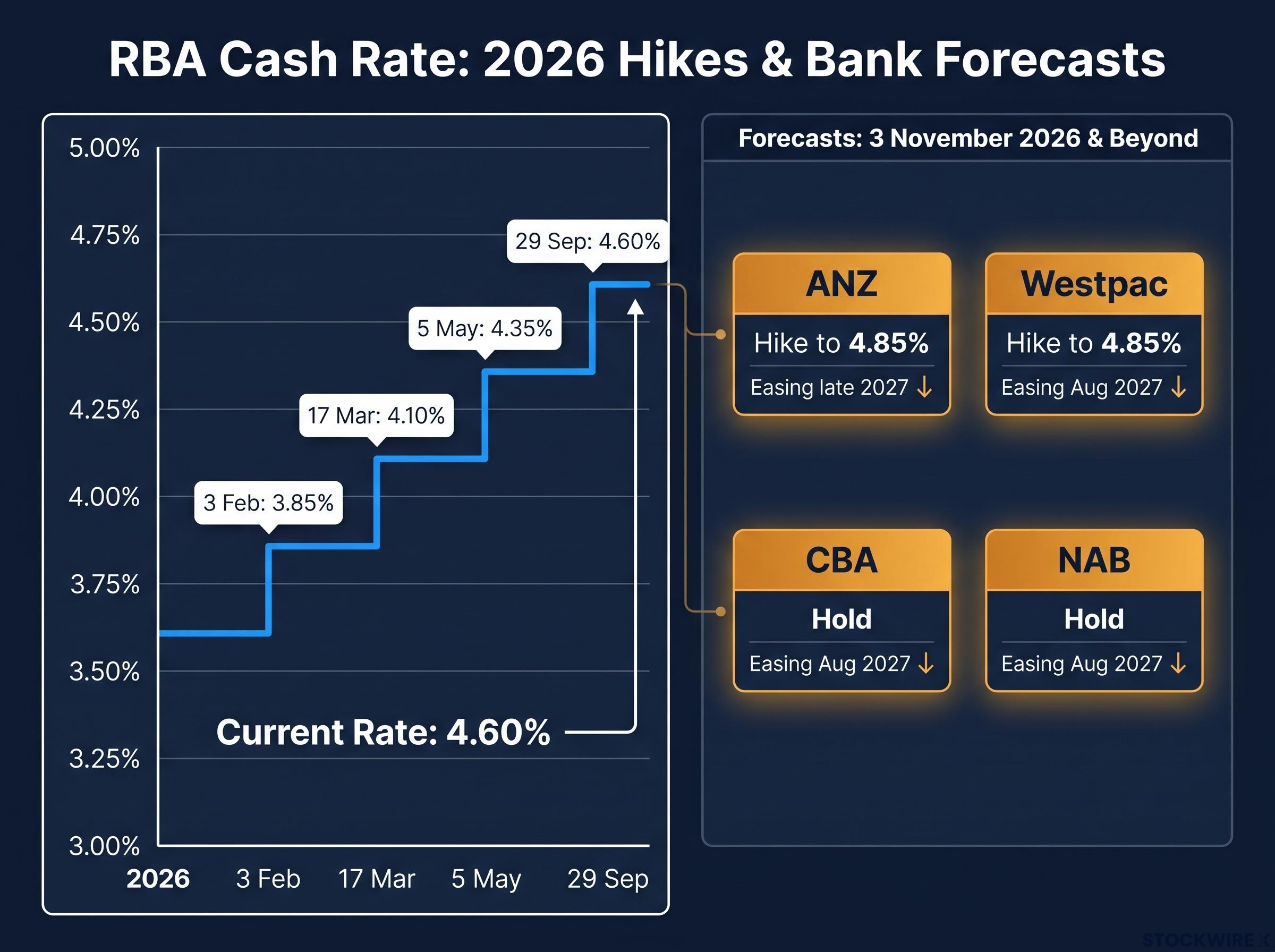
The RBA lifted the cash rate (the overnight interest rate it sets, which flows through to mortgages and deposits) on 3 February to 3.85%, on 17 March to 4.10%, on 5 May to 4.35% and on 29 September to 4.60%. That adds up to 100 basis points of tightening, where one basis point is one-hundredth of a percentage point. The board’s latest minutes kept further increases explicitly on the table.
The RBA’s tightening cycle has been unusually aggressive among developed economies, and signals such as money supply growth and the yield curve have raised questions about whether the board risks overshooting into recession territory.
The major banks split into camps over what comes next.
| Bank | November view | Cut timing |
|---|---|---|
| ANZ | Hike to 4.85% | Easing from late 2027 |
| Westpac | Hike to 4.85% | From August 2027 |
| CBA | Hold, but “very much live” | From August 2027 |
| NAB | Hold | From August 2027 |
On 13 October, CBA put the odds of a November hike at about 30%, while the podcast source cited a bond-market-implied figure near 40%. The gap likely reflects different measures and timing, but both figures say the same thing: another hike is a genuine possibility.
Clark suggests starting to position around the new year and calls October slightly early. Lee thinks the cycle is near its peak, with one or two more hikes to come. Treat their view as one input, not a settled timetable.
What the economy is signalling
The data explains why the forecasters disagree:
- Headline CPI rose to 4.0% in August, up from 3.5% in July
- Trimmed mean inflation, which strips out the most extreme price moves to show the underlying trend, reached 3.6%
- Unemployment climbed to 4.7% in September
- National house prices are down 3.3% from the March peak after six consecutive monthly falls
The inflation readings point towards further hikes. The labour market and housing figures point towards damage that is already building. Greg Jericho, chief economist at the Australia Institute, warned that unemployment reaching 5% would put Australia near recession territory.
With every major bank pointing to cuts no earlier than the second half of 2027, and a hike still live, you should treat any rate-cut portfolio shift today as early positioning that carries false-pivot risk. It is not a response to a confirmed turn.
When big ASX news breaks, our subscribers know first
How do rate cuts rotate money across the ASX?
If cuts do arrive, the basic mechanism is familiar to most investors. Cheaper money helps some businesses and hurts others, and capital follows.
| Sector | Effect of lower rates | Direction | Key caveat |
|---|---|---|---|
| Retailers | Lower mortgage repayments free up household cash; investors pay higher multiples | Positive | Spending may still fall if job losses drive the cuts |
| REITs and developers | Lower discount rates and refinancing costs support property values | Positive | Values stay exposed if rates remain high for longer |
| Insurers and cash-earning businesses | Less income earned on investments and client cash | Negative | Pricing and business mix can offset the hit |
A discount rate is the interest rate investors use to convert future earnings into a value today. When it falls, those future earnings are worth more now, which is why property trusts and growth stocks tend to rise.
The discount rate effect is only one of several channels linking rates to property trusts, alongside refinancing costs and yield competition with bonds, which is why REIT values can lag even when cuts are expected.
Lee describes this as a “great rotation” out of expensive defensives (utilities, health care and, to some extent, financials) and into cyclicals such as consumer discretionary, energy and materials. That is a factor view: a bet on which types of stock benefit. It does not prove that any individual company is undervalued.
History complicates the simple version. In 2019, easing did support rate-sensitive assets, but the strongest performers were the businesses with resilient earnings and sound balance sheets. Between 2023 and 2025, returns were shaped as much by inflation, bond yields, housing, commodities and global tech valuations as by the cash rate.
The lesson from past cycles Why rates fall matters more than the fact that they fall.
A cut driven by cooling inflation in a soft landing is very different from a cut forced by rising unemployment. The rotation is effectively a bet on the first kind, so check the reason behind any easing before you buy cyclicals.
Which stocks do the fund managers want to buy, and which to sell?
With that logic in place, the specific calls become easier to test.
| Stock | Call | Rate-cut mechanism | Bull case | Principal risk |
|---|---|---|---|---|
| JB Hi-Fi | Buy (both) | More household cash flow | Scale, cash generation, market share | Weak spending if unemployment rises |
| Goodman | Buy (both) | Lower discount and refinancing rates | Logistics and data-centre demand | Execution; multiples if rates stay high |
| REA Group | Buy (both) | Housing recovery lifts listings | FY26 earnings and cash flow growth | AI disruption, falling volumes |
| IAG | Sell (Clark) | Lower investment income | Premium increases, reserve releases | Catastrophe and repair-cost swings |
| Computershare | Sell (Lee) | Lower income on client cash | Diversified registry and servicing | Recession reduces transactions |
The three buys
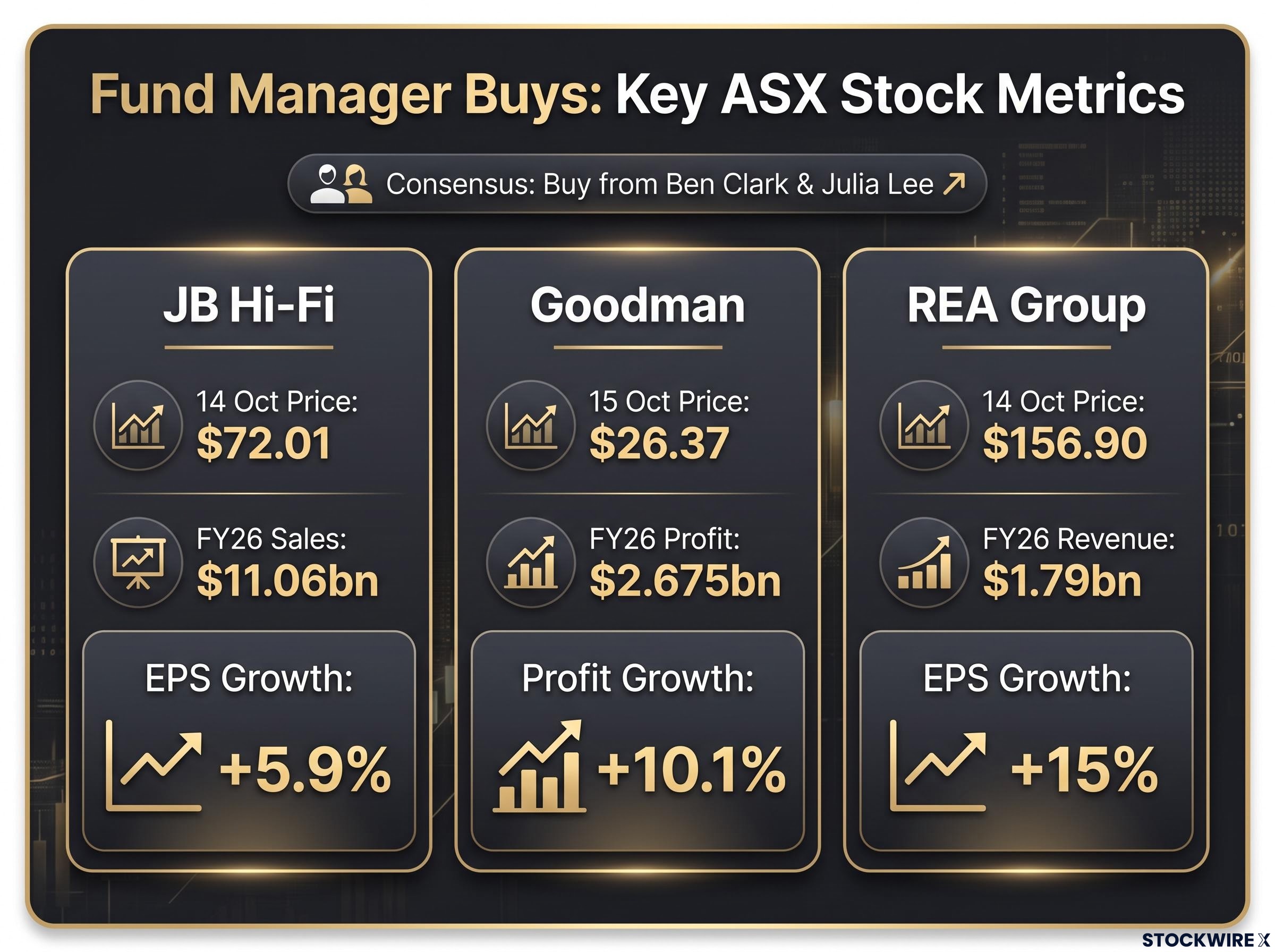
JB Hi-Fi traded at $72.01 on 14 October, down about 38% over 12 months according to the source.
- FY26 sales of $11.06bn; statutory earnings per share (EPS) of 448.1c, up 5.9%
- Early FY27 trading softer, with product shortages
- Morgans cut FY27-28 net profit after tax (NPAT) forecasts by about 5%
- Return on invested capital (ROIC), a measure of profit generated on the money a business deploys, typically runs at around 30-35%
Clark sees a likely early bid from fund managers, and Lee’s firm has already started buying. The risk is that cuts driven by recession could leave discretionary spending falling anyway.
Goodman traded at $26.37 on 15 October.
- FY26 operating profit of $2.675bn, up 10.1%
- Data-centre work in progress (WIP), meaning projects under construction, of $19.7bn
- Management targets about 9% FY27 EPS growth
The sources conflict. The podcast described the shares as down about 20% over the year, while Yahoo Finance data shows a gain of 22.84%. The podcast also said Goodman builds without pre-signed customers, whereas research reports 90% of WIP is held through partnerships.
REA Group traded at $156.90 on 14 October. The source puts it down 28% over 12 months at about 26 times earnings, which Clark calls the cheapest he can recall.
- FY26 EPS up 15% to $4.93
- Revenue up 7% to $1.79bn
The sell-off followed fears that AI agents could erode property-portal moats, and that threat remains the principal risk.
The two sells
Clark sees IAG as a crowded trade, with expensive valuations built on peak-like earnings after benign claims years. Insurers do earn more when yields rise, but premium increases, reserve releases and lower claims inflation can offset falling yields.
Lee’s case against Computershare rests on margin income from client cash, which shrinks as rates fall. Registry, employee share plans and mortgage servicing diversify that exposure, and lower rates can lift deal activity.
No verified price, 12-month move or P/E ratio (share price divided by earnings per share) was found for either stock, nor beyond the source’s figures for REA. The buys show you where the managers see mispriced recovery potential. The thinner sell cases suggest you should not exit IAG or Computershare on rate direction alone.
A sector-by-sector ASX outlook shows that the market now demands visible disinflation and earnings resilience before paying up, which tempers any simple belief that cyclicals will rally on rate-cut hopes alone.
How can you position for a pivot without calling the exact date?
The disagreement over timing is precisely why a process beats a prediction. These six steps convert the managers’ views into actions you could begin this week:
- Watch the policy signal. Look for inflation falling sustainably across several monthly CPI prints, not one soft month.
- Check the labour market. If cuts follow rising unemployment, expect cyclicals to struggle at first.
- Separate valuation from earnings. Lower discount rates lift valuations, but earnings downgrades can outweigh them.
- Prefer strong balance sheets. Companies with manageable refinancing needs can survive a delayed pivot.
- Stage your entries. Build positions in tranches rather than all at once.
- Balance your exposure. Pair likely beneficiaries such as retailers and REITs with defensive, cash-generative holdings.
Staging works best with fixed checkpoints. The 3 November RBA decision is the first, followed by Q1 FY27 updates (covering July to September) and Q2 FY27 results (October to December). Clark’s new-year timing offers a natural point to reassess.
Decide your triggers now. For example, you might set a first tranche after two consecutive softer CPI prints, or wait until the RBA drops its tightening bias.
The false-pivot risk Buying cyclicals while inflation is sticky risks another hike, higher bond yields and earnings downgrades arriving together.
With the cash rate at 4.60%, CPI at 4.0% and CBA putting November hike odds near 30%, that scenario is far from remote. Your edge lies in a pre-defined plan, not in guessing the first cut. This is general information only; consider your own circumstances or speak with a licensed adviser.
Preparing for the pivot while the hiking cycle is still live
JB Hi-Fi, Goodman and REA are logical beneficiaries of a genuine easing cycle. As of 15 October 2026, however, the evidence favours waiting for confirmation or building exposure gradually rather than rotating in full.
The sell calls deserve more scepticism. IAG and Computershare both have company-specific earnings drivers that can blunt the effect of falling rates.
Your next signals are the 3 November decision, the coming CPI and unemployment prints, and above all the reason behind any eventual cut. Cooling inflation supports the rotation, while a weakening jobs market undermines it. Set your triggers before the headlines move, and let the data decide when you act.
This article is for informational purposes only and should not be considered financial advice. Investors should conduct their own research and consult with financial professionals before making investment decisions. Past performance does not guarantee future results, and forecasts are subject to market conditions and various risk factors.