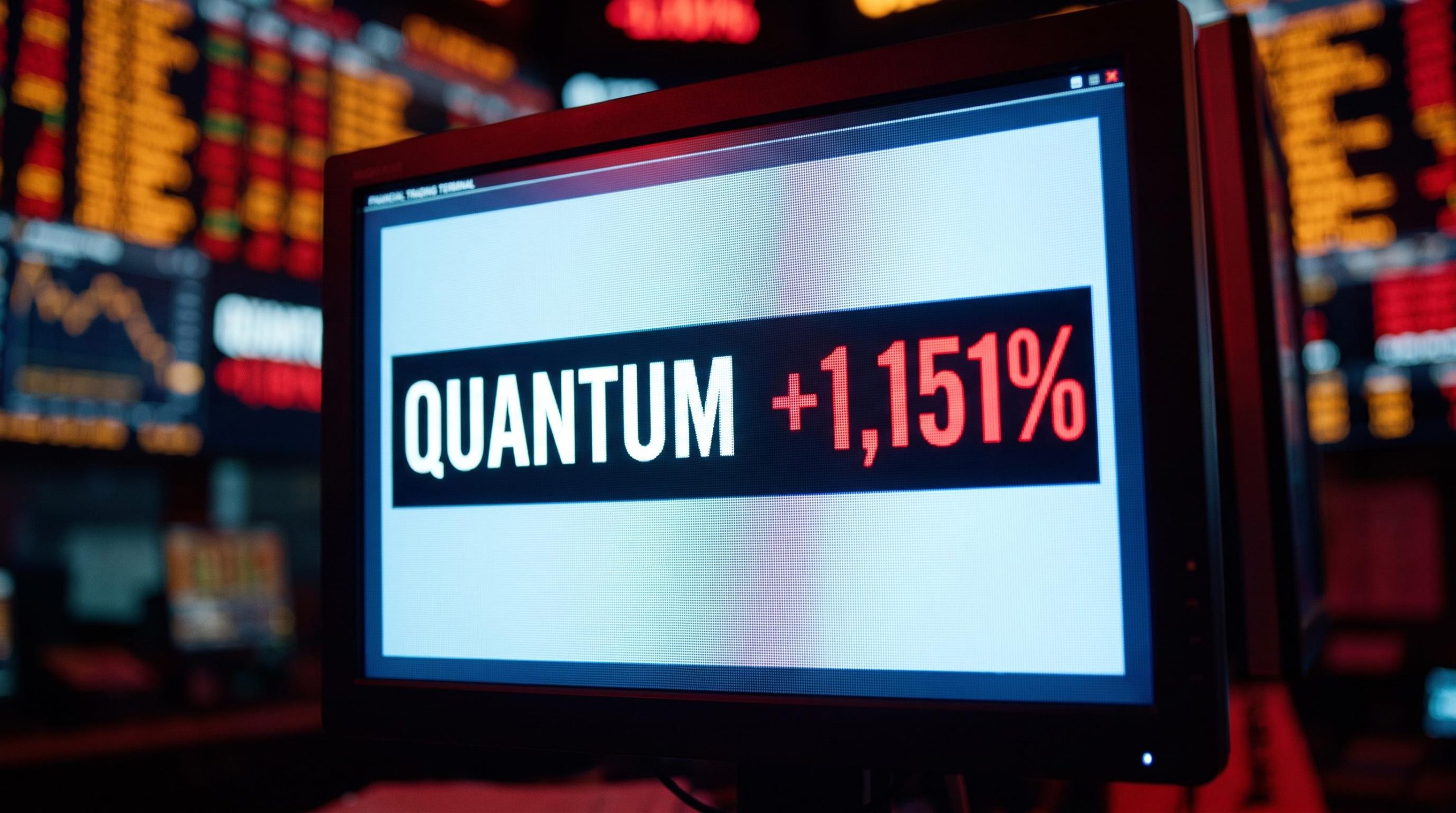
In late 2024, one of the best-performing stocks in the entire market was a data-storage company with no quantum technology whatsoever. Quantum Corporation rose 1,151% in the final two months of the year, and the only thing that changed was the market’s appetite for a single word in its name.
That detachment from reality was the defining feature of one of the most compressed boom-and-bust cycles in recent memory. From late 2024 through 2026, genuine quantum computing pure-plays posted multi-hundred-percent gains, then reversed just as violently, while companies with only a nominal connection to the field rode the same wave. The pattern has a direct historical precedent: the blockchain rebranding frenzy of 2017-2018 followed the identical script.
Technology boom-bust cycles across railways, fibre optics, and the dot-com era share a structural pattern: roughly three-quarters of historical general-purpose technology booms produced massive overinvestment and capital destruction before the surviving infrastructure enabled the next wave of productivity growth.
Here is a diagnostic framework for spotting narrative-driven speculation before it collapses, using the quantum computing hype cycle as the case study that makes the mechanics visible.
When a buzzword becomes a buying signal: the anatomy of the quantum frenzy
Retail enthusiasm ignited in late 2024 and accelerated into early 2025, producing single-stock moves rarely seen outside of meme-stock territory. The pure-plays led the charge.
Rigetti Computing climbed 1,449.4% across 2024, then shed more than 45% in a single session on 8 January 2025. D-Wave Quantum surged 854% in 2024 and added a further 211.4% in 2025 before its year-to-date return collapsed to negative 36.63% by 1 September 2026. These were real quantum companies, and even they could not hold their gains.
But the more revealing story sat one layer down, among firms that had no quantum technology at all.
A 1,151% rally in two months, driven entirely by a word in a company’s name and zero quantum technology involved. That is a data point worth sitting with before reading further.
Name-only stocks and the rebranding wave
Quantum-Si, a proteomics firm, rose 285% in the same late-2024 window. QuantumScape, a solid-state battery developer, and Quanta Services, an infrastructure contractor, drew speculative inflows for no reason other than nominal association.
By mid-2025, management teams had noticed the pattern and started acting on it. Companies across cybersecurity, artificial intelligence, and IT infrastructure began rebranding into the label, which tells you they recognised it as a valuation lever rather than a description of what they did.
- 01 Communique (cybersecurity) became 01 Quantum Inc. in July 2025
- Integrated Cyber Solutions became Integrated Quantum Technologies Inc. in December 2025
- Two Hands Corporation (AI) became Quantum X Inc. in July 2026
- Tyto Athene (IT integration) became Quantum Sky in August 2026
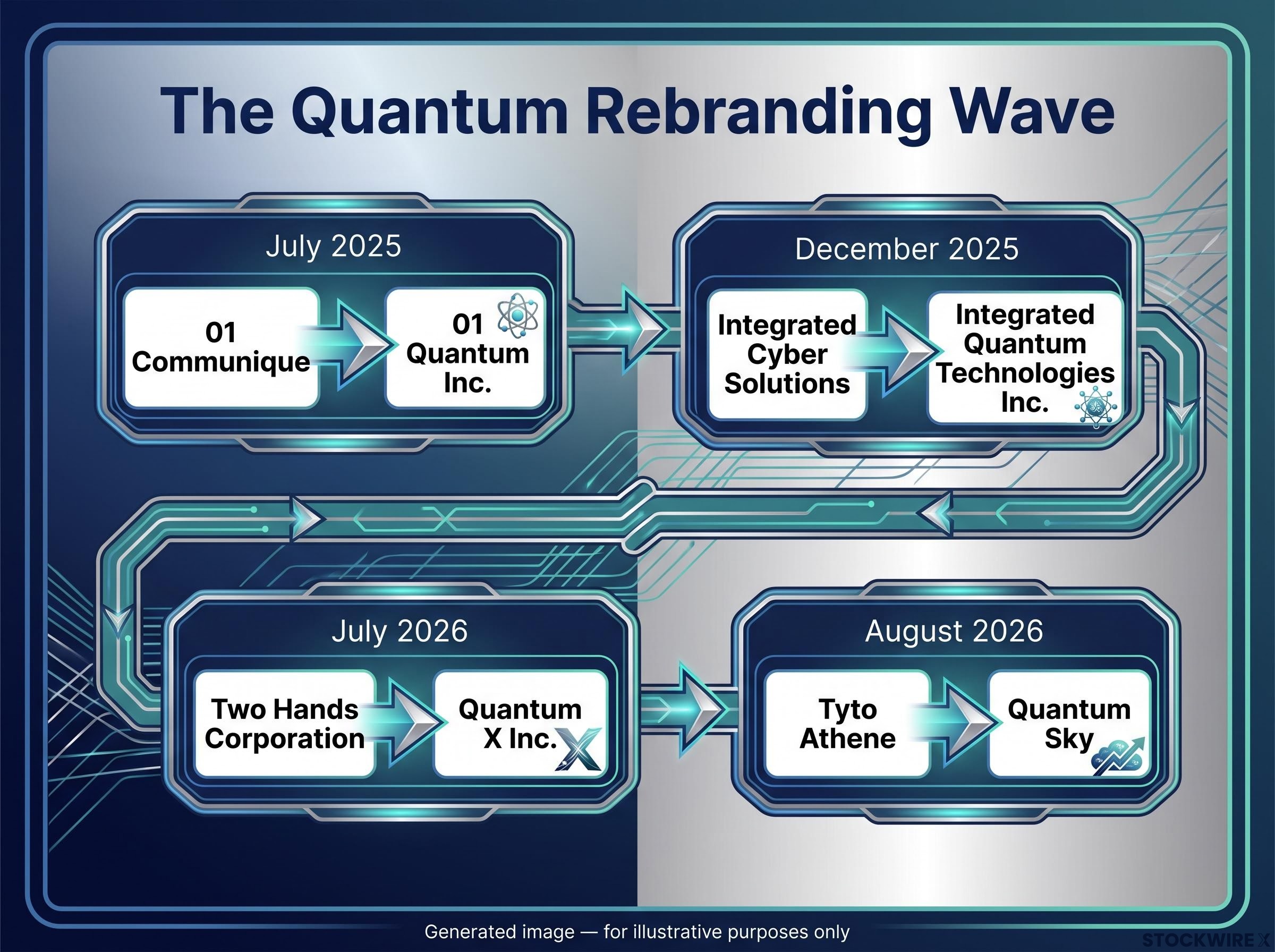
When companies with no quantum technology adopt the label and immediately attract capital, the market is pricing the narrative, not the business. That is a structural warning sign, not an isolated oddity. The lesson for the next cycle is direct: when the label spreads faster than the technology, the peak is probably already forming.
When big ASX news breaks, our subscribers know first
What the Gartner curve actually predicted, and why retail investors ignored it
The entire arc of the quantum frenzy was mapped out years before it happened. The Gartner Hype Cycle framework describes how emerging technologies move through predictable emotional stages, and quantum computing followed the path almost exactly.
- Technology trigger: Breakthrough disclosures from major labs and pure-plays sparked initial excitement and media coverage.
- Peak of inflated expectations: Prices detached from fundamentals as retail buyers chased any name associated with the theme.
- Trough of disillusionment: Insider selling accelerated and near-term promises fell short, and the violent reversals followed.
Retail behaviour during this cycle matched a documented pattern. The SSRN study “Investor Technophilia” describes exactly this: strong short-term price reactions to hyped technology disclosures, followed by severe reversals once insiders sell and the promised milestones slip. The quantum boom was not unique. It was a recognisable instance of a phenomenon academics had already named.
The scale of participation is what made the eventual correction structurally inevitable.
By April 2025, individual traders accounted for 36% of total order flow, with $155.3 billion in net retail inflows during the first half of the year into technology and AI-related stocks.
Nearly four in ten trades at the peak were driven by individual investors. That tells you the pricing inefficiency was large enough to matter and that the money pushing valuations higher had little connection to fundamentals.
The blockchain parallel makes the point sharper. Companies that added “blockchain” to their names in 2017-2018 saw the same short-term stock reactions for the same structural reasons. Recognising that these cycles follow an observable, repeating arc lets you position yourself as an observer of the pattern rather than a participant in it.
What insiders and short sellers saw that retail investors did not
The skeptical case against quantum valuations came from two independent directions at once, and that convergence is what makes it worth taking seriously. One set of doubts was technical. The other was financial.
On the technical side, corporate roadmaps and independent scientists disagreed sharply on when commercial quantum computing would actually arrive.
| Source | Timeline estimate | Basis for claim | Independence |
|---|---|---|---|
| IBM | Quantum advantage by end of 2026; fault-tolerant machine by 2029 | Internal engineering roadmap | Corporate |
| Google / Amazon | Initial practical applications in a 5-to-7-year window | Chip development analyses | Corporate |
| U.S. National Academies | Decades away | Peer-reviewed scientific assessment | Independent |
| IEEE Spectrum | Decades away | Engineering community assessment | Independent |
IBM announced a $10 billion commitment on 2 June 2026 to support its roadmap. Yet the U.S. National Academies and IEEE Spectrum maintain that a true commercial machine remains decades out, noting that present-day Noisy Intermediate-Scale Quantum (NISQ) machines have no known algorithms capable of effective commercial use. This is not a factual dispute for the reader to resolve. It is a signal that even the most credible corporate timeline should be weighted against independent peer review before it becomes an investment thesis.
The financial doubts were more pointed. Wolfpack Research published a critical report on IonQ, alleging that up to 86% of the company’s 2022-2024 revenue came from non-recurring Pentagon earmarks, creating what it called a $54.6 million hole in expected future revenues. The report also flagged nearly $400 million in insider stock sales during periods of elevated hype. IonQ disputed these claims.
Revenue quality signals, including the gap between GAAP and non-GAAP earnings, free cash flow alignment, and the proportion of recurring versus one-off receipts, are the same analytical tools that would have surfaced the Wolfpack allegation about IonQ’s Pentagon-dependent revenue before it became a short-seller thesis.
Kerrisdale Capital added a valuation critique, arguing that even after pullbacks, IonQ traded at roughly 40 times the consensus 2026 revenue estimate despite scaling challenges and limited commercial adoption.
Roughly 40 times the 2026 revenue consensus. That number contextualises the risk regardless of whether you accept the short-seller narrative in full.
When insiders are selling hundreds of millions of dollars of stock at the peak and revenue is concentrated in one-off government contracts, the risk profile of the position is fundamentally different from what the price chart suggests.
Five filters for the next speculative cycle
The failure modes in the quantum cycle were visible in real time, and each one maps to a specific question you can ask before allocating capital. Applied during the frenzy, these filters would have produced a more calibrated position rather than a momentum-driven one.
- Revenue quality: Ask whether revenue is recurring commercial demand or one-off grants and earmarks. The Wolfpack allegation that most of IonQ’s revenue came from non-recurring Pentagon contracts (disputed by the company) is the illustrative failure case.
- Technological utility: Distinguish contrived benchmark tests from practical workloads. Independent assessments noted that “quantum supremacy” demonstrations solved artificial problems with no real-world use.
- Valuation discipline: Treat historically anomalous multiples as a warning. A stock trading at 40 times forward revenue with limited commercial adoption is priced for a future that has not arrived.
- Insider behaviour: Watch what management does with its own shares. The nearly $400 million in insider sales flagged during peak hype (disputed) was a behavioural indicator visible before the reversal.
- Independent peer review: Cross-check corporate roadmaps against neutral scientific bodies such as IEEE and the National Academies to filter out innovation theatre.
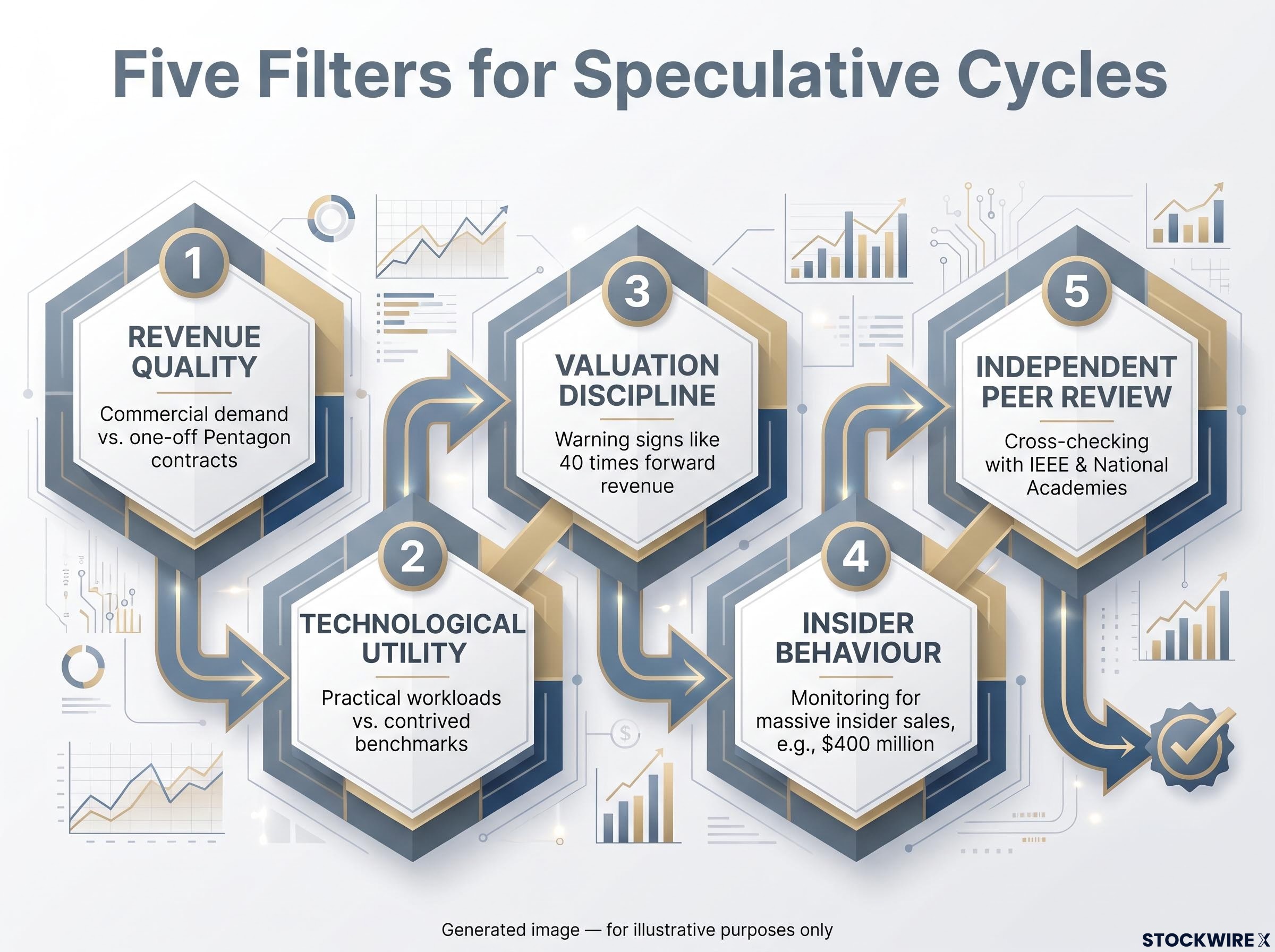
None of this requires you to be a quantum physicist or a professional short seller. It requires only that you ask a specific set of questions before committing capital, which makes the framework portable to any speculative narrative regardless of the underlying technology.
A thematic investing framework that tests problem size, realistic total addressable market, long-term durability, valuation, and competitive moat applies directly to the quantum case: the theme scored well on problem relevance but poorly on near-term TAM and valuation discipline during the 2024-2025 frenzy.
The quantum cycle is unlikely to be the last deep-technology hype event. Carrying a checklist derived from a documented failure case is the difference between informed positioning and reactive momentum trading.
What separates the survivors from the hype casualties
Quantum computing is real science, and long-term commercial applications are genuinely plausible. But “real technology, distant commercialisation” is a completely different investment thesis from the one retail investors were acting on in 2024-2025, and conflating the two is where the money was lost.
Genuine progress has a measurable signature. IBM’s roadmap targets 100 million quantum gates on 200 logical qubits with its fault-tolerant machine slated for 2029, and Google’s 105-qubit Willow chip sits behind the more credible 5-to-7-year window for initial practical applications. These are specifications you can track, not slogans.
- Signals of genuine progress: measurable metrics such as logical qubit counts and error rates, revenue from paying commercial customers, claims validated by independent peer review
- Signals of narrative excess: vague roadmaps and marketing promises, revenue dependent on government earmarks, inflows driven by a name rather than a product
The distinction matters because even companies with real technology were not spared. D-Wave’s year-to-date return sat at negative 36.63% by 1 September 2026, which tells you that valuation corrections do not discriminate between substance and hype once the narrative breaks.
Present-day NISQ machines have no known algorithms capable of effective commercial use, per independent scientific consensus. That is the most direct technical anchor for the entire skeptical case.
The correction in quantum stocks neither validates nor invalidates the underlying science. It validates a narrower observation: narrative-driven valuations revert to fundamental anchors regardless of the technology’s eventual merit. A company publishing measurable milestones and winning commercial customers sits in a different risk category from one whose valuation rests on a label, and that is the primary sorting mechanism to use when the next cycle emerges.
This article is for informational purposes only and should not be considered financial advice. Investors should conduct their own research and consult with financial professionals before making investment decisions. Past performance does not guarantee future results, and financial projections are subject to market conditions and various risk factors.
The pattern outlasts the sector
The quantum computing cycle was never really a story about a failed technology. It was a story about what happens when investor narrative detaches from commercial timeline reality, and that story repeats across sectors with different labels attached.
The five filters collapse into a single forward-looking frame. Readers who can spot the gap between a technology trigger and commercial viability, identify name-driven inflows, interrogate revenue quality, and cross-check corporate roadmaps against independent science will be structurally better positioned in any speculative cycle, whatever the underlying innovation happens to be.
Speculative bubble dynamics are not confined to niche sectors: peer-reviewed econometric research detected speculative pricing in all seven Magnificent Seven stocks between 2017 and 2025, suggesting that the retail behaviour and valuation detachment observed in the quantum cycle may be a systemic feature of the current technology investment era rather than an isolated episode.
None of this is a dismissal of quantum computing itself. The science continues, the timelines are long, and the companies that emerge from the trough of disillusionment with measurable progress and real commercial customers may eventually reward patient, informed investors. That is simply a different investment thesis from the one the 2024-2025 frenzy was built on, and knowing the difference is the whole point.