When a single property developer collapses owing about $3.4 billion while its sites carry a preliminary stated value of roughly $4.9 billion, that $1.5 billion gap looks like comfort. It is not. It is the exact question every retail investor holding a private credit fund should be asking about their own fund’s loan book right now.
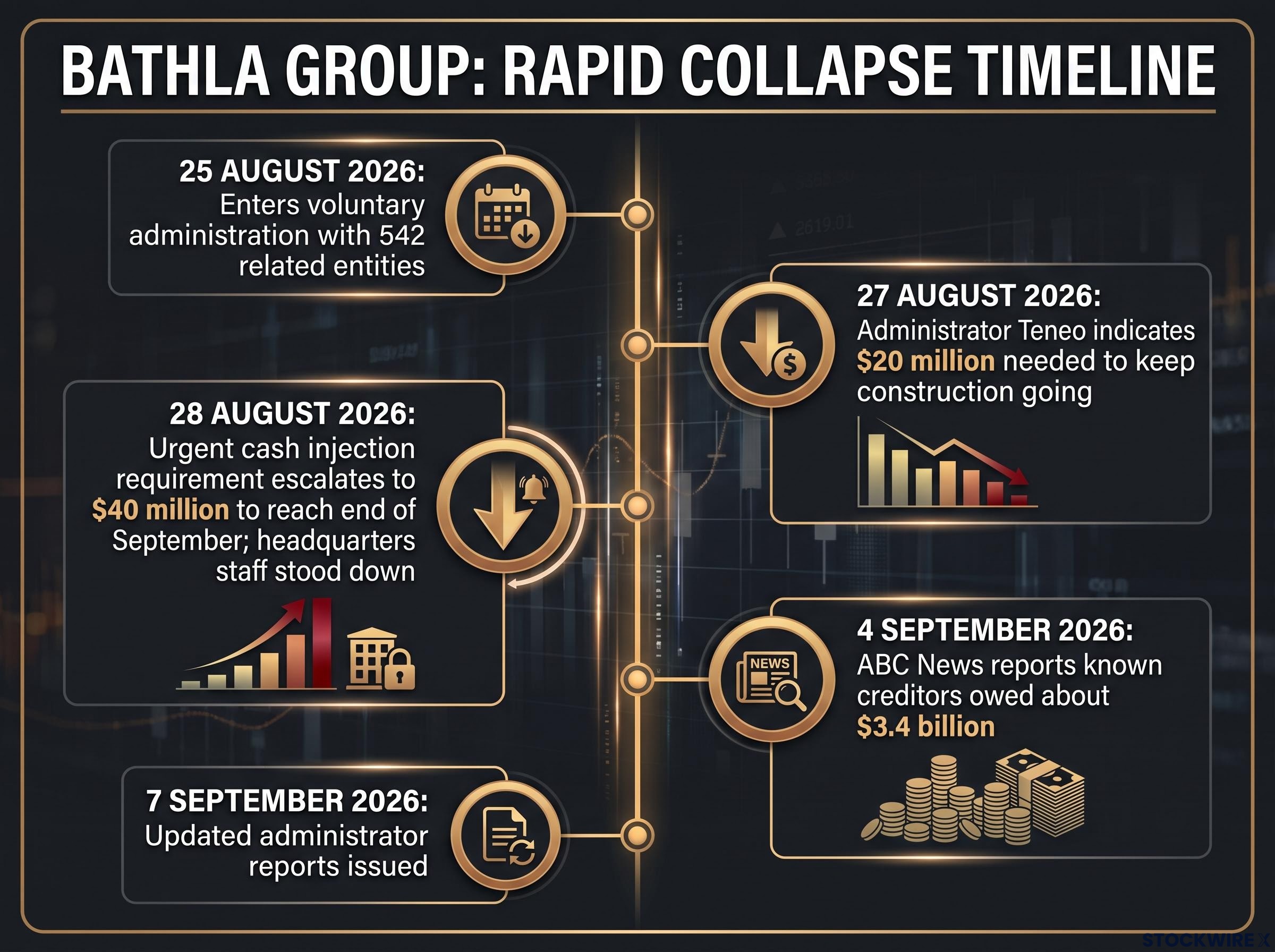
That collapse belongs to Bathla Group, which entered voluntary administration on 25 August 2026 with 542 related entities following it in a single event. Its debts were owed largely to private creditors, not the major banks, and it arrived at an awkward moment. Vesna Peroska, Portfolio Manager at Morningstar Investment Management, had described the recent period as unusually benign from a credit perspective, with very few defaults or impairments. That description is now being tested.
This analysis gives you the specific questions to ask of any private credit fund you hold or are considering. Each one is drawn from what the Bathla case reveals about where the risks in retail-facing private credit actually sit, rather than where the marketing suggests they do.
What Bathla’s collapse reveals about who was actually lending
Start with the composition of the debt, because it is the analytical foundation for everything that follows. According to ABC News on 4 September 2026, Bathla Group owes known creditors about $3.4 billion on preliminary figures, of which $3.08 billion is owed to secured lenders.
The remainder splits across the parties that sit lower in the queue. Bathla owes roughly $145 million to the Australian Taxation Office, $42 million in land tax, $130 million to other unsecured creditors, and around $4 million to employees for wages and superannuation.
| Creditor class | Approximate amount owed | Secured or unsecured |
|---|---|---|
| Secured lenders | $3.08 billion | Secured |
| Australian Taxation Office | $145 million | Unsecured (priority elements vary) |
| Land tax | $42 million | Unsecured |
| Other unsecured creditors | $130 million | Unsecured |
| Employees | Approximately $4 million | Priority unsecured |
The point that matters for a private credit investor is who filled the secured lender line. Bathla’s debts were owed largely to private creditors rather than the big banks, which makes this a private credit event, not a bank credit event.
And Bathla’s reliance on private capital was not an outlier. It was structurally typical for a large Australian developer.
The structural anchor CBRE data shows private credit funds around 26% of residential development debt, compared with just 0.3% of residential mortgages. Large developers turning to private lenders is the pattern, not the exception.
Here is the interpretive read. That gap between $3.4 billion in debt and $4.9 billion in stated site value is not a recovery cushion you can rely on. These are preliminary administrator figures subject to significant revision, and what any individual lender recovers is determined by where they sit in that creditor stack, not by the headline asset value. If your fund lent behind the senior secured lenders, the composition of that stack is your exposure.
When big ASX news breaks, our subscribers know first
How private credit became so exposed to property development in the first place
None of this happened by accident. To understand why retail-facing private credit gravitated toward property development, you have to follow the money the banks left behind.
Over the past decade, the major banks retreated from development finance, largely because regulatory capital requirements made that lending expensive to hold on their balance sheets. That withdrawal opened a funding gap, and private credit managers moved in to fill it.
The economics made the shift attractive from both directions. Development loans pay higher rates than senior secured commercial or residential mortgage lending, which suited managers competing for inflows from retail investors hunting for yield.
The scale of the tilt toward development
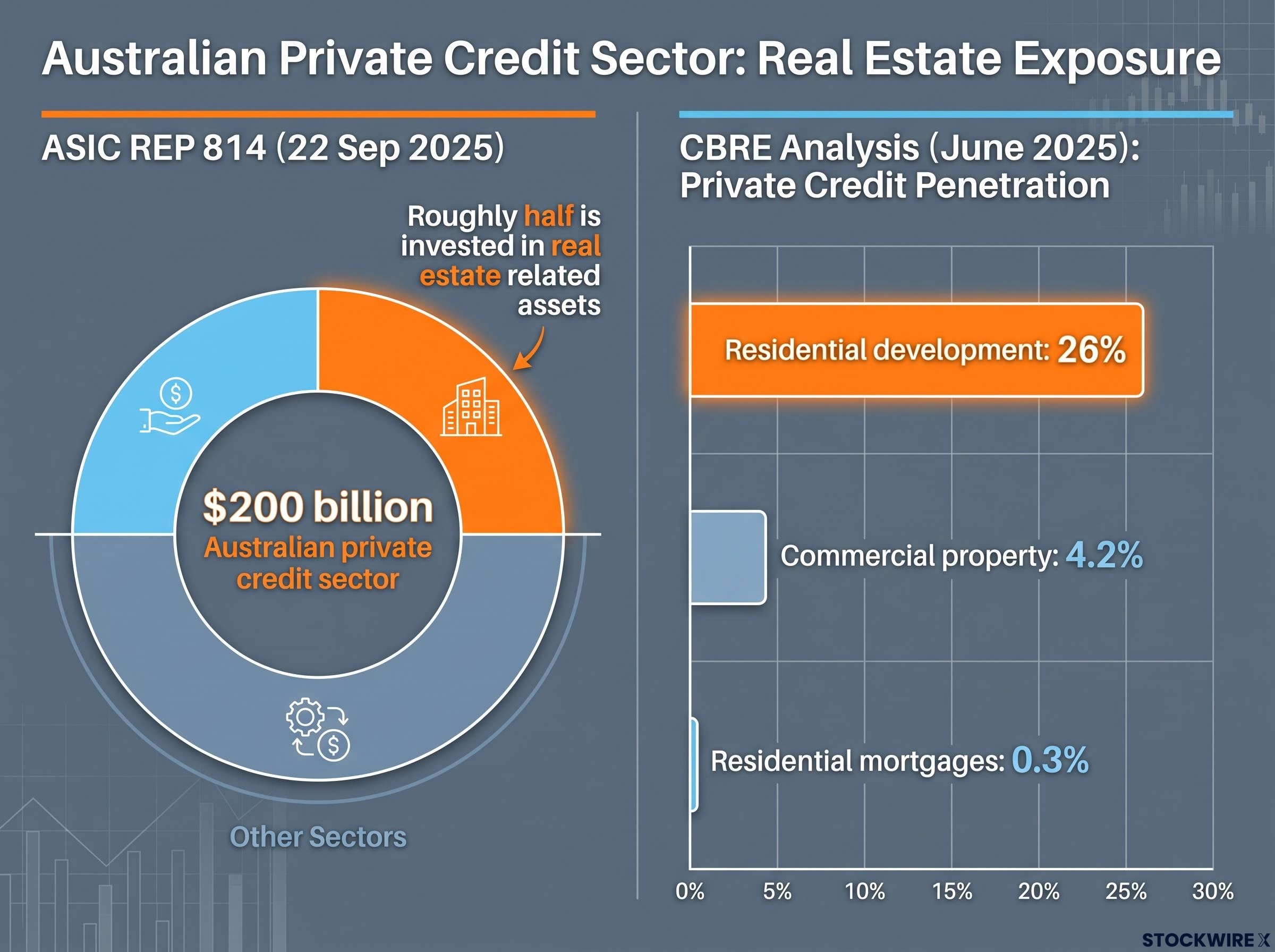
The numbers show how pronounced that concentration became. ASIC’s report REP 814, published on 22 September 2025, estimated the Australian private credit sector at around $200 billion, with roughly half invested in real estate related assets.
CBRE’s June 2025 analysis breaks down where that real estate exposure actually sits:
- Residential development: 26% private credit penetration
- Commercial property: 4.2% private credit penetration
- Residential mortgages: 0.3% private credit penetration
That is not an even spread across property. It is a heavy tilt toward the single most cyclically sensitive corner of the market, the one banks deliberately stepped back from.
Why you may hold this exposure without seeing it
The uncomfortable part is how this reaches ordinary investors. ASIC’s REP 814 notes that much private credit funding is sourced from superannuation funds and collective investment schemes, meaning retail investors often hold the exposure indirectly.
In practice, that means the development loans rarely appear in your portfolio view. You see a private credit fund, or a super option, or a diversified income product. You do not see the individual construction loans underneath.
So the read for you is this. The tilt toward development lending followed bank withdrawal and yield demand, which makes it rational rather than negligent in isolation. But that same tilt means an investor who believes they hold a “diversified” private credit fund may actually hold concentrated exposure to the exact segment of property lending banks chose to exit. Understanding why that allocation exists is the first step in judging whether the yield on offer compensates you for it.
That structural tilt also connects to a broader architecture problem in retail private credit: the liquidity mismatch between investor redemption terms and the underlying illiquidity of development loans is the mechanism regulators at the Federal Reserve, IMF, and BIS have formally identified as the primary systemic concern, sitting above borrower default risk in their assessments.
The benign credit cycle is ending, and manager quality is about to matter more
For most of the recent past, that development exposure did not look like a problem. Peroska’s characterisation of the period as unusually benign captures why: very few defaults or impairments, strong house prices, robust construction demand, and low interest rates that supported borrowers and made private credit returns appear stable.
In a benign environment, weak underwriting and strong underwriting produce returns that look almost identical. The difference is there, but nothing forces it to the surface.
Several mechanisms are now forcing it to the surface:
- Higher interest rates that compress developer cashflows, particularly on floating rate or short term facilities
- Construction cost inflation that erodes project margins before a single unit is sold
- Tighter financing conditions that make rolling over or refinancing existing loans harder
Bathla shows how fast that combination can turn into a liquidity crunch at a large borrower. ABC News reported on 27 August 2026 that the administrator, Teneo, indicated Bathla needed around $20 million to keep construction going in the near term. By 28 August 2026, that had escalated: Bathla was seeking an urgent $40 million cash injection to see it through to the end of September, with staff at headquarters stood down while funding talks continued.
The Guardian framed Bathla’s collapse not as an isolated failure but as part of wider fragility across Australia’s construction industry. That framing matters, because it suggests Bathla may be an early signal rather than a one-off.
The diagnostic observation Peroska’s point is that a shift toward economic weakness makes manager selection and sector allocation significantly more consequential for investors. When conditions were benign, manager quality was invisible. As conditions tighten, it becomes decisive.
Here is what that means if you chose a private credit fund during the recent high-rate, high-yield window. The credit cycle shift is the reason your fund selection decision now carries more weight than it did twelve months ago. You cannot assume the yield you are being paid reflects the quality of the loans underneath it. In a benign cycle it may have. As stress arrives, that assumption is precisely what gets tested.
What separates higher-quality managers from riskier ones
If manager quality is about to matter more, the practical question is how you actually tell managers apart. Peroska identified three capability areas that do the separating: underwriting standards, portfolio construction, and workout capability. Each converts into a question you can put directly to a fund manager or adviser.
- What are your maximum loan-to-value ratios on development loans, and how much sponsor equity sits beneath your position before your capital is at risk?
- What is your single-borrower concentration limit, and what proportion of the fund is in construction and development lending versus other loan types?
- Who runs your workout process, what are their credentials, and where do investors sit in the capital structure relative to the senior secured lenders?
A higher-quality manager answers these clearly. They point to conservative LVRs with real equity cushions, staged drawdowns tied to construction progress, hard concentration caps, and a named, experienced workout team that has handled administrations and deed of company arrangement processes before.
Markers of riskier managers
The contrast tells you where the danger sits. Riskier managers tend to show:
- Aggressive LVRs with thin equity buffers, leaving little room before losses reach investor capital
- Heavy concentration in construction and development loans with limited diversification across borrower types
- No named workout team or clearly defined restructuring process
- Marketing that leads with yield while burying illiquidity and capital-structure subordination in the fine print
There is a valuation trap layered on top. ASIC’s REP 814 warns that infrequent or model-based loan valuations can mask deterioration in borrower quality, giving a misleading picture of net asset value until losses are formally recognised. A fund that revalues rarely can look healthy right up to the moment it does not.
NAV stress in private credit is not confined to Australian development lending: public BDCs holding comparable assets now trade at discounts of 17-26% to stated net asset values, the widest gap since 2020, providing a live market-based rebuttal to the quarterly marks that fund managers report to retail investors.
Both ASIC and APRA have flagged that complex structures, layered trusts, subordinated tranches and intercreditor arrangements, can prevent retail investors from understanding their true position in a capital stack. That makes transparency itself a quality signal.
So treat the checklist as a filter. If a manager cannot clearly explain their maximum single-borrower exposure, their workout team’s credentials, and where you sit relative to senior secured lenders, those are not disclosure gaps to be patient with. They are due diligence red flags you should treat as disqualifying.
What retail investors in private credit should do now
The response to all this is not panic, and it is not a blanket exit. It is a specific, ordered assessment you can run on any fund you hold.
- Assess your exposure. Find out what type of loans your fund holds, its single-borrower concentration limit, and the proportion of the book in property development lending.
- Interrogate the liquidity terms. Identify the conditions that permit the fund to gate or suspend redemptions, and how it commits to communicating those events to unit-holders.
- Evaluate manager transparency. Establish whether the manager proactively discloses stressed positions or waits until a loss is formally impaired.
Not every private credit fund is in the firing line. Peroska has been clear that not all of these funds hold property development exposure, and that the impact of the Bathla collapse varies depending on the specific fund. Your first job is simply to find out which kind you own.
The regulatory reminder ASIC has repeatedly warned that in these products capital is not guaranteed, distributions may be reduced or stopped, and withdrawals can be frozen in stressed conditions.
For investors wanting to understand how gating events actually unfold in practice, our full explainer on private credit redemption gates covers the Blue Owl case in detail, including how a 5% quarterly redemption cap left $5.4 billion in withdrawal requests unfulfilled and what that sequence reveals about the structural limits of semi-liquid private credit vehicles.
This article is for informational purposes only and should not be considered financial advice. Investors should conduct their own research and consult with financial professionals before making investment decisions. Past performance does not guarantee future results, and financial projections are subject to market conditions and various risk factors.
The practical upshot is straightforward. Bathla is not a reason to abandon private credit wholesale, but it is a concrete reason to open the product disclosure statement, locate the concentration limits and liquidity conditions, and have a specific conversation with an adviser before the next credit event lands. Yield-seeking investors who entered during the benign cycle now face the first real test of whether their manager can protect their capital. Acting before a problem surfaces, rather than after, is the only position from which you keep meaningful options.
The Bathla test and what comes next for Australian private credit
Widen the lens, and Bathla stops being one developer’s administration and becomes a diagnostic for the entire asset class. If managers with strong underwriting and workout capabilities navigate this without material losses, that validates retail private credit. If retail funds instead face NAV reductions, gating, or suspended distributions, it will reset how yield-seeking investors price the illiquidity premium they have been accepting.
The resolution will not be quick. With 542 Bathla-related entities entering voluntary administration simultaneously, and Teneo Australia running a complex, prolonged restructuring, the full picture of creditor recovery will emerge only gradually through administrator reports and deed of company arrangement processes. Updated administrator reports were issued around 7 September 2026, and more will follow.
Three forward variables will tell the story:
- The actual recovery outcomes for creditors as Bathla’s administration progresses
- Any fund-level gating or NAV adjustments disclosed by private credit managers with exposure
- Further distress events across a construction sector the Guardian has already flagged as fragile
For an income-focused investor, those next administrator reports and fund disclosures are not background financial news. They are specific data points about whether your manager belongs in the higher-quality or riskier category this analysis has described. The credit cycle shift Peroska identified means Australian private credit is entering a period where manager selection, not asset class selection, decides investor outcomes. That makes the questions you ask today consequential, not premature.
Australian superannuation funds expanding into offshore private credit risks face an additional layer of opacity: the FSB, IMF, and BIS have independently flagged hidden leverage and rising defaults among leveraged borrowers in the US$2.3 trillion global market as compounding concerns that domestic stress tests were not designed to fully capture.