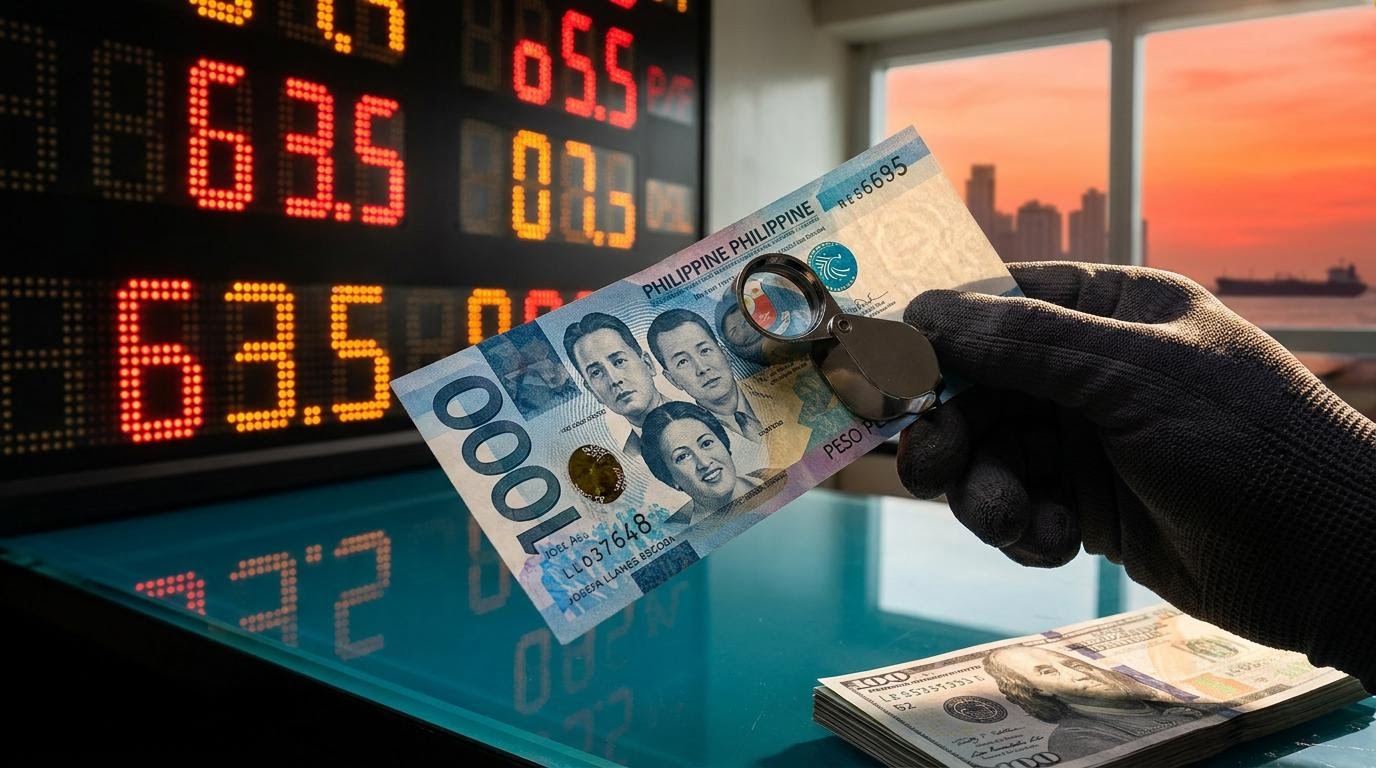
The Bangko Sentral ng Pilipinas (BSP) delivered a bigger rate hike than markets expected on 22 October 2026, lifting its policy rate by 50 basis points to 5.50%. The peso firmed briefly to about ₱63.31 per US dollar, then gave the gain back and slid toward ₱63.5, close to record-low territory.
That reversal is the signal worth reading. The market looked at a larger-than-forecast hike and judged it insufficient.
The move was the BSP’s fourth consecutive increase and its largest in more than three years. Even so, the peso is down about 6.9% this year, and Brent crude is trading above US$110 a barrel. If you assume that a rate hike automatically means a stronger currency, the Philippine peso outlook is the case that tests that assumption.
Here is a combined fundamental and technical read: why higher rates are not enough to steady the peso, and which USD/PHP levels matter from here.
Why did a bigger-than-expected hike fail to lift the peso?
Yesterday’s decision raised the target reverse-repurchase rate to 5.50%. The overnight deposit and lending rates moved to 5.00% and 6.00%. The BSP called the move proactive and said it targets second-round inflation effects, meaning the knock-on price rises that follow an initial shock such as higher fuel costs. It also left the door open to further tightening if core inflation stays elevated. No vote split was reported.
The BSP’s move sits inside a wider regional tightening cycle, where Asian central banks have raised rates to defend currencies against dollar strength and energy costs that hikes alone cannot resolve.
The peso touched about ₱63.309 soon after the announcement. Within the session it was back at ₱63.40, then in the ₱63.5 area.
Sources disagree slightly on the exact record. Philippine reporting cited ₱63.361, Reuters-linked coverage ₱63.438 and BusinessMirror ₱63.52. The range itself is the story: the peso is trading in a record-low area of ₱63.4-₱63.5, against ₱58.80 at the end of 2025.
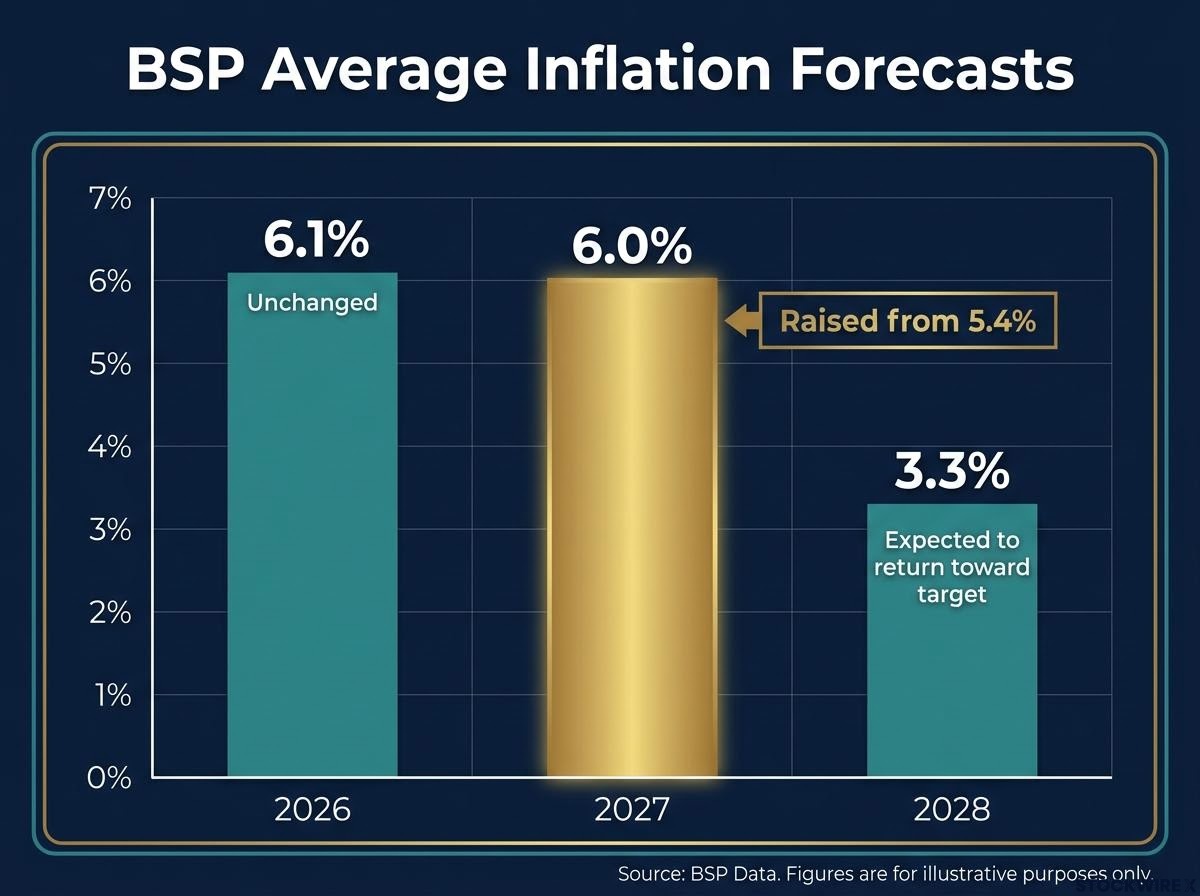
The forecasts released with the decision help explain the reaction.
| Year | BSP average inflation forecast | Change versus prior forecast |
|---|---|---|
| 2026 | 6.1% | Unchanged |
| 2027 | 6.0% | Raised from 5.4% |
| 2028 | 3.3% | Expected to return toward target |
The 2027 upgrade carries the most weight. The BSP linked it to oil, transport fares, possible supply disruptions and El Niño food pressures. Governor Eli Remolona has reportedly said the central bank does not defend a particular peso level.
OCBC strategists’ view Christopher Wong and Sim Moh Siong of OCBC observed that the peso remained weak even after the larger-than-anticipated hike, and they describe their stance as bearish but cautious.
This reads as a verdict on adequacy rather than on credibility. A hike supports a currency when it changes what investors expect to earn or risk. This one mostly confirmed that inflation is worse than hoped, and that is the message you should take from the price action.
When big ASX news breaks, our subscribers know first
What is really driving the pressure: oil, external deficits and thinning reserves
If the hike did not decide the peso’s direction, the pressure is coming from elsewhere. It starts with oil.
The oil and trade channel
Brent traded between roughly US$113.73 and US$116.23 a barrel on 23 October. The quotes vary by contract and source, but every one of them is above US$110. The Philippines imports almost all of its oil, according to Trading Economics, so each dollar added to the barrel price is a dollar the country must buy abroad.
That bill feeds directly into the trade gap. The 2026 trade deficit is forecast at US$58.6 billion. The current-account deficit, which is the broadest measure of what a country pays out versus what it earns abroad, reached US$15.4 billion in the first half, equal to 6.4% of GDP. The BSP projects US$19.1 billion (3.8% of GDP) for the full year.
Oil also passes through to prices at home. Headline inflation hit 7.2% year on year in September, as higher fuel costs flowed into transport, food and production.
Balance of payments and reserves
The balance of payments records all money flowing in and out of a country, including trade and investment. It showed a US$3.1 billion deficit in September, taking the January-September shortfall to US$9.1 billion.
Gross international reserves fell to US$99.5 billion at the end of September, down from US$104.8 billion in August. That remains a sizeable buffer, but it is moving in the wrong direction.
Remittances from Filipinos working overseas usually cushion the current account. No October 2026 figure was available to measure how much they are offsetting this year.
| Indicator | Latest figure | What it signals |
|---|---|---|
| Brent crude | US$113.73-US$116.23 (23 October) | Higher dollar cost of fuel imports |
| Headline inflation | 7.2% (September) | Oil passing through to domestic prices |
| Current-account deficit | US$15.4 billion (H1 2026) | Ongoing need to finance dollar outflows |
| BOP deficit | US$9.1 billion (Jan-Sep) | Net dollars leaving the country |
| Gross reserves | US$99.5 billion (September) | Buffer shrinking month on month |
Some of this is cyclical, driven by oil and El Niño, and some is structural, reflecting persistent financing needs. Either way, this dollar demand exists regardless of interest rates. You cannot expect carry alone to absorb it.
The weakness looks domestic rather than shared, because regional peers have gained against the dollar this year while the peso alone slipped, pointing to Philippine-specific oil dependence and inflation pressure.
Can the BSP keep hiking when growth is already slowing?
That leaves the BSP with an uncomfortable trade-off. Each additional hike may support the currency, but the economy pays for it.
The growth constraint
GDP grew 2.3% year on year in the second quarter and 2.6% across the first half. The IMF forecasts 3.4% growth for 2026, down from 4.4% in 2025. Japan Credit Rating Agency kept its rating but flagged weak household consumption and sluggish public investment.
OCBC senior ASEAN economist Lavanya Venkateswaran described the 50bp move as proactive and said further hikes remain possible if core inflation stays high. El Niño food risks are the main reason that door remains open.
Wong and Sim point to the cost. Their argument is that more tightening burdens an economy already losing momentum, and that lasting improvement would probably depend on cheaper oil and a healthier global external setting.
What could turn the peso around
The bearish case is not the only one. MUFG senior currency analyst Michael Wan had earlier expected narrower trade deficits and wider Philippine-US rate differentials to support the peso. MUFG Global Markets Research considers the currency undervalued and particularly sensitive to oil. Potential rebound triggers include:
- Lower Brent prices
- Easing US-Iran tensions
- Stronger electronics exports
- A narrower trade deficit
- Lower US yields
- Returning foreign capital
Tightening also works with a lag. A weak reaction on decision day does not prove the hike will fail, because higher peso rates can affect portfolio flows and import demand over the following months. The 2022 slide toward ₱59 may offer a parallel. Reports suggest BSP tightening alone could not stabilise the currency then, while dollar strength and energy costs dominated, though that account has not been independently confirmed.
The peso’s upside depends more on external relief from oil, geopolitics and US yields than on further BSP action. Those are the signals to watch for a change in direction.
How rate differentials, carry and FX intervention actually work
The starting idea is simple: higher rates attract capital. A rate differential is the gap between interest rates in two countries. Carry is the return investors earn by holding the higher-yielding currency. In theory, the chain runs like this:
- The central bank raises rates.
- Local assets offer a better yield than US assets.
- Foreign capital flows in to capture that pickup.
- Offsets kick in: inflation erodes the real return, deficits keep dollars flowing out and growth risk deters investors.
- The net effect depends on which side is larger.
The Philippine numbers show where step four takes over. The policy rate is 5.50%, while headline inflation is 7.2%. Simple arithmetic puts the policy rate below inflation, which implies a negative real policy rate. A negative real rate means that, after inflation, holding pesos loses value.
Negative real yields explain much of the market’s verdict: when inflation runs above the policy rate, holding pesos erodes purchasing power, and that feedback loop between inflation, outflows and a weaker currency keeps feeding itself.
A hike that restores positive real returns earns credit from the market. A hike that appears to be reacting to worsening inflation and external stress earns much less.
Analyst consensus Across the commentary, the shared conclusion is that rate differentials can slow the peso’s decline but cannot by themselves overcome a large oil-driven import shock or persistent external financing needs.
Reserves follow similar limits. US$99.5 billion gives the BSP room to smooth disorderly trading, but not to reverse a trend, and Remolona’s reported stance suggests it will not try. Judge any emerging-market rate hike against inflation and the external balance, not on its own, because that comparison decides whether it protects the currency.
Where is USD/PHP likely to find resistance and support?
With the fundamentals still pointing toward pressure, the technical map shows where price may pause. OCBC, in its read as of about 23 October, describes daily momentum as mildly bullish for USD/PHP, which means bearish for the peso. It also notes that the relative strength index (RSI), a gauge of how stretched recent moves are, sits in overbought territory. Price could still swing both ways around the current peaks.
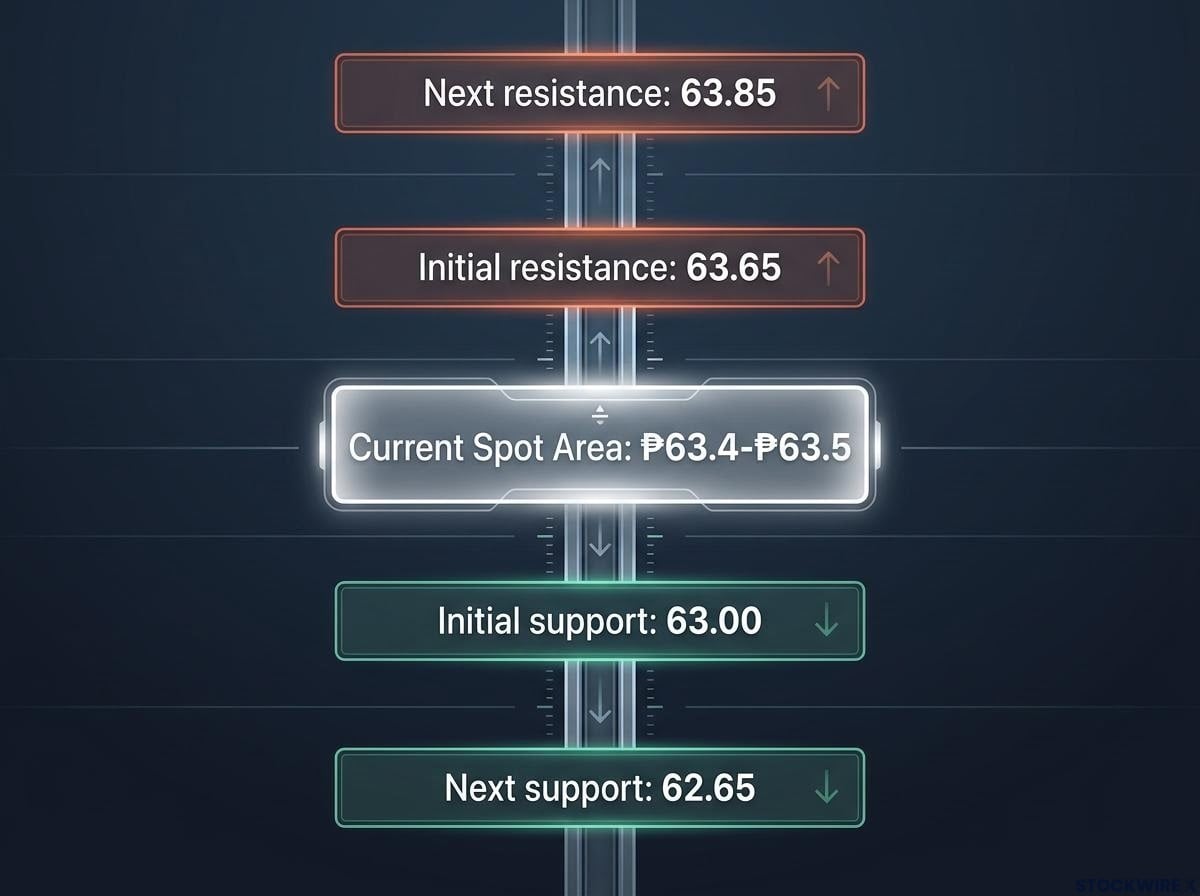
| Level type | USD/PHP | What it represents |
|---|---|---|
| Next resistance | 63.85 | Recent high; a break would extend the peso’s record lows |
| Initial resistance | 63.65 | First ceiling above the current spot |
| Initial support | 63.00 | 21-day moving average, the recent trend line |
| Next support | 62.65 | Deeper pullback zone if peso relief builds |
Spot is in the ₱63.4-₱63.5 area, near the top of this range. The 21-day moving average, which is the average closing price over the past 21 trading days, marks 63.00 as the first meaningful floor.
Price is likely to break through a level because of fundamentals: an oil spike or a weak reserve print could push it past 63.65, while a Brent pullback or a firmer BSP signal could test 63.00. With an overbought reading this close to the highs, a dip toward 63.00 would not by itself change the bearish fundamentals. This is analysis, not trading advice.
What the hike changes for the Philippine peso outlook, and what it does not
The 50bp hike may slow the peso’s slide. It does not remove the oil bill, the external deficits or the growth drag behind it, which is why OCBC remains bearish but cautious.
Your watchlist is short. Track Brent, core inflation and any further BSP signal, the monthly reserve and balance-of-payments releases, and whether USD/PHP holds below 63.65 or slips toward 63.00.
The decision in front of you is whether external relief arrives before reserves and growth erode further. That depends on oil and geopolitics more than on the next policy meeting.
Past performance does not guarantee future results. Financial projections are subject to market conditions and various risk factors. These statements are speculative and subject to change based on market developments.
This article is for informational purposes only and should not be considered financial advice. Investors should conduct their own research and consult with financial professionals before making investment decisions.
—