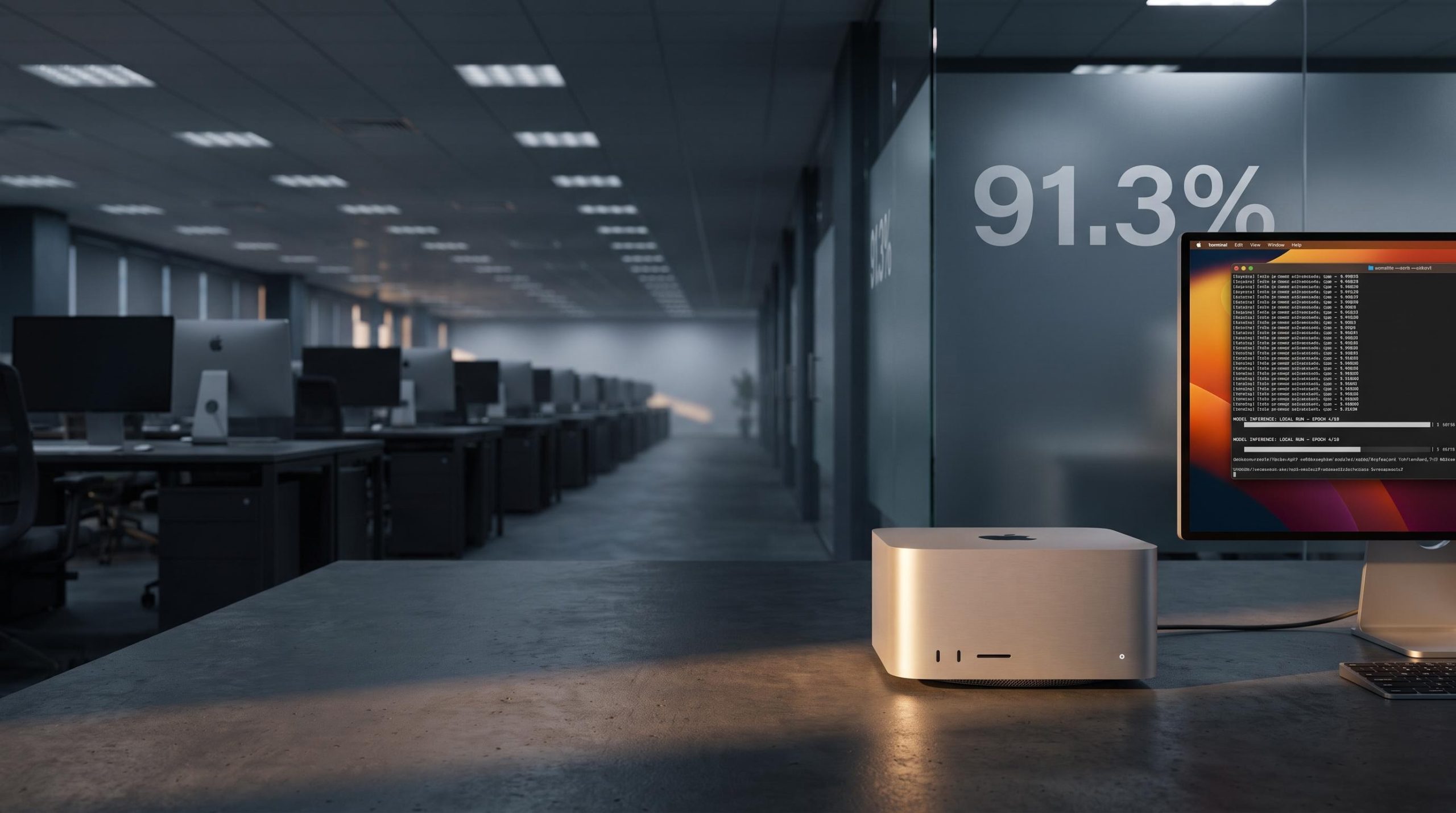
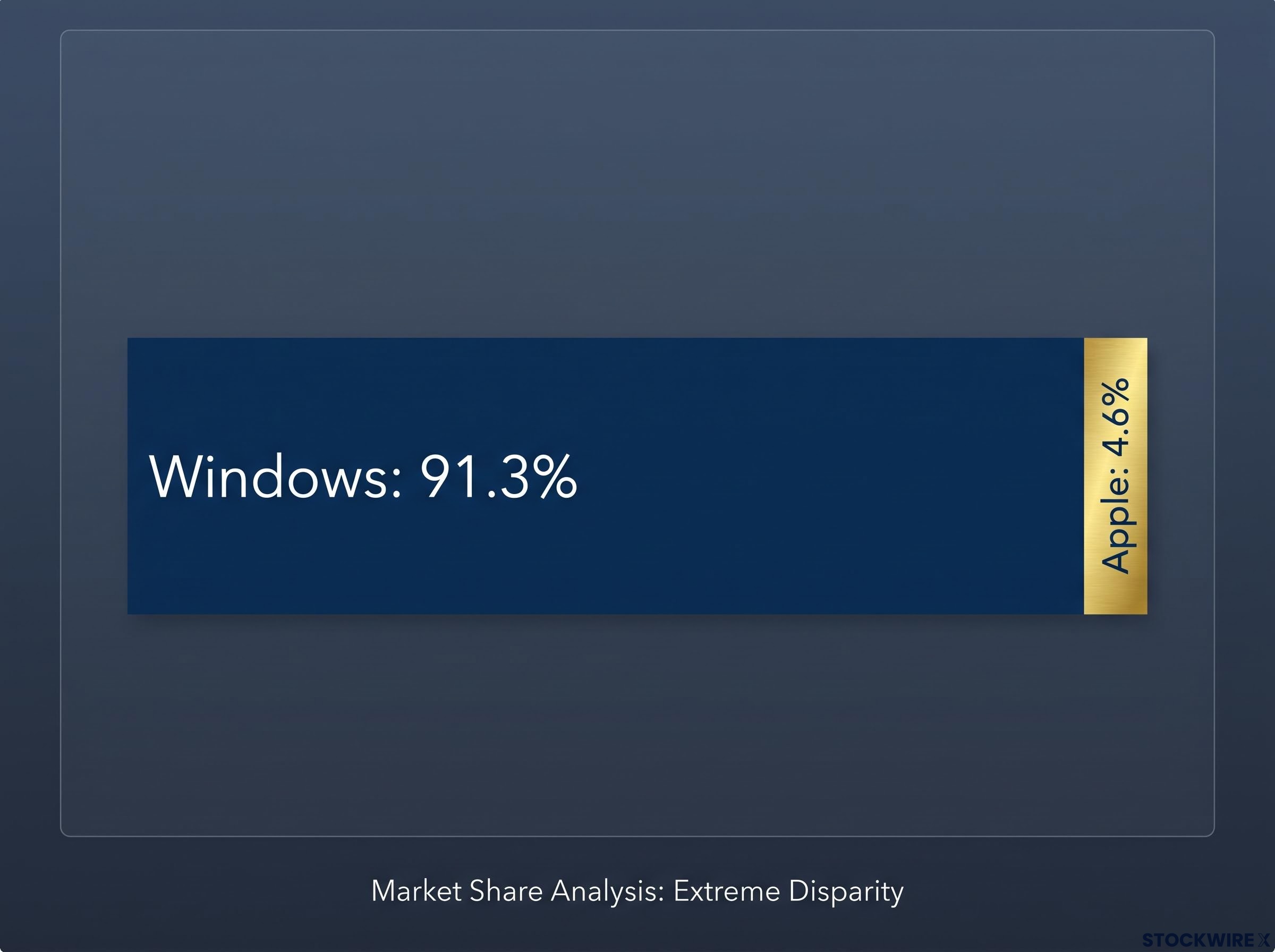
One number frames the entire race for on-device AI in the enterprise. Windows machines hold 91.3% of the enterprise desktop and laptop market, according to IDC. Apple holds 4.6%.
Now consider that the company with arguably the most capable silicon in the segment is the one sitting on that 4.6% base, while the incumbent controls the territory almost entirely. That asymmetry is what makes this competition worth watching.
The timing is not accidental. As of late September 2026, the first RTX Spark devices are weeks from shipping, Apple has just announced new AI-focused Mac hardware for corporate buyers, and Microsoft’s Windows AI event is imminent. All three companies are moving at once because the cost of running AI models on local hardware, rather than paying for it in the cloud, is falling fast enough to make on-device inference a credible alternative to cloud spend.
What follows here is not a scorecard of today’s specifications. This gives you a framework for judging which of the three positions in the on-device AI competition is structurally durable and which carries the most execution risk. That is the question a portfolio manager weighing exposure to this buildout would actually ask.
Why the 91% problem is also an opportunity
The obvious reading of IDC’s figures is that Apple is boxed in. The more useful reading is that 91.3% Windows penetration is precisely why capital is flowing into this space at all.
IDC Group Vice President Linn Huang, quoted in Reuters reporting on 22 September 2026, put Apple’s enterprise ambitions plainly.
The IDC estimates cited by GuruFocus, published 22 September 2026, place Apple at 4.6% of enterprise computers against Windows at 91.3%, figures that also anchor the analyst commentary on Apple’s corporate hardware push accompanying those numbers.
Apple faces a “steep challenge” in displacing Windows across enterprise desktops, given a market share disparity that has held for years.
Read the same number from the demand side and it inverts. If 91% of enterprise desktops run Windows, then 91% of enterprise desktops are potential upgrade targets for AI-capable hardware once they reach refresh eligibility. The enterprise procurement cycles that have protected the Windows installed base for decades also create something valuable to every vendor here: a large, predictable, and datable upgrade wave.
Those same cycles are exactly what keeps Apple’s share low. Three structural barriers have entrenched the disparity:
- Procurement and refresh cycle lock-in, which rewards sticking with existing Windows standards rather than switching platforms
- Windows-centric IT tooling investment, where years of spending on management, security, and identity systems make a move costly
- Software ecosystem dependency, built around Microsoft Office and bespoke line-of-business applications that raise both migration risk and retraining costs
This is why Apple’s realistic near-term play is not broad displacement. It is winning high-value islands: engineering, creative, and data science teams where on-device AI inference is already a genuine workload. Apple’s historical ambivalence toward enterprise, rooted in Steve Jobs-era philosophy, is now under active reversal as the company leans on the power-efficient chip design it developed for the iPhone.
There is a second signal buried in the distribution data. Lenovo, HP, Dell, and Apple together held roughly 75% of the global PC market in Q1 2026 (a figure attributed to BBC reporting that has not been independently confirmed, so treat it as directional). That concentration tells you Nvidia’s RTX Spark ambitions are not purely a silicon question. They are an OEM relationship question, and those relationships are already held by incumbents who are simultaneously Nvidia’s customers and, in Apple’s case, its competitor.
For an investor, the takeaway is to resist reading Apple’s 4.6% as failure. At Apple’s hardware margin profile, even modest gains among AI-intensive teams carry meaningful revenue implications.
When big ASX news breaks, our subscribers know first
Three bets on the same thesis, three different architectural wagers
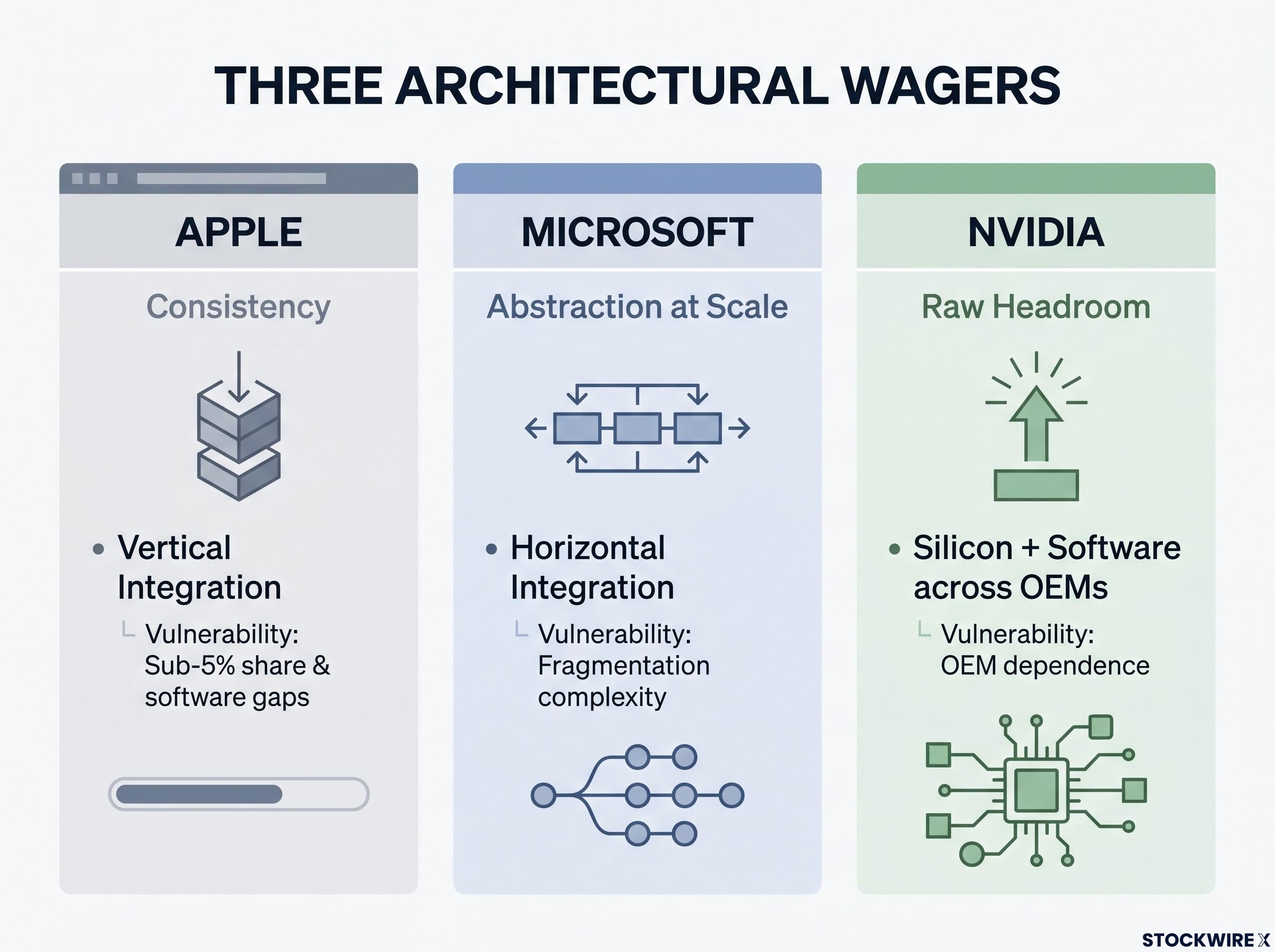
All three companies agree that inference is moving toward the device. Where they disagree is on how to win it, and each has staked a distinct architectural wager with a distinct failure mode.
| Dimension | Apple | Microsoft / Windows OEMs | Nvidia |
|---|---|---|---|
| Enterprise share | ~4.6% | ~91.3% | N/A (chip supplier) |
| AI integration model | Vertical: silicon, OS, frameworks | Horizontal: APIs, ONNX, diverse OEMs | Silicon plus software across OEMs |
| Primary enterprise pitch | Local inference cost savings, privacy, cross-device scaling | Unmetered intelligence, Copilot, super app | Peak performance, data-centre-to-edge continuity |
| Key strength | Consistency and unified platform | Installed base and ecosystem breadth | Raw AI compute headroom |
| Key vulnerability | Sub-5% share, software gaps | Fragmentation, developer optimisation burden | OEM dependence, margin pressure |
Apple’s coherence advantage
Apple’s wager is consistency. By co-designing the silicon, the operating system, and the Core ML frameworks together, it produces predictable local performance across the entire product range, from Mac Studio down to iPhone and iPad.
That cross-device coherence, not raw specifications, is the actual enterprise pitch. A model built and tuned on a Mac Studio scales down the range without re-engineering, and high-end clustered configurations approaching $20,000 have been demonstrated running trillion-parameter models. Detailed chip figures beyond generic Apple Silicon descriptions were not disclosed, so the pitch rests on architectural consistency rather than headline numbers.
Microsoft’s abstraction play
Microsoft’s wager is abstraction at scale. CEO Satya Nadella has framed the goal as “unmetered intelligence”, on-device AI that does not charge per query, delivered eventually through a unified Windows super app.
Because Windows runs on hardware from many manufacturers, the company leans on tooling to smooth over that heterogeneity: Windows ML developer tools, ONNX runtimes, and investment in RDMA interconnect technology. The bet is that abstraction layers can narrow performance gaps across diverse OEM hardware, though this shifts the optimisation burden onto developers. The next visible milestone is Microsoft’s Windows AI hardware event, expected in San Francisco in October 2026.
Nvidia’s compute-ceiling bet
Nvidia’s wager is raw headroom. The RTX Spark superchip, internally N1X, delivers roughly 1 petaflop of AI compute, pairing a 20-core Grace CPU, 6,144 Blackwell CUDA cores, and up to 128 GB of unified memory in its high-end desktop form.
At the other end sits the DGX Station for Windows: a 72-core Grace CPU, up to 748 GB of coherent memory, up to 20 petaflops of FP4 compute, and an 800 Gb/s ConnectX-8 SuperNIC. Both are the same thesis, local inference from laptop to deskside supercomputer, delivered through OEM partners: ASUS, Dell, HP, Lenovo, Microsoft Surface, and MSI, with Acer and GIGABYTE to follow. Each partner must validate firmware, drivers, and workloads independently.
Nvidia’s OEM partner strategy for PC silicon was publicly framed at Computex in June 2026, where Microsoft Surface and Dell were confirmed as the first hardware partners; the RTX Spark rollout to ASUS, HP, Lenovo, and others follows the same OEM-dependent model, making execution across that expanding partner network the central execution risk.
Watch the narrative split here. Jensen Huang describes the goal as expanding what Windows PCs can accomplish; CNBC frames it as an attempt to “own every part of the AI stack.” That divergence is the investor signal, because which framing proves dominant determines whether Nvidia’s PC push enhances or dilutes its data-centre margin story. Each wager also implies a different revenue model: Apple earns on hardware margin, Microsoft on platform and software attachment, and Nvidia on silicon volume through partners it does not fully control.
What enterprises are actually deploying, and why it matters more than specs
Step away from the specifications and the picture changes. What enterprises are actually buying is being driven by cost and privacy, not benchmark supremacy.
The clearest documented example comes from AMD’s Iterate.ai case study, published 16 September 2026. Iterate.ai runs a 32-billion-parameter private language model with a 32k context window entirely on laptops powered by Ryzen AI PRO processors, achieving roughly 60-80 tokens per second.
The reasons given were not peak performance. They were cutting cloud costs and reducing data-security exposure.
The Iterate.ai deployment sits squarely in what research on enterprise AI adoption identifies as the minority: organisations that move beyond pilot theatre into genuine infrastructure-level embedding, where cost and privacy logic drives the architecture rather than benchmark ambition.
That reveals the real decision logic. Adoption is selective and workload-driven: high-value or data-sensitive tasks move to local hardware while the broader corporate desktop stays on conventional machines. Three archetypes now describe how enterprises are actually deploying on-device AI:
- Targeted private LLM workloads, the Iterate.ai model, where a specific sensitive model runs locally for cost and privacy reasons
- AI-intensive team islands, the Apple Mac Studio model, where creative, engineering, and data science teams get local inference power
- Deskside AI supercomputer deployments, the Nvidia DGX model, built on the GB10 Grace Blackwell Superchip for local autonomous agents
The enterprise buying decision for on-device AI is driven by CFO-level cost reduction and data-security logic, not CTO-level benchmark comparisons.
That framing carries a sharp implication for investors. The vendor with the clearest total-cost-of-ownership story holds an advantage that never appears on a performance chart.
Notably, Nvidia’s RTX Spark marketing has so far emphasised capabilities rather than published broad, company-wide deployment case studies. Apple’s Mac Mini and Mac Studio deployments, by contrast, map directly onto the island pattern enterprises are already following.
If cost and privacy are the primary drivers, the investment read shifts. Apple’s pitch of lower inference costs through local silicon aligns most directly with what enterprises say they want, while Nvidia’s highest-performing configurations may address a narrower market than their specifications imply.
Where each company’s position is structurally durable, and where it is not
Strengths and vulnerabilities deserve equal analytical weight. Each position is defensible in one dimension and exposed in another, and finishing with a ranked winner would flatten that nuance.
Apple’s durability lies in vertical integration. Cross-device coherence is genuinely hard to replicate, and models built on Mac Studio scaling cleanly to iPhone and iPad give it a defensible premium position for AI-intensive teams. What superior silicon does not solve is the sub-5% share ceiling or the software ecosystem gaps that keep enterprises on Windows.
Apple’s vertical integration strategy extends well beyond the Mac lineup; its cross-device coherence argument for enterprise rests on the same unified silicon and OS architecture it is deploying across iPhone, iPad, and Private Cloud Compute, a multi-year compounding play that becomes harder to replicate the further the ecosystem develops.
Microsoft’s durability is the 91.3% installed base and ecosystem breadth, which are real moats. The exposure is that its heterogeneous hardware model puts the consistency burden on tooling and partners rather than the platform itself, and consistency is precisely what enterprise IT teams price most highly. Windows ML and RDMA investment are the responses, but they are unproven against Apple’s unified approach.
Nvidia holds a genuine advantage in raw compute headroom and data-centre-to-edge continuity. Its exposure runs in the other direction, toward the price-sensitive, cyclical PC segment where AMD, Intel, and Apple compete, a risk flagged by Investors Business Daily and Reuters.
Each company carries one structural vulnerability worth isolating:
- Apple: a sub-5% enterprise share and software ecosystem gaps that silicon alone cannot close
- Microsoft: fragmentation complexity, where consistency depends on tooling and partner execution rather than the platform
- Nvidia: OEM dependence, margin pressure from the cyclical PC market, and the burden of validating workloads across eight or more OEM hardware configurations
The investor question is not which chip is best today. It is which position becomes more defensible as enterprise refresh cycles accelerate into 2027 and beyond. On that basis, Apple’s consistency advantage tends to compound with scale, Microsoft’s ecosystem advantage is already largely priced into the stock, and Nvidia’s PC entry adds revenue optionality alongside genuine margin uncertainty.
Which position gets stronger as the enterprise refresh wave arrives
The refresh cycle is the mechanism that converts today’s advantages and vulnerabilities into actual revenue. October 2026 does not settle the competition; it opens the enterprise AI PC refresh window.
That month, the first RTX Spark PCs from Lenovo and Acer are due to ship, confirmed in Reuters reporting on 3 September 2026, while Microsoft holds its Windows AI hardware event in San Francisco. The convergence is telling: three companies choosing the same month for their major enterprise AI hardware moves signals that all three treat the refresh window as opening now.
Rather than ranking them, watch three variables over the next twelve months:
- TCO evidence from early deployments, since the Iterate.ai pattern suggests cost stories decide purchases before benchmarks do
- Windows ML developer tooling progress, and whether it closes the consistency gap with Apple’s unified platform
- Nvidia OEM execution quality, across a partner network that must each validate AI workloads independently, with broad-deployment case studies still absent as of today
For an investor, monitoring these leading indicators beats simply tracking quarterly revenue. The structural outcome of this competition will show up in developer tooling, TCO case studies, and OEM execution well before it appears in reported financials.
Selecting the right on-device hardware architecture also determines which side of an enterprise AI return on investment divide a company sits on; BCG research shows early architectural adopters building on shared data foundations delivered 3.6x higher three-year total shareholder return than slower movers.
This article is for informational purposes only and should not be considered financial advice. Investors should conduct their own research and consult with financial professionals before making investment decisions. These statements are speculative and subject to change based on market developments and company performance.