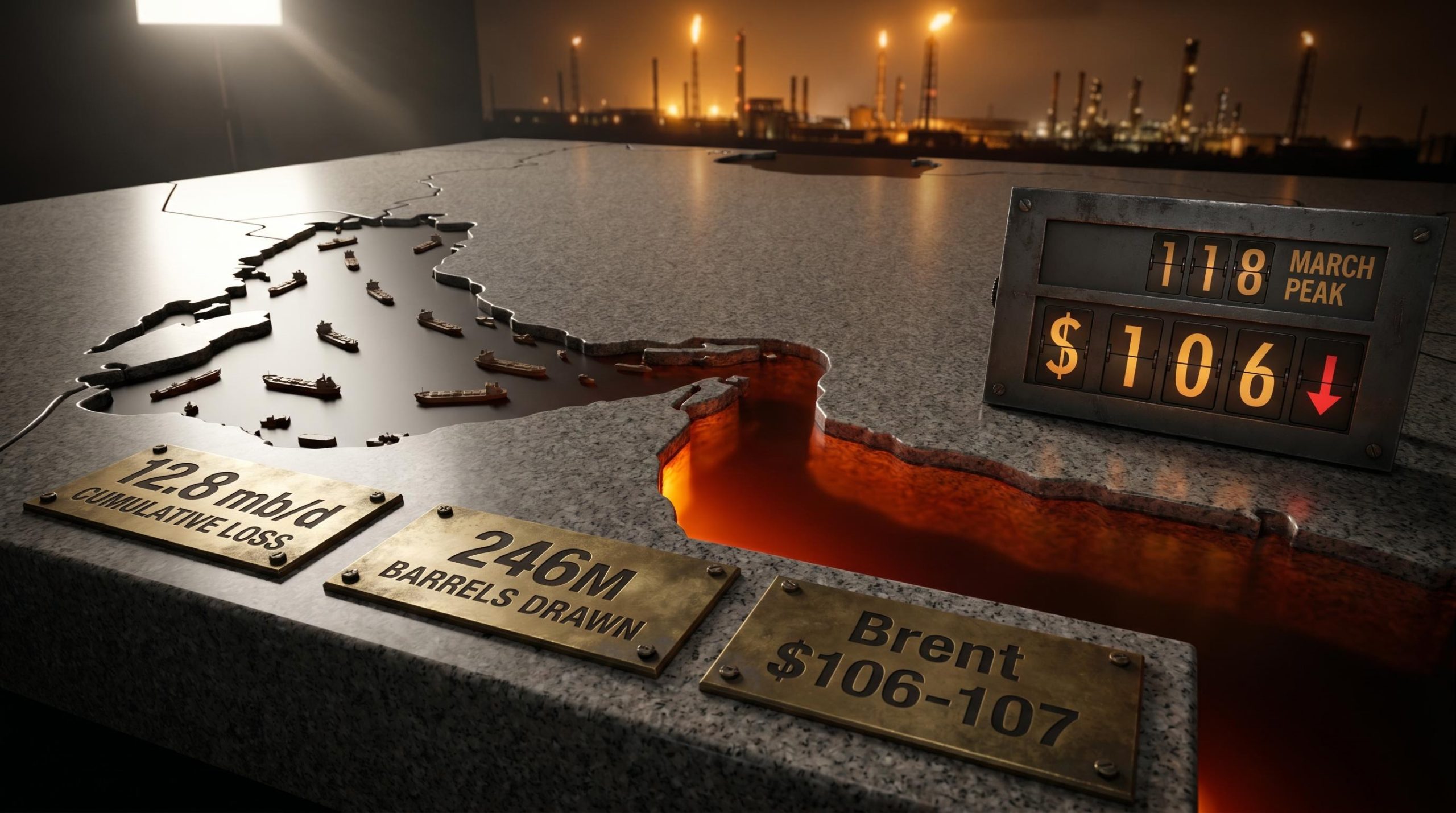
Global oil supply has absorbed a cumulative loss of 12.8 million barrels per day since February 2026, yet Brent crude sits at roughly $106-107 per barrel in mid-May rather than retesting its $118 March peak. The gap between a historically large supply shock and a price that has actually retreated from its highs tells investors something specific: demand destruction and reopening probability are already being priced against the physical deficit. The Strait of Hormuz has been effectively closed to normal commercial traffic since 28 February 2026. Iran’s toll regime, a US naval blockade imposed on 13 April, and resumed Houthi attacks on Red Sea shipping have shut both of the Gulf’s major energy corridors simultaneously, a configuration without modern precedent. This analysis traces the disruption’s scale and structure, examines the sharp divergences between OPEC, the IEA, and the EIA on what comes next, follows the shock’s path into aluminium and LNG markets, and identifies the positioning variables that separate informed commodity exposure from undifferentiated directional bets.
A 12.8 million barrel deficit: the anatomy of the supply shock
Global oil supply fell to 94.2 mb/d in April 2026, down 2.8 mb/d from March alone. Since the Hormuz closure on 28 February, cumulative supply losses have reached 12.8 mb/d, a deficit that has drawn an estimated 246 million barrels from commercial inventories across March and April combined.
Three distinct mechanisms are compounding the losses:
- Iran’s “Persian Gulf Strait Authority” toll regime, imposing levies above $1 million per vessel on any commercial traffic attempting transit, a system maritime law experts assess as likely violating UNCLOS
- The US naval blockade of Iranian ports, operational since 13 April, with mine-clearing operations underway in the strait itself
- Resumed Houthi attacks on Red Sea shipping, restarting on 28 February and closing the Bab al-Mandeb corridor to normal traffic simultaneously
Over 1,550 vessels and approximately 22,500 mariners remain stranded in or near the Gulf.
According to Cambridge analysis cited by AOG Worldwide, this represents the first simultaneous closure of both major Gulf energy corridors in modern history.
The inventory draw magnitude is what matters most for near-term price formation. Demand forecasts can be revised downward. Physical barrels already consumed from storage cannot be revised back into existence. That 246 million barrel deficit sets a floor under prices that persists regardless of where agencies project demand heading next.
When big ASX news breaks, our subscribers know first
What the agencies are projecting, and where they sharply disagree
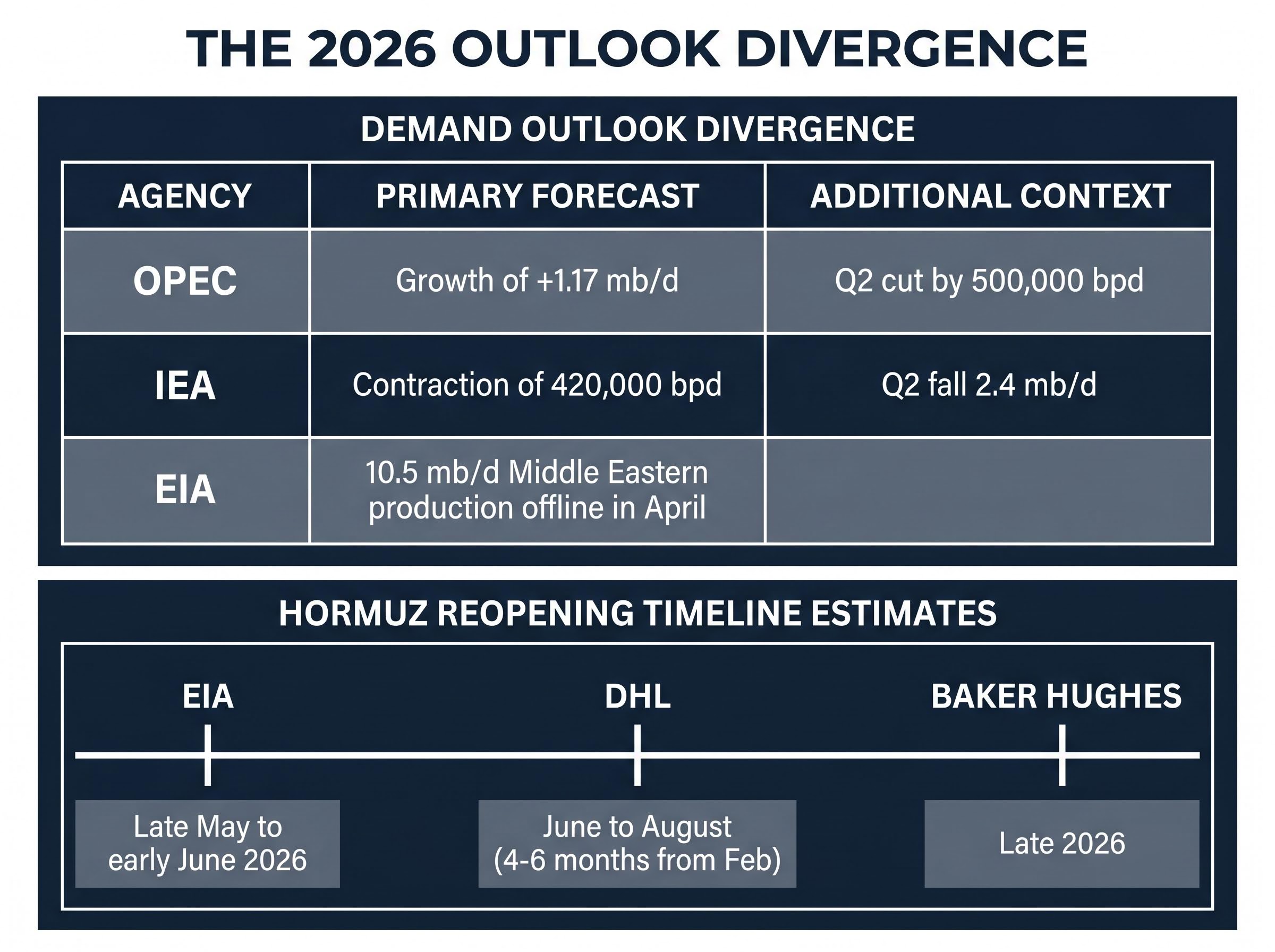
The three agencies that anchor institutional commodity analysis have reached materially different conclusions about 2026, and the spread between them is itself the most useful data point for investors building scenario frameworks.
| Agency | 2026 Demand Outlook | Hormuz Reopening Assumption |
|---|---|---|
| OPEC | Growth of +1.17 mb/d; April-June demand estimate cut by 500,000 bpd | Not explicitly specified; optimistic on demand resilience |
| IEA | Full-year demand contraction of 420,000 bpd year-on-year; Q2 demand expected to fall 2.4 mb/d | Frames normalisation probabilistically; stresses downside risk |
| EIA | Approximately 10.5 mb/d of Middle Eastern production offline during April | Base case embeds flows resuming late May to early June 2026 |
The OPEC-to-IEA gap on demand alone spans roughly 1.6 mb/d, the distance between a market that is still growing and one that is contracting outright. The EIA’s reopening assumption, the most optimistic of the three, is not yet supported by observable carrier schedules or any signed agreement. Baker Hughes’ CFO has cautioned that the strait may not fully reopen until late 2026. DHL’s regional leadership is guiding clients to plan for four to six months of ongoing disruption from February, extending into at least June to August.
Investors who anchor to a single agency view without accounting for the full cone are accepting scenario risk they may not have sized.
Brent-Dubai benchmark divergence has created the most extreme regional price split in oil market history, with Dubai crude reaching approximately $260 per barrel at its May 2026 peak while Brent held near $108, meaning any investor or refiner modelling Asian energy costs from headline Brent alone was systematically underestimating real acquisition costs by more than 140%.
Why prices have not re-accelerated to March highs
The paradox is real but resolvable. Physical balances show a historically large supply hole and massive inventory draws, yet Brent at $106-107 sits well below the $118 March peak. Two forces explain the gap: demand expectations have been cut sharply across all three agencies, and markets are pricing a non-zero probability of partial reopening in the coming months, particularly given the EIA’s late May to early June base case.
The oil pricing paradox of falling spot prices alongside a deepening physical deficit is not unique to mid-May: WTI fell 1.86% to $100.37 on 6 May even as Hormuz remained closed and a second major refinery disruption compounded upstream tightness, with ceasefire sentiment overriding physical inventory signals for several consecutive sessions.
The futures curve remains in backwardation, a signal of near-term physical tightness where buyers pay a premium for immediate delivery. But front-end calendar spreads have narrowed from their March extremes as the demand downgrades partially offset the supply deficit. The curve is tight, not panicked.
The Hormuz chokepoint: what makes this disruption structurally different
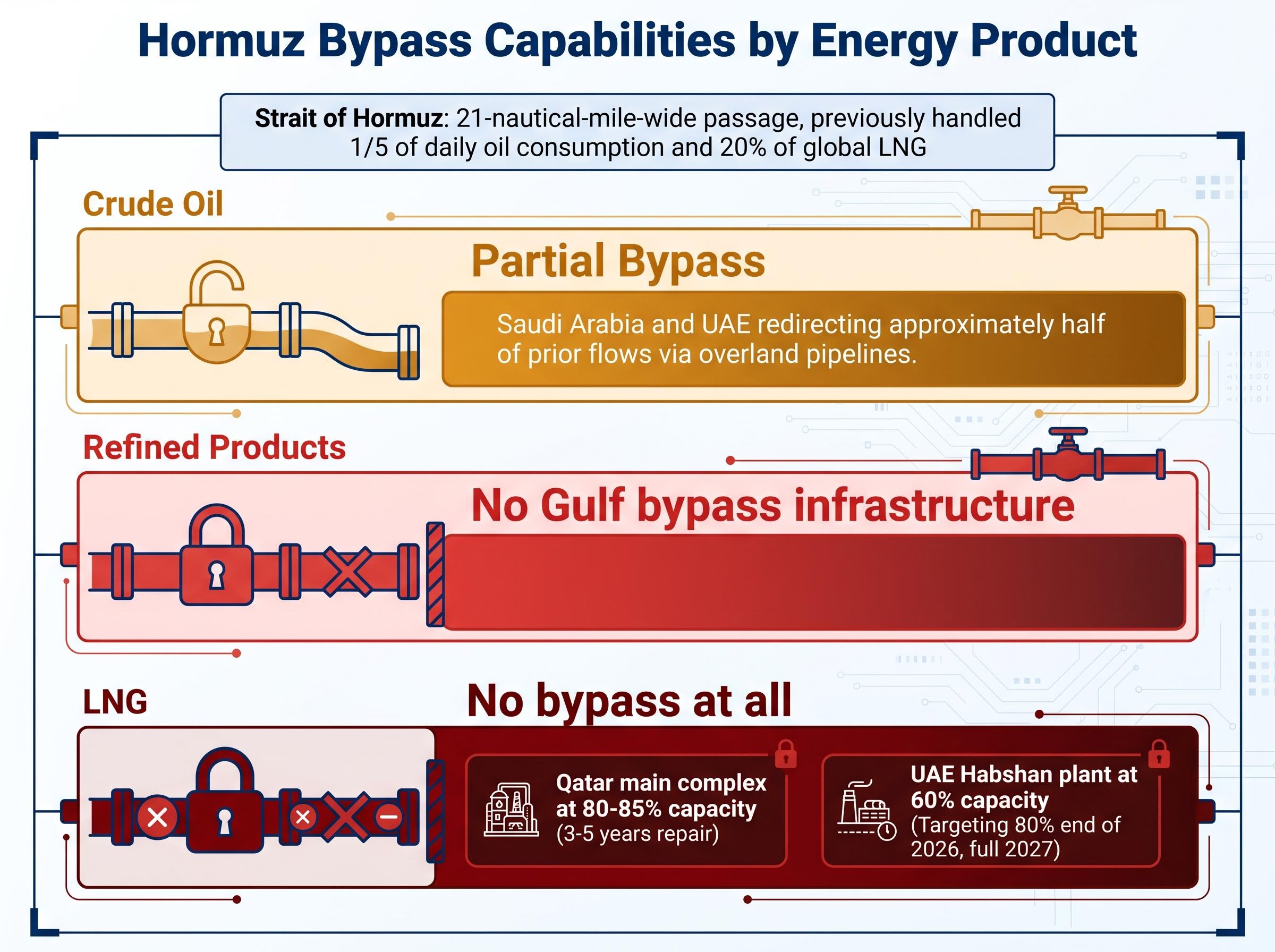
The Strait of Hormuz is a 21-nautical-mile-wide passage between Iran and Oman through which roughly a fifth of the world’s daily oil consumption and approximately 20% of global liquefied natural gas (LNG) previously transited. It is not a trade route that can be substituted; it is physical infrastructure that either functions or does not.
What distinguishes this crisis from prior single-chokepoint disruptions is the asymmetry of bypass options across energy products:
- Crude oil has partial bypass. Saudi Arabia and the UAE have redirected approximately half of their prior Hormuz oil flows via existing overland pipelines to terminals at Fujairah and other Red Sea and Arabian Sea ports.
- Refined products (diesel, gasoline, jet fuel) have no Gulf bypass infrastructure. The Middle East is a major refined product exporter to Europe and Asia, and those flows remain constrained.
- LNG has no bypass at all. No pipeline infrastructure exists to move gas from the Gulf to alternative export terminals. Qatar’s main LNG complex is operating at approximately 80-85% of pre-crisis capacity following Iranian strikes, with 3-5 years of repair time estimated.
Refined product supply constraints are tightening on a faster timeline than crude oil markets, with jet fuel tanker loadings collapsing approximately 50% week-on-week in early May 2026 and ConocoPhillips flagging critical shortfall risk for import-dependent nations as early as June to July, a vulnerability that the absence of Gulf bypass infrastructure for refined products makes structurally difficult to offset.
The UAE’s Habshan gas plant is operating at 60% of capacity, targeting 80% by end of 2026 and full restoration only in 2027.
According to US intelligence assessments, Iran retains access to 30 of 33 missile positions along the Hormuz corridor and approximately 70% of its pre-conflict missile inventory.
That military posture is the structural reason reopening is not imminent. It is not a political impasse waiting for a phone call; it is a defended geographic position that any reopening framework must physically account for. LNG exposure is structurally more vulnerable than crude oil exposure to prolonged disruption precisely because there is no workaround.
From barrels to ingots: how the oil crisis is repricing aluminium
Aluminium smelting is among the most electricity-intensive industrial processes globally. When energy prices rise and stay elevated, the most expensive smelters face margin compression that no hedging programme can fully offset over multiple quarters.
The Hormuz closure has added a second pressure: the UAE, Bahrain, and Qatar are major aluminium exporters, and their product now faces significantly longer and costlier routing via the Cape of Good Hope or exposure to Iran’s toll regime. LME aluminium cash settlement reached approximately $3,653.85 per tonne on 13 May 2026, up roughly 44.81% over the prior year.
Three compounding pressures are tightening the aluminium market simultaneously:
- Gulf producer logistics costs have risen sharply as export routes lengthen and war-risk insurance premiums persist
- Energy-intensive smelting economics are under pressure globally, with sustained high power prices squeezing margins at the most expensive facilities
- Chinese aluminium production is capped at 45 million tonnes, with annual demand growth forecast at 3-4%, limiting the substitution response that would normally ease a regional supply shock
Alcoa has warned that physical aluminium scarcity is anticipated in Europe or North America within approximately six months of May 2026.
Alcoa’s Spain smelter is operating at full capacity through 2027, and the company is pursuing asset monetisation targeting $500 million to $1 billion in proceeds alongside a $65 million investment to expand recycling capacity at its Mosjøen facility in Norway. These are not crisis responses; they are structural repositioning moves by a producer that expects tightness to persist.
For investors seeking commodity exposure without direct crude risk, aluminium has become the clearest non-oil expression of the Hormuz disruption, though positioning is growing increasingly crowded.
How investors are navigating energy and materials exposure right now
The supply shock has created three distinct categories of commodity-linked exposure, each carrying a different risk-reward profile:
- Upstream producers are structural beneficiaries of sustained high prices, with the strongest cash generation among energy names but exposure to demand destruction if prices trigger a sharper economic slowdown
- Refiners are experiencing a margin windfall as crack spreads widen, particularly European refiners re-optimising crude slates toward US Gulf Coast, West Africa, and North Sea grades, though crude availability risk increases if the disruption extends further
- Integrated materials companies such as aluminium smelters with energy hedges and geographic optionality occupy a middle ground: leveraged to physical tightness but exposed to cyclical demand deterioration
The scenario matrix that frames duration risk is specific enough to size positions against:
| Scenario | Brent Price Range | Aluminium Outlook | Key Trigger |
|---|---|---|---|
| EIA base case: partial reopening June 2026 | $90-100/bbl | Premiums ease but physical tightness persists 3-6 months | Verified tanker traffic resuming through Hormuz |
| Baker Hughes: late 2026 partial reopening | $100-110/bbl | Physical scarcity materialises in Europe/North America per Alcoa warning | No signed ceasefire by Q3 2026 |
| Full closure into 2027 | $110+/bbl | Structural deficit; smelter curtailments likely | Renewed military escalation or negotiation breakdown |
The demand destruction feedback loop constrains the upside in all three scenarios. US headline PPI reached 1.4% month-on-month in April 2026 (versus 0.7% expected), annualising at 6.0%, with final demand energy prices up 7.8% and gasoline up 15.6% month-on-month. Sustained high energy prices are generating their own demand headwind, which limits the runway for price-only commodity positions.
The UAE’s departure from OPEC on 28 April 2026 adds a further variable: an independent production strategy from the Gulf’s most Hormuz-bypass-ready producer, signalling that the post-crisis supply architecture will not resemble what came before. Ceasefire-on, ceasefire-off cycle risk is keeping war-risk insurance premiums elevated even beyond any initial partial reopening.
Investors wanting to trace the supply shock through to specific sector earnings impacts will find our full explainer on the Iran conflict’s corporate earnings cascade, which examines how ExxonMobil and Chevron reported Q1 net income declines of 36-45% despite beating estimates, how Spirit Airlines permanently closed on 2 May 2026 as jet fuel costs destroyed its recovery plan, and how the UAE OPEC exit on 28 April structurally altered the alliance’s production architecture.
The supply shock’s legacy will outlast any ceasefire
The near-term price question will resolve when Hormuz reopens, partially or otherwise. The structural investment question will not.
Gulf national oil companies are fast-tracking pipeline expansions to Red Sea and Arabian Sea ports designed to bypass Hormuz permanently, not as a temporary contingency but as long-term infrastructure. US and other Atlantic Basin LNG producers are emerging as structural beneficiaries as buyer supply chains redirect toward non-Gulf sources. The UAE’s post-OPEC exit enables independent production above former quota ceilings wherever pipeline capacity permits.
The effects that will fade with a ceasefire are distinct from those that will not:
- Cyclical effects (likely to normalise): demand destruction, refining margin compression, freight cost premiums from Cape of Good Hope rerouting
- Structural legacy effects (likely to persist for years): Hormuz bypass pipeline build-outs, LNG supply realignment toward North America, UAE’s independent production strategy, buyer supply chain diversification away from Gulf chokepoints
According to academic analysis consistent with Tufts maritime research and Cambridge assessments, pre-2026 energy trade architecture is unlikely to return even after shipping resumes. The diversification investments being made now will reshape buyer and seller strategies for years.
Investors who treat this disruption as a temporary price spike to ride and exit are missing the more durable theme. The structural re-mapping of global energy trade is creating long-duration opportunities in pipeline infrastructure, Atlantic Basin LNG capacity, and Gulf NOC diversification strategies that do not depend on Brent staying above $100.
Pricing disruption, not panic: the commodity investor’s framework for 2026
The supply hole is historically large: 12.8 mb/d in cumulative losses and a 246 million barrel inventory draw across two months. Yet Brent at $106-107 is well below the $118 March peak because demand destruction and reopening probability have both been priced into the curve. Edge in this market does not come from directional conviction on whether Hormuz reopens. It comes from scenario-width thinking: sizing positions for the full range of duration outcomes, from June reopening to full closure into 2027.
The Alcoa scarcity timeline, physical deficit in aluminium within approximately six months, represents the most near-term actionable signal for materials investors. The difference between the EIA’s June reopening base case and Baker Hughes’ late-2026 partial reopening call is not a matter of degree; it is a different investment thesis with different position sizing, different hedging structures, and different exit triggers.
Three leading indicators are worth monitoring on a recurring basis: EIA Short-Term Energy Outlook updates (monthly), LME aluminium forward curve structure (cash versus three-month settlement as a barometer of physical tightness), and observable tanker traffic data through Hormuz as the empirical test of any reopening claim.
This article is for informational purposes only and should not be considered financial advice. Investors should conduct their own research and consult with financial professionals before making investment decisions. Past performance does not guarantee future results. Financial projections are subject to market conditions and various risk factors.