The Australian Dollar rose for a second straight session on Monday, 19 October 2026, trading near 0.6970 against a weakening US Dollar. Firmer Chinese growth data and fading bets on an October Federal Reserve rate hike both pushed the pair higher.
Both forces arrived together. China’s third-quarter figures came in slightly ahead of expectations, while the market-implied odds of a Fed hike at the 27-28 October Federal Open Market Committee (FOMC) meeting fell sharply. The FOMC is the Fed committee that sets US interest rates.
The pair had traded as low as 0.6944 on 18 October, so the move is real but small. The question for any near-term AUD/USD forecast is which driver is doing more of the work.
Here is how much each force contributed, and which dates over the next fortnight could reverse the gain.
Why did Fed hike bets collapse, and what does it mean for the dollar?
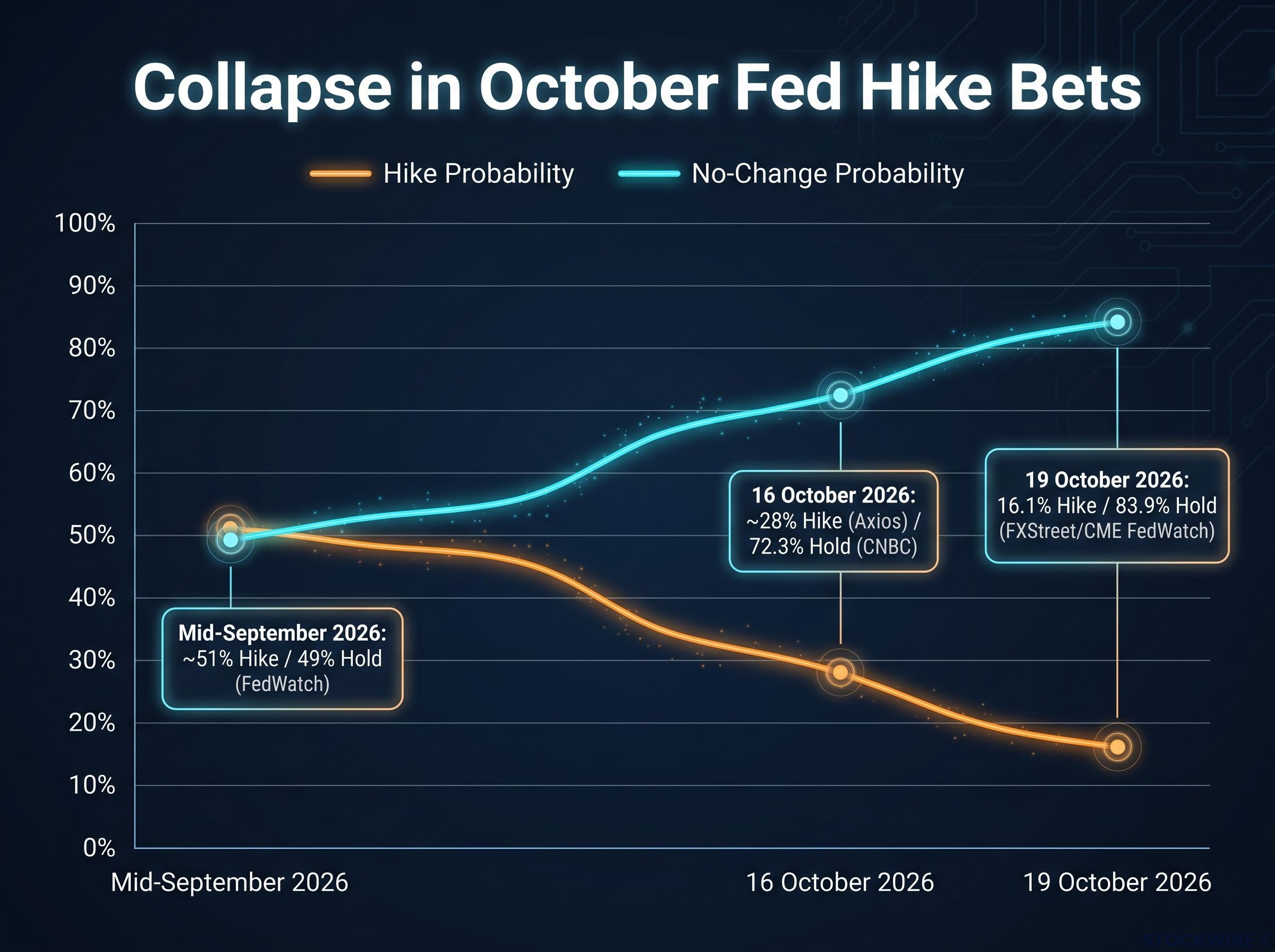
A month ago, markets saw roughly even odds of an October hike. They now see about one chance in six.
According to CME FedWatch data cited by FXStreet on 19 October, the probability of no change at the 27-28 October meeting stands at about 83.9%, up from 49% a month earlier. That means the implied hike probability fell from about 51% to 16.1%. Hotter inflation data had briefly pushed hike odds to around 50% before the reversal.
| Source | Date | No-change probability | Hike probability |
|---|---|---|---|
| FedWatch (one month earlier) | Mid-September 2026 | 49% | About 51% |
| CNBC | 16 October 2026 | 72.3% | Not reported |
| Axios | 16 October 2026 | Not reported | About 28% |
| FXStreet (CME FedWatch) | 19 October 2026 | 83.9% | 16.1% |
Readings from CNBC, Axios and FXStreet differ because they were taken at different points as the repricing unfolded. The direction, however, is the same in all three.
The catalyst was a speech that deliberately said nothing. Fed Chair Kevin Warsh, speaking at an International Monetary Fund event in Bangkok on Friday, 16 October, declined to signal either way.
Kevin Warsh, Federal Reserve Chair Warsh said he does not “prejudge” meetings, offering no clear hint on whether the Fed would hike or hold.
Markets heard a lean toward waiting. Warsh did not back an immediate hike, and several other Fed officials had already floated a pause. Commentators split on whether his neutrality was genuinely non-committal or a quiet form of reassurance. Goldman Sachs economists led by Jan Hatzius read the remarks as pointing to an October pause, while keeping their call for a second and final hike in December.
Warsh’s refusal to signal either way fits a Fed that has scrapped forward guidance, which concentrates repricing risk into single speeches and data releases rather than spreading it gradually.
The speech itself did not move the dollar. The repricing of Treasury yields and rate differentials did. A rate differential is the gap between interest rates in two countries, which shapes where capital flows.
This tells you the dollar’s recent strength was a rate-expectations trade. With a pause now largely priced in, a hold on 28 October would add little. A hawkish surprise would carry far more force.
How much support did China’s data really give the Aussie?
China delivered a beat, but only by a narrow margin. The National Bureau of Statistics of China figures, released on 19 October, are shown below as reported by the original source. Pre-release consensus varied between previews.
| Indicator | Actual | Consensus | Prior |
|---|---|---|---|
| Q3 GDP (y/y) | 4.5% | 4.4% | 4.3% (Q2) |
| Q3 GDP (q/q) | 1.2% | 1.1% | 0.9% (Q2) |
| September retail sales (y/y) | 1.1% | 0.5% | 0.4% (August) |
| September industrial production (y/y) | 5.5% | 5.4% | 5.2% (August) |
Most beats were a single tenth of a percentage point. Retail sales stood out, and previews had ranged from 0.5% to 0.7%, so the beat looks clear against any of them.
Even small Chinese surprises move the Aussie because FXStreet describes it as a “China-proxy” currency. Three channels carry the effect:
- Trade: China is the dominant buyer of Australian raw materials.
- Commodities: Iron ore and other metals track Chinese construction and industrial activity.
- Risk sentiment: Stronger Chinese data tends to lift Asian equities and cyclical currencies, and reduces demand for the US Dollar as a safe haven.
Iron ore added a modest tailwind, rebounding on 16 October from a more-than-two-year low on signs of better Chinese steel margins.
The quality of the beat matters as much as its size. A preview from Pip Theory argued the effect depends on whether China is actually building and consuming, not just exporting. Property investment and consumer spending were still weak heading into the release.
That makes retail sales the figure that matters most to you. It points to domestic demand rather than export strength, and domestic demand is what sustains appetite for Australian commodities.
The Aussie’s status as a China-proxy currency is only one of five simultaneous forces acting on it, alongside RBA policy, iron ore, global risk sentiment and the trade balance.
What could reverse the move before and after the FOMC?
Key dates
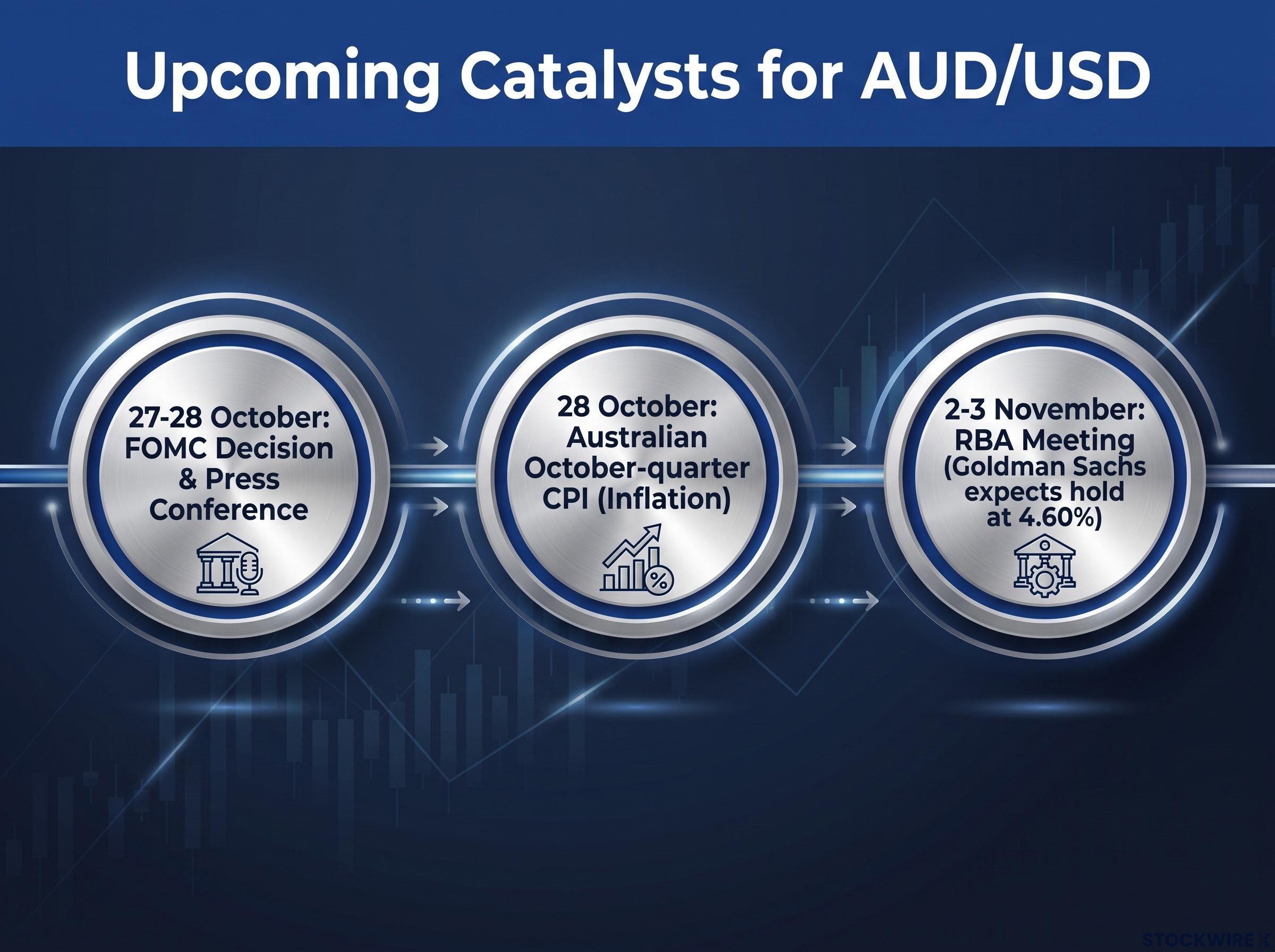
The calendar is compressed into roughly two weeks:
- 27-28 October: FOMC decision and press conference.
- 28 October: Australian October-quarter CPI (consumer price index, the main measure of inflation).
- 2-3 November: Reserve Bank of Australia (RBA) meeting.
Risks to the rally
The RBA is restrictive but not committed. Governor Michele Bullock has struck a dovish tone, suggesting the four hikes already delivered may prove sufficient. Assistant Governor Chris Kent questioned whether policy is restrictive enough, citing evidence that neutral rates are rising. Goldman Sachs expects a hold at 4.60%, but said the 28 October CPI print could lower the bar for a November hike.
Australian CPI has been running well above target, with electricity bills up 22.4% annually and a trimmed mean of 3.6% in the June print, which sets the bar for the 28 October release.
| Risk | Direction for AUD/USD | Trigger |
|---|---|---|
| Hawkish Fed surprise | Lower | Hike or hawkish tone on 28 October |
| US inflation shock | Lower | Hotter data reviving hike bets |
| Falling iron ore | Lower | Rebound from multi-year low fades |
| China property weakness | Lower | Soft construction and household demand |
| Dovish RBA relative to Fed | Lower | Soft CPI, hold signalled on 2-3 November |
No documented historical study pins down how the pair has moved after similar episodes, so precedent offers little guidance here.
The practical read: the next leg depends more on US yields and the 28 October CPI than on China. Treat the Chinese beat as a tailwind, not a thesis.
What the second straight gain does and does not tell you
The rise toward 0.6970 reflects a softer dollar and a modest Chinese beat. It does not signal a change in the underlying trend, and neither driver is decisive alone.
Two events now carry the most weight: the FOMC outcome and tone on 27-28 October, and Australian CPI the same day. If the Fed holds without hawkish language and CPI keeps the RBA in play, the current support may hold. A hawkish Fed or soft Australian inflation would test it quickly.
Readers wanting more context on dollar weakness will find our detailed coverage of the earlier AUD/USD breakout above 0.7200, which shows how Fed and BoJ moves squeezed the greenback.
This article is for informational purposes only and should not be considered financial advice. Investors should conduct their own research and consult with financial professionals before making investment decisions. Past performance does not guarantee future results, and forecasts cited are subject to market conditions and change.