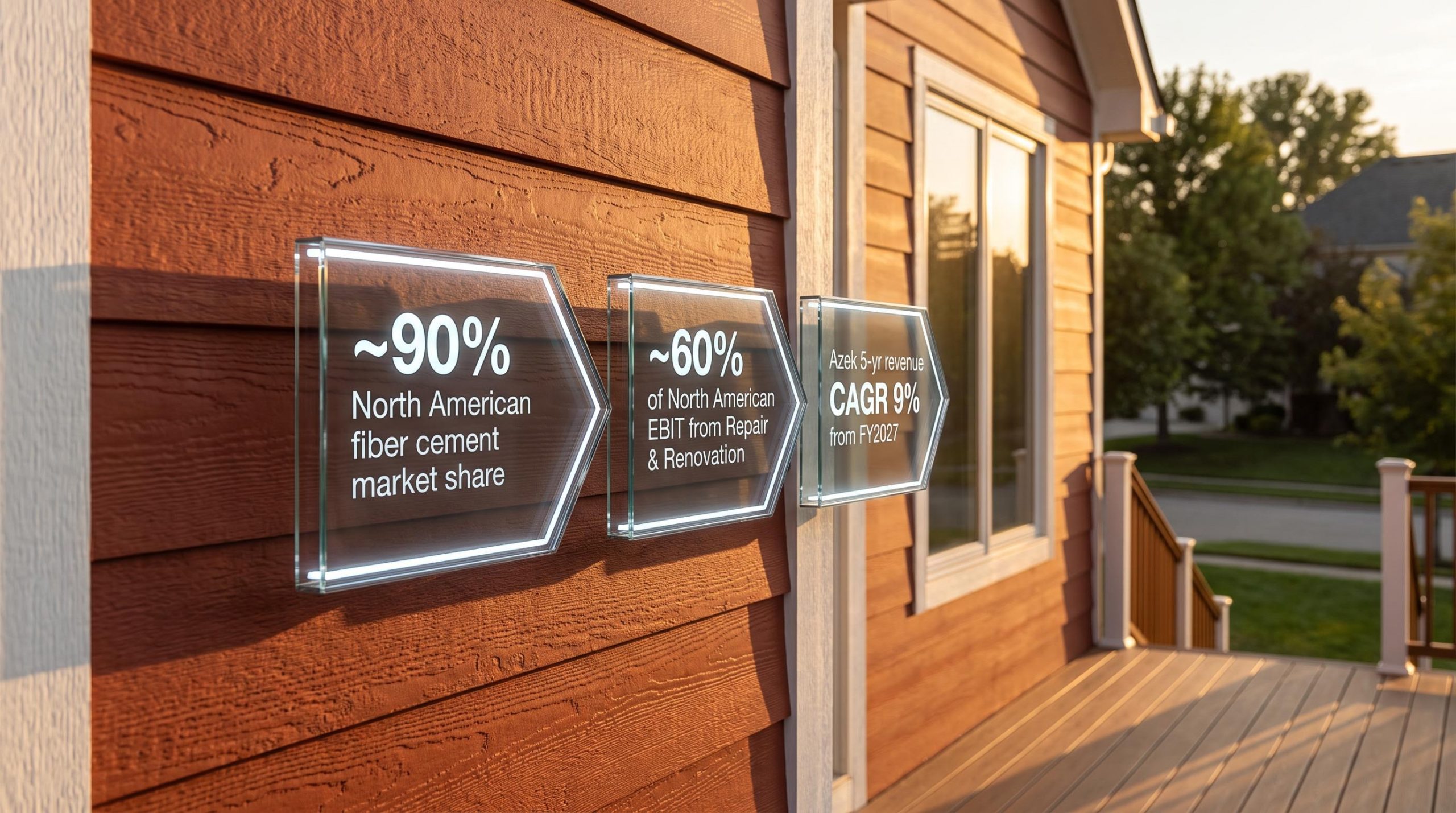
James Hardie controls roughly 90% of the North American fiber cement siding market. That is not a market-leading position. That is near-monopoly territory in a building materials category that is actively taking share from vinyl, wood, and brick.
For investors evaluating JHX, the question is no longer whether the core business is dominant. It demonstrably is. The more pressing question is whether the July 2025 acquisition of premium outdoor living company Azek extends that dominance into adjacent categories, or simply represents a large capital allocation bet on unproven cross-selling economics.
Here is the analytical framework for evaluating the structural sources of Hardie’s moat, how the repair and renovation segment insulates earnings from housing cycle volatility, what Azek realistically adds, and where the bull and bear cases diverge most materially. This is the groundwork for forming a considered view on JHX as a long-term holding.
How Hardie built a near-monopoly, and why it has held
~90% of the North American fiber cement siding market belongs to one company. That figure alone reframes how you assess competitive risk.
The 90% share is not an accident of timing. It is the output of a deliberate, multi-decade system built on four reinforcing structural advantages:
- Category creation: Hardie pioneered fiber cement for construction use and became synonymous with the category before meaningful competition could form.
- Homeowner-directed marketing: Rather than relying solely on builder procurement relationships, Hardie invested in direct-to-homeowner and architect marketing, raising switching costs at the top of the decision funnel.
- National manufacturing footprint: Scale advantages across production and distribution make it difficult for smaller competitors to match cost, availability, or lead times.
- Certified installer programmes: Contractor certification deepens loyalty and reduces the likelihood that an installer recommends a competing product.
U.S. Census Bureau data shows that fiber cement’s share of newly built homes rose by 3 percentage points in the five years through 2022, while vinyl lost 2% and brick shed 2%, with stucco gaining 2% and wood falling 1%. North America generates roughly 80% of group operating income, according to Morningstar, meaning the moat and the earnings are concentrated in the same geography.
One figure deserves particular attention: approximately 8% of existing U.S. homes currently have James Hardie siding installed. That is not just a historical share count. It is the seed of a compounding future repair and renovation revenue stream, and investors should read it as a forward demand indicator. HardieBacker backer board, which holds approximately 95% of the rigid underlayment category (unverified estimate), illustrates the same pattern: proprietary products capturing dominant category share through scale and channel entrenchment.
When big ASX news breaks, our subscribers know first
Why the repair and renovation segment is the real earnings engine
Most investors encounter James Hardie through the lens of new home construction. That framing understates the durability of the earnings base.
According to Morningstar analyst Esther Holloway, approximately 60% of North American EBIT (earnings before interest and tax, the profit a company generates from its core operations before financing costs) comes from the repair and renovation segment, not new builds. The mechanics are straightforward: once Hardie siding is installed, contractors and homeowners source replacement planks from the same manufacturer for fit continuity. That creates built-in repeat business with low churn.
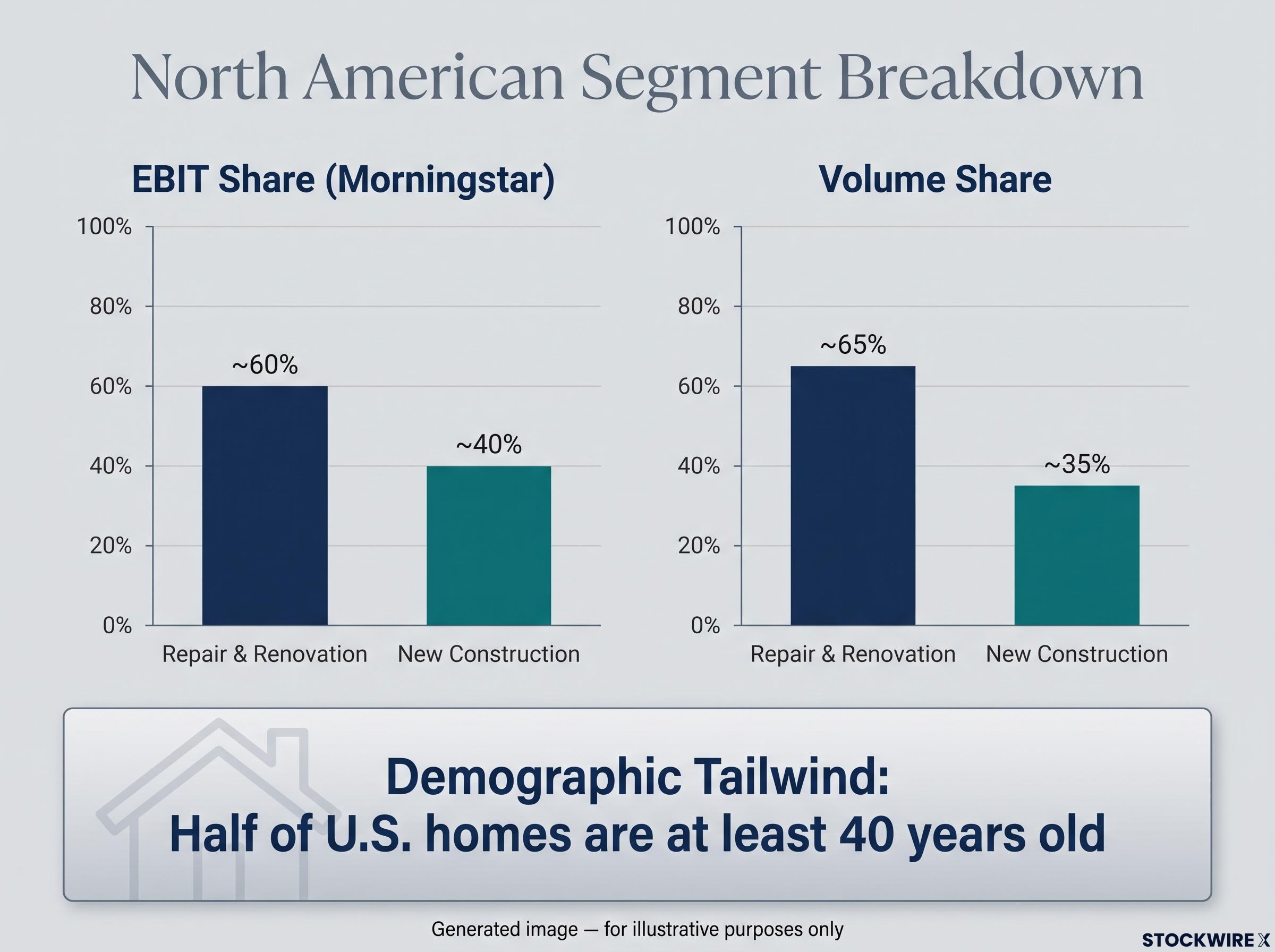
| Segment | EBIT Share (Morningstar) | Volume Share (Unverified Estimate) |
|---|---|---|
| Repair & Renovation | ~60% | ~65% |
| New Construction | ~40% | ~35% |
The demographic tailwind behind that 60% figure is substantial.
U.S. Census Bureau data shows that roughly half of all U.S. homes are at least 40 years old. Given that residential siding typically reaches the end of its serviceable life at around that same threshold, a substantial wave of the existing housing stock is now entering the replacement window at the same time.
Fiber cement accounted for 22% of all new U.S. housing completions in 2024, according to Census Bureau data. Every one of those installations feeds the future R&R pipeline.
The Census Bureau characteristics of new housing survey tracks wall material type across all new privately-owned residential completions annually, providing the primary dataset behind the fiber cement share gains that have eroded vinyl and wood’s combined position over the past decade.
For a long-term investor, the R&R skew means JHX earnings are less dependent on housing starts than the company’s building materials classification implies. That materially changes how to think about the stock in a rate-elevated or construction-softening environment.
Housing market decoupling from broader GDP has shrunk the sector’s capacity to drag the economy into contraction, a dynamic that partially insulates Hardie’s R&R revenue from the cyclical swings in new single-family construction starts that most building materials investors treat as the primary demand driver.
What fiber cement siding is, and why it wins on the attributes that matter to homeowners
Fiber cement is a composite material made from cement, sand, and cellulose fibres. It is engineered to replicate the appearance of wood, stucco, or stone while offering superior resistance to rot, fire, insects, and moisture. It sits at the premium end of the siding category, above vinyl and engineered wood, and its price premium is justified by a significantly longer lifespan and lower long-term maintenance cost.
Key performance advantages over competing materials include:
- Durability: Resists cracking, warping, and impact damage that degrades vinyl over time
- Fire resistance: Non-combustible, a meaningful advantage in wildfire-prone regions
- Rot and insect resistance: Outperforms wood on both fronts without chemical treatment
- Aesthetic versatility: Available in textures that mimic wood grain, shingle, and stone profiles
- ColorPlus factory-applied finishes: Hardie’s proprietary finishing process extends colour longevity and reduces post-installation maintenance, reinforcing the brand among contractors
The certified installer programme adds another layer. Contractors trained and certified by Hardie deliver more consistent installation quality, which reduces failure rates and strengthens the brand’s reputation at the point of sale.
The 35/90 strategy: still in the middle of the penetration curve
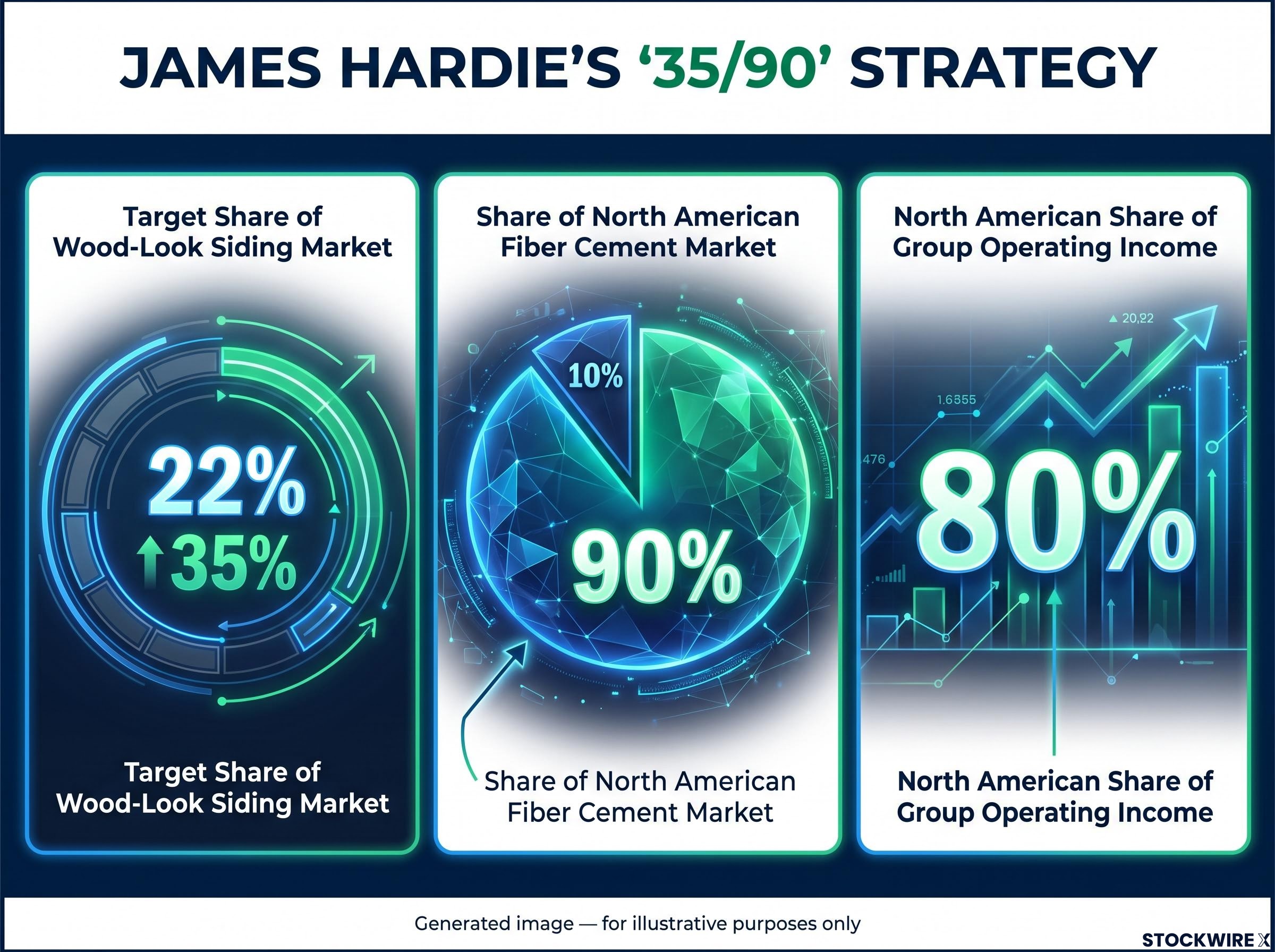
Hardie’s stated growth framework is known internally as the “35/90” strategy (unverified Perplexity-sourced description): grow fiber cement’s share of the total wood-look siding market from 22% to 35%, while maintaining 90% share of the fiber cement sub-category.
That target is not a marketing slogan. It is the quantified version of the argument that fiber cement siding is still in the middle of its penetration curve, which is the most important variable for long-run revenue growth forecasts. Geographic expansion supports the ambition: Hardie has introduced stucco-appearance fiber cement targeting southwestern U.S. markets where stucco dominates, extending the addressable market into regions where fiber cement historically had limited presence.
What Azek brings to the table, and where the strategic logic is strongest
Azek is a premium outdoor living products company specialising in composite decking, trim, and related exterior products. The acquisition, completed in July 2025, gives Hardie a broader portfolio across the exterior envelope rather than remaining concentrated in siding and backer board.
The strategic logic rests on channel depth. Hardie already possesses deep distributor, dealer, and installer relationships across North America. Adding Azek’s product lines into those relationships increases revenue per channel partner and deepens the economic value of each relationship. Morningstar expects most benefits to come from cross-selling via shared sales teams rather than from cost cutting, and combined sales teams were already carrying both product lines by April 2026.
The three most credible sources of Azek value creation, ranked by confidence:
- Channel revenue per partner: Distributors and installers sell a broader basket of premium products, increasing Hardie’s share of each relationship’s economics.
- Homeowner bundling proposition: Affluent homeowners undertaking exterior renovations can source siding, decking, and trim from one premium brand, which reinforces brand recognition and raises switching costs.
- Manufacturing and procurement scale: A broader product portfolio may support procurement leverage and composite materials expertise over time, though this is more speculative and longer-dated.
Morningstar projects Azek to achieve a 5-year revenue CAGR of 9% from fiscal 2027, supported by Hardie’s distribution network, according to analyst Esther Holloway. Morningstar increased its fair value estimate by approximately 2% following early integration progress.
That 9% projected CAGR is an analyst scenario, not a guaranteed outcome. Investors should treat it as a credible upper-bound estimate contingent on cross-selling execution, not as a baseline assumption already baked into the thesis.
Bull case, bear case, and the variables that will determine which plays out
| Thesis Variable | Bull Case Assumption | Bear Case Assumption |
|---|---|---|
| Housing mix | Single-family construction holds steady; fiber cement share gains continue | High mortgage rates and a secular shift toward multifamily housing shrink the core addressable market |
| R&R trajectory | Aging housing stock drives compounding R&R demand; installed base grows | R&R spending softens in a prolonged high-rate environment; homeowners defer renovations |
| Azek synergies | Cross-selling accelerates Azek revenue; channel depth widens the moat | Category differences limit synergy capture; capital allocation is questioned |
| European segment | Maintains optionality without distracting from North American focus | Fiber cement remains niche in Europe; mid-term targets missed; management focus diluted |
The bull case is concise: a wide-moat business with R&R demographic tailwinds, continued share gains from vinyl and wood, Azek as a growth accelerator, and Morningstar’s assessment of an approximately 40% discount to fair value as a potential entry point.
The bear case carries equal weight. Prolonged high mortgage rates could dampen new single-family construction. Morningstar notes that fiber cement has seen slow adoption across Europe over two decades of presence, and that the segment’s mid-term financial targets look difficult to achieve. And if Azek synergies fall short, investors may reassess the capital allocation decision even if the core business remains strong.
The single-family vs multifamily divergence in U.S. housing construction is particularly relevant to the bull case: fiber cement’s addressable market is concentrated in single-family residential, meaning the segment-level composition of housing starts matters more to Hardie’s volume trajectory than aggregate housing headline figures.
A prior analysis cited approximately 26x trailing P/E and 20x forward P/E as mid-range of Hardie’s 10-year history (unverified estimate).
What the valuation gap actually signals
The Morningstar 40% discount to fair value does not mean the stock is definitively cheap. It means that investors who accept Morningstar’s moat assessment and synergy assumptions should find the current price compelling. Investors who weight the bear case higher will arrive at a different fair value.
Morningstar views the market’s scepticism about Azek synergies and execution risk as the primary source of the discount, rather than disagreement about the core fiber cement moat. That gap tells you how sensitive the conclusion is to your assumptions about a single variable: Azek execution.
JHX valuation compression has been severe: the price-to-sales ratio fell to 1.97x by May 2026, less than half the five-year average of 4.14x, driven largely by the Q1 FY26 earnings miss and guidance cut that erased roughly 36.5% of market capitalisation in a single session.
Separating what is structurally durable from what still needs to be proven
The durable core of the JHX thesis is well established by evidence: the fiber cement near-monopoly, the homeowner brand pull, the R&R demographic anchor, and returns on capital of approximately 18% (unverified estimate) that are characteristic of wide-moat industrial businesses. Sales CAGR of approximately 6-8% since the mid-2000s (unverified estimate) supports the pattern.
Already proven:
- ~90% fiber cement market share with reinforcing structural moat
- ~60% of North American EBIT from R&R (Morningstar)
- Sustained share gains from vinyl, wood, and brick over multiple cycles
- Premium brand positioning with contractor and homeowner loyalty
Execution-dependent:
- Azek cross-selling revenue delivery in fiscal 2027 and 2028
- Geographic expansion of fiber cement into stucco and brick-dominant markets
- European segment reaching mid-term financial targets
- Maintenance of 90% fiber cement sub-category share as the category scales
Azek is best understood as a potential moat extender rather than a prerequisite. If cross-selling succeeds, Hardie becomes a broader premium exterior platform with deeper channel moats. If it disappoints, the core siding franchise remains intact, but growth and valuation expectations may need resetting.
For an investor with a five-plus year horizon, the core thesis does not depend on Azek succeeding. It depends on the R&R demographic tailwind continuing to compound and on Hardie maintaining its fiber cement share advantage. Azek is upside optionality, not the load-bearing wall. That distinction is what allows position-sizing to match actual thesis confidence.
This article is for informational purposes only and should not be considered financial advice. Investors should conduct their own research and consult with financial professionals before making investment decisions. Past performance does not guarantee future results. Financial projections referenced are subject to market conditions and various risk factors.
—