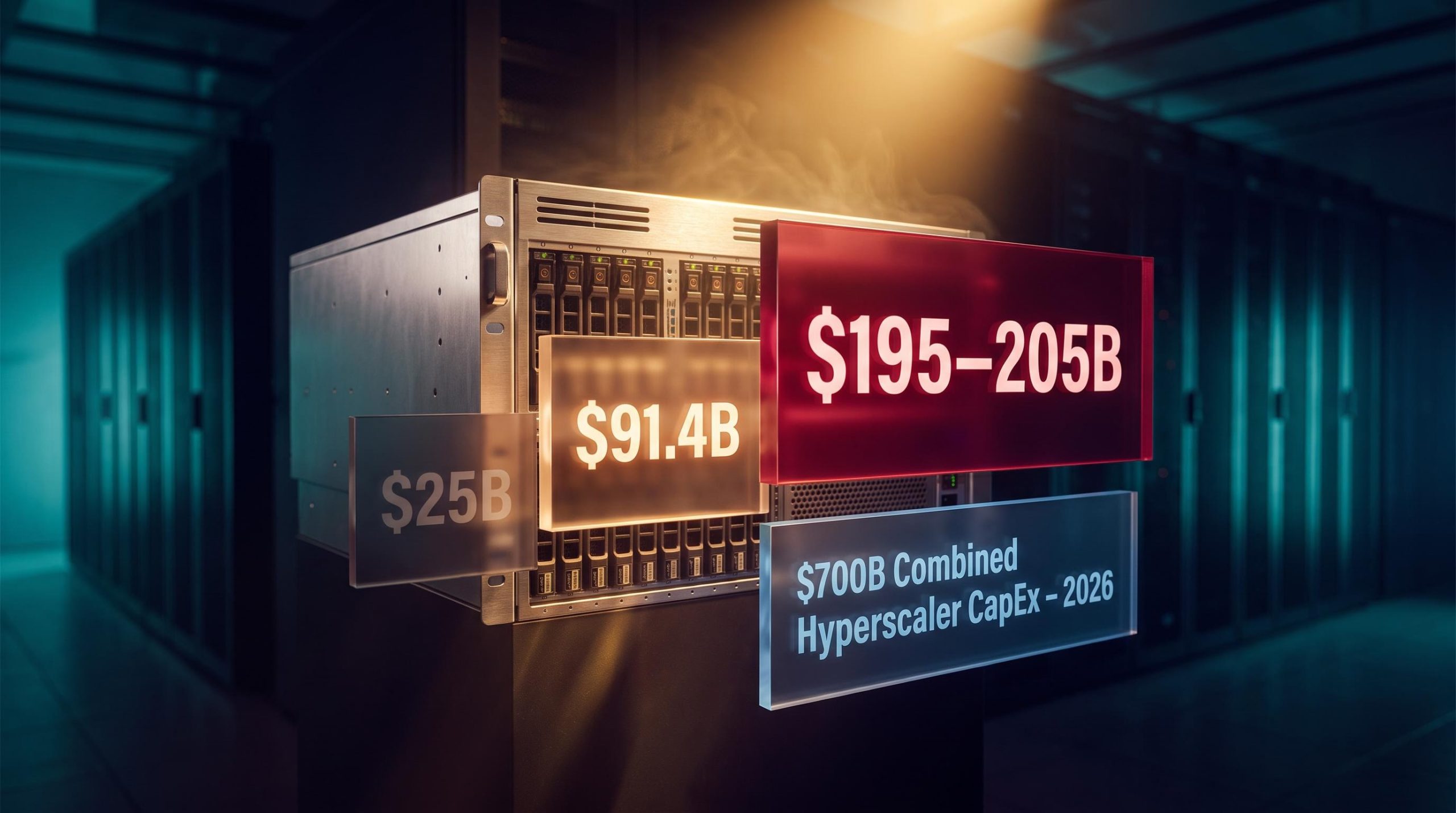
Alphabet just told investors it expects to spend $195-205 billion on capital expenditure in 2026, a figure roughly eight times what the company spent just five years ago. This is not a marginal adjustment to spending plans. It is a redefinition of what AI infrastructure commitment looks like at scale.
The timing sharpens the stakes. This guidance revision landed as investors prepare for earnings from Amazon and Microsoft, both of which face the same line of questioning about whether AI spending can earn its keep. The combined AI-linked spending of the four largest hyperscalers is approaching $700 billion in 2026 alone, and markets are questioning whether returns will justify the outlay. Meanwhile, the software sector has been selling off broadly, with investors treating the entire category as an AI casualty regardless of actual business-model exposure.
Two distinct analytical questions sit at the centre of this moment: what Alphabet’s spending numbers actually signal about the AI investment cycle, and which software stocks may be trading well below their real AI-risk-adjusted value. Here is the framework for reading both sides of that trade before the next wave of earnings data arrives.
Alphabet’s CapEx trajectory decoded: what three upward revisions in one year actually signal
The headline figure matters. The trajectory matters more. Alphabet has revised its 2026 CapEx guidance upward three times in a single year:
- Early 2026: initial guidance of $175-185 billion
- Mid-2026: revised upward to $180-190 billion
- Late July 2026: raised again to $195-205 billion
Each revision represents AI infrastructure demand exceeding the company’s own internal projections. A decade ago, Alphabet’s annual CapEx was a fraction of today’s outlay, and as recently as five years back the company was spending roughly $25 billion per year on capital investment. In 2024, that figure was $52.5 billion. In 2025, it reached $91.4 billion. The current guidance midpoint of roughly $200 billion represents nearly a fourfold increase in two years.
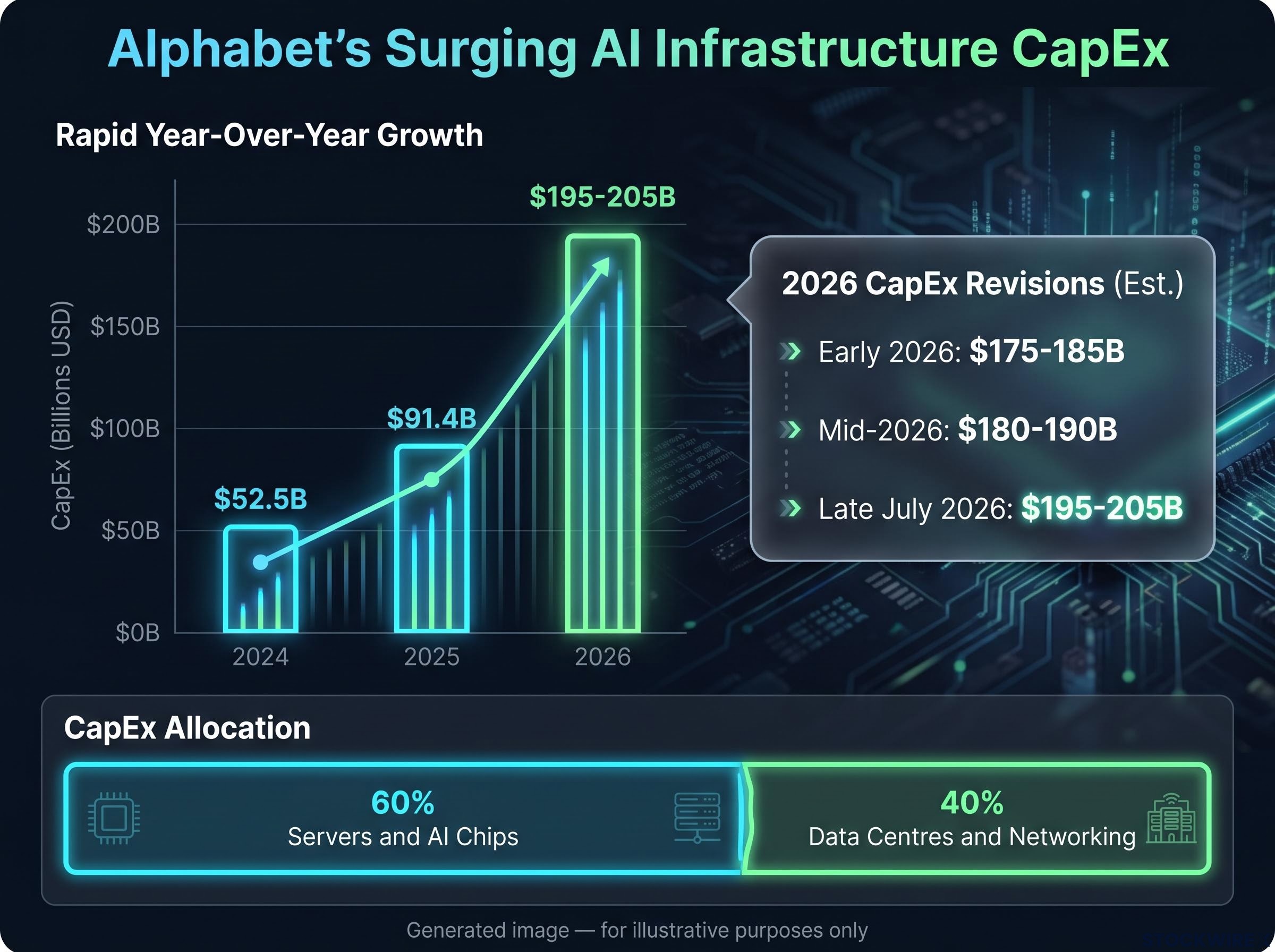
Where the money goes: Management has indicated approximately 60% of CapEx is directed to servers and AI chips, with around 40% going to data centres and networking. This is overwhelmingly AI infrastructure spending, not traditional growth CapEx.
Bryce Anderson, Senior Portfolio Manager at Morningstar Investment Management, identified this latest upward revision as having unsettled markets. When a company raises its spending forecast three times in one year, each subsequent raise should be read not as a one-off but as a directional indicator of where spending is heading in 2027 and beyond. The acceleration itself is the signal.
When big ASX news breaks, our subscribers know first
The $700 billion question: can hyperscaler AI spending earn its keep?
Alphabet’s numbers are staggering in isolation. In context, they are one quarter of a collective bet that has no precedent in corporate history.
| Company | 2026 CapEx Range | Primary Use of Funds | Key Investor Concern |
|---|---|---|---|
| Alphabet | $195-205B | AI chips, servers, data centres | First recorded cash burn; FCF compression |
| Amazon | ~$200B | AWS AI workloads, data centres | ROIC on massive infrastructure build |
| Microsoft | $145-190B | Azure AI infrastructure, Copilot integration | Spending pace vs. monetisation timeline |
| Meta | $115-135B | AI compute, generative AI products | Consumer AI monetisation uncertainty |
The combined total sits at roughly $650-725 billion, depending on where each company lands within its range. Alphabet alone is spending $15 billion more in 2026 than previously guided, with further increases signalled for 2027.
The market’s concern is not whether AI is a legitimate technology shift. It is whether the capital committed will produce adequate returns. Return on invested capital (ROIC), the measure of how much profit each dollar of investment generates, is the metric that matters most when spending reaches this magnitude. Alphabet’s first recorded cash burn has given that concern a concrete data point.
ROE compression mechanics explain part of why markets are reacting to spending announcements with more alarm than the underlying business quality may warrant: Goldman Sachs projects a seven-point average decline in mega-cap tech return on equity driven by depreciation schedules, not by deteriorating competitive position, which means near-term financial metrics will look worse precisely as the infrastructure investment matures.
Two interpretations compete for investor attention. The first: this is value-creating investment in a genuine long-cycle technology platform, and the returns will compound over years, not quarters. The second: this is the front end of an over-capitalisation cycle where supply is being built faster than monetisable demand can absorb it. When four companies are collectively spending more than the GDP of most countries on a single technology cycle, the unresolved question of whether AI workloads will generate sufficient cash conversion is the central risk to hold in mind.
Why software stocks sold off, and what the sell-off is actually pricing in
While hyperscalers pour capital into AI infrastructure, the software sector has absorbed the other side of the impact. The S&P 500 software and services index fell nearly 4% in a single session during early 2026, and sector market value has declined approximately $830 billion since late January 2026.
The core investor fear is specific: AI agents and automation tools may replicate functions currently sold as licensed or subscription software, undermining pricing power and long-term growth trajectories. Companies facing these concerns include:
- Salesforce, where AI-driven CRM automation could compress demand for traditional seat-based licensing
- ServiceNow, where workflow automation overlaps with emerging AI agent capabilities
- Broader categories of single-function SaaS tools whose features can be subsumed into larger AI platforms
Bryce Anderson, Senior Portfolio Manager at Morningstar Investment Management, described the selling pressure as sweeping and non-selective, observing that although certain AI-driven threats to software business models are genuine, the breadth and speed of the market’s reaction has left a number of names trading at prices that no longer reflect their underlying value.
A decline of $830 billion in sector market value is pricing in a specific thesis about AI displacement. The question worth asking is whether the businesses being sold have the same AI exposure as the businesses the thesis was built around, or whether they simply share a sector label. That distinction is where the analytical opportunity sits.
Software sector dispersion tells a more nuanced story than aggregate index moves suggest: the spread between the top and bottom deciles of US technology stocks reached a record 133 percentage points in 2026, confirming that investors making sharp within-sector distinctions are being rewarded while those selling the category wholesale are misreading the signal.
Substitute or complement? The framework that separates the real risk from the noise
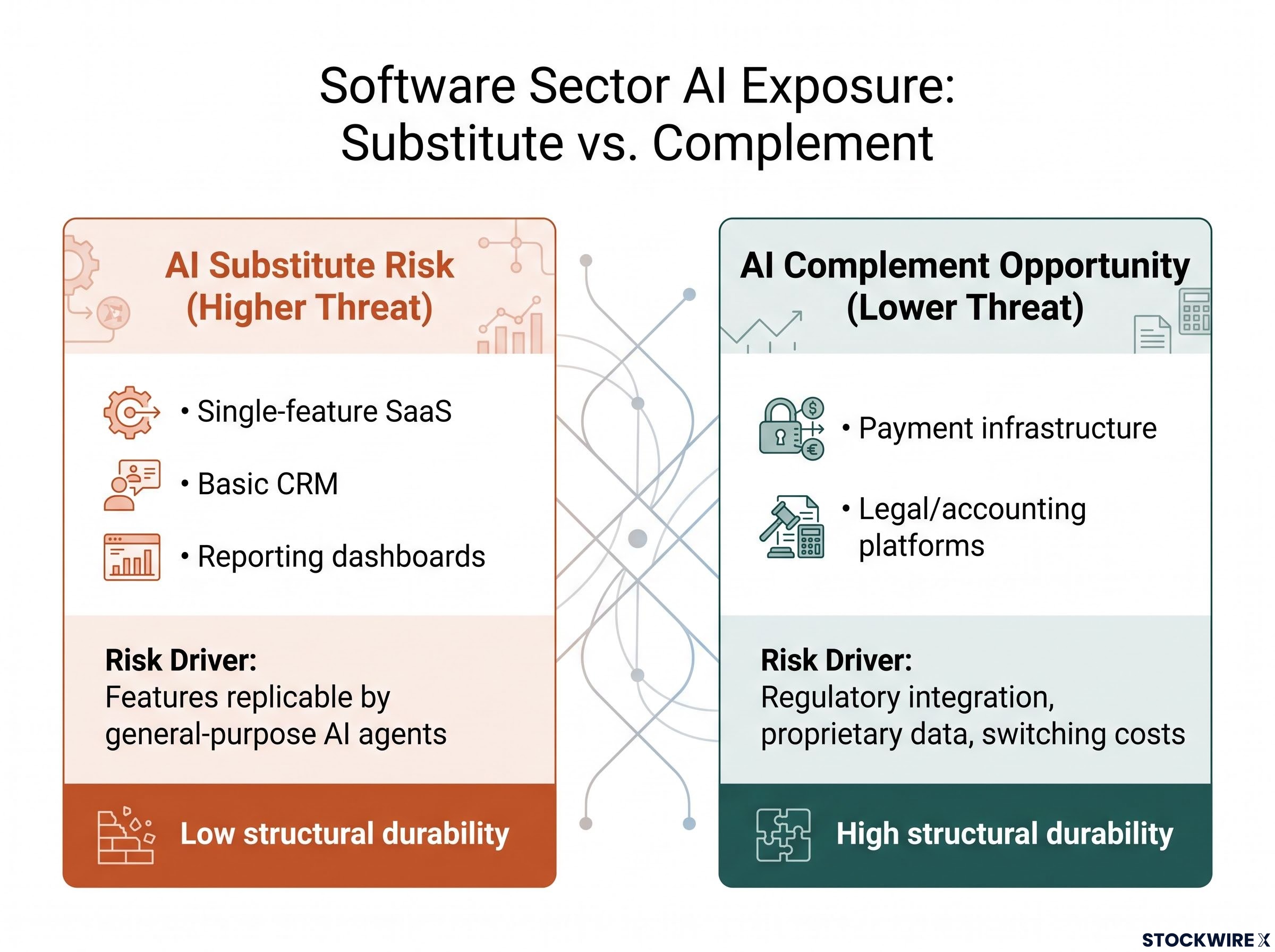
The most useful lens for sorting genuine AI risk from indiscriminate selling is a single question: does AI do the same job more cheaply (a substitute), or does it make the existing product more powerful and harder to leave (a complement)?
That distinction determines whether a software business faces structural threat or structural reinforcement from the AI cycle. The market, at present, is not making this distinction at scale.
Where AI substitution risk is genuinely elevated
Single-feature SaaS and narrow workflow automation tools sit in the highest-risk category. Products that mainly automate discrete tasks, such as basic CRM functions, simple ticket routing, or low-complexity analytics, can be replicated by general-purpose AI agents embedded into hyperscaler platforms or productivity suites.
Per-seat pricing erosion is the mechanism through which AI substitution risk becomes financially concrete: AI-native entrants are targeting enterprise markets with consumption-based models priced 80-90% below incumbent SaaS costs, and at least one documented case shows a company reducing a software analytics deployment from 20 seats to 3 after deploying a natural language AI interface.
Data-wrangling and reporting-layer products without unique data moats face a similar problem. Software that sits on top of widely available data and offers standard dashboards may be commoditised as AI systems generate and customise insights natively. These products lack the deep integrations or proprietary data assets that would make displacement costly.
Where the sell-off has outpaced the actual risk
Financial payments and transaction infrastructure operate within dense regulatory, banking, and compliance frameworks. AI may improve front-end experiences, from fraud detection to personalisation, but the core payment rails and trusted counterparty relationships are unlikely to be displaced by generic AI software. Anderson specifically identified financial payments as a sub-segment where his team is finding selective value.
Professional services software serving legal, accounting, design, and engineering workflows presents a similar dynamic. AI is changing how professionals work, but existing platforms with embedded compliance functionality, domain expertise, and client records tend to become more valuable as AI is layered in. They serve as the distribution channel for AI features rather than being replaced by them. Anderson identified professional services software as another area of active opportunity.
| Category | Example Products/Sectors | Key Risk Driver | Structural Durability |
|---|---|---|---|
| AI Substitute Risk (Higher Threat) | Single-feature SaaS, basic CRM, reporting dashboards | Features replicable by general-purpose AI agents | Low; limited moat against platform-embedded AI |
| AI Complement Opportunity (Lower Threat) | Payment infrastructure, legal/accounting platforms | Regulatory integration, proprietary data, switching costs | High; AI deepens value rather than displacing it |
Applying this substitute-vs-complement test to specific names gives you a materially different risk picture than treating all software as uniformly threatened by AI, which is the error the market appears to be making at scale right now.
Microsoft as a case study in holding both sides of the trade at once
The binary framing of “AI winner vs. AI casualty” breaks down when you look at a single company that occupies both categories simultaneously. Microsoft is one of the largest AI infrastructure spenders in the world and the owner of one of the most widely distributed enterprise software franchises.
Its AI CapEx, roughly $145-190 billion depending on measurement period (with the fiscal year ending July 2026 toward the lower end and calendar-year estimates trending higher), places it squarely in the hyperscaler spending conversation. But its software franchise is where the complement dynamic becomes concrete:
- Office 365 with Copilot embedded across Word, Excel, PowerPoint, and Teams
- Dynamics 365 with AI-powered business process automation
- GitHub with Copilot for code generation and developer workflows
- LinkedIn with AI-driven talent matching and content distribution
In each case, AI deepens product lock-in and raises switching costs. Copilot does not compete with Microsoft’s own software. It makes that software harder to replace.
Bryce Anderson, Senior Portfolio Manager at Morningstar Investment Management, named Microsoft as a position his team has been actively adding to, viewing the company as a way to gain simultaneous exposure to AI infrastructure growth and the software sector’s recovery potential (Morningstar Market Minute, 28 July 2026).
When a stock that is simultaneously a top-ten hyperscaler spender and the owner of one of the most widely distributed enterprise software franchises trades down because of “software sector” concerns, the sell-off is almost certainly not distinguishing between what it is selling and why. Microsoft’s dual positioning makes it a useful real-world test case for the substitute-vs-complement framework, and its inclusion in Anderson’s active thesis gives you a named, professional-grade reference point for how this analysis translates into an actual portfolio decision.
What to watch as Amazon and Microsoft earnings arrive
Amazon and Microsoft earnings are the next major data points in this story, and they arrive while Alphabet’s guidance revision is still being absorbed. What those calls reveal will either validate or challenge the market’s current anxiety about cash burn at scale.
The metrics worth tracking go well beyond headline revenue and earnings per share. In order of analytical priority:
- Data-centre utilisation rates: Are these massive new facilities being filled with paying workloads, or is capacity running ahead of demand?
- AI product unit economics: What are companies charging per token, per seat, or per workload, and are those prices holding or compressing?
- Free cash flow and ROIC trajectory: Is spending translating into cash generation, or is cash burn deepening alongside CapEx?
- 2027 CapEx guidance language: Any upward revision or acceleration signal extends the investment cycle further; any language suggesting a plateau changes the calculus.
- Software valuation spreads: Whether earnings distinguish between genuinely disrupted software categories and structurally durable ones will determine if the indiscriminate sell-off starts to correct.
How Amazon and Microsoft frame their AI CapEx returns in the coming calls will shape whether the roughly $700 billion in combined hyperscaler spending starts to demonstrate cash conversion or remains an open question. Having a specific analytical checklist going into those calls is worth more than a general sense of concern or optimism.
For investors wanting to benchmark the current buildout against historical precedents, our full explainer on AI spending versus prior tech cycles documents how 2026 IT investment surpassed the dot-com era peak and maps where returns have concentrated across infrastructure, energy, and application layers.
This article is for informational purposes only and should not be considered financial advice. Investors should conduct their own research and consult with financial professionals before making investment decisions. Past performance does not guarantee future results. Financial projections are subject to market conditions and various risk factors.