For years, the market treated Japan’s currency as little more than a cheap loan. Borrow in yen at near-zero cost, convert to dollars, and invest wherever the yields sat higher. That trade defined a generation of global capital flows.
Then the yen surged to the low-150s this summer, and the assumption started to crack. As of September 2026, a rare convergence of domestic monetary tightening and coordinated international intervention has reshaped the calculus for foreign exchange markets worldwide.
The Japanese Yen outlook now hinges on whether this move is a fleeting cyclical bounce or the first leg of a multi-year revaluation. This analysis gives you the framework to weigh both possibilities against the evidence, so you can decide which thesis deserves your portfolio’s attention.
Understanding the mechanical ceiling on Japan’s currency
Before you can judge whether the recent rally is real, you need to understand what has kept the yen suppressed for so long. The currency does not trade in a vacuum. It sits at the intersection of interest rate differentials, structural trade flows, and the plumbing of global finance.
As of early September 2026, the dollar buys roughly 153 yen, according to real-time quotes from Investing.com and TradingView. DBS Group Research strategist Chang Wei Liang identified the yen as the top-performing currency across both G10 and Asian groupings during its recent retreat toward that level, approaching a near seven-month high for the currency.
To grasp why the yen has struggled to break higher, view it not as a spot price on a screen but as a pressure valve for global capital. When policy shifts even slightly, that pressure releases violently. Three structural forces explain the pattern:
- Negative real rates: When inflation-adjusted Japanese rates stay below zero, holding yen means losing purchasing power. Capital flows out in search of positive real returns, capping any upward momentum.
- A persistent trade deficit: Japan imports the bulk of its energy. Every oil price spike or geopolitical shock forces more yen-selling to pay for imports, leaving the currency exposed to forces well beyond its central bank’s control.
- The carry trade: Investors borrow yen cheaply and deploy it into higher-yielding assets abroad. This structural funding role creates a constant, mechanical drag on appreciation.
Carry trade risk dynamics do not follow the calendar: Bank of America found no statistical support for a summer calm thesis, and three of the largest carry blowups on record, including the August 2024 BoJ shock, each occurred in the window that market convention treats as the safest season for funding positions.
There is a political dimension too. A rapidly strengthening yen compresses the margins of Japan’s export giants, squeezing corporate profits and complicating wage negotiations at home.
That tension matters for you. It means the central bank cannot simply engineer a stronger currency without domestic consequences, which is precisely why appreciation tends to arrive in fits rather than smooth trends. Understanding this baseline prevents you from overreacting to short-term swings and helps you recognise when a genuine fundamental shift is underway.
When big ASX news breaks, our subscribers know first
The central bank pivot from caution to acceleration
The era of zero-cost yen funding is closing, and the Bank of Japan (BoJ) is the reason. What began as tentative liftoff has hardened into a normalisation cycle with growing internal pressure to move faster.
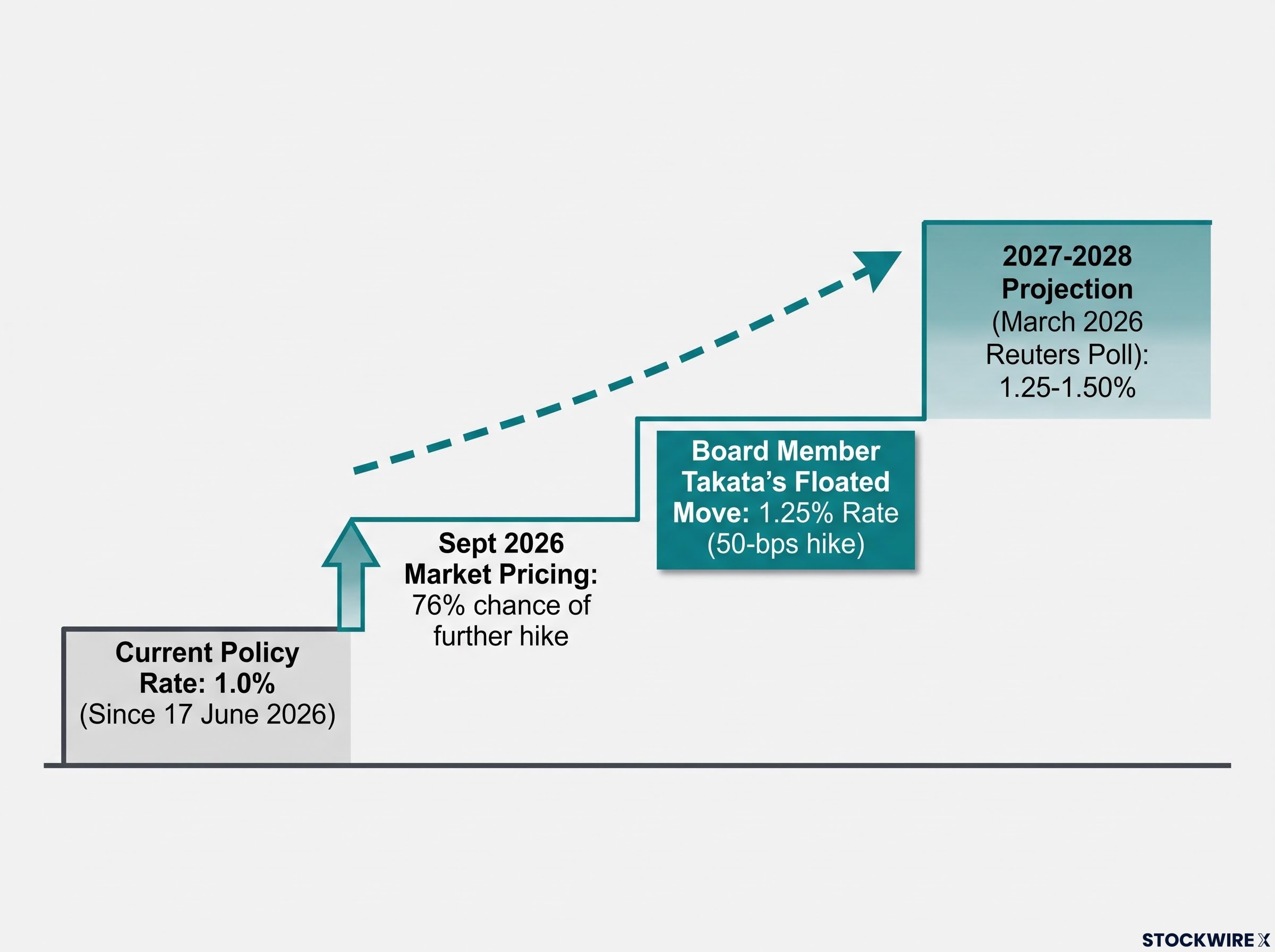
The BoJ’s short-term policy rate has stood at 1.0% since 17 June 2026. That is a meaningful distance from the negative-rate world that defined the carry trade for years, and the direction of travel is now firmly upward.
The June 2026 rate decision that lifted the overnight call rate to 1.0%, the highest since September 1995, also introduced a structured bond tapering schedule reducing monthly JGB purchases toward a 2 trillion yen floor by 2027, adding a second channel of monetary tightening beyond the policy rate alone.
The debate inside the central bank is where the real story sits. Governor Kazuo Ueda has held to cautious, data-dependent messaging, signalling gradual normalisation without committing to a pace. Board member Hajime Takata has pushed harder, repeatedly advocating for faster tightening and raising the prospect of consecutive, back-to-back rate increases.
Takata previously dissented in favour of a 1.25% rate and has suggested a 50-basis-point hike is on the table. When a sitting board member floats moves of that size, it signals the hawkish wing is no longer content with a slow drift.
The prospect of compounding rate hikes tells you domestic inflation is no longer treated as a passing anomaly. For your portfolio, that means the cost of hedging any Japan-linked exposure is set to rise structurally, not temporarily. The next BoJ guidance, expected this Friday, will shape the immediate trajectory of the market.
Market expectations for the normalisation timeline
Following the June decision, markets priced roughly a 76% chance of a further hike in September 2026. That is not a coin flip; it is a market leaning firmly toward continued tightening.
The projected sequence is telling. Takuji Aida, an economic adviser to the Prime Minister, expects the BoJ to raise rates in September and then once per quarter through to January of the following year.
That quarterly cadence points well beyond current levels. A March 2026 Reuters poll projected rates climbing to 1.25-1.50% across 2027-2028, which would put the widest part of the US-Japan yield gap firmly in the rear-view mirror.
The gap between cautious official messaging and the hawkish internal push is where you should focus. It tells you the speed of future rate shocks is genuinely uncertain, and surprises are more likely to land on the hawkish side.
The stealth catalyst of pension fund repatriation
While markets fixate on interest rate debates, a far quieter force is gathering. Japan’s Government Pension Investment Fund (GPIF), one of the largest pools of capital on earth, unexpectedly called a Management Committee meeting in late August to review its asset allocation.
Analysts read that unusual meeting as a possible precursor to a major reallocation away from foreign assets and toward yen-denominated holdings. No formal shift has been announced. But the sheer scale of what a shift would mean is difficult to overstate.
The GPIF reallocation announcement on 10 July 2026 produced an immediate same-session USD/JPY decline, a higher Nikkei 225, and stronger Japanese government bonds, confirming that markets are treating the pension repatriation signal as active policy direction rather than aspirational commentary from a single minister.
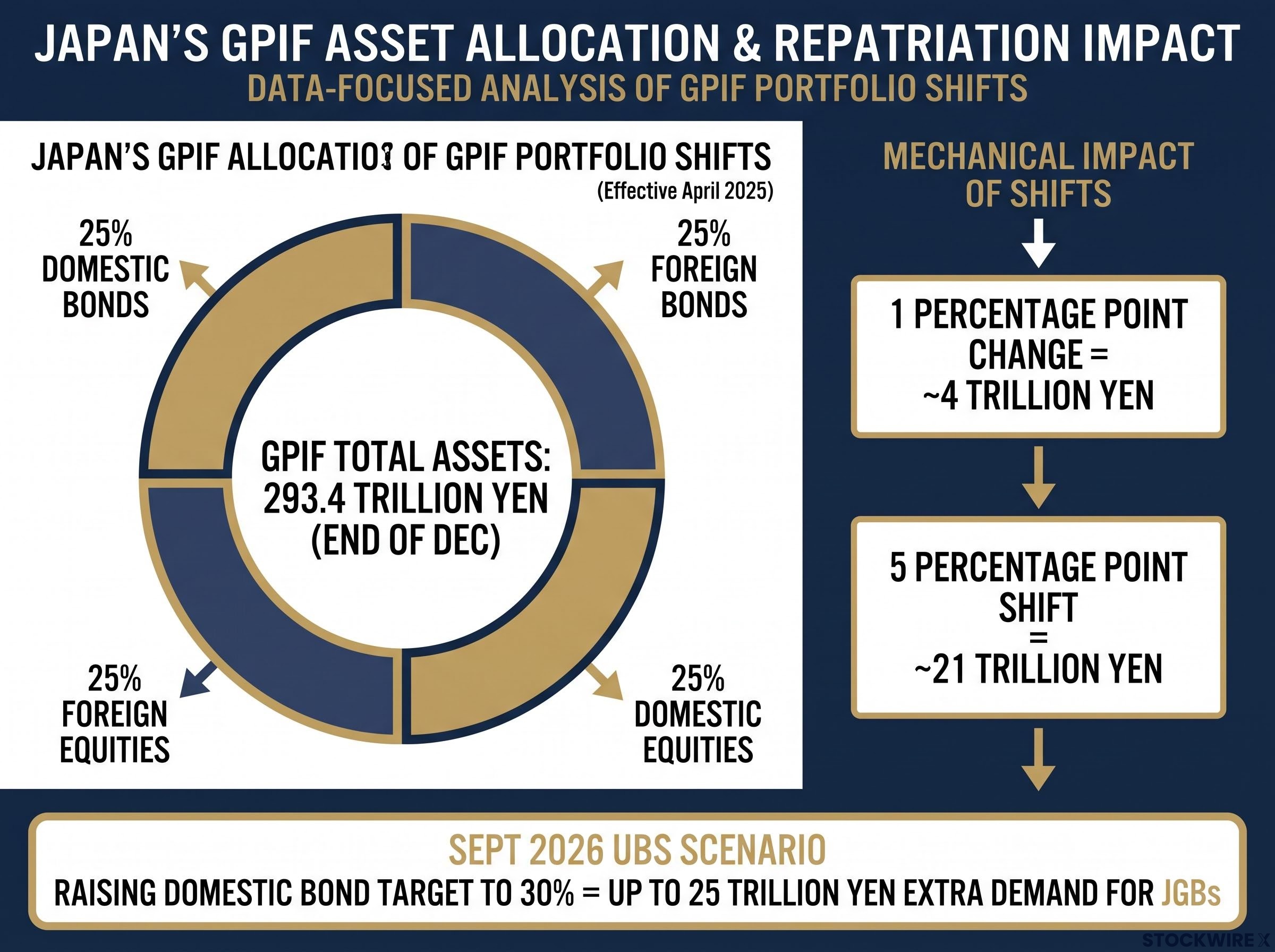
GPIF held approximately 293.4 trillion yen in total assets at the end of December. Its policy mix, effective since April 2025, sets an equal 25% target across four buckets: domestic bonds, foreign bonds, domestic equities, and foreign equities.
Here is why this matters more than any single rate decision. A pivot home supports the yen mechanically, through capital repatriation, rather than through yield incentives. The steps are straightforward:
- GPIF slows or reverses purchases of foreign assets, immediately reducing the structural outflow of yen.
- Active rebalancing means selling foreign holdings and converting the proceeds back into yen.
- That conversion generates direct, mechanical yen-buying pressure regardless of where interest rate differentials sit.
The arithmetic is stark. Each one-percentage-point change in Japanese public pension allocations represents roughly 4 trillion yen in reallocation. A 5-percentage-point shift equates to around 21 trillion yen in flows.
A September 2026 UBS scenario analysis estimated that raising the domestic bond target to 30% could generate up to 25 trillion yen in extra demand for Japanese government bonds. To put that in perspective, it dwarfs the scale of Japan’s unilateral currency interventions earlier in the year.
You should treat these institutional flows as a mechanical floor under the market. Even if the yield gap stays wide, sheer domestic buying power could force the currency higher, and that gives you an edge over analysis that watches only interest rates.
Weighing a structural bull market against cyclical traps
Wall Street cannot agree on where the yen goes from here, and that disagreement is the single most important signal for your positioning. One camp sees the start of a multi-year revaluation. The other sees another false dawn in a long history of them.
The structural-bullish case rests on three pillars: long-term undervaluation, ongoing BoJ normalisation, and the repatriation flows building beneath the surface. The cyclical case counters that negative real rates and structural outflows will reassert themselves once the current excitement fades.
A catalyst has emboldened the bulls. In July and August 2026, the US Treasury and Japan’s Ministry of Finance executed a coordinated intervention, the first joint yen-buying operation since 1998, built on a September 2025 joint statement between the two finance ministries.
The scale was extraordinary. Japanese estimates point to roughly 36.6 trillion yen in yen purchases, alongside a US contribution of around 26 billion euros deployed via the Exchange Stabilisation Fund and related channels.
Crucially, analysts view the intervention as a catalyst rather than a cure. It gave Japan political cover to pursue tightening without destabilising markets. But a broad Reuters poll found that nearly 95% of surveyed strategists believe intervention alone cannot sustainably curb yen weakness without a fundamental narrowing of US-Japan yield differentials.
The forecasts themselves reveal how wide the divide runs.
| Institutional Source | View | End-2026 Target | Primary Rationale |
|---|---|---|---|
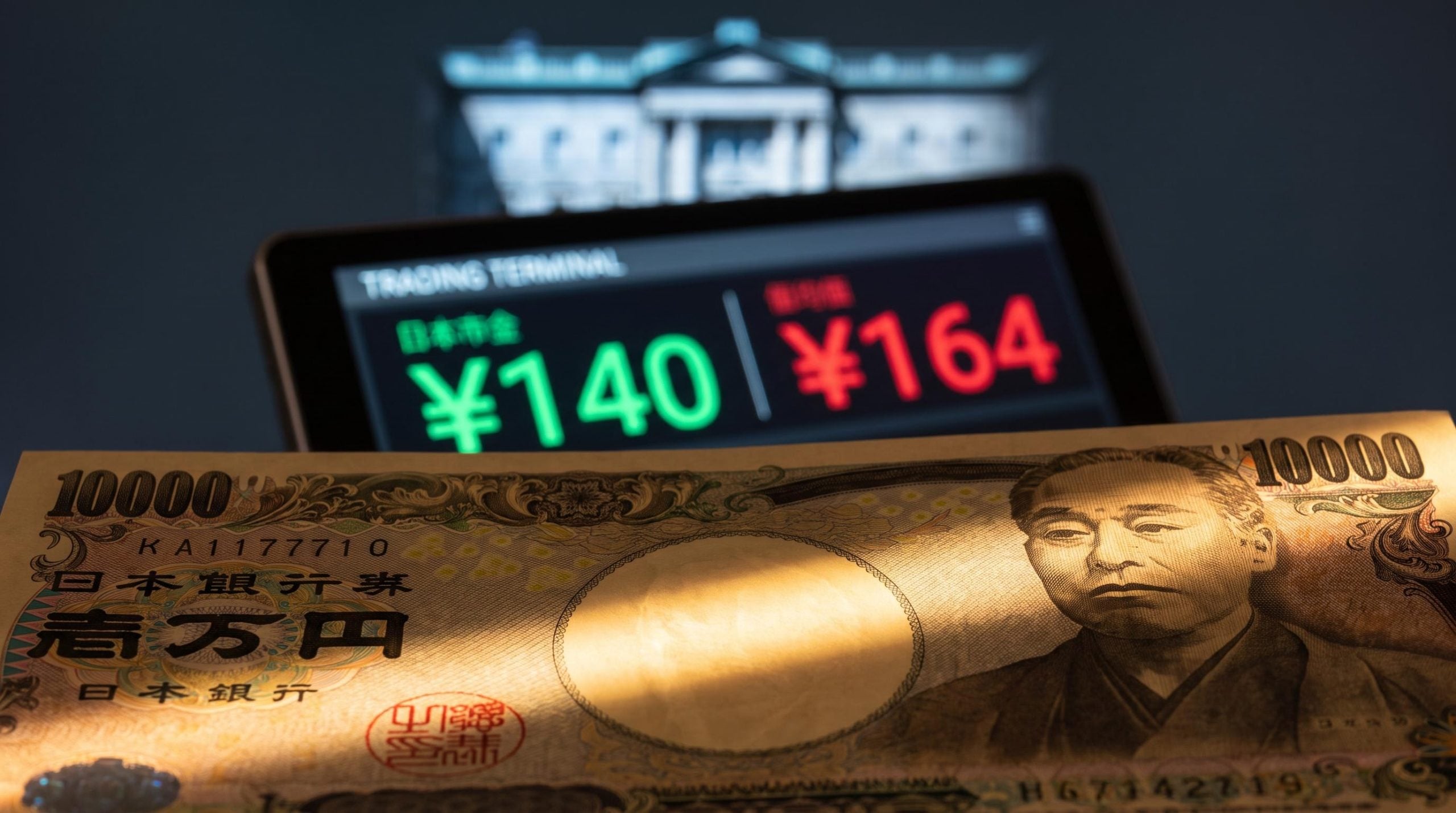
| State Street Global Advisors | Structural bullish | 140-145 (120-130 over 3-5 years) | Yen very cheap versus long-run fair value; repatriation and normalisation |
| J.P. Morgan | Cyclical limited | 164 | Persistent negative real rates, structural outflows, fiscal concerns |
The distance between those two numbers is not a rounding error. It is the difference between a portfolio positioned for a stronger yen and one bracing for renewed weakness.
That divide tells you consensus is genuinely broken. You cannot lean on an index average here; you have to choose which structural thesis you believe and size your exposure accordingly.
Past performance does not guarantee future results. Financial projections are subject to market conditions and various risk factors, and these forward-looking targets are speculative and subject to change based on policy and market developments.
Navigating currency exposure in a shifting rate environment
Three forces are pulling in the same direction: an accelerating central bank, the gravitational weight of pension repatriation, and the political cover provided by coordinated intervention. Together they explain why the summer rally happened and why it might be more than noise.
Japan equity market implications of yen appreciation cut in two directions: stronger domestic purchasing power and improved real wage growth support consumption, while compressed export margins squeeze the corporate earnings base that has driven Nikkei outperformance in local-currency terms through much of 2026.
Whether it sustains through the end of 2026 depends on convergence. The BoJ needs to keep tightening, the US-Japan yield gap needs to narrow, and global conditions need to cooperate. Absent all three, the structural drag of negative real rates and carry-trade funding can quietly reassert itself.
For actionable monitoring, two indicators sit above the rest. Watch this Friday’s BoJ guidance for confirmation that consecutive hikes are genuinely on the table, and track the US-Japan bond yield differential as the truest gauge of whether the fundamental case is strengthening or fading.
This article is for informational purposes only and should not be considered financial advice. Investors should conduct their own research and consult with financial professionals before making investment decisions.