
At a 3% mortgage rate, the arithmetic was straightforward. The S&P 500’s long-run 10% average annual return left a 7-percentage-point spread in favour of investing, and prepayment looked like an expensive form of conservatism. At 6.37% today, that spread has compressed to less than half a percentage point on an after-tax basis in a taxable account. Millions of homeowners are still operating on advice calibrated to a rate environment that no longer exists.
Between 2022 and 2025, roughly 15 million American households locked in mortgages at rates between 6% and 8%. For most of them, the conventional “invest the difference” guidance that proliferated during the 2020-2021 low-rate window is now directionally wrong, or at minimum, far less decisive. Financial planners have updated their frameworks. Many homeowners have not.
What follows is the actual scenario maths at current rates, an honest accounting of what each strategy wins and loses, and a sequenced decision framework calibrated to where rates stand in May 2026.
How rising mortgage rates rewrote the investing maths
In 2021, a homeowner carrying a 3% fixed mortgage and investing the difference in a broad index fund could reasonably expect a 7-percentage-point annual spread between investment returns and borrowing costs. That spread made the decision nearly automatic.
By May 2026, the 30-year fixed rate has climbed to 6.37%, according to the Freddie Mac Primary Mortgage Market Survey. Forward-looking return expectations have moved in the opposite direction. Vanguard’s April 2026 outlook projects 4%-5% annualised real returns through 2030. JPMorgan’s Q1 2026 guide estimates 5.8% annualised over ten years, roughly half the historical 10% average.
The Fed interest rate outlook matters directly to this decision: borrowers expecting rates to fall below 5% within two to three years may reassess refinancing timelines, which would change the effective cost of carrying a 6.37% mortgage and shift the break-even return threshold for the invest-first strategy.
For most borrowers, the effective cost of a 6.37% mortgage is the full 6.37%. The 2026 standard deduction of $30,000 for married filing jointly means most households cannot itemise, eliminating the mortgage interest deduction that once softened effective borrowing costs.
| Year | Mortgage Rate | Realistic After-Tax Return | Rate Spread |
|---|---|---|---|
| 2021 | 3.0% | ~7-8% | ~5 percentage points |
| 2026 | 6.37% | ~3-5% | Under 0.5 percentage points |
In a taxable account, the after-tax spread between expected investment returns and a 6.37% mortgage now sits below 0.5 percentage points, down from roughly 5 points five years ago.
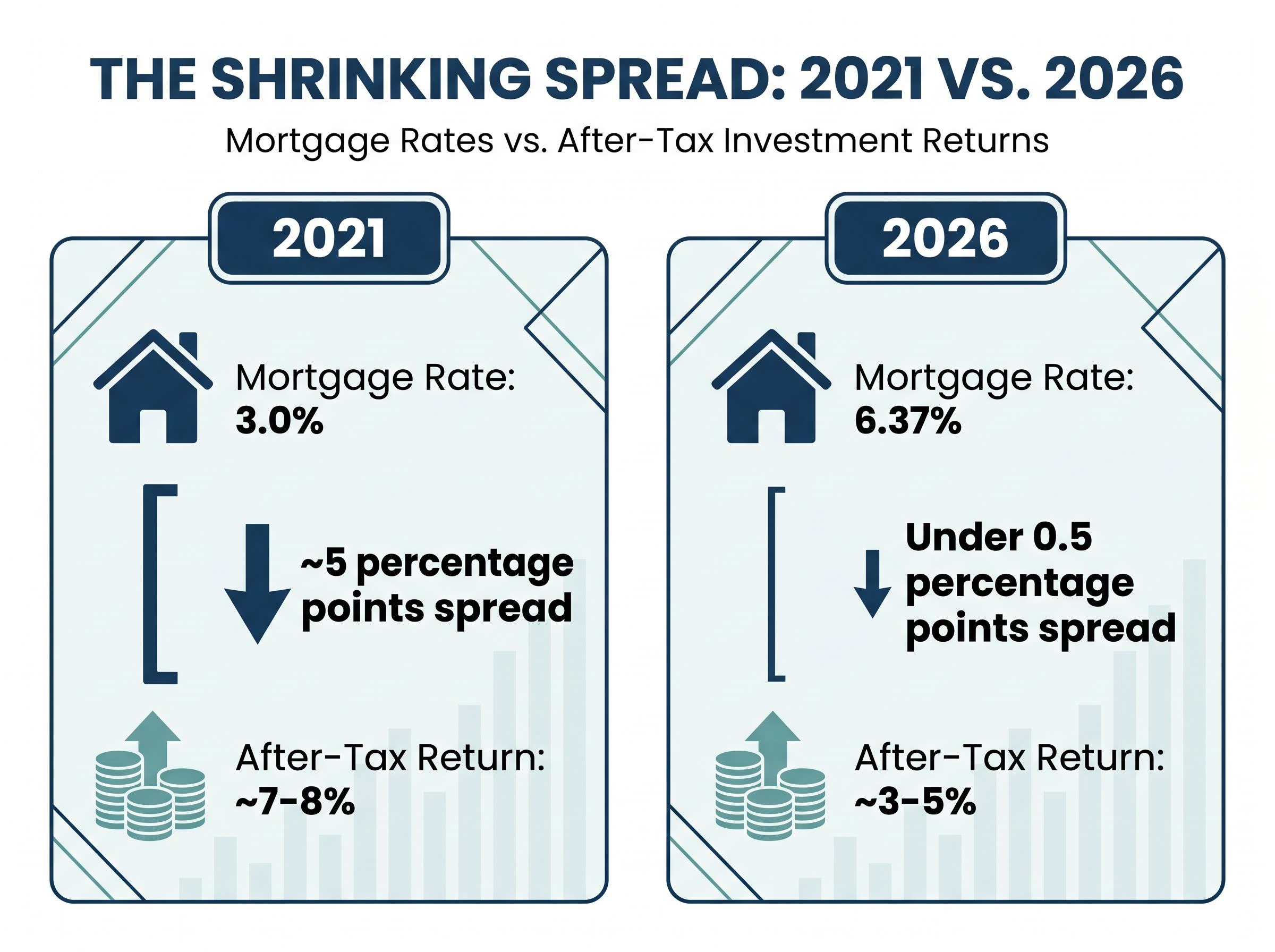
The compression is not a matter of opinion. It is a measurable shift in the financial arithmetic that once made carrying mortgage debt an easy decision.
When big ASX news breaks, our subscribers know first
What the 30-year scenario model actually shows
The assumptions behind the model
The scenario model uses the following starting conditions: a 35-year-old borrower earning $90,000 annually, purchasing a $400,000 home with 20% down, financed at 6.5% over 30 years. Monthly principal and interest on the $320,000 balance comes to approximately $2,022. The borrower has $500 per month in discretionary surplus.
Under the prepayment path, that $500 goes to additional principal each month. The mortgage is eliminated by year 18, freeing $2,522 per month for investing in years 18-30. Under the invest-first path, the $500 goes into a low-cost index fund for the full 30-year term while minimum mortgage payments continue on schedule.
These are modelled calculations, not guarantees. Actual outcomes depend on realised market returns, tax rates, and individual circumstances.
What the outcomes look like across return scenarios
At 7% annualised returns, the invest-first portfolio reaches approximately $612,000, while the prepayment portfolio accumulates roughly $560,000. After capital gains taxes (approximately $61,000 for the invest-first path versus $30,000 for the prepayment path), after-tax net worth lands at roughly $951,000 versus $930,000. The gap: about $21,000, or less than 2.5%.
The outcome, however, shifts entirely depending on realised returns.
| Market Return | Invest-First Net Worth | Prepayment Net Worth | Difference | Winner |
|---|---|---|---|---|
| 5% | ~$830,000 | ~$930,000 | ~$100,000 | Prepayment |
| 6% | ~$890,000 | ~$930,000 | ~$40,000 | Prepayment |
| 7% | ~$951,000 | ~$930,000 | ~$21,000 | Invest-first |
| 8% | ~$1,020,000 | ~$930,000 | ~$90,000 | Invest-first |
| 10% | ~$1,130,000 | ~$930,000 | ~$200,000 | Invest-first |
At a 10-year midpoint check, the prepayment borrower has reduced the remaining balance to roughly $28,000 versus approximately $260,000 still on schedule for the invest-first borrower. The investor holds roughly $87,000 in a brokerage portfolio.
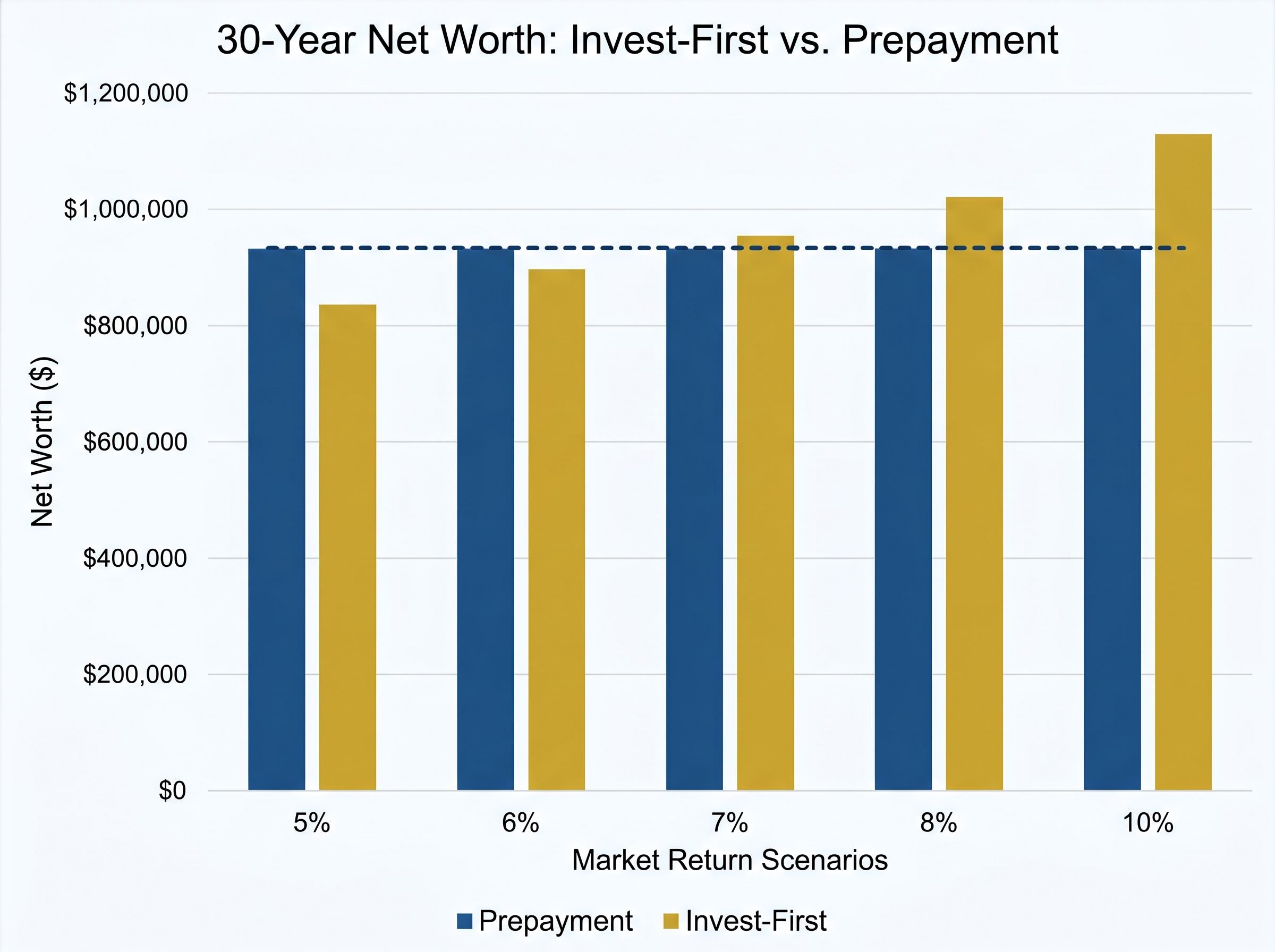
The sensitivity table is the article’s core finding. Neither strategy is a guaranteed winner. The outcome depends almost entirely on the actual market return achieved over 30 years, a variable that no one can predict with certainty.
Long-term compounding mechanics explain why the gap between invest-first and prepayment outcomes widens dramatically at higher return scenarios: the second decade of an uninterrupted investment generates nearly double the dollar gains of the first decade on the same initial capital, which is why the 10% return scenario in the sensitivity table produces a $200,000 advantage rather than a proportional one.
The quantitative case for prepaying a 6.37% mortgage
Each dollar applied to mortgage principal at 6.37% delivers a guaranteed, risk-free return equal to the interest that dollar would otherwise have cost. That 6.37% compares favourably to 2026’s alternative risk-free options:
The Freddie Mac Primary Mortgage Market Survey tracks weekly 30-year fixed-rate averages drawn from lenders across the country, making it the benchmark data source that mortgage analysts, financial planners, and policymakers use when assessing current borrowing costs against historical norms.
A guaranteed 6.37% return on prepaid mortgage principal, realised tax-free, exceeds the approximately 4% available from high-yield savings accounts and the roughly 4.5% Treasury yield available in May 2026.
The prepayment case rests on three distinct advantages:
- Guaranteed return rate: 6.37% on every prepaid dollar, with no market risk, no sequence-of-returns risk, and no dependence on forward valuations
- Tax-free realisation: Interest savings from prepayment trigger no capital gains event, unlike investment gains that face federal long-term capital gains rates of 15% plus applicable state taxes upon liquidation
- Retirement expense reduction: Eliminating a fixed $2,022 monthly obligation before age 65 removes a mandatory expense during the years when sequence-of-returns risk is most damaging to portfolio longevity
By year 5 under a prepayment strategy, approximately $38,000 in future interest has been eliminated from the loan’s lifetime cost.
The behavioural dimension reinforces the quantitative case. Research in behavioural finance consistently shows the average investor underperforms the broad market by approximately 1%-2% annually through panic selling and mistimed re-entry. That behavioural gap, applied to an already thin theoretical spread, can turn a marginal investing advantage into a realised loss relative to prepayment.
At current rates, prepayment has a quantitative foundation that was absent when mortgages cost 3%. It is a rational financial choice, not merely an emotional one.
Where the invest-first approach holds up and where the numbers turn against it
The strongest version of the investing case centres on tax-advantaged accounts. A 401(k) employer match delivers an immediate 50%-100% return on contributed dollars, a guaranteed return that exceeds any mortgage prepayment benefit regardless of rate. Tax-deferred or tax-free compounding within a 401(k) (up to the 2026 limit of $24,000 for those under 50) or an IRA (up to $7,000) can outperform the mortgage rate even in a compressed-spread environment.
The taxable account version is where the numbers become less favourable. Capital gains taxes on liquidation reduce the realised portfolio value, and the spread over a 6.37% mortgage in a taxable account is too thin to reliably absorb market volatility across a 30-year window.
Federal long-term capital gains rates of 15% apply to liquidated brokerage positions, and the capital gains tax treatment of investment portfolios could become more complex if state-level proposals gain traction, adding another layer of uncertainty to the after-tax return assumptions that underpin the invest-first case.
Three structural vulnerabilities weaken the taxable invest-first approach at current rates:
- After-tax realised returns of 3%-5% in a taxable account may not clear the 6.37% hurdle consistently
- Federal long-term capital gains rates of 15% (plus state taxes) reduce the terminal portfolio value at liquidation
- Behavioural underperformance of 1%-2% annually erodes the theoretical spread further
The liquidity argument, however, remains legitimate. A brokerage account can be converted to cash within approximately three business days.
| Method | Cost to Access $40,000 | Time to Access |
|---|---|---|
| Brokerage liquidation (year 12) | ~$3,000-$4,000 in capital gains tax | 3 business days |
| HELOC | $1,000-$3,000 closing costs + 8%-9% interest | 4-6 weeks |
For borrowers already heavily concentrated in real estate relative to financial assets, aggressive prepayment worsens portfolio diversification. A home is a single, geographically concentrated, illiquid asset that generates no income. Continued investing, even at higher rates, may improve overall portfolio balance for some borrowers.
What 2026 borrowers should actually do with surplus cash
Foundations that matter before the mortgage question arises
The mortgage-versus-invest question is not the first decision. It is the last one. Four prerequisites should be resolved before it enters the picture:
- Maintain an emergency fund of 3-6 months of living expenses in liquid savings before directing surplus cash anywhere else
- Capture the full employer 401(k) match, which delivers an immediate 50%-100% guaranteed return on contributed dollars
- Maximise tax-advantaged account contributions (401(k) up to $24,000; IRA up to $7,000 in 2026), where tax-sheltered compounding meaningfully outperforms after-tax alternatives
- Eliminate private mortgage insurance (PMI) if applicable, by reaching 20% equity, a high-return prepayment opportunity that typically exceeds the base mortgage rate
Only after these four steps have been addressed does the remaining discretionary surplus reach the investing-versus-prepayment question.
Where your mortgage rate determines the answer
At that final step, mortgage rate determines the answer:
- Under 5%: The spread favours investing. Borrowers with 2020-2021 vintage mortgages at 3%-4% have a clear mathematical case to invest the difference.
- Above 7%: The spread favours prepayment. The guaranteed return from principal reduction exceeds reasonable after-tax investment return expectations.
- 5%-7%: This is the grey zone where most 2022-2026 borrowers sit. The financial difference between strategies is small enough that risk tolerance and the psychological value of debt reduction become legitimate tiebreakers, not signs of irrational thinking. A split allocation, directing surplus cash partially to both prepayment and investing, is a defensible approach.
According to a CFP Board Q1 2026 survey, 55% of certified financial planners now recommend split strategies at current rates, allocating extra cash partially to both prepayment and investing.
An Ameriprise survey of more than 500 advisors found 62% now favour mortgage payoff over pure investing at rates above 6%, compared with just 28% in 2021. The professional consensus has shifted; the question is whether individual financial plans have shifted with it.
What the updated maths means for your next financial plan review
The 6%+ rate environment represents a genuine inflection point where the automatic “always invest” rule no longer applies. The scenario model presented above shows a total net worth gap of roughly $21,000 (under 2.5%) at 7% returns, a margin too thin to declare either strategy a clear winner.
The most common error is skipping the sequenced hierarchy and jumping directly to the mortgage-versus-invest question before capturing the guaranteed returns available from employer matches and tax-advantaged accounts. Those steps are unambiguous regardless of mortgage rate.
For homeowners operating on a financial plan designed before 2022, three actions are worth taking:
- Review the plan’s vintage: if it includes a fixed “invest vs. prepay” recommendation without reference to specific mortgage rate, it may need updating
- Verify tax-advantaged account status: confirm that 401(k) employer match is fully captured and contribution room is maximised before surplus cash goes elsewhere
- Identify mortgage rate tier: the answer for a borrower at 3.2% is categorically different from the answer at 6.5%
At 6.37%, neither strategy is reckless. The decision comes down to the reader’s actual numbers: their rate, their tax situation, and their available account types.
For readers who have determined that investing the difference is the right path at their rate tier and want a structured framework for executing it, our full explainer on long-term investment strategies covers dividend investing, index ETFs, international diversification, and the specific tax-advantaged account structures — including IRAs and 401(k) plans — that amplify compounding across a 20-30 year horizon.
This article is for informational purposes only and should not be considered financial advice. Investors should conduct their own research and consult with financial professionals before making investment decisions. Past performance does not guarantee future results. Financial projections are subject to market conditions and various risk factors.
—