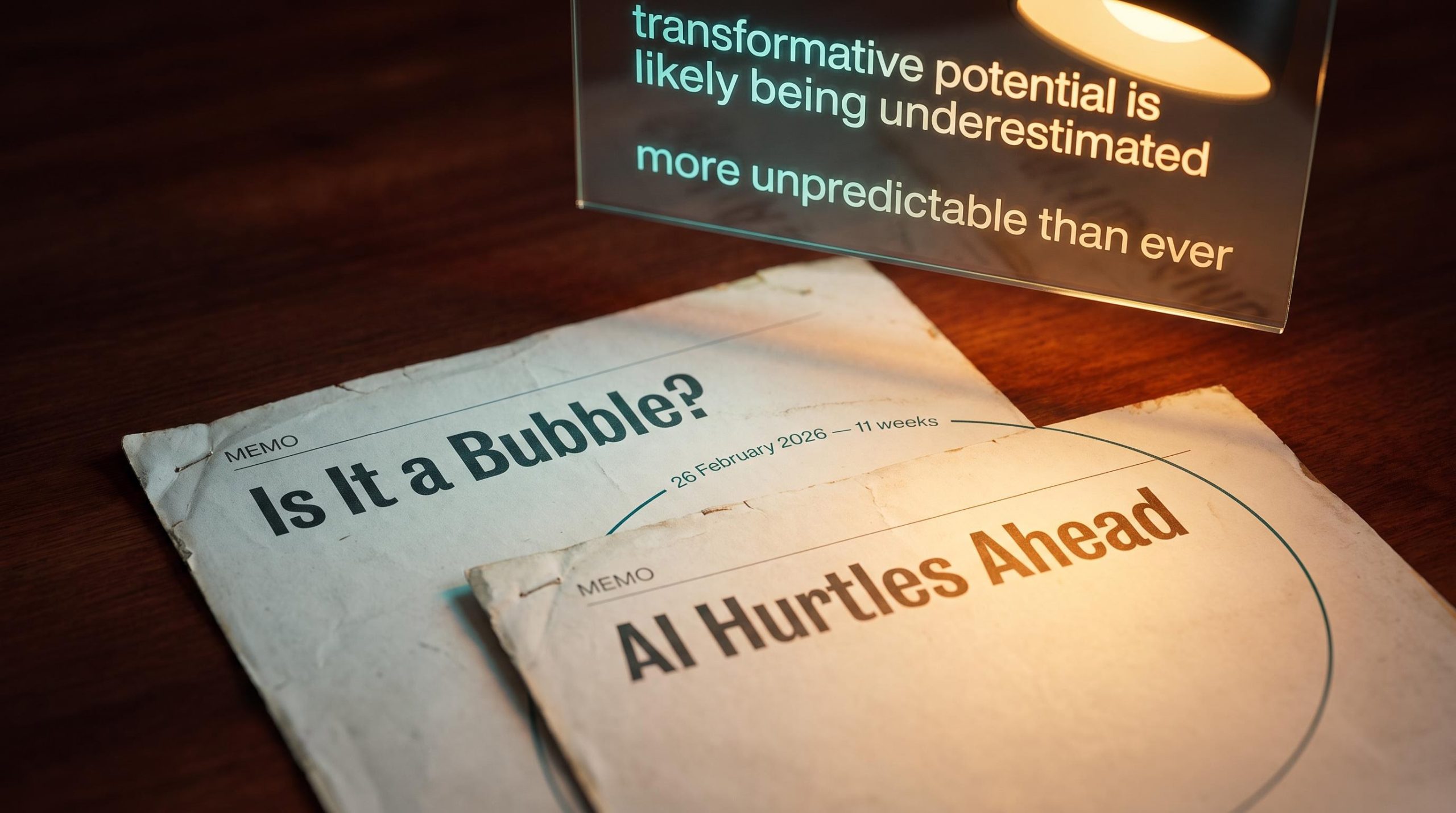
In late 2024, Howard Marks sat down to write a memo about artificial intelligence. The product, titled “Is It a Bubble?”, carried the measured scepticism his readers have come to expect from one of the sharpest risk assessors in institutional investing. Eleven weeks later, he told the world that memo needed to be effectively thrown out.
The gap between those two documents is the entry point for everything that follows. Marks is not a technologist guessing at software timelines. He is an investor whose entire intellectual framework rests on pattern recognition, cycle analysis, and the systematic assessment of what can go wrong. When that kind of thinker publishes a second memo saying AI makes the future “more unpredictable than ever,” the claim warrants more than a headline skim.
Here is the framework Marks has built for thinking about what AI actually changes for investors, drawn from his memos, his interviews, and the broader body of work that produced second-level thinking as a concept. It is less a prediction than a diagnostic tool, and the diagnosis it delivers is uncomfortable for most professionals in the industry.
The eleven-week reversal: what changed Marks’ mind
The catalyst was not a conference keynote or a sell-side research note. It was his son.
Andrew Marks, a venture capitalist who works directly with AI companies, reviewed the original memo in early February 2026 and told his father not to revise it but to rewrite it entirely. The technology had moved too fast for amendments. Marks took the advice, sat through a deep tutorial with Anthropic’s Claude model, and emerged with a categorically different view.
What specifically shifted his assessment were three qualities he had not expected to find in a machine system:
- The ability to contextualise information to a specific user, tailoring responses rather than delivering generic output
- Self-awareness of its own limitations, acknowledging what it did not know
- The capacity to incorporate humour, a quality Marks considered distinctly human
The result was “AI Hurtles Ahead”, published approximately 26 February 2026, roughly 11 weeks after the original sceptical memo.
The AI Hurtles Ahead memo, published by Oaktree Capital Management on 26 February 2026, sets out Marks’ full reasoning for why his prior scepticism required not revision but replacement, including his direct observations from working through Claude’s capabilities with his son Andrew.
Marks concluded that AI’s transformative potential is likely being underestimated, even as he questioned whether AI stocks are appropriately priced.
If a framework as disciplined as Marks’ could not hold for eleven weeks, that is itself a data point. The technology is moving faster than most professional investors are currently pricing into their assumptions about their own careers, let alone their portfolios.
When big ASX news breaks, our subscribers know first
Why AI is categorically different from the internet, the spreadsheet, and the algorithm
Every prior tool in the investor’s kit shares a common property. Spreadsheets, trading algorithms, quantitative screens, and databases all do exactly what a human programmer tells them to do. Their logic is transparent. Their boundaries are defined by whoever wrote the code. They are powerful servants, but they are servants.
For Marks, what sets AI apart comes down to one essential property: the capacity to act without being told how. Every prior technological wave, from railways to computers to the internet, produced tools that accelerated productivity but still required human specification of the task and method. AI breaks that pattern entirely. You can hand it a goal and it works out the approach on its own, sometimes generating and testing code in the process. That is a fundamentally different kind of capability, not a faster version of what came before.
- Prior technologies are rule-bound: a human specifies inputs, logic, and outputs
- Prior technologies are transparent: the reasoning can be fully inspected
- AI is objective-driven, self-directing, and open-ended: the system decides how to reach the goal
This is what Marks calls “Level 3 AI”, systems capable of full labour replacement rather than mere assistance, because they can execute complex tasks with minimal human direction.
What ‘autonomy’ actually means for investing
In Marks’ view, no previous innovation, the internet included, has left the future feeling so genuinely opaque and beyond prediction as AI does today. The reason is that AI’s trajectory is not merely fast. It is self-accelerating and potentially open-ended, which makes traditional 3-5 year forecasts almost meaningless. Whether AI’s current capability ceiling is defined or unbounded remains one of his central unresolved questions.
For readers accustomed to calibrating new technology by reference to prior waves, this changes the calibration instrument itself. The appropriate question is not “how big was the internet disruption” but “how do you plan for a technology whose trajectory you cannot bound.”
The passive indexing parallel: who AI will sort out
Index funds did not kill active management. They did something more precise: they exposed that most active managers were generating fees rather than alpha, because the majority underperformed simple benchmarks over time. The industry did not shrink because indexing was brilliant. It shrank because indexing revealed that much of what passed for skill was routine data processing dressed in the language of judgment.
The indexing parallel Marks draws is not a historical metaphor: active fund underperformance reached a two-decade extreme in 2026, with just 28% of large-cap managers beating the S&P 500 by mid-May, a figure that illustrates how the industry’s structural vulnerabilities were already widening before AI begins absorbing the analytical work those managers charge fees to perform.
Marks applies the same structural logic to AI. Investment processes centred on collecting publicly available information, constructing financial models, and screening stocks by ratio are doing precisely the work AI can absorb, completing it at greater speed, lower cost, and with none of the arithmetic slippage or emotional interference that affects human analysts.
One structural consequence of AI absorbing routine screening and pattern recognition across institutions is AI model convergence, where shared architectures and overlapping training data quietly create herding behaviour at scale, compressing routine inefficiencies on calm days while amplifying correlated exits when stress conditions arrive.
| The disrupting force | What it revealed | Who survived | Who was exposed |
|---|---|---|---|
| Passive index funds | Most active managers underperformed simple benchmarks | Managers with genuine, repeatable alpha | Managers charging active fees for market-average returns |
| AI systems | Conventional analysis (screening, modelling, ratio comparison) is commoditisable | Investors whose edge lives in judgment AI cannot replicate | Professionals whose claimed edge is mostly data-gathering and process complexity |
Marks has observed that many of the traits needed to be a “phenomenal investor,” including rapid data absorption, pattern recognition, and freedom from greed and fear, are now present in AI systems.
He expects a significant share of asset managers to be pushed out, with only those adding something AI cannot easily replicate continuing to justify their fees. The readers most at risk are those whose investment process, if honestly described, is primarily data-gathering and ratio-comparison dressed in the language of judgment.
Where the human moat holds: Marks’ three AI-resistant domains
The temptation here is to read the following as reassurance. It is not. Marks frames these three domains as genuinely demanding conditions that most investors will not meet, which means “human edge remains” is a qualified and narrowing claim.
- Judgment in genuinely novel situations. AI builds its capability substantially on learning from historical data and carrying those patterns forward. But markets periodically enter territory for which no usable history exists: new credit regimes, structural ruptures, or crises that superficially resemble the past while being fundamentally different in character. Profitable investing in those moments has always required recognising what makes the current environment unlike prior ones, rather than assuming the old patterns hold. Marks sees that kind of off-pattern reasoning as among the hardest things for AI to replicate.
- Qualitative, human-centred assessment. Tasks like evaluating management quality, reading counterparties, and judging whether a business’s stated competitive advantage is real involve rich, unstructured, interpersonal information that does not fit neatly into data fields.
- Skin in the game. AI models have no capital at stake, no visceral sense of loss, and do not feel fear or regret. Marks believes that having money and reputation on the line shapes decision-making in ways that may be important for prudent risk-taking under deep uncertainty.
The instinct that cannot be quantified
Marks has pointed to the kind of intuitive judgment seasoned investors bring to assessing counterparties, an unquantifiable read on a situation that resists easy explanation or instruction, as one area where human experience may retain real value. This surfaces in practical contexts: reading whether a CEO’s confidence is genuine or performed, evaluating incentive structures in a deal negotiation, judging whether a business’s stated moat is real or aspirational.
These three domains are not a hedge against AI. They are a filter. Most readers should use them to honestly assess whether their claimed edge actually lives in one of these categories or whether it lives in the data-gathering territory AI is already absorbing. The investors who survive, as Marks frames it, will be “strong where AI is weakest”: in understanding people, incentives, and qualitative nuance.
Whether machines can replicate what elite investors do by instinct
Marks defines second-level thinking as the disciplined capacity to reach conclusions that diverge from the consensus and, crucially, to be right about that divergence consistently over time. Ordinary analysis tends to arrive at the conclusions the market has already absorbed. The second-level thinker identifies specifically where the prevailing view misprices a company’s quality, its growth prospects, its earnings power, or the multiple it warrants, and then bets on that independent assessment, repeatedly and correctly.
Marks has long argued that this skill cannot be reliably taught. Explaining its importance is straightforward, as is walking someone through the logic of why non-consensus thinking generates alpha. What cannot be transferred, in his view, is the underlying capacity itself: the ability to form correct views that deviate from what the market has concluded, and to do so with enough consistency to matter.
He compared investment insight to height in basketball: a quality that coaching cannot create. Some people possess it innately, and others do not. He referenced Steve Cohen being described as intuitively attuned to market movements from a young age as illustrative of that innate quality.
AI forces the sharpest version of this question. If second-level thinking cannot be taught to most humans, can it be trained into a machine? This connects directly to the concept of artificial general intelligence (AGI), which refers to the threshold at which machine capability would encompass the full range of human cognition, including the kind of investing intuition that has historically driven enduring outperformance. Marks’ position is honest uncertainty. AI already mimics aspects of the synthesis that investors like Buffett and Munger are known for. But whether it can genuinely replicate the intuitive, non-consensus insight that drives enduring outperformance remains unknown, and Marks treats that uncertainty with real humility.
The AGI question is not a philosophical detachment from practical investing. It is the most consequential variable in every investor’s 10-year career calculus, because the answer determines whether the domains Marks identifies as human-edge moats remain durable or are eventually absorbed entirely.
The unpredictability Marks emphasises has a practical corollary for portfolio construction: tail risk hedging strategies like collars and long-dated puts become structurally more attractive when forecasting tools, including AI systems themselves, are shown to compress away precisely the low-probability outcomes that carry the most destructive potential.
What Marks’ framework actually tells investors to do now
Marks keeps a sharp distinction between AI as a transformative technology and AI-related stocks as investments. His warning is direct: transforming the world and generating returns for shareholders are “not synonymous.” Productivity revolutions do not automatically translate into high investment returns.
Marks keeps a sharp distinction between AI as a transformative technology and AI-related stocks as investments, a tension that sits at the core of price vs value investing: the quality of the underlying asset and the price paid for it are separate questions, and conflating them has historically destroyed more wealth than any single market downturn.
His practical stance is three-part: not all-in (risk of ruin), not all-out (risk of missing a generational leap), but moderate and selective exposure focused on profitable, established technology companies with durable cash flows rather than lottery-ticket narratives. He warns explicitly against moonshot investing in unprofitable AI startups.
The deeper contribution, though, is the diagnostic framework his thinking implies:
| Layer | What AI does to it | Who is affected | What survival looks like |
|---|---|---|---|
| Raising the floor | Commoditises data gathering, screening, routine modelling, and standard pattern recognition | Any investor whose edge rested on doing these tasks competently rather than brilliantly | Adopting AI as infrastructure and competing on higher-order judgment |
| Exposing false edge | Reveals that process complexity and spreadsheet sophistication are not the same as alpha generation | Managers charging active fees for what AI can replicate faster and cheaper | Demonstrating returns that survive the removal of routine analytical advantage |
| AI-resistant domains | Cannot reliably replicate judgment in novel situations, qualitative assessment of people, or genuine second-level thinking | Investors whose edge genuinely lives here (a small minority) | Doubling down on human moat activities and being honest about what is and is not replicable |
The question Marks’ framework implicitly poses to every professional investor: what do you do that a powerful, data-hungry, emotionally neutral AI cannot eventually replicate?
The reader who finds their edge described in the first two layers has received a warning, not a historical observation.
This article is for informational purposes only and should not be considered financial advice. Investors should conduct their own research and consult with financial professionals before making investment decisions.
These statements reflect Howard Marks’ views as expressed in his memos and interviews. Forward-looking assessments of AI’s trajectory and market impact are speculative and subject to change based on technological developments and market conditions.
What the framework cannot resolve, and why that matters more than the answers it gives
Marks’ core contribution is not a prediction about AI’s trajectory. It is a coherent framework for identifying where human judgment is genuinely irreplaceable versus where it is merely habitual. What remains genuinely open in his own thinking, the AGI question, the capability ceiling, whether any current human moat survives at full artificial general intelligence, is part of the framework’s value, not a weakness. When an investor known for methodically mapping risk states openly admits the future is fundamentally unknowable, the intellectual honesty itself is informative.
The investors best positioned in the AI era are those who do the hard introspective work now, before competitive pressure forces the question. Marks’ framework does not tell you what AI will become. It tells you what to ask yourself while there is still time to act on the answer.