Markets are pricing ECB tightening that Capital Economics says will never arrive. With the deposit rate at 2.50% following the September 2026 hike, traders have built a more aggressive path into forward curves than one prominent research firm believes the economic fundamentals justify.
Eurozone headline inflation reached 3.2% in August 2026, up from 2.9% in July, a move that has reinforced hawkish sentiment. Capital Economics argues the composition of that surge matters more than its headline level: energy costs, not wages, are doing most of the work, and that distinction carries large consequences for how far the ECB actually needs to go.
Here is what the inflation debate that institutional actors are currently having means for anyone trying to read the ECB’s next move, with the specific numbers that separate Capital Economics’ forecast from the market consensus laid out clearly.
Why Capital Economics thinks markets have got the ECB wrong
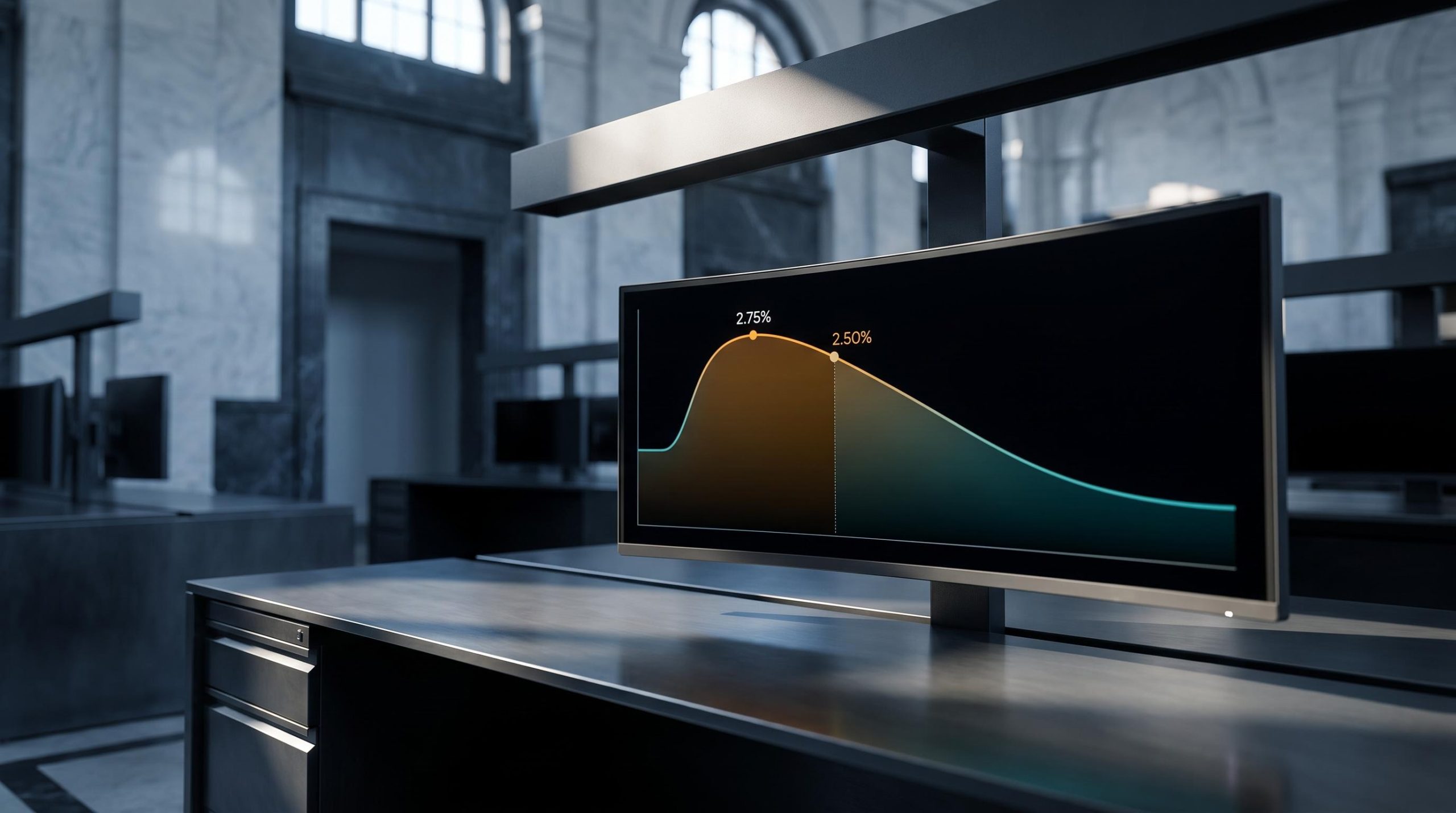
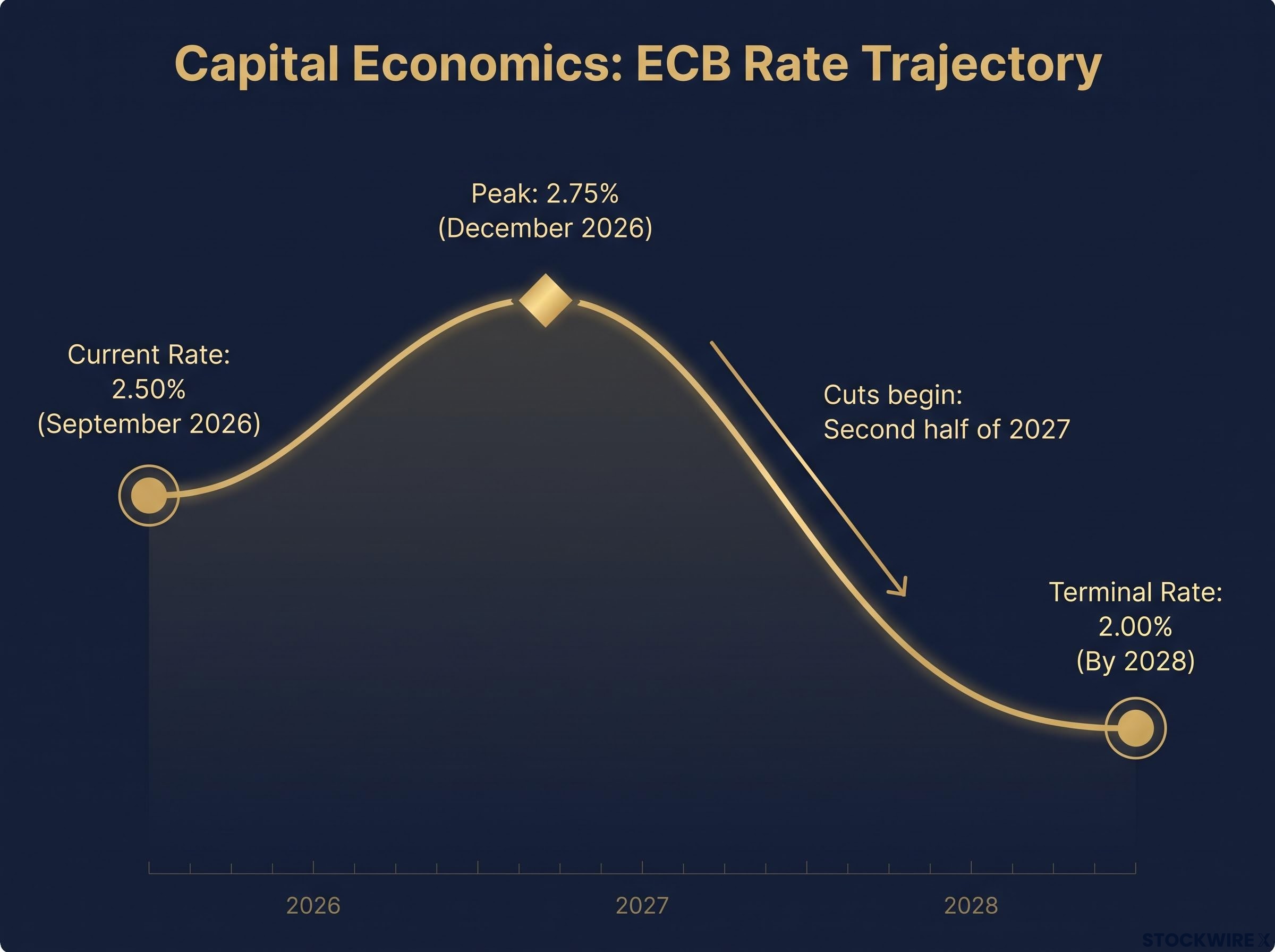
The ECB Governing Council lifted the deposit rate to 2.50% on 10 September 2026, effective 16 September 2026. Capital Economics believes the central bank has only one more move in it, a hike to 2.75% in December 2026, before a cutting cycle begins.
The ECB rate corridor, which separates the deposit facility, main refinancing, and marginal lending rates, means the deposit facility rate is the operative number that reprices overnight borrowing costs across the entire eurozone banking system, and it is the figure that makes Capital Economics’ 2.75% peak forecast so consequential for duration-sensitive assets.
That is where the disagreement opens up. Market pricing has built in a more aggressive tightening path, while Capital Economics sees the deposit rate falling back to a terminal 2.00% by 2028, with cuts starting in the second half of 2027.
The ECB’s September 2026 monetary policy statement confirmed the deposit rate move to 2.50% and published the Governing Council’s baseline projections for inflation and growth, the same figures Capital Economics is now arguing markets have misread as a signal of more tightening to come.
The distance between those two positions is not a rounding error. It is the entire analytical stake of this debate.
| Scenario | Current Rate (Sep 2026) | Projected Peak | Peak Timing | Terminal Rate |
|---|---|---|---|---|
| Capital Economics | 2.50% | 2.75% | Dec 2026 | 2.00% by 2028 |
| ECB current setting | 2.50% | Not disclosed | Data-dependent | Not disclosed |
Capital Economics’ dovish stance rests on a single diagnostic. The firm reads the inflation surge as energy-driven rather than demand-driven, and it argues that the ECB’s toolkit, built for cooling excess demand, is poorly matched to supply-side price shocks it cannot control.
That framing matters because it changes what “success” looks like. If inflation is being pushed up by the cost of imported energy, raising rates does little to bring it down and a great deal to weaken an already fragile economy.
Capital Economics projects a terminal deposit rate of 2.00% by 2028, below the trajectory currently embedded in market pricing.
Here is what the gap means for you. One of these two positions will be wrong by a material margin, and if Capital Economics is right, markets are overpriced for tightening that will not materialise. That has direct consequences for anyone holding duration-sensitive assets, watching eurozone bond yields, or trying to read ECB forward guidance for a euro position.
When big ASX news breaks, our subscribers know first
What the inflation data actually shows, and what it does not
Open the inflation file and the first thing worth separating is the headline number from the core number. Headline HICP, the broadest measure of consumer prices, ran at 3.2% in August 2026. Core HICPX, which strips out volatile energy and food, sat at 2.4% over the same month, according to the ECB’s September 2026 projections.
That gap is the whole argument. Headline inflation is elevated; underlying inflation, the part driven by wages and services rather than a barrel of oil, is far closer to the ECB’s 2% target.
The distinction between headline versus core HICP is not merely technical: energy accounts for roughly 9% of the eurozone basket, meaning even a 20% energy price surge can only mechanically contribute around 1.8 percentage points to the headline reading, which is why the August 3.2% print and the 2.4% core figure are telling fundamentally different stories about underlying price dynamics.
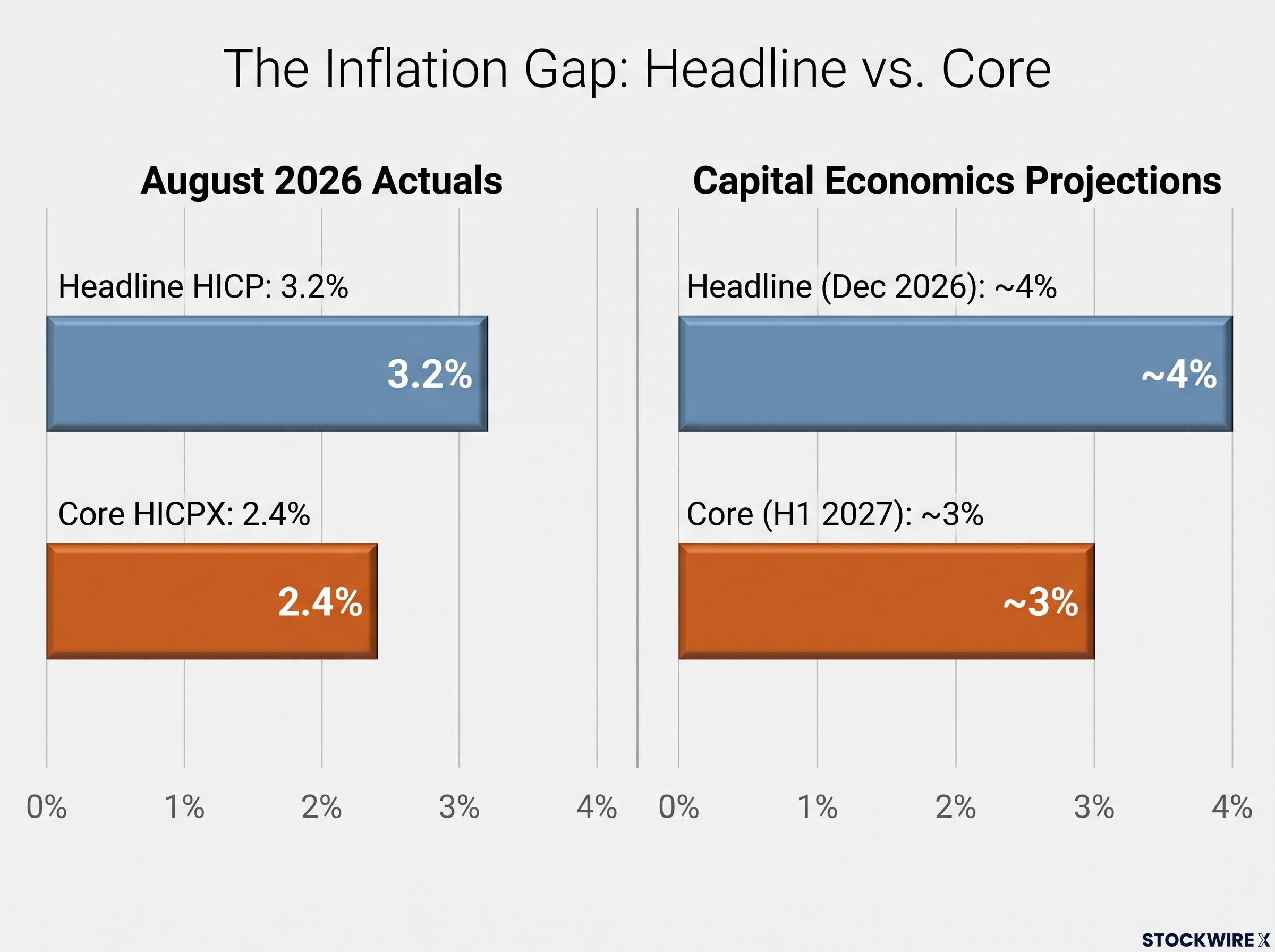
Notably, Capital Economics is not dismissing the near-term surge. The firm projects headline inflation climbing to around 4% by December 2026, with core reaching approximately 3% in the first half of 2027 as indirect energy cost pass-through works its way through the economy. Even the dovish camp sees prices getting worse before they get better.
The difference is what comes after the peak. Capital Economics, the ECB, and the IMF all expect a pronounced decline back toward target once the energy effect fades.
| Institution | 2026 | 2027 | 2028 | Key assumption |
|---|---|---|---|---|
| ECB/Eurosystem (Jun 2026) | 3.0% | 2.3% | 2.0% | Energy normalises, expectations anchored |
| IMF (Jul 2026) | 2.9% | 2.3% | Not disclosed | No major new energy disruption |
| Capital Economics | ~4% (Dec reading) | Core peak ~3% H1 | Toward 2% | Surge is transitory, energy-led |
The core-versus-headline split is the crux. If you accept that 2.4% core is consistent with gradual disinflation, the dovish case holds. If you believe structural forces are keeping core sticky above target, the longer-for-higher view becomes far more defensible.
The case for and against calling this transitory
The transitory camp points to a clean sequence: an energy-driven headline, moderating wage growth, inflation expectations that remain anchored, and second-round effects held in check by weak aggregate demand. On this reading, the current spike is a pass-through event that fades on its own.
The structural camp reads the same data differently. ECB Executive Board member Isabel Schnabel has argued since 2022 that Europe faces a “new age of energy inflation,” in which the green transition and geopolitical fragmentation keep energy prices structurally higher rather than delivering a one-off shock.
Research from the Bank for International Settlements (BIS) reinforces the point from another angle, linking deglobalisation and reshoring, the relocation of supply chains closer to home, to persistently higher production costs. Add elevated corporate margins that suggest durable pricing power, and the argument for sticky core inflation gains weight.
Both readings are internally consistent. Which one you find persuasive determines whether you see the ECB as nearly finished or as still fighting.
Labour markets, growth, and why Capital Economics is not alarmed by second-round effects
The load-bearing column of the dovish thesis is not inflation at all. It is the state of the labour market and the growth backdrop, because that is what determines whether a wage-price spiral can actually take hold.
Capital Economics views the eurozone labour market as having sufficient slack and sees no evidence that overall spending is pushing up against the limits of productive capacity. In plain terms, there is not enough heat in the economy to sustain the feedback loop where higher wages drive higher prices, which then drive higher wages again.
The growth numbers back that up. The ECB’s September 2026 baseline puts GDP growth at just 0.9% for 2026, Capital Economics has it at 1.0%, and the IMF at 0.9%. Every institution sees sub-trend growth.
| Institution | 2026 | 2027 | 2028 |
|---|---|---|---|
| ECB (Sep 2026 Bulletin) | 0.9% | 1.4% | 1.5% |
| IMF (Jul 2026) | 0.9% | 1.2% | Not disclosed |
| Capital Economics | 1.0% | 1.1% | 1.0% |
The IMF adds a sobering footnote: its 2026 and 2027 figures sit 0.5 and 0.2 percentage points below pre-war estimates, a reminder of how much geopolitical disruption has already cost European output.
The hawkish counterpoint lives in the wage data. Collective bargaining outcomes in 2023-2024 frequently landed in the 4-5% range, high enough to look alarming in isolation. Capital Economics counters that negotiated wage growth is slowing and that labour-intensive sectors are softening, evidence that the wage peak has passed rather than a signal it is building.
The firm identifies four conditions it expects to keep second-round effects contained:
- Weak aggregate demand across the euro area
- A labour market it does not assess as tight
- Slowing negotiated wage growth after the 2024 peak
- Cooling activity in labour-intensive sectors
The read you should take from this is straightforward. Sub-1% growth alongside a labour market that is not overheating means the conditions that usually generate self-sustaining wage-price spirals are largely absent, so current inflation readings do not, on their own, justify the rate path markets have priced. If you are tracking the ECB, negotiated wage settlements and quarterly GDP prints are the leading indicators to watch.
The Hormuz stress test: Capital Economics’ key risk scenario and why it does not change the conclusion
Every dovish thesis needs a stress test, and Capital Economics names its own. An extended disruption to energy flows through the Strait of Hormuz, a chokepoint for global oil and liquefied natural gas, is the clearest upside risk to its inflation call.
The transmission is direct. A prolonged blockage would push global oil and gas prices higher, and Europe is particularly exposed through its reliance on imported gas and refined products. Higher energy prices feed straight into the HICP energy component and then bleed into transport, production, and food costs.
The Hormuz shipping disruption is considerably more severe than headline ceasefire declarations imply: commercial transits collapsed to 3-14 vessels per day against a pre-war norm of 120-140, war-risk insurance premiums are running at roughly 30 times normal rates, and bypass pipeline capacity can cover only about 9 million of the 20 million barrels per day Hormuz normally carries.
Under that stress case, Capital Economics expects headline inflation could approach or exceed 4% for an extended period rather than as a brief peak. That is a genuine shock to the baseline, not a footnote.
Here is where the firm’s reasoning holds. The firm’s position is that subdued household spending and a labour market with room to absorb shocks would prevent price pressures from becoming self-reinforcing, keeping the case for additional tightening beyond the single projected hike weak.
The contrast between the two scenarios is worth laying out:
- Energy price path: Baseline assumes no major new disruption; stress case assumes energy prices materially above forward curves
- Headline inflation peak: Baseline near 4% briefly in December 2026; stress case near or above 4% for an extended period
- ECB rate response: Baseline one hike to 2.75%; stress case the same hike, delayed cuts
- Second-round effects: Contained in both, buffered by demand weakness
The 2022-2023 precedent shows the ECB would keep rates higher for longer if wage and expectations data signalled significant spillovers. Capital Economics judges those conditions unlikely to materialise even under a Hormuz shock, because the demand simply is not there to sustain them.
Capital Economics’ core stress-case conclusion is that second-round effects remain contained even under adverse energy conditions, because weak consumer demand and a soft labour market act as buffers.
What this means for you is a lower ceiling on ECB tightening than markets assume, regardless of which energy scenario plays out. Under the firm’s logic, further rate-hike pricing is more likely to unwind than to extend, even if the worst-case energy shock arrives.
What the transitory-versus-structural debate means in practice
An institutional debate is only useful if you can turn it into something to watch. Both camps have made testable claims, which means the next four to six quarters of data will do most of the arguing.
The structural argument carries a specific vulnerability. It requires persistent energy price elevation, an active wage-price feedback loop, and resilient demand to hold simultaneously. The current 0.9% GDP growth backdrop makes that trio difficult to sustain, because weak demand tends to break the wage-price link before it becomes self-reinforcing.
Capital Economics’ projected cutting cycle, beginning in the second half of 2027 and reaching a 2.00% terminal rate by 2028, is best treated as a testable hypothesis rather than a certainty. Knowing which data series confirm or crack it lets you track the thesis in real time rather than waiting for the ECB to deliver a retrospective verdict.
Signals that would confirm the dovish thesis
- Negotiated wage growth decelerating toward the 2.5-3% range in 2027 settlements
- Monthly core HICPX prints trending toward 2% through 2027
- ECB Governing Council shifting its language from “sufficiently restrictive” toward “calibrating normalisation”
- GDP growth holding near or below 1% through 2026-2027, limiting demand-side pressure
Signals that would challenge it
- Core HICPX holding persistently above 2.5% into 2027
- Renewed acceleration in negotiated wage outcomes following the 2024 peak
- The ECB removing or qualifying its forward guidance on rate normalisation
- An extended Strait of Hormuz disruption pushing energy prices materially above current forward curves for more than one quarter
The practical value is that ECB communications and eurozone data releases become legible rather than ambiguous. You are no longer reacting to the headline inflation number; you are watching the specific series that decide the argument.
One more hike, then a long descent: where Capital Economics’ rate call stands
Strip the analysis to its spine and the picture is clean. The ECB is close to done, the argument for further tightening is narrow and conditional, and the more consequential question is now the speed and depth of the cutting cycle rather than the height of the peak.
The neutral rate debate adds a second layer of uncertainty beneath Capital Economics’ peak call: if the eurozone nominal neutral rate sits anywhere in the 2%-3% model range, a deposit rate of 2.50% may already be mildly restrictive or may still be accommodative, and that uncertainty is precisely what makes Bundesbank President Nagel’s deliberate ambiguity on forward guidance so difficult to trade around.
Capital Economics’ full projected path: 2.50% now, a peak of 2.75% in December 2026, then a descent to a 2.00% terminal rate by 2028.
For the market’s more hawkish pricing to prove correct, one of two things must happen. Either structural wage-price dynamics take hold that the current 0.9% growth and untight labour market do not support, or an energy disruption arrives large enough to unanchor expectations despite weak demand. Neither condition is present in the data as it stands, with headline HICP at 3.2% and core at 2.4%.
That is a meaningful distinction from simple uncertainty. The conclusion is not that Capital Economics is definitely right, but that the specific conditions the hawkish case needs are absent right now.
For you, that points to where policy risk is asymmetric: more likely to undershoot market-priced tightening than to overshoot it. Reading ECB communications and eurozone data with that calibrated prior, rather than the headline inflation figure alone, is the practical takeaway.
This article is for informational purposes only and should not be considered financial advice. Investors should conduct their own research and consult with financial professionals before making investment decisions. Past performance does not guarantee future results. Financial projections are subject to market conditions and various risk factors, and forecasts discussed here are speculative and subject to change based on economic developments.