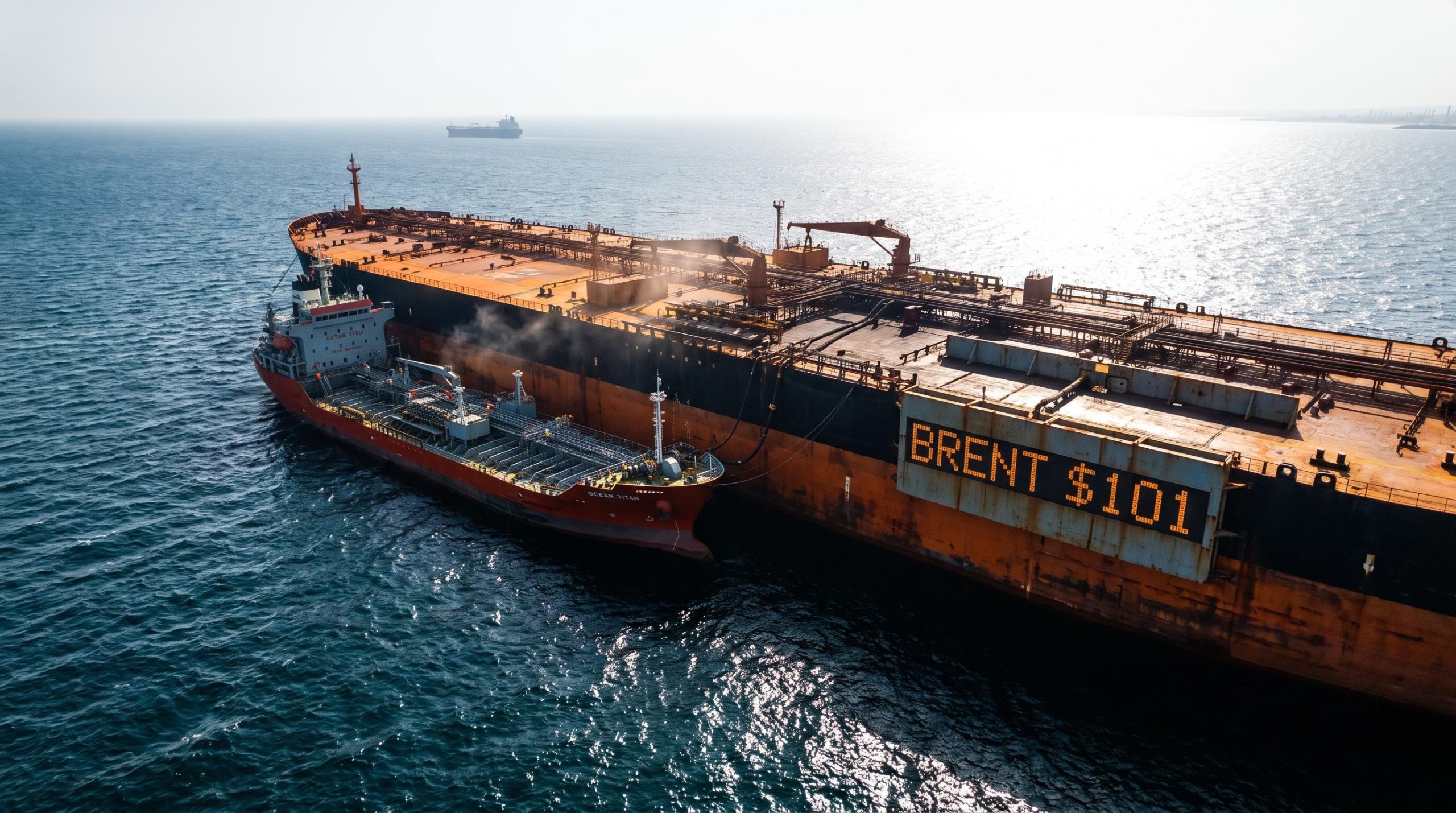
Vessel traffic through one of the world’s most important oil corridors has collapsed by roughly 95%, yet global energy markets have not seized up. They have adapted.
That adaptation carries a price. As of late September 2026, Brent crude is holding above $101 per barrel and US benchmark WTI is trading in the low $90s, a level that reflects compounding pressure from live military conflict in the Gulf and political maneuvering in Washington.
This is the paradox at the heart of the current global oil market squeeze: barrels are still moving, but the cost and risk of moving them have been fundamentally reset.
What follows here is a framework for understanding how a distant geopolitical conflict translates into local scarcity, why traders at a single storage hub in Oklahoma are paying record premiums, and why a politically popular fix being floated in the US could make the volatility worse, not better.
The physical reality of the Strait of Hormuz bottleneck
Start with the water. The most useful way to grasp this crisis is not through the price ticker but through the shipping lanes, because the physical logistics tell you what the price is actually responding to.
Vessel traffic through the Strait of Hormuz has fallen to roughly five ships per day, a drop of approximately 90-95% from pre-conflict baselines, according to a UK Maritime Trade Operations weekly report summarised by Ahram Online on 19 September 2026. Al Jazeera described the strait as, in effect, closed.
The danger is not abstract. UKMTO data records 83 Iran-US conflict-related incidents and 39 piracy attacks in regional waters since 28 February 2026. Reuters reporting from July documented tankers struck by Iranian missiles and traffic near a standstill following renewed airstrikes.
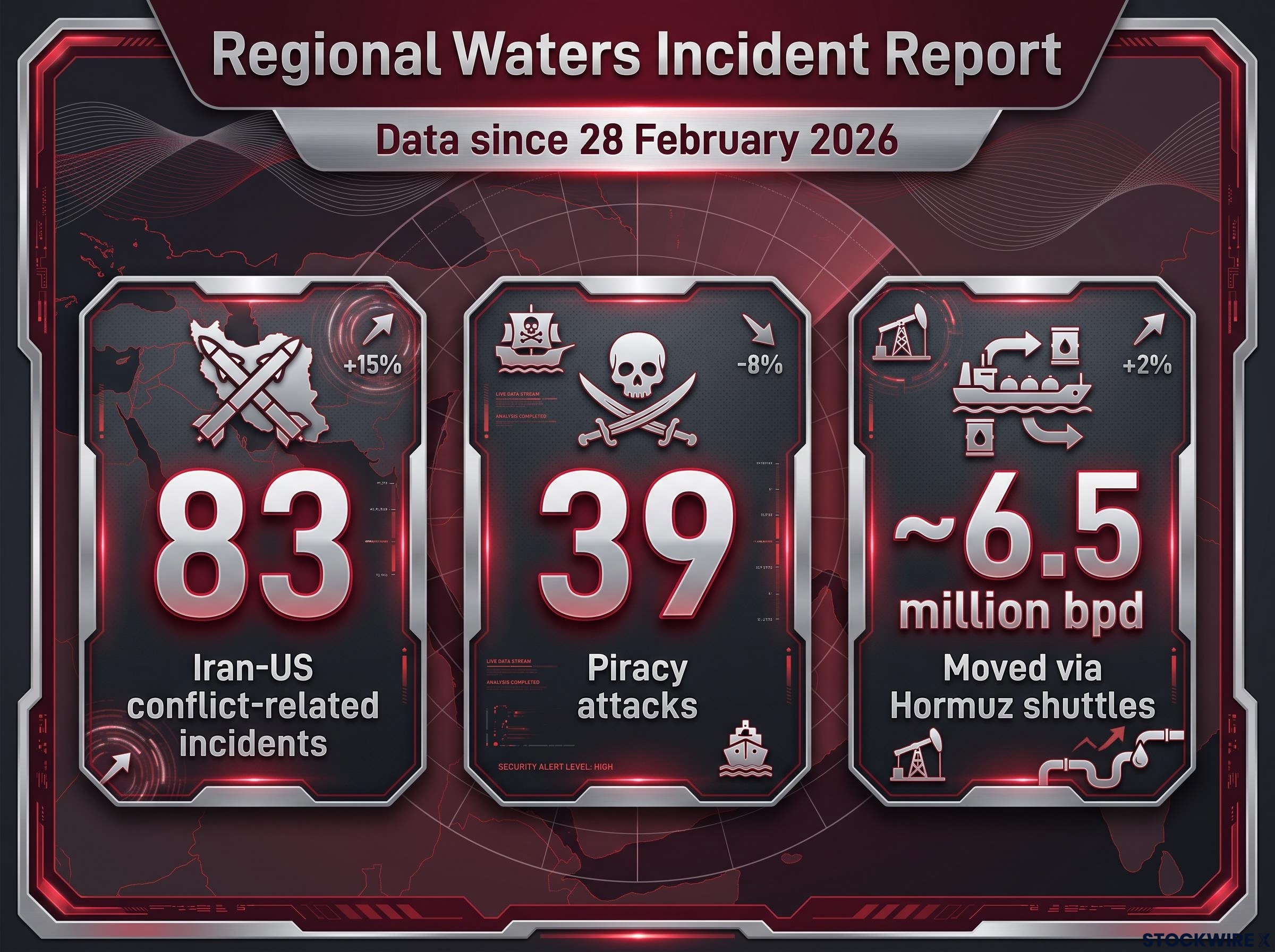
Yet crude is still reaching market. Exporters have moved approximately 6.5 million barrels per day through the region in September using ship-to-ship “Hormuz shuttles”, loading in the Gulf and transferring cargo to longer-haul tankers in the safer waters of the Gulf of Oman, according to Reuters commentary on 21 September 2026.
| Metric | Pre-Conflict Baseline | September 2026 Reality |
|---|---|---|
| Gulf crude exports | ~17 million bpd (2025) | ~9 million bpd (August 2026) |
| Daily vessel traffic | Normal transit levels | ~5 ships per day (down ~95%) |
| Direct crude flows via strait | Full throughput | ~2.2 million bpd |
This is the distinction that mainstream headlines flatten. The strait is not sealed shut; it is an expensive, constrained, high-risk supply chain that still functions through logistical improvisation.
Available bypass pipeline capacity through Saudi Arabia’s East-West line and the UAE’s Habshan-Fujairah route totals roughly 9 million barrels per day, leaving a structural gap of approximately 11 million barrels per day against Hormuz’s pre-war throughput, which is why no infrastructure workaround can substitute for a genuine reopening of the strait.
What this means for you is straightforward. The global oil supply has not stopped, but the operational cost and danger of moving each barrel have permanently lifted the baseline price of every energy asset in your portfolio. The premium is no longer a spike. It is a new floor.
When big ASX news breaks, our subscribers know first
Decoding the mechanics of crude oil risk premiums
Why does a bottleneck in one narrow waterway move the price of oil produced thousands of miles away? Understanding the transmission mechanism is what separates temporary headline noise from a sustained market shift.
The Strait of Hormuz is a structural chokepoint. The International Energy Agency (IEA) and the US Energy Information Administration (EIA) consistently classify it as one of the world’s most critical, because traditionally around one-fifth of globally traded oil must pass through it, and no alternative route exists at comparable scale.
When that chokepoint is threatened, the disruption infects Brent crude, the global benchmark, through two separate channels stacked on top of each other.
The first is the physical quantity effect: fewer barrels clearing per unit of time. The second is a risk and freight premium, and this is the part investors often miss. Lloyd’s List described crude tanker spot rates on 23 September 2026 as “astronomical”, and those elevated freight and insurance costs are immediately capitalised into the delivered price of every marginal barrel.
The result is that Brent is now carrying two things at once: a real supply-demand imbalance, and a forward-looking bet on how much worse the conflict might get. History shows this pattern is not new.
Goldman Sachs estimates approximately $14 per barrel of the current crude price is a geopolitical risk premium tied to the Hormuz crisis rather than any change in underlying supply and demand fundamentals, a distinction that matters because premiums built on fear can collapse within 24 hours of a credible de-escalation signal.
- 1980s Tanker War: During the Iran-Iraq conflict, both sides attacked tankers around Hormuz, raising insurance costs and reducing throughput. Flows were disrupted but never eliminated.
- 2019 tanker attacks: A series of mine attacks and vessel seizures near the strait triggered repeated price spikes as traders priced in the risk of closure, even as volumes largely kept flowing.
- 1973 Arab oil embargo: Not specific to Hormuz, but it cemented the idea that targeted Gulf supply restrictions translate rapidly into global shortages.
The 2026 disruption is more severe in physical flow terms than any of these precedents. Traffic collapses of 90-95% exceed anything the 2019 attacks produced, and Kpler data recorded periods with no large ships transiting at all.
Seeing this mechanical link gives you a reliable tool. When the next Gulf incident hits the headlines, you can distinguish a genuine structural shift from a passing scare by asking one question: is the risk premium being embedded into forward prices, or is it just a one-day reaction?
How Cushing storage constraints amplify global anxieties
Now shift from the ocean to the financial plumbing, because the US does not lose a single barrel through Hormuz, yet its domestic market is being pulled tight by the same fear.
The link runs through Cushing, Oklahoma, the physical delivery point for NYMEX WTI crude futures. WTI was trading at $93.12 per barrel in late September 2026, and beneath that headline number, traders were behaving with real urgency.
Commerzbank analysts, reported via the FXStreet Insights Team, noted that traders at Cushing were paying all-time high premiums to secure immediate physical delivery of crude.
Oil traders at Cushing, Oklahoma, the largest US crude storage facility, were reportedly paying all-time high premiums to obtain immediate physical barrels, a direct signal of acute near-term supply tightness at the hub.
The mechanic here matters. When inventories at Cushing are thin, front-month WTI prices become extremely sensitive to any perceived shock. Fear of running short at the delivery hub encourages aggressive buying of near-dated contracts and discourages traders from betting against the price.
Cushing inventory thresholds matter because when stocks fall below approximately 20 million barrels, as they did in late July 2026, the hub’s logistical mechanics become acutely sensitive to even routine supply disruptions, amplifying front-month WTI price swings well beyond what the underlying supply deficit would otherwise justify.
That behaviour magnifies price swings and produces steep backwardation, a market condition where barrels for immediate delivery cost more than barrels for later delivery, which is the futures market’s clearest signal that buyers expect scarcity now rather than later.
For you, those record physical premiums are a tell. They signal that institutional money is deeply worried about near-term supply, and that concern rarely stays contained to the oil price. Brace for sustained volatility across energy equities, refiners, and anything with heavy fuel input costs.
The US export policy debate and its unintended consequences
Into this already tight market comes a political wildcard, and it introduces a friction between protecting domestic prices and preserving global supply stability.
President Trump has indicated support for exploring a prohibition on US diesel exports, encouraging advisers to examine the measure in response to near-record diesel pricing, according to Commerzbank analysts via the FXStreet Insights Team. The administration had not settled on a definitive stance at the time, and ongoing conflicts involving Iran and Ukraine were cited as the drivers behind the elevated pricing.
The political logic is simple and appealing. Restricting exports would, in theory, keep more diesel at home, increase domestic availability, and put downward pressure on prices for US consumers during an acute shortage. Regional politicians frame overseas sales as fuel being sent away when it is needed at home.
Diesel crack spreads running at $80-$100 per barrel, four to five times the historical norm of around $20 per barrel, confirm that a large portion of the current fuel price inflation originates in the refining layer rather than from crude oil alone, a structural detail that changes how investors should interpret the relationship between Brent’s headline price and domestic pump economics.
Industry pushback and second-order effects
The industry response is forceful and points in the opposite direction. Bodies including the American Petroleum Institute and the American Fuel & Petrochemical Manufacturers argue that export restrictions would ultimately raise domestic prices by distorting how refineries operate.
The reasoning is structural: US refineries are configured to produce more diesel than the domestic market can efficiently absorb, so exports are a necessary outlet. Cut them off and refiners are forced to reduce runs, which tightens gasoline and jet fuel supply and erodes margins.
The knock-on effects extend well beyond US borders:
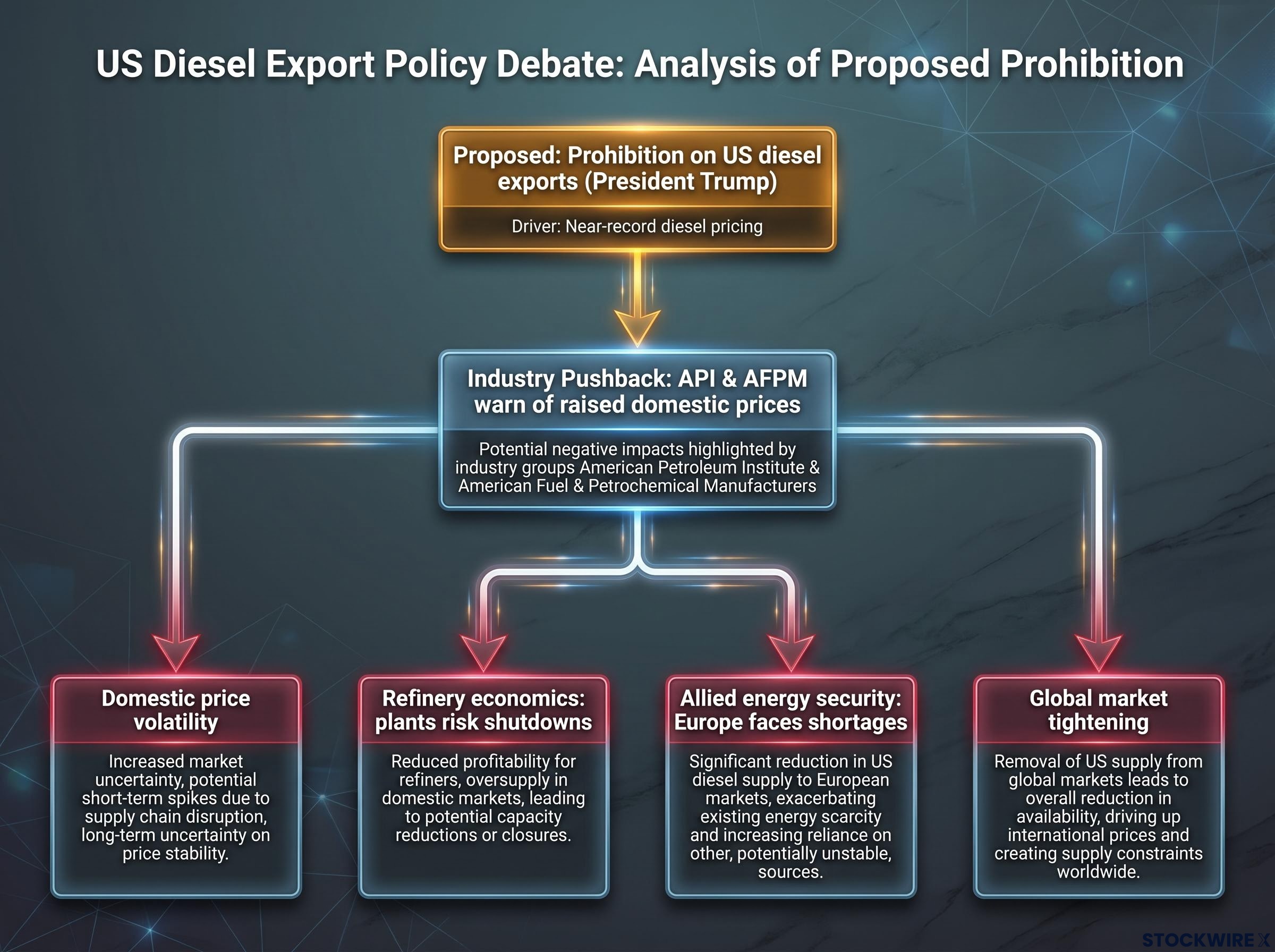
- Domestic price volatility: Short-term relief is possible if inventories build, but most analysts expect eventual tightness as refinery runs adjust downward.
- Refinery economics: Profitable export-oriented plants could become loss-making, risking shutdowns or deferred maintenance that cuts capacity when it is most needed.
- Allied energy security: Europe, heavily reliant on US diesel since the structural loss of Russian supplies, would face immediate shortages and price spikes.
- Global market tightening: Restricting US flows widens regional price spreads and increases freight arbitrage, potentially worsening volatility rather than calming it.
Here is what you must recognise. A US diesel export ban may be marketed as instant domestic relief, but the second-order effects risk fracturing global supply chains and squeezing the very refining margins sitting inside your energy holdings. For now, no ban has been implemented, and significant legal and diplomatic objections make full enactment less likely, but the debate itself is a live source of headline risk.
Navigating the limits of the current commodity cycle
The current squeeze is the product of two forces layered together: a genuine physical disruption at Hormuz and a policy uncertainty in Washington that could distort supply further. Neither, however, guarantees prices climb indefinitely.
Natural market forces work against sustained extremes. Prolonged Brent above $100 eventually triggers demand destruction, particularly in price-sensitive emerging markets, which caps further upside. Major Gulf producers retain flexibility too; Saudi Arabia has already partially restored flows on a major pipeline and can adjust cargoes and draw on spare capacity to blunt the worst of the risk premium.
The “Hormuz shuttles” also demonstrate that markets adapt. As rerouting becomes routine, the incremental premium baked into Brent may compress even while the strait stays formally constrained.
Over the coming quarter, watch two variables above all: whether inventories at hubs like Cushing normalise, and whether conflict incidents in the Gulf de-escalate. Falling incident counts and rebuilding stocks would signal the premium is easing. Renewed escalation or a genuine blockade would turn today’s prices into a floor rather than a peak.
This article is for informational purposes only and should not be considered financial advice. Investors should conduct their own research and consult with financial professionals before making investment decisions.
Past performance does not guarantee future results. Financial projections are subject to market conditions and various risk factors, and forward-looking scenarios here are speculative and subject to change based on geopolitical and policy developments.