
Commonwealth Bank shares are trading more than 50% above Morningstar’s $108 fair value estimate, a figure the research house left unchanged on 11 November 2026 after the bank reported a flat quarter. The quality of the franchise is not in question. The price investors are paying for it is.
Commonwealth Bank of Australia‘s first-quarter FY2027 trading update covered July to September 2026. It showed cash profit of about $2.8 billion, flat against the FY2026 second-half quarterly average and up 8% year on year.
The shares closed at $171.76 on 12 November. The original Morningstar piece cited $169.57, so the exact gap depends on when you check the price.
This walks through what the quarter showed, why the valuation gap has not closed, and what each side of the argument rests on, so you can judge whether CBA’s premium still makes sense.
Why does Morningstar still see Commonwealth Bank shares as over 50% overvalued?
Start with the two numbers: $108 against roughly $172. Morningstar rates CBA as having a wide moat, meaning a durable competitive advantage it expects to protect profits for 20 years or more. Even so, it does not think the moat justifies the price.
Morningstar’s assessment CBA shares trade more than 50% above the $108 fair value estimate, updated 11 November 2026.
Morningstar analyst Nathan Zaia argues the valuation has detached from near-term fundamentals. His core evidence is earnings growth of about 5% a year, which is solid but ordinary.
The price-to-earnings (P/E) ratio shows the premium most clearly. It measures how many dollars investors pay for each dollar of annual profit. CBA’s forward P/E sits at about 25-26x, depending on source and date, against 15-18x for its peers.
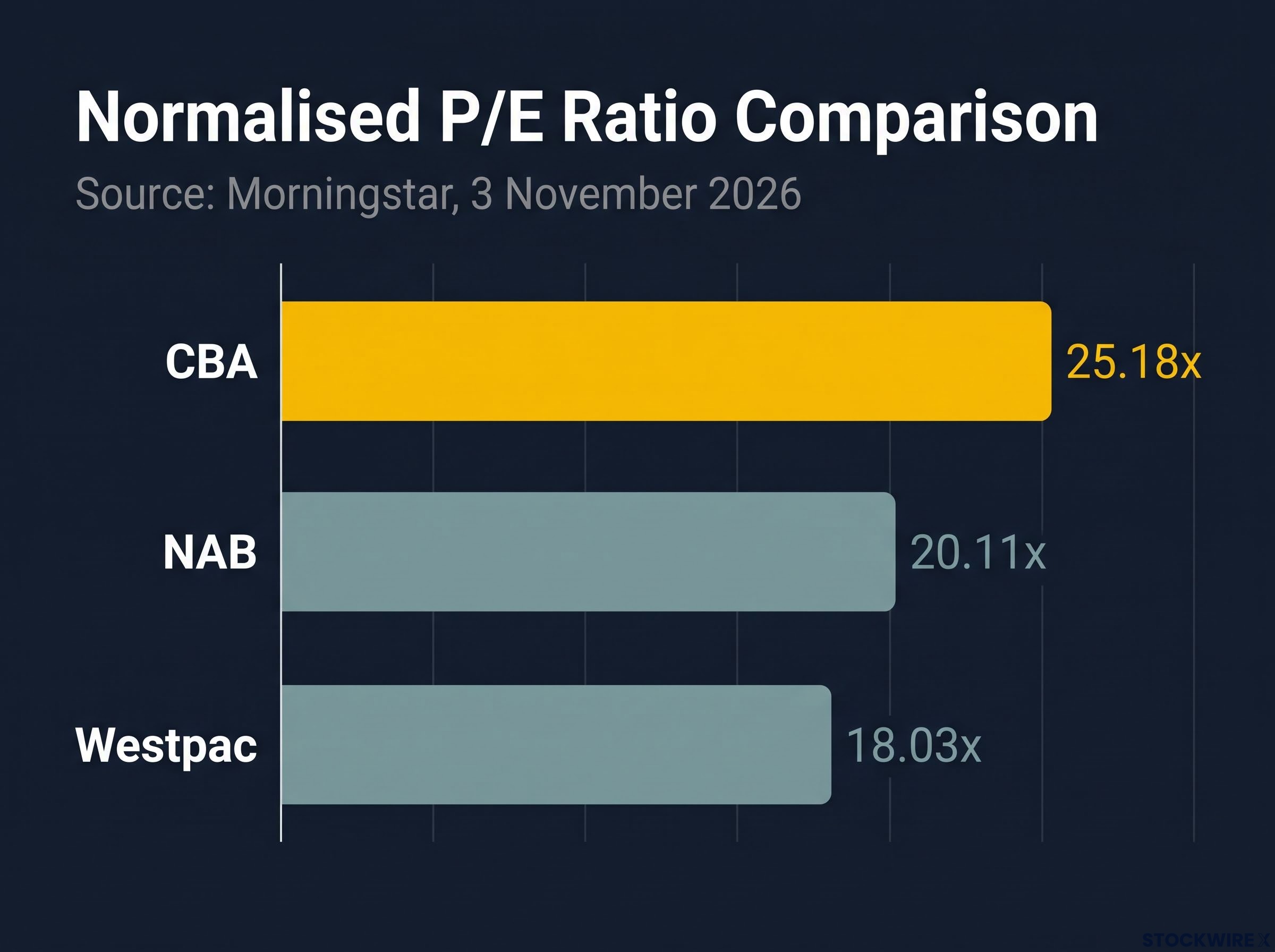
Morningstar data from 3 November 2026 shows CBA trading at a 25.18x normalised P/E, compared to NAB at 20.11x and Westpac at 18.03x.
| Bank | Valuation measure | Figure | Date or source |
|---|---|---|---|
| CBA | Normalised P/E | 25.18x | Morningstar, 3 November 2026 |
| Westpac | Normalised P/E | 18.03x | Morningstar, 3 November 2026 |
| NAB | Normalised P/E | 20.11x | Morningstar, 3 November 2026 |
CBA’s forward dividend yield sits around 3%. CBA closed at $167.23 on 3 November, so the shares have climbed further since the multiples above were struck.
The sell side shares the unease, according to published commentary (the primary notes were not directly accessible). Macquarie put CBA at about 26x FY2026 earnings and about 3.5x book value, where book value is the net assets on the balance sheet. Citi flagged the premium as vulnerable if peers show better earnings momentum, and UBS noted price-to-book is unusually high against CBA’s own history. JPMorgan‘s Andrew Triggs expects modest cuts to FY2027 cash-profit forecasts as impairments rise.
At roughly 25x earnings for 5% growth and a 3% yield, you are paying for CBA’s quality at a price that already assumes it. That leaves very little room for disappointment.
Earnings multiples capture only part of the picture when valuing bank stocks, because provisioning judgements, margin sensitivity and capital requirements determine whether reported profits are sustainable.
What did the quarter actually show: business lending strength against rising costs and credit stress?
The growth numbers were strong on their own:
- Cash profit: about $2.8 billion, up 8% year on year
- Business lending: up 13.6% year on year, about 1.3x system growth
- Home lending: up 6.6%, about 1.1x system
- Operating income: up 3%
- Loan impairment expense: $300 million
Business lending ran well ahead of Morningstar’s FY2027 forecast of 7%. The net interest margin, the gap between what CBA earns on loans and pays on deposits, held broadly stable thanks to earnings on deposit hedges.
Then costs took it all back. CBA’s announcement, as reported by Reuters, put expense growth at 3%, matching income. Morningstar’s detailed analysis put it at 5%, above peers’ FY2027 guidance of 0%-3%; the sources do not explain the difference. Either way, operating leverage, where income grows faster than costs, did not show up.
CBA pointed to wages, technology vendors, cloud and software. Morningstar sees scope for management to curb spending if growth slows.
Credit costs added pressure. Impairments, the money set aside for loans that may not be repaid, reached 11 basis points of loans (a basis point is one hundredth of a percentage point), up from 0.08% in FY2026 but below Morningstar’s 0.15% medium-term forecast. Collective provisions rose $105 million, arrears ticked up modestly and total provisions stood at about $6.5 billion.
Zaia describes credit quality as returning toward normal from very low levels.
Housing demand and the RBA backdrop
Home-loan applications across CommBank and Bankwest fell 16% year on year, which Reuters attributed to higher rates and tax changes. Investor credit softened most.
Australian Bureau of Statistics data, via The Adviser, showed new housing-loan commitments down 15.5% quarter on quarter to $81.157 billion. The Reserve Bank of Australia (RBA) said commitments sit 27% below the November 2025 peak, after lifting the cash rate 25 basis points to 4.85%, effective 4 November. The RBA expects higher rates and falling prices to weigh on consumption and dwelling investment.
Morningstar expects housing credit growth to slow to 3% in FY2027 from 6%. For you as a shareholder, earnings growth is leaning on business lending just as housing weakens, so the near-term profit path depends on how long commercial demand holds.
Diverging housing credit forecasts between the major banks show how much of the FY2027 earnings debate turns on mortgage growth, with CBA’s own guidance already revised lower from its earlier range.
Quality or price: how do the bull and bear cases stack up?
The bull case rests on the franchise. Scale, brand, a deep deposit base and strong capital support a premium, and Morningstar points to tight underwriting, lenders mortgage insurance, low loan-to-valuation ratios and full-recourse lending as mortgage protections.
The bear case starts with the mechanism the quarter exposed. Higher rates strain households, deposit competition pressures margins, and commercial lending fills the gap while increasing exposure to a slowing economy. Rising arrears and provisions can then offset the volume gains.
Morgan Stanley’s view that the market underprices loan loss risk, with FY2027 impairments forecast 12-14% above consensus for the Big Four, adds a credit-quality dimension to the bear case.
| Bull case | Bear case |
|---|---|
| Wide moat, scale and brand justify a premium | About 25-26x earnings leaves little room for error |
| Business lending growing ahead of system | Fast business-loan growth can raise future losses |
| Margins broadly stable | Deposit competition; Macquarie flagged possible cracks in the deposit advantage |
| Strong capital and provisions | Impairments at $300M and arrears rising |
| Housing supply limits and population growth support mortgages | Applications down 16%; housing indicators weakening |
| Dividend growth supports income investors | Yield near 3% versus Westpac’s roughly 4% fully franked |
Regulatory scrutiny and tax changes add a further layer of pressure on returns.
What past re-rating tells investors
CBA’s 2024-2025 rally came mainly from multiple expansion, investors paying more per dollar of profit, rather than faster earnings. Citi notes CBA tends to de-rate when peers post stronger earnings revisions.
Premiums persist when stability, funding and returns look structurally superior. They contract when earnings converge, deposit advantages weaken, margins compress or credit losses rise. Whether CBA shares suit you comes down to one choice: a permanent premium for the franchise, or convergence with peers that compresses it.
Three signals to watch before the next CBA update
This was a solid but unspectacular quarter that moved neither Morningstar’s $108 view nor the price gap. Three indicators will show which way the argument breaks:
- Housing approvals and applications. Watch whether the slowdown tracks Morningstar’s 3% FY2027 housing credit forecast.
- Impairments and arrears. Track them against Morningstar’s 0.15% medium-term assumption.
- Peer earnings momentum. Stronger revisions at rivals, with expense guidance of 0%-3%, could narrow the gap.
This article is for informational purposes only and should not be considered financial advice. Investors should conduct their own research and consult with financial professionals before making investment decisions.