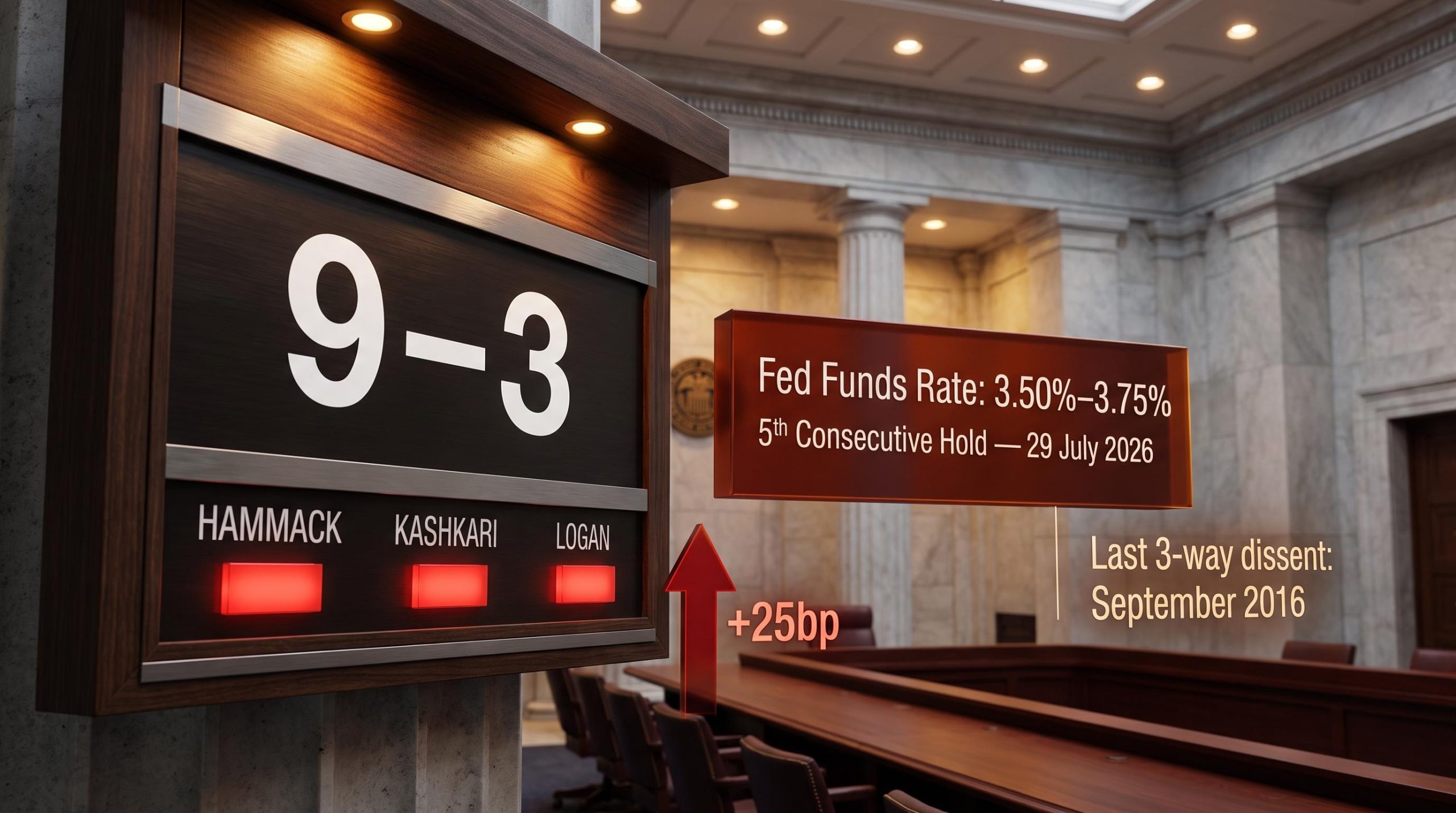
Three sitting members of the Federal Open Market Committee (FOMC) just put their dissent on the record, calling current interest rate policy too loose and voting for an immediate hike. The last time the Fed saw a split this wide in the same direction was September 2016, a full decade ago.
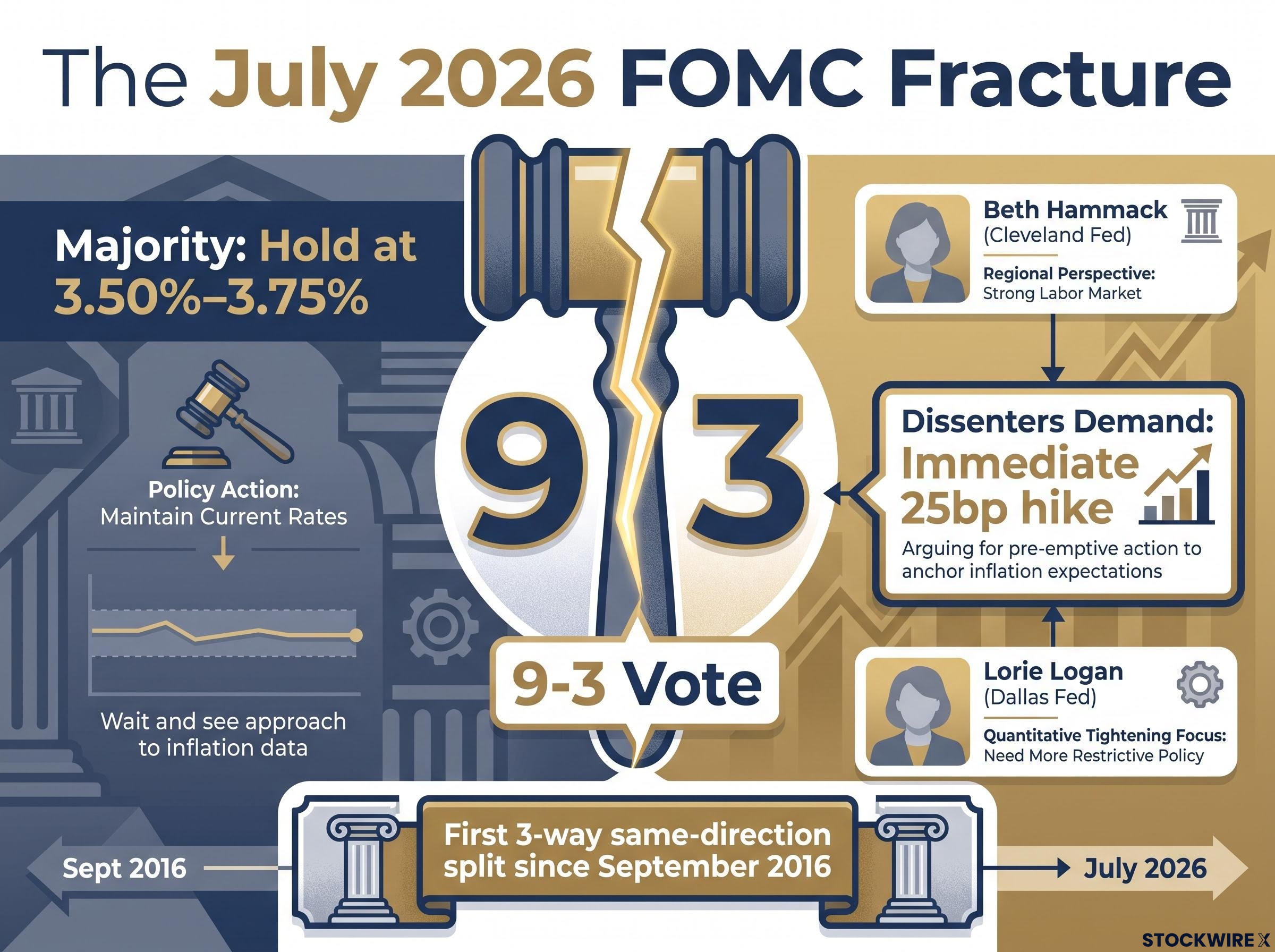
The headline from the 29 July 2026 meeting was a hold. The federal funds rate was left at 3.50%-3.75% for the fifth meeting in a row without a change. But the headline is not the story. The story is a 9-3 vote that exposed a coordinated hawkish bloc inside the committee, three senior regional presidents who looked at the same data as the majority and reached a fundamentally different conclusion about what to do with it.
That fracture gives you something unusual: two explicitly articulated policy paths, laid out in real time by the people who set rates. Here is what the dissent actually argues, why it carries more weight than a typical split vote, and how to stress-test your own positioning given that both scenarios for the rest of 2026 are now on the record.
Who voted no, and what exactly they are demanding
The three dissenting votes did not come from the fringes of the committee. They came from Beth Hammack (Cleveland Fed), Neel Kashkari (Minneapolis Fed), and Lorie Logan (Dallas Fed), all senior regional presidents with full voting rights and access to the same economic data that informed the majority’s decision to hold.
Each of the three cast their vote for the same thing: a 25 basis point rise in rates, effective immediately. That unanimity matters. This was not scattered disagreement from officials with different concerns. It was a coordinated hawkish position.
The July 2026 FOMC statement records the 9-3 vote formally, naming Hammack, Kashkari, and Logan as the three dissenting members who preferred an immediate 25 basis point increase, and constitutes the official policy record against which all subsequent communications and market interpretations should be measured.
| Dissenter | Fed district | Policy preference |
|---|---|---|
| Beth Hammack | Cleveland | Immediate 25bp hike |
| Neel Kashkari | Minneapolis | Immediate 25bp hike |
| Lorie Logan | Dallas | Immediate 25bp hike |
September 2016 was the last time three FOMC officials dissented in the same direction on a rate decision. A three-way split of this kind is historically rare and signals unusually strong internal conviction.
As of reporting, Logan’s official post-meeting statement had yet to be published, though the substance of her vote was in line with her recent public remarks calling for additional monetary tightening. The coordinated nature of these three votes tells you the hawkish position inside the FOMC is organised and on the record. Any shift in incoming data that validates their concerns could move one or two majority members toward a hike faster than markets currently expect.
When big ASX news breaks, our subscribers know first
The hawkish case, in the dissenters’ own words
Hammack made the credibility argument first, and she made it bluntly. With inflation above the 2% target for more than five consecutive years, she argued the costs of waiting are compounding, not holding steady.
“In my view, now is the time for the [FOMC] to act to speed the return of PCE inflation to our 2 percent objective and deliver on our commitment to price stability for the American people.”
“The longer that high inflation persists, the more challenging and costly it can be to bring it back down.”
Hammack’s case rests on the view that existing policy falls short of the restriction needed when unemployment is sitting close to its historical floor. Firms across the Cleveland Fed’s footprint backed that reading: rather than easing, cost pressures were proving stubborn and extending into a widening range of sectors.
Kashkari then escalated the argument from credibility to consequence. His framing was explicit: act modestly now, or act aggressively later.
“In my view, a potential series of small policy moves would be better than waiting and eventually concluding that even bolder actions were necessary.”
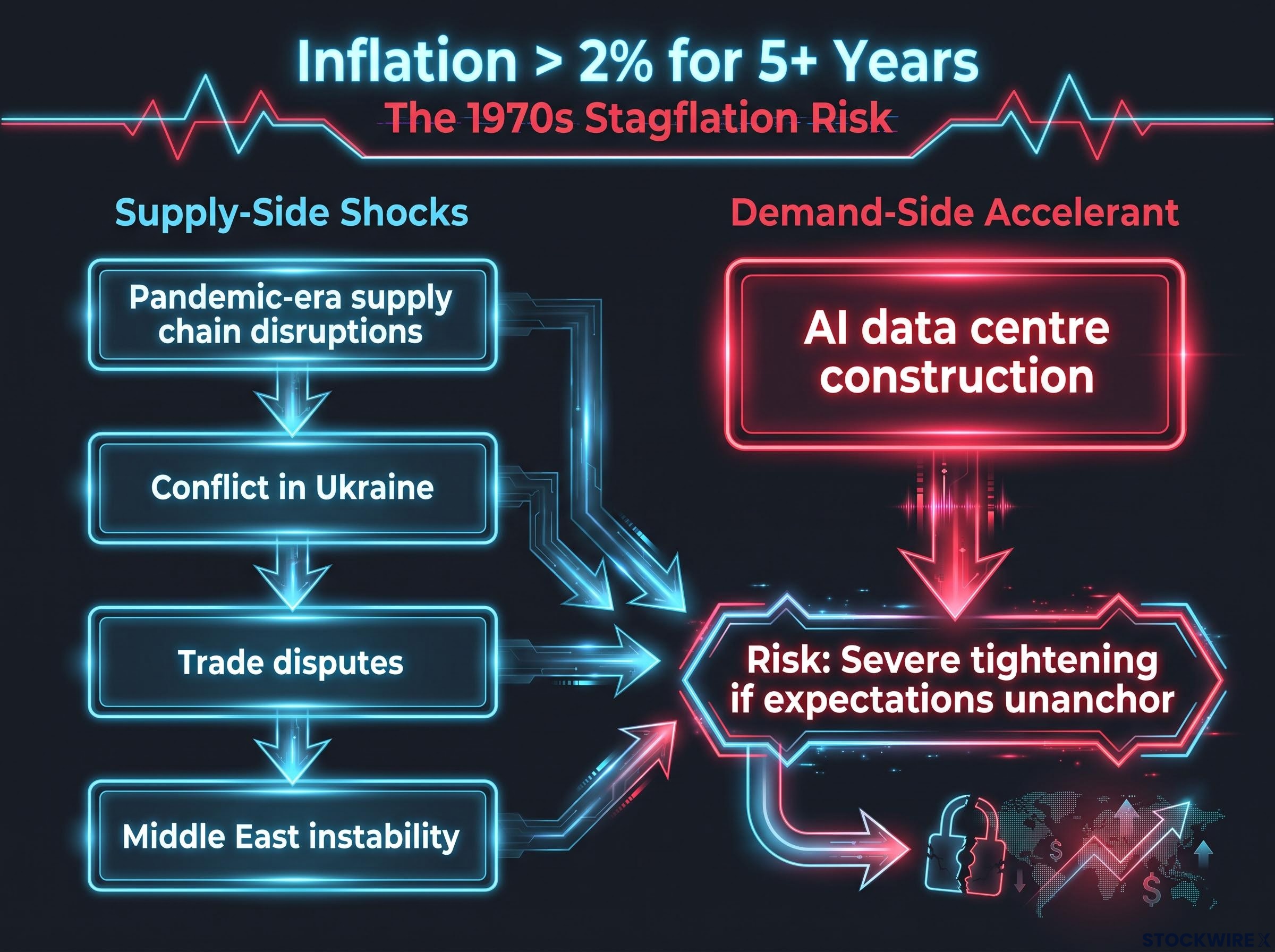
He drew a direct parallel to the 1970s stagflation experience, where delayed action allowed inflation expectations to drift so far from anchor that the eventual correction required severe monetary tightening. That comparison is not rhetorical flourish. It is a specific warning: if expectations shift, the eventual policy response will be far more painful than the 25 basis points the dissenters are asking for today.
Kashkari identified a broad range of supply-side inflation contributors:
- Pandemic-era supply chain disruptions
- The conflict in Ukraine
- Various trade disputes
- Ongoing instability in the Middle East
On top of those supply shocks, Kashkari pointed to the enormous wave of AI data centre construction as a notable new driver of demand-side inflationary pressure. This framing originates from Kashkari’s own analysis; it does not appear in the FOMC’s official statement.
The energy-driven CPI divergence between a 4.2% headline and a 2.9% core reading in May 2026 is precisely the diagnostic the hawks are asking the majority to discount less readily; if the core remains sticky while energy partially reverses, the dissenters’ argument that current policy is insufficiently restrictive becomes harder for swing voters to dismiss.
What five years above target actually means for Fed credibility
The central plank of the dissenters’ case is not the level of inflation but how long it has persisted: by July 2026, prices had been running above the 2% target for well over five years. Understanding why duration matters, not just the level of inflation, is what separates a surface-level reading of this vote from a structural one.
How inflation expectations become self-fulfilling
A central bank with a symmetric inflation target (meaning it treats undershoots and overshoots equally) can tolerate a short-lived overshoot. A five-plus year overshoot is a different problem entirely because it generates two compounding risks:
- Credibility risk: The longer inflation stays elevated, the harder it becomes for the Fed to convince households, businesses, and markets that 2% is genuinely the long-run anchor. Credibility, once lost, takes years to rebuild.
- Expectations risk: When high inflation persists long enough, wage bargaining, price-setting, and household financial planning start embedding higher inflation as normal. That behavioural shift makes the inflation itself harder and more expensive to reverse.
This is the mechanism that connects Hammack’s “now is the time” argument to Kashkari’s 1970s parallel. Early, moderate tightening is less economically costly than delayed, aggressive tightening once expectations have drifted. Chair Kevin Warsh reinforced the seriousness of the issue, stating that the committee will “deliver price stability” and that raising rates “could well be part of that solution,” language notably more hawkish than his earlier 2026 communications.
Energy supply shocks, including from the Iran conflict, were explicitly cited in the FOMC statement as a compounding factor. The oil price surge adds a real-time inflation accelerant on top of the structural pressures the hawks are already warning about.
For you as an investor, the credibility dynamic is why this pause period feels different from the post-2009 era. If the Fed’s 2% anchor loses traction, the repricing of long-term rates would not be a one-meeting event but a sustained structural shift in asset valuations.
The yield curve steepening that followed the July 29 announcement reflects a specific investor judgement: short-term rates are anchored to Fed inaction while long-term rates absorb a credibility premium for 63 months of above-target inflation, a dynamic that makes the bond market’s reaction as informative as the vote itself.
What historical dissent patterns signal about what comes next
A three-way same-direction dissent is rare enough to carry predictive weight. The September 2016 precedent is the only direct comparison in the past decade, and dissent at that scale has historically preceded shifts in the policy path when subsequent data validated the minority’s concerns. This is not a symbolic protest. It is a documented fault line that incoming data can widen.
FOMC dissent patterns became a defining feature of 2026 well before the July meeting; the April session produced four votes against the majority, spanning both hawkish and dovish directions, establishing a committee dynamic in which the current three-way hawkish bloc represents a narrowing and consolidation of opposition rather than an isolated event.
The forward-looking picture now has a concrete shape. The June 2026 dot plot already pencilled in one quarter-point increase by year-end. The July hawkish dissent reinforces the plausibility of that path. If one or two current majority members shift toward the hawks as data arrives, a rate hike at the September 2026 meeting becomes a realistic scenario rather than a tail risk.
Chair Warsh’s language, stressing that the committee “will deliver price stability” and that raising rates “could well be part of that solution,” signals a more hawkish tone than at any earlier point in 2026.
Three conditions would push the vote closer to a hike in September:
- Incoming inflation data (PCE and CPI prints) that shows price pressures holding or accelerating rather than easing
- Governor Waller shifting his public communications toward the hawkish framing, given that he voiced inflation concern at the July meeting but ultimately supported the hold
- Oil prices remaining elevated or rising further amid the Iran conflict, compounding the supply-side inflation pressures the hawks have identified
Waller’s position is the most important data point to watch. He is the most visible potential swing vote on the committee right now, and any shift in his communications would signal that the three-vote bloc has a real path to expansion.
What the two-scenario split means for your portfolio now
The 9-3 vote gave you something the Fed rarely provides this explicitly: two articulated policy paths, both now on the record. The mistake would be treating Scenario 1 as the baseline and Scenario 2 as a distant tail risk. The dissent tells you both are live.
Scenario 1 is the majority’s position: the Fed holds, inflation drifts lower over time, and the current pause eventually gives way to a slow easing cycle. Most portfolios are already positioned for this outcome.
Scenario 2 is the dissenters’ warning: inflation stays sticky, supported by demand, energy prices, supply shocks, and structural drivers like AI infrastructure investment. The Fed is ultimately forced to restart hikes, potentially beginning in late 2026. This is the scenario that requires stress-testing, because it is the one most portfolios are not built for.
| Asset category | Scenario 1: hold, inflation eases | Scenario 2: sticky inflation, hikes resume |
|---|---|---|
| Growth equities | Stable or lower discount rates support valuations | High-multiple names face compression as discount rates rise |
| Rate-sensitive equities (real estate, utilities) | Gradual recovery as hiking cycle is seen as over | Renewed pressure from rising refinancing costs |
| Fixed income | Long-duration bonds recover | Long-duration bonds face price pressure; shorter-duration and floating-rate instruments offer better protection |
| Inflation hedges | Less urgency, though energy risks persist | TIPS, commodities, and real assets become more attractive |
These reflect standard relationships between interest rates and asset pricing, not specific forecasts or individualised financial advice.
The practical takeaway is not to rotate entirely into Scenario 2 hedges. It is to examine whether a portfolio built for Scenario 1 alone has enough resilience if the dissenters’ warning proves correct over the next two to three meetings.
This article is for informational purposes only and should not be considered financial advice. Investors should conduct their own research and consult with financial professionals before making investment decisions. Past performance does not guarantee future results. Financial projections are subject to market conditions and various risk factors.
What to watch before the September 2026 meeting
The analytical work is done. What remains is translating it into a monitoring framework you can act on between now and September.
Data releases to track:
- PCE (personal consumption expenditures price index, the Fed’s preferred inflation measure) and CPI prints for signs that price pressures are validating or undercutting the hawks’ argument
- Oil prices and energy market developments tied to the Iran conflict
Communications to monitor:
- Speeches and statements from Chair Warsh, dissenters Hammack, Kashkari, and Logan, and swing vote Waller
- Logan’s formal post-meeting statement, which had yet to be released at the time of writing and whose publication will therefore carry particular weight as a next data point
- Fed funds futures curves for real-time shifts in market pricing of a late-2026 hike
Warsh’s decision to dismantle the forward guidance regime means the monitoring framework described here now carries more weight than it would have under prior chairs; without Fed-provided rate-path signals, every PCE print and every public speech from Hammack, Kashkari, or Waller lands on markets with less institutional buffering than investors were accustomed to before June 2026.
Portfolio stress-testing before September
If your portfolio carries significant exposure to long-duration fixed income or high-multiple growth equities, the dissenters’ publicly stated logic provides a ready-made template for stress-testing. The question is straightforward: what happens to your positions if the hawks are right and the September meeting becomes a live decision point?
If Waller’s post-July communications shift toward the hawkish framing, treat that as an early signal that September is live in a way current pricing may not yet fully reflect.
Reading the fracture, not just the headline vote
The 9-3 vote is not a failed hike attempt. It is a documented fault line inside the FOMC that changes how you should interpret every inflation print, every Fed speech, and every shift in the futures curve between now and year-end.
The dissent makes the September meeting a genuine decision point rather than a formality. Both policy scenarios are now explicitly on the record rather than speculative. The question for the rest of 2026 is no longer whether the Fed is done hiking. It is whether the incoming data gives the majority a reason to move toward the hawks, or gives the hawks a reason to stand down.
The data will answer that. Your job is to be positioned for both answers, not just the comfortable one.