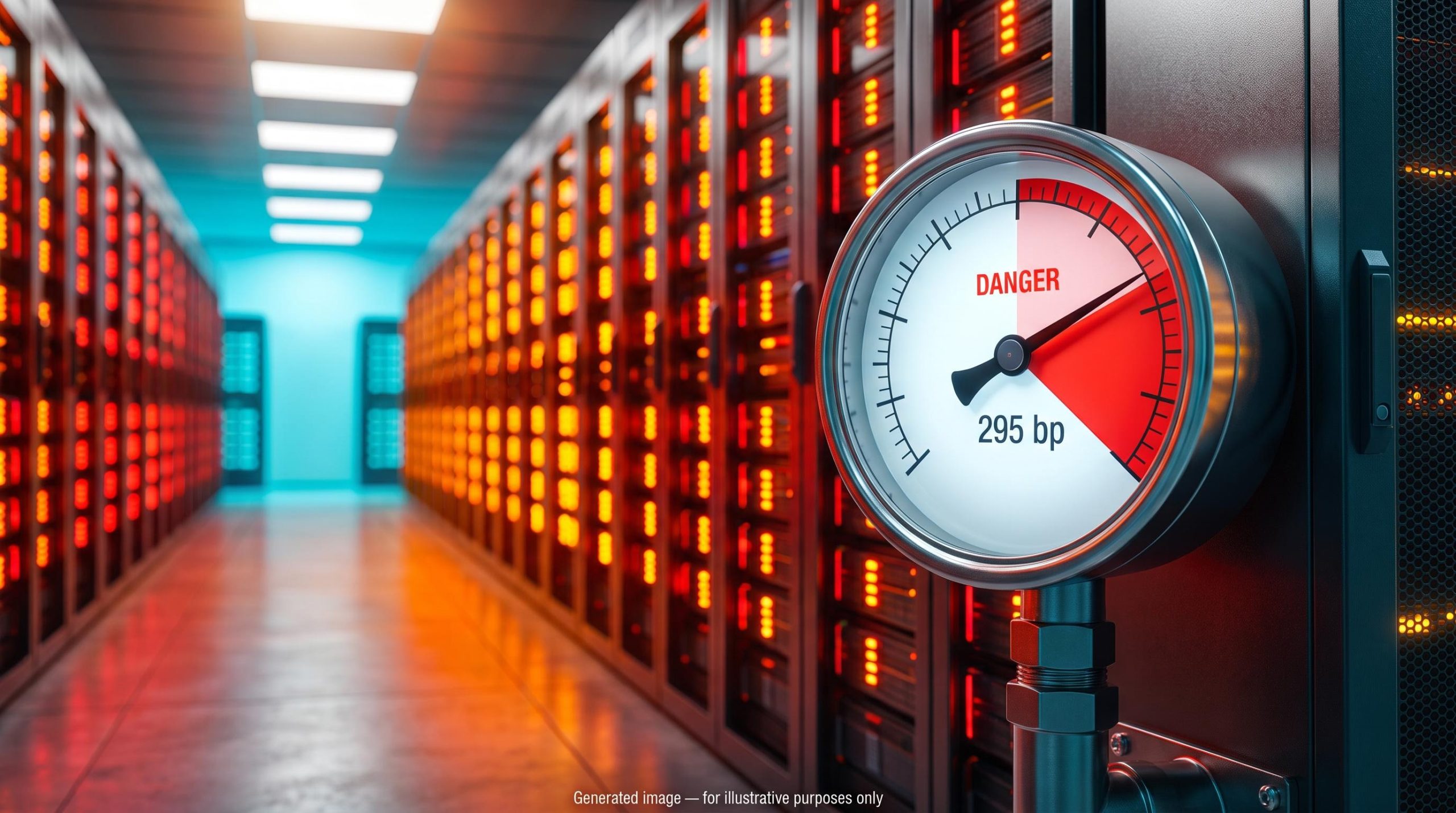
Oracle’s five-year credit default swaps closed near 295 basis points on 19 October, up 287% year over year. Equity markets have barely flinched. That gap between what bond traders are pricing and what stock investors are paying is the signal most hyperscaler debt watchers are either missing or misreading.
A credit default swap (CDS) is a contract that pays out if a borrower defaults, so its price works as a running gauge of how risky lenders think that borrower is. When it climbs this fast, someone is paying up for protection.
The argument gaining attention, associated with strategist Karsan, links three forces: rising discount rates, a coming refinancing wave and record AI-related borrowing. It ends with a contested claim that government will eventually monetise debt and prop up equities. The backdrop is a 10-year Treasury yield of about 5.09% and a 30-year near 5.43% as of 16 October.
This piece gives you a way to separate genuine credit stress from noisy signals, and to weigh the bull and bear cases on the evidence rather than the headlines.
Why are credit markets flashing before equities do?
Bond investors are pricing a risk that equity investors are not. That looks like a contradiction, but the mechanics make the order logical.
Start with discount rates. A discount rate is the return investors require to hold an asset, and it sets how much future earnings are worth today.
The valuation maths A rise in the discount rate from 4% to 5% needs roughly 25% higher earnings just to keep a valuation flat.
With risk-free yields around 5.25%, Karsan argues the old “there is no alternative” (TINA) logic for owning stocks has flipped. Cash and bonds now compete seriously with equities. In his view, multiples have not adjusted yet because the refinancing of cheap debt has not fully hit.
Six forces are pushing long-end yields higher:
- Fiscal deficits: a US deficit of about $1.992 trillion, with interest costs near $1.1 trillion.
- Term premium: heavier long-bond supply raises the extra return investors demand.
- Crowding out: hyperscaler bonds compete with government issuance for buyers.
- Inflation uncertainty: AI, energy and fiscal spending can lift demand and prices.
- Weak foreign demand: fewer overseas buyers means domestic investors must absorb more.
- Credit-equity transmission: higher yields cut equity values and raise interest costs.
Credit moves first because bondholders care about repayment and covenants, while equity holders can keep capitalising optimistic revenue forecasts. The Bank for International Settlements (BIS) observed exactly this pattern: CDS spreads rose before any full equity repricing.
The gap between how bond markets price Big Tech and how equity multiples treat it shows up in long-dated paper, where some hyperscaler bonds trade far below par while stock valuations barely move.
What this tells you is uncomfortable. If long-end yields stay high, long-duration growth stocks are being squeezed on valuation, however healthy today’s earnings look.
When big ASX news breaks, our subscribers know first
How big is hyperscaler debt, and how much of it is real stress?
The aggregate picture
The five major hyperscalers issued about $121 billion of bonds in 2025, against roughly $40 billion in 2020. Alphabet, Amazon, Meta and Oracle then raised about $194 billion through 7 July 2026 alone.
Goldman Sachs estimates about $750 billion of hyperscaler capex in 2026 against roughly $778 billion of operating cash flow, with debt funding about one-third. Other forecasts cluster nearby: S&P Global at about $600 billion for the top five, Moody’s at $785 billion for six, and UBP at about $820 billion.
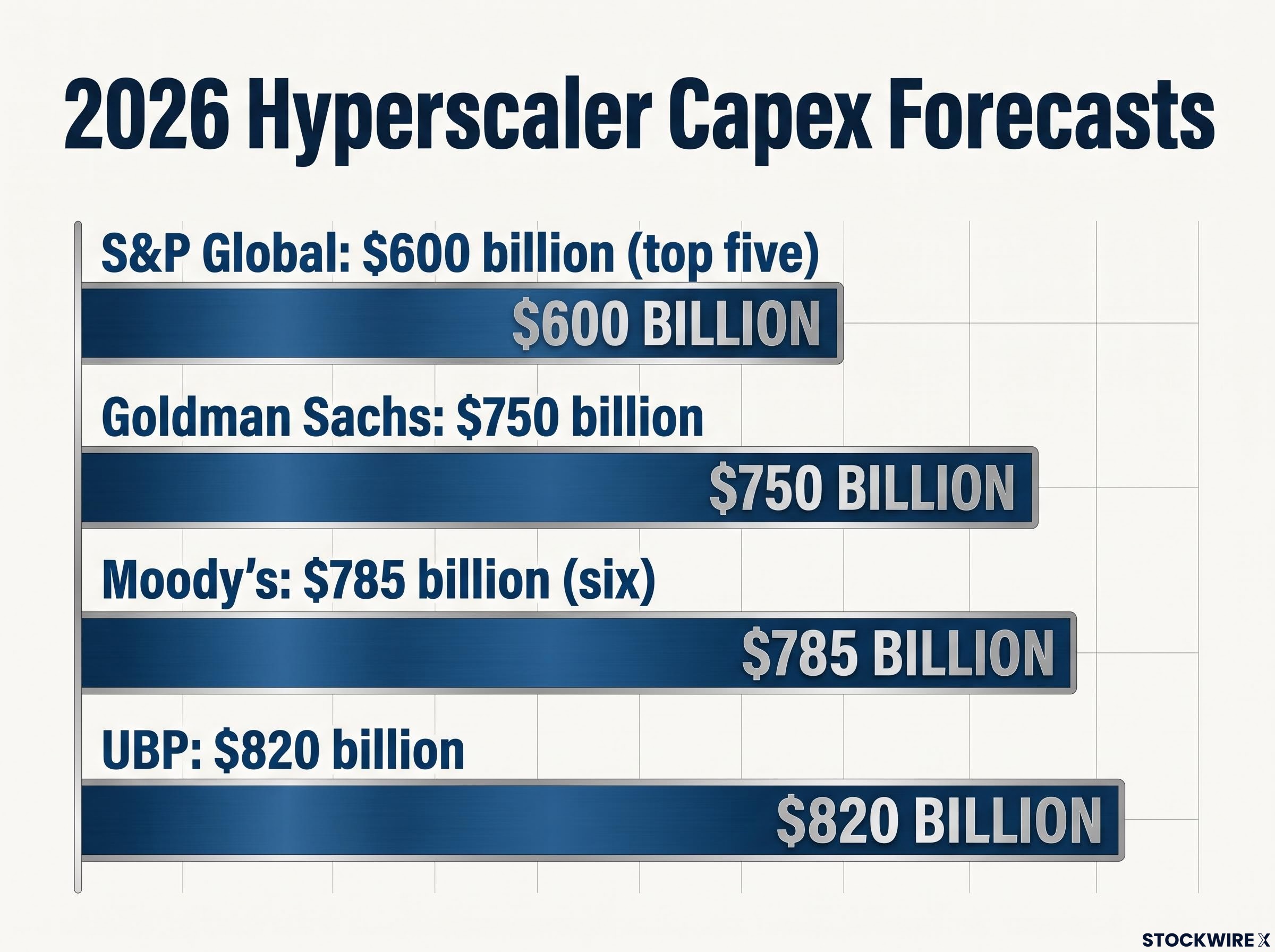
Those are aggregate figures. Karsan’s framing of $500-600 billion in commitments for each company over two years overstates per-company spending. His estimate of AI capex at 3.6% of GDP also rests on his own presentation; no authoritative published figure exists. The IMF puts AI capex at about $3.4 trillion through 2029.
Company by company
The free cash flow (FCF) numbers show how quickly self-funding has eroded. FCF is the cash left after a company pays for operations and investment.
| Company | Recent FCF | Capex or debt datapoint | Credit read |
|---|---|---|---|
| Alphabet | -$5.9B (quarterly) | First negative FCF since 2004 IPO | Strong ratings, cash generation intact |
| Amazon | -$8.8B (quarterly) | Quarterly capex $54.21B, up 68% | Heavy spend, scale cushions it |
| Meta | $784M vs $8.55B a year earlier | Long-term debt $83.66B | Thinning margin, still highly rated |
| Oracle | -$5.4B | Capex $28.5B | Clearest stress case |
Microsoft, Alphabet and Meta keep high ratings and substantial cash generation. Oracle stands apart, with a weaker balance sheet carrying an aggressive build-out.
Oracle’s credit downgrade to BBB-minus, driven by heavy capex and negative free cash flow, shows why the company is the clearest stress case and why its balance sheet makes it a poor proxy for the wider group.
The question is no longer whether AI is debt-funded. It is whether returns arrive before refinancing costs bite, and your answer should differ sharply by issuer.
What do CDS spreads and the French-German gap actually tell us?
The bear reading is stark. Oracle’s CDS sat at 257 bp on 9 October and about 182 bp in mid-September before reaching 295 bp. Notional CDS outstanding on Oracle hit $25.1 billion in July, up from $6.9 billion a year earlier. At the same time, the France-Germany 10-year spread has widened to about 150 bp.
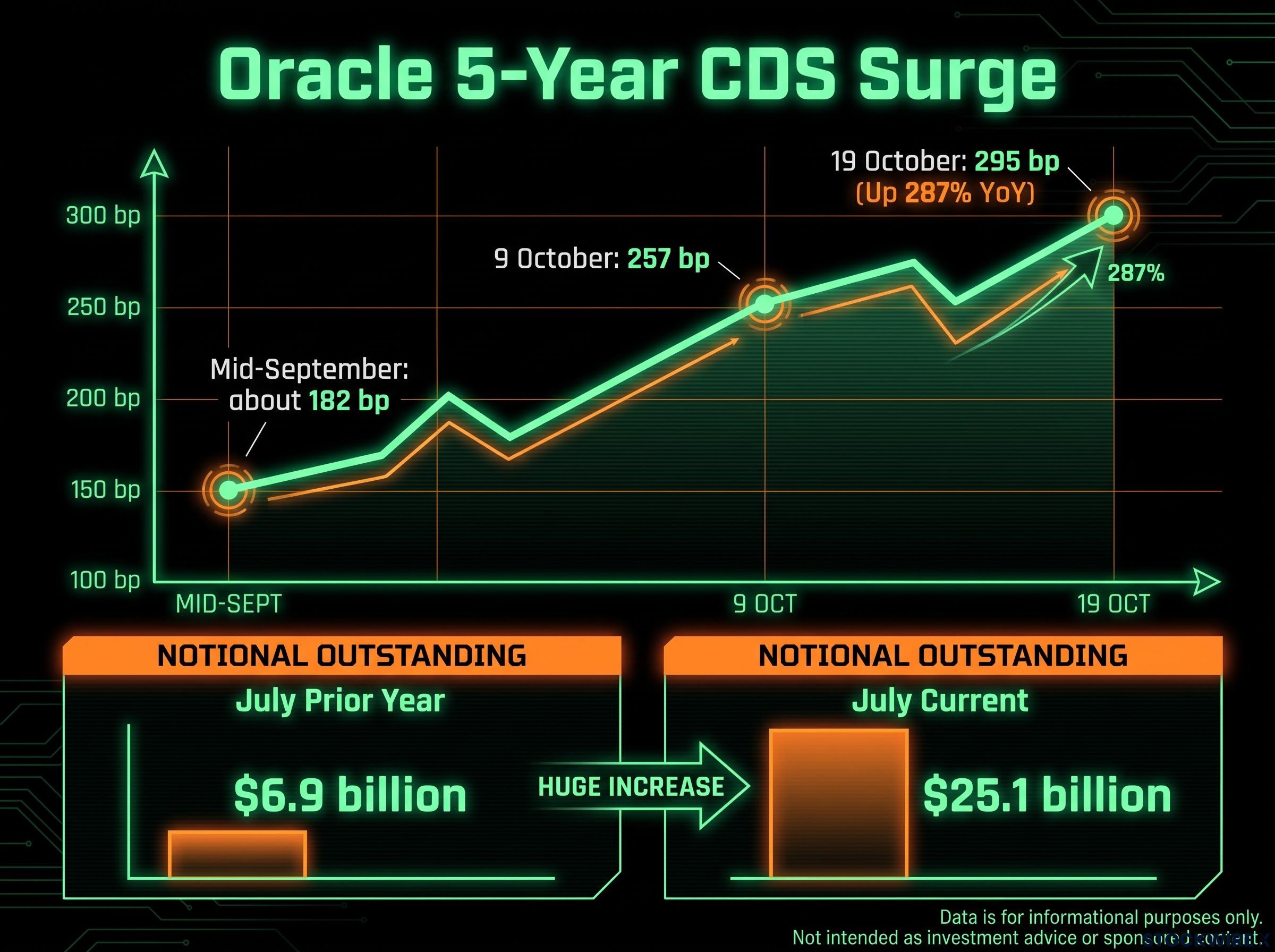
Karsan reads the simultaneous moves as a broad repricing of risk premiums, not a European story. The BIS has flagged hyperscaler issuance above $100 billion in 2025, and S&P Global’s Mark Habib has warned that more AI-linked liabilities exist than are currently visible.
Part of the reason S&P warns that more AI-linked liabilities exist than are visible is the scale of off-balance sheet obligations, including non-cancellable commitments and uncommenced leases that sit in filing footnotes rather than headline debt.
Then the picture complicates. Several factors can inflate these signals:
- Hedging demand: JPMorgan’s five-hyperscaler CDS basket gives investors a liquid hedge, and more buying widens spreads without higher default risk.
- Technical supply: heavy issuance raises dealer inventory risk, so CDS reprices faster than bonds.
- Oracle-specificity: its balance sheet is weaker than peers, making it a poor sector proxy.
- Index inclusion: Meta, Alphabet and Microsoft joining the investment-grade CDX index may drive hedging flows.
- French politics: budget fights and coalition instability, not imminent default, drive much of the spread.
- Ratings lag: S&P says it sees no current need to change hyperscaler ratings.
| Signal | Latest level | Bear reading | Counter-reading |
|---|---|---|---|
| Oracle 5-year CDS | 295 bp | AI financing under strain | Issuer-specific, hedging-inflated |
| Meta 5-year CDS | 87 bp | Stress spreading | Far below Oracle, low absolute level |
| France-Germany spread | 150 bp | Global risk-premium repricing | Domestic fiscal politics |
| France CDS | No authoritative level widely reported | Sovereign stress | Insufficient data |
Oracle’s CDS is a credible warning, not proof of sector-wide insolvency. Treat CDS as a stress gauge distorted by positioning, and weigh Oracle separately from the rest of the group.
What is state-directed capitalism, and why do some expect it?
What the thesis claims
State-directed capitalism describes an economy where government steers capital toward chosen outcomes rather than leaving prices to markets. Karsan’s version has three steps: monetise debt (the central bank creates money to buy government bonds), suppress long-term yields, and support equities directly.
He compares it to government-backed railroads and China’s approach, and calls it pro-growth if a liquidity crisis is avoided. He expects action after the midterms, now about two weeks away. Trump Accounts, in his view, could become a channel for that equity support.
What is actually enacted
Trump Accounts are real. The speculation sits around them.
| Item | Status |
|---|---|
| Legal basis | IRC section 530A; $1,000 seed under section 6434 |
| Launch | 4 July 2026 |
| Enrolment | About 70 million children by 8 October |
| Annual limit | Generally $5,000 |
| Stock contributions | October 2026 rules allow individual stock |
| Tech-leader share donations | No confirmed announcements |
Karsan says Elon Musk, Anthropic’s leadership and Dell have voiced support for donating shares. Public reporting shows no confirmed donations. Voiced support is not a transfer of stock.
Costs and precedents
Supporters point to debt-service stabilisation, a nominal-growth path that erodes real debt, and a backstop against forced selling. Japan’s yield-curve control, China’s state-directed credit and 1940s US financial repression all show governments can hold yields down for long periods.
The risks are equally documented: inflation, fiscal dominance (where monetary policy serves debt service), moral hazard, misallocation, a disorderly exit and wider inequality. Railroads and the 1990s fibre boom earned poor returns despite strategic value.
The free-market objection Public support is possible. The problem is that it changes who bears the loss.
For you, that distinction matters. Intervention could hold up share prices while pushing losses onto savers and currency holders. “Equities protected” and “wealth protected” are not the same outcome.
Bull case, bear case: how should you weigh them?
The bull case says compute is scarce, utilisation will catch up, and operating cash flow will close the gap with capex. IMF scenario work links faster AI productivity to stronger global growth. The bear case points to under-utilisation, a refinancing wall, and contagion through off-balance-sheet structures and private credit.
| Factor | Bull signal | Bear signal |
|---|---|---|
| Utilisation | Demand absorbs new capacity | Power and commissioning delays (Moody’s) |
| Refinancing | Rates ease before maturities | B- and lower maturities rise from $56.6B (2026) to $215B (2028) |
| Cash buffers | Cash flow catches up with capex | IMF warns buffers may fall short |
| Contagion | Stress stays issuer-specific | BIS flags private credit and insurers |
The S&P maturity figures cover lower-rated US debt broadly, not hyperscalers, but they align with Karsan’s expected 2027-28 refinancing peak. Goldman’s 2027 capex estimate of about $1.2 trillion means the funding need grows into that window.
Track these indicators to see which scenario is gaining weight:
- Oracle CDS trend: a move sustainably above 300 bp strengthens the bear case.
- Long-end yields: a 30-year holding above 5.4% keeps valuation pressure on.
- Free cash flow turns: a return to positive FCF at Alphabet or Amazon favours the bulls.
- Utilisation and power delays: Moody’s identifies these as early cracks.
- Post-midterm policy action: any yield-suppression or equity-support measures.
The most plausible near-term path, on current evidence, is higher financing costs and pressure on the most leveraged issuers, not an immediate system-wide default wave. These statements are speculative and subject to change based on market developments and company performance. Past performance does not guarantee future results.
What the credit signals change, and what they do not
Credit stress is real, but concentrated. Oracle carries most of it, while the larger hyperscalers still have cash and ratings on their side. Equity complacency is the bigger risk, because valuations have not yet absorbed yields above 5%.
The intervention thesis is plausible but unproven. Trump Accounts exist; the share donations and debt monetisation do not, yet.
Your framework is simple: read CDS as distorted stress gauges, judge each issuer on its own cash flow, and watch long-end yields and refinancing into 2027-28. The weeks after the midterms will test whether policy moves at all. Apply these indicators to your own exposures before the market forces the question.
This article is for informational purposes only and should not be considered financial advice. Investors should conduct their own research and consult with financial professionals before making investment decisions.