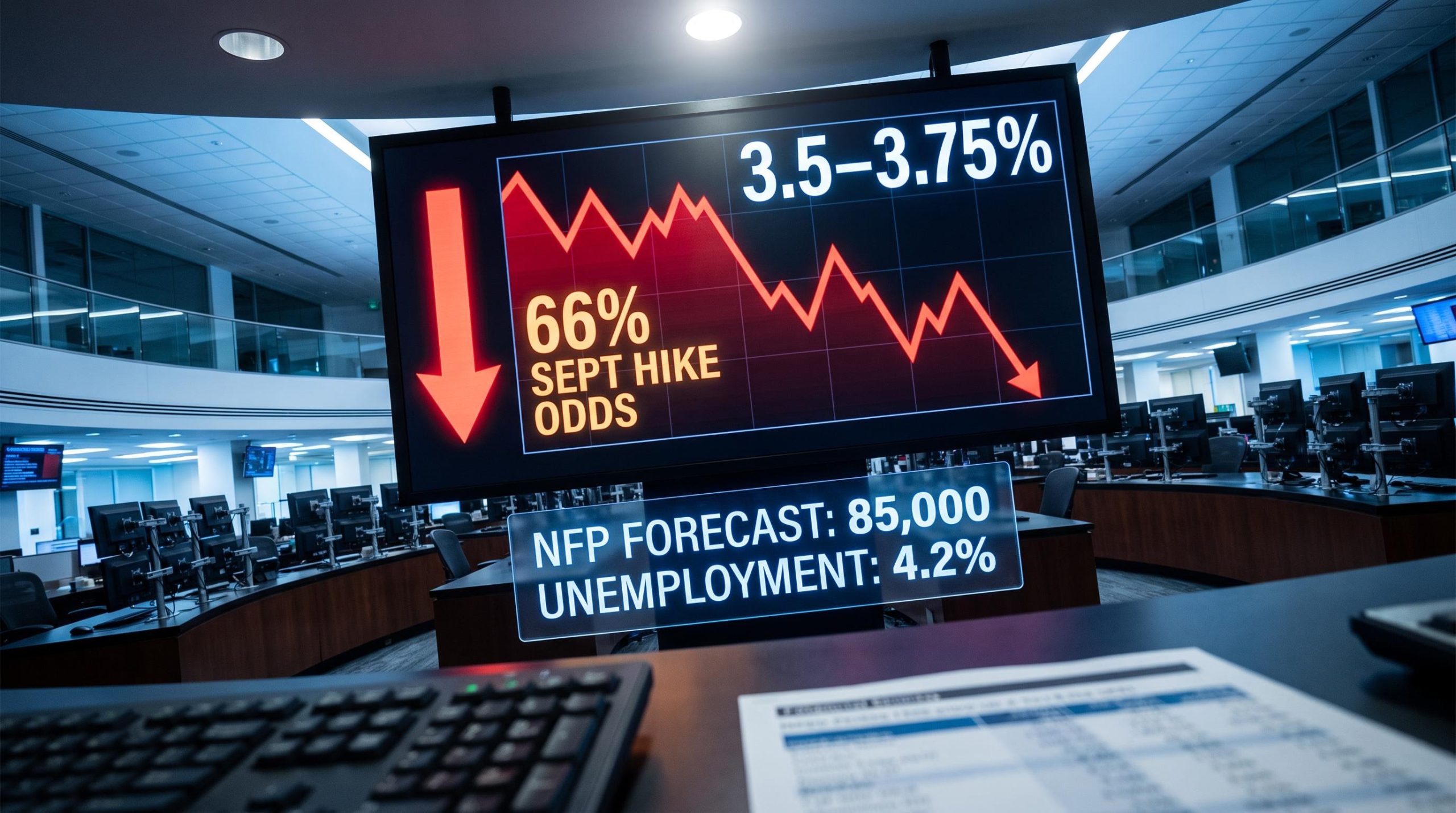
The Fed held rates steady at 3.5-3.75% on Wednesday, and the Dollar Index slid to levels last seen at the June FOMC meeting. Chair Kevin Warsh offered no signal on where rates are heading next. That silence, for the second consecutive meeting, is now the story.
This is not a routine post-meeting pullback. The dollar had been supported by speculative long positions that had swelled to a multi-year peak not seen since 2021, built on the expectation that Warsh would deliver clear hawkish guidance. When that guidance failed to materialise again, the unwind accelerated. Pricing in money markets now assigns around a 66% chance of a rate increase at the September meeting, a number that feels firm until you consider how little is anchoring it.
Friday’s non-farm payrolls report and the inflation data scheduled before September will determine whether that 66% holds, climbs, or collapses. Here is what each NFP scenario means for the dollar and rate odds, and what the full data calendar between now and mid-September actually tells you about positioning risk.
How Warsh has rewritten the Fed’s communication playbook
For two decades, the Fed chair’s primary tool between meetings was forward guidance: a pre-announced indication of where rates were likely heading, designed to let markets price policy shifts gradually rather than abruptly. Kevin Warsh dismantled that tool in his first week on the job.
Warsh was sworn in on 22 May 2026. His first FOMC statement, issued after the June meeting, ran approximately 130 words and stripped out all language about the likely future path of rates. He has since declined to explain why the committee considers the current rate level appropriate, even when pressed directly at press conferences.
The June FOMC statement, which ran approximately 130 words and eliminated all forward guidance language, was the first indication that Warsh intended an institutional overhaul rather than a rhetorical adjustment, and also established his preference for trimmed mean PCE over headline CPI as his primary inflation measure.
This is not a literal blackout. Regional Fed presidents and governors continue speaking freely, and former Vice Chair Richard Clarida has addressed the distinction directly.
“We’re not going into a Fed blackout in terms of conversation or communication.”
Reuters has framed the approach as a “skinny Fed approach in a complex world.” The distinction matters. The Fed is still talking, but the chair is no longer connecting the dots. That forces investors to triangulate policy direction from disparate voices rather than a coherent rate path, which makes every data release more consequential and the dollar more reactive to individual officials’ remarks than it has been in years.
When big ASX news breaks, our subscribers know first
Why the dollar sold off when the Fed said nothing
The slide was not random. It was structural, and the setup made it close to inevitable.
Before the July meeting, net speculative dollar positioning had climbed to heights not recorded in half a decade. The trade thesis was straightforward: Warsh’s first meeting had emphasised inflation without offering nuance, which traders read as a hawkish lean. Longs built aggressively on the assumption that the second meeting would confirm the direction.
The selloff followed a three-stage sequence:
- Position buildup: Speculative longs accumulated over six weeks on the expectation of explicit hawkish guidance.
- Catalyst failure: The July FOMC held rates at 3.5-3.75% with no forward path language and no explanation of the committee’s reasoning.
- Squeeze unwind: With no catalyst to justify the position, crowded longs exited, and the Dollar Index gave back its gains to trade back at the level where it stood after the June FOMC.
The market’s response was widely characterised as sharply divided, which understates what actually happened. The dollar’s reaction was not proportional to any change in policy; rates stayed exactly where they were. It was proportional to the gap between what was expected (a signal) and what was delivered (silence).
That gap reflects something broader than one meeting. Traders are repricing the entire information regime. With no chair-level guidance anchoring expectations, crowded positions remain vulnerable to further squeezes every time an anticipated catalyst fails to appear.
What forward guidance actually does (and what happens without it)
Forward guidance is the Fed’s practice of indicating the likely future path of interest rates so that markets can price policy changes gradually rather than abruptly. When the chair says “we expect to raise rates twice more this year,” currency traders, bond desks, and rate markets align their positioning around that trajectory. Volatility between meetings stays contained because the destination is known; only the speed of arrival is uncertain.
Remove the guidance, and the mechanics change entirely.
The historical record of forward guidance failures, including the 2013 taper tantrum and the 2021-2022 transitory inflation episode, shows that the credibility damage from guidance reversals often exceeds the disruption caused by the underlying policy change itself.
| Characteristic | With forward guidance |
|---|---|
| Policy pricing | Pre-emptive; markets adjust gradually ahead of moves |
| Inter-meeting volatility | Suppressed; narrative anchors positioning |
| Currency sensitivity | Moderate; shocks absorbed by the guidance floor |
| Where to look for signals | Chair’s statements and dot plot |
| Characteristic | Without forward guidance (current regime) |
|---|---|
| Policy pricing | Reactive; markets reprice sharply on each data release |
| Inter-meeting volatility | Elevated; no narrative to anchor between meetings |
| Currency sensitivity | High; individual data points and officials’ remarks move the dollar |
| Where to look for signals | Regional Fed officials, high-frequency economic data |
The practical implication is direct: rate expectations now move faster and further on each data release than they did under prior chairs. The cost of being positioned on the wrong side of a major print, like Friday’s payrolls report, has increased materially.
Three NFP scenarios and what each one does to September odds
Because Warsh will not signal direction, Friday’s non-farm payrolls release on 7 August 2026 effectively performs the anchoring function the chair has vacated. Jamie Dutta, Vantage Market Analyst, has pointed to the NFP result as a crucial factor shaping where the dollar heads next. He is right; in a guidance vacuum, data is guidance.
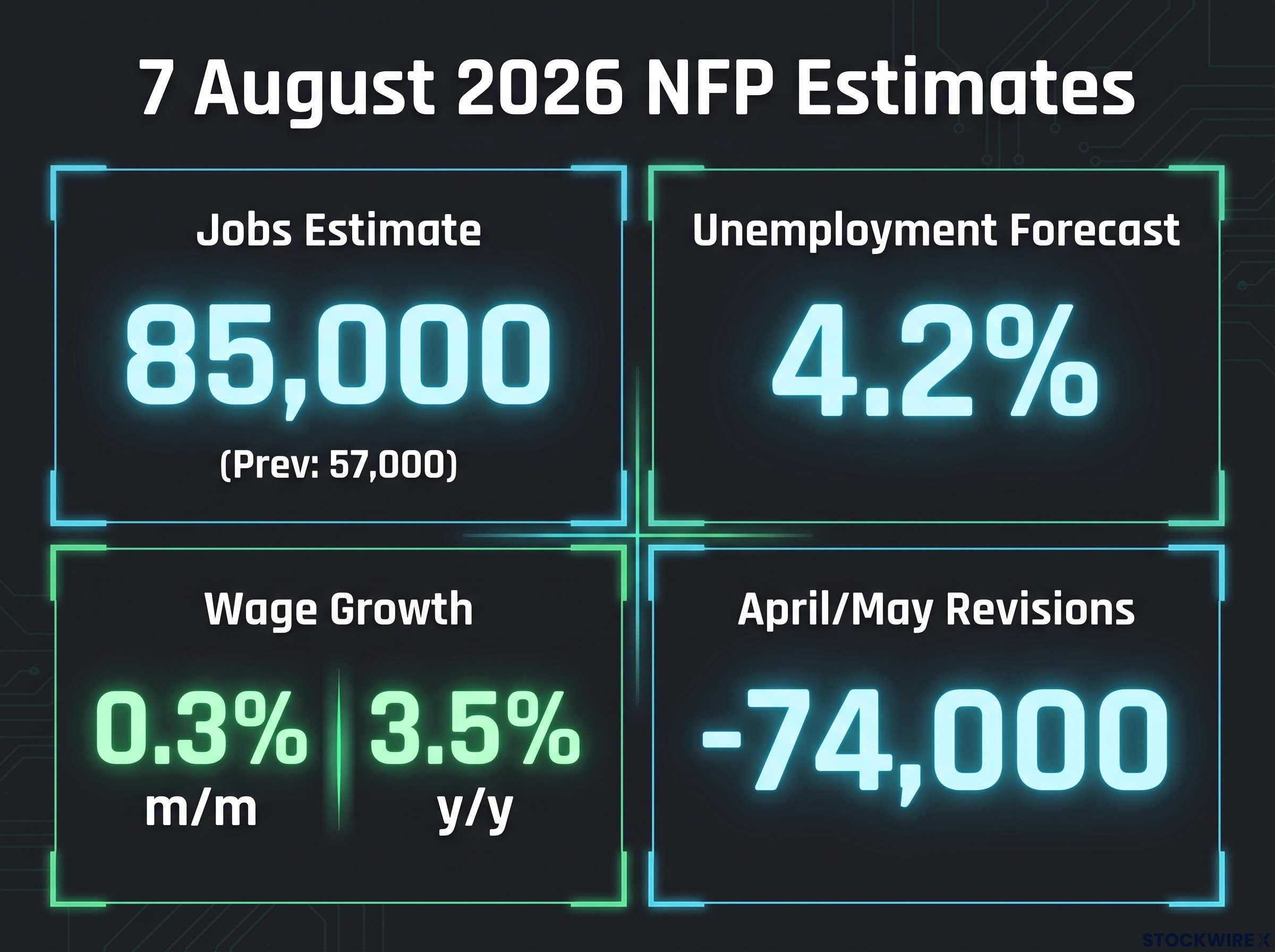
Market estimates point to 85,000 jobs being added in July, compared with 57,000 previously, with April and May figures having been collectively revised lower by 74,000. The unemployment rate is forecast to remain unchanged at 4.2%, with monthly wage growth steady at 0.3% and the annual rate at 3.5%, meaning the headline number lands against an already softened backdrop.
| Scenario | Headline threshold | Wage growth signal | September hike odds | Dollar direction |
|---|---|---|---|---|
| Strong upside | Well above 85,000 with upward prior revisions | Above 0.3% m/m and 3.5% y/y | Rises above 66% | Rebounds as longs rebuild |
| Weak or soft household survey | Below 85,000 or weak household data | Below consensus | Falls sharply; hold probability rises | Extends the post-FOMC slide |
| Mixed internals | Near 85,000 but noisy components | In line but conflicting signals | Stays near 66%; uncertainty persists | Vulnerable to next inflation print |
Jamie Dutta, Vantage Market Analyst, has framed the NFP as the key determinant of the dollar’s near-term trajectory, a role the data now plays precisely because the chair will not.
Beyond the headline, the variable traders will watch most closely is the household survey and wage growth internals. Recent months have seen the household survey deliver particularly erratic readings, and a divergence between the establishment and household readings would leave markets unable to resolve the labour picture cleanly, which keeps September genuinely uncertain.
The asymmetric NFP risk in a guidance vacuum skews toward sharper downside dollar moves on a miss than upside moves on a beat, a pattern that held for the June report when crowded long positioning amplified the market reaction to a weak headline.
The data calendar between now and September’s decision
Friday’s payrolls report is the first test, not the last. Between now and the mid-September FOMC meeting, three additional releases will compound or counteract whatever Friday’s number tells markets.
- July NFP (7 August 2026): The immediate read on labour market momentum. A strong or weak print sets the baseline for September pricing.
- First inflation release (August): CPI data will tell markets whether the price pressures Warsh has described as his primary concern are easing or persisting. A hot print lifts hike odds; a soft one undercuts them.
- Second inflation release (early September): The final inflation reading before the FOMC gathers. This print carries outsized weight because it is the last inflation signal the committee will have.
- August NFP (early September): The final labour market snapshot. Confirms or reverses whatever trend the July report established.
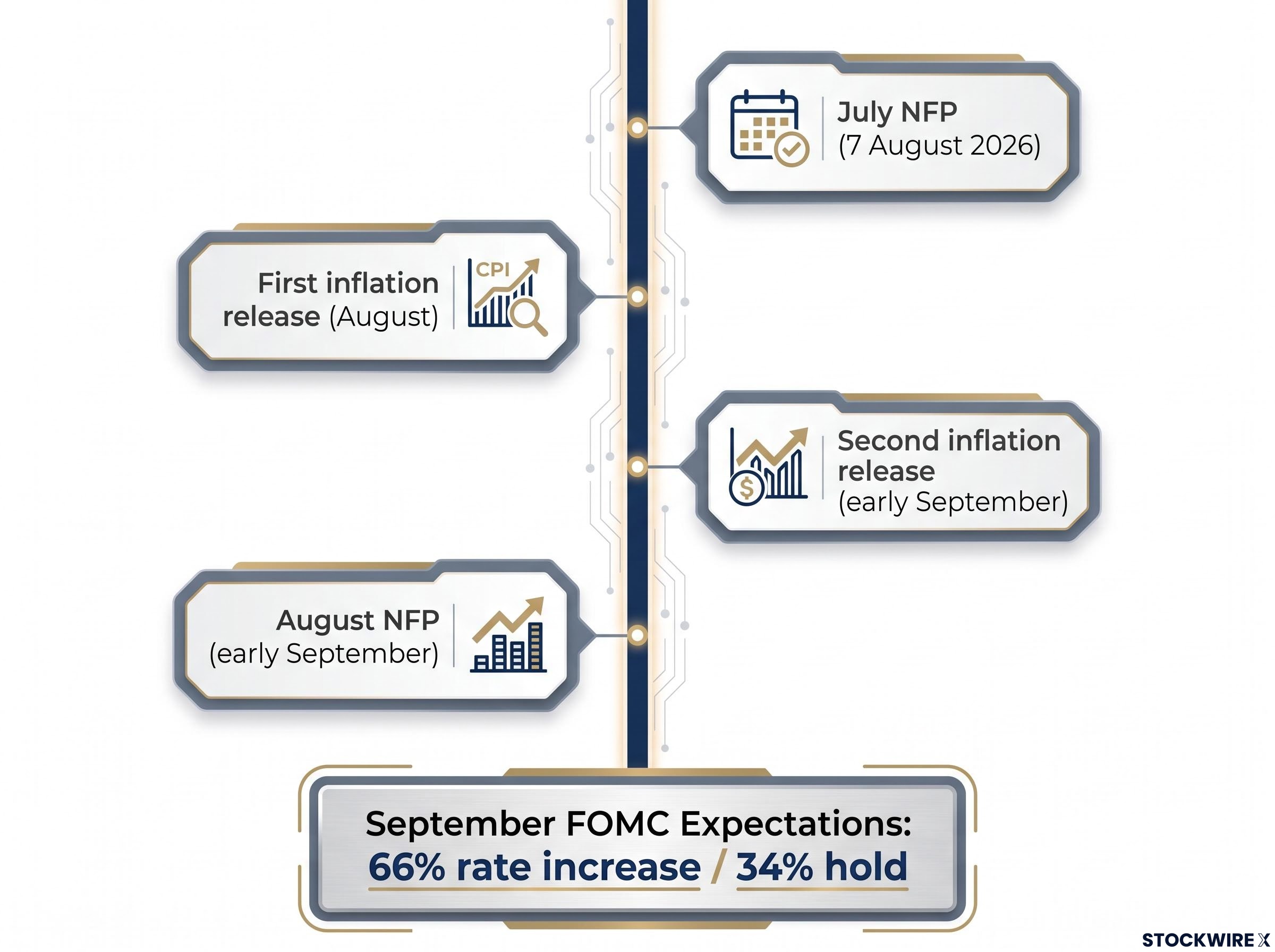
Each of these releases carries more interpretive weight than it would under a normal guidance regime. With no chair-level narrative to contextualise the data, each print effectively functions as its own policy signal. The current 66% hike probability is less sticky and more symmetric than it would be if Warsh were anchoring expectations. A string of soft readings could pull it below 50%; a run of strong data could push it toward 80%.
Other FOMC officials’ remarks between now and the pre-meeting blackout period are worth monitoring closely. They now serve the signalling function the chair has vacated, and a coordinated hawkish tone from multiple governors could move markets almost as much as the data itself.
What the guidance vacuum means when the data finally speaks
The dollar’s post-FOMC slide is a symptom, not a standalone event. It reflects a regime change in how the Fed communicates, and that regime will persist through September and beyond. Warsh has stated his determination to “bring inflation down” without specifying how, when, or at what pace. That is the one rhetorical anchor remaining, and it is deliberately vague.
Warsh has expressed a clear determination to “bring inflation down,” but has offered no specifics on the path, the timeline, or the tools he favours. That is the only anchor left, and it does not tell markets what they need to know about September.
What would change the picture is a consistently strong data run, payrolls and inflation both running hot, that makes a September hike feel inevitable regardless of what the chair says. That would effectively substitute for the guidance Warsh is withholding. Without it, the 66% probability remains genuinely two-sided; a 34% chance of a hold is not negligible, particularly with crowded long positions remaining exposed to additional unwinds should incoming data fall short of expectations.
The September rate decision belongs to the data now, not to the Fed chair. Watching for a guidance signal that will not come is a waste of attention. The payrolls number on Friday, the inflation prints that follow, and the remarks from other FOMC officials before the blackout period are where the answer will form. Reading that data clearly is more valuable than waiting for Warsh to show his hand.
Rebuilding a rate-expectations toolkit for the Warsh era means shifting monitoring weight from the chair’s statements to regional Fed officials, high-frequency labour data, and the trimmed mean PCE series Warsh has flagged as his preferred inflation gauge.
This article is for informational purposes only and should not be considered financial advice. Investors should conduct their own research and consult with financial professionals before making investment decisions. Past performance does not guarantee future results. Financial projections are subject to market conditions and various risk factors.