
SEC Moves to End Mandatory Quarterly Reporting After 50 Years
Apr 24, 2026


The Federal Reserve’s balance sheet has shrunk from $9 trillion to $6.7 trillion, yet a research paper published two days ago suggests up to $2.1 trillion more could come off. The question of how much further is suddenly live again.
This analysis sits at a critical juncture. Quantitative tightening officially concluded on 1 December 2025, but the policy debate is far from settled. Kevin Warsh’s confirmation hearing today brings balance sheet policy back into the spotlight, with the nominee known for advocating aggressive reduction. What follows unpacks what the Fed has accomplished, where policy stands, and what investors should watch as the balance sheet debate enters a new phase.
The Federal Reserve’s quantitative tightening programme delivered one of the largest liquidity withdrawals in central bank history. The balance sheet peaked at approximately $9 trillion during the pandemic, reflecting emergency asset purchases deployed to stabilise markets. As of April 2026, that figure stands at $6.7 trillion, marking a reduction of roughly $2.4 trillion.
The programme officially concluded on 1 December 2025, ending a multi-year effort to normalise monetary policy following pandemic-era stimulus. This was not a pause driven by market stress. It was a deliberate endpoint, calibrated to prevent reserves from falling below levels the Fed deems adequate for smooth financial system functioning.
Key Milestone: Quantitative tightening officially concluded on 1 December 2025, after reducing the balance sheet by approximately $2.4 trillion.
Mortgage-backed securities holdings tell part of the story. According to the Fed’s H.4.1 release as of 16 April 2026:
The Fed’s H.4.1 release tracking weekly balance sheet changes provides the authoritative data source for monitoring reserve levels, Treasury holdings, and mortgage-backed securities positions that determine whether the central bank is approaching the ample reserves threshold.
The $2.4 trillion withdrawal was absorbed without a 2019-style repo crisis. That outcome matters. It demonstrates the Fed learned from past mistakes and calibrated reduction to avoid funding market disruption. The success of this phase shapes what comes next.
The Fed’s shift from passive runoff to active management began on 10-12 December 2025, nine days after quantitative tightening concluded. The central bank introduced reserve management purchases (RMPs), a programme purchasing approximately $40 billion per month in Treasury bills.
RMPs are not quantitative easing. They represent operational maintenance, not stimulus. The distinction matters for market interpretation.
The programme serves a specific purpose: maintaining ample reserves through seasonal pressures. The Fed projected reserve declines in mid-to-late April 2026, driven by tax payments flowing out of the banking system. Without RMPs, reserves risked falling below the threshold the Fed considers adequate for stable money market functioning.
The transition unfolded in three steps:
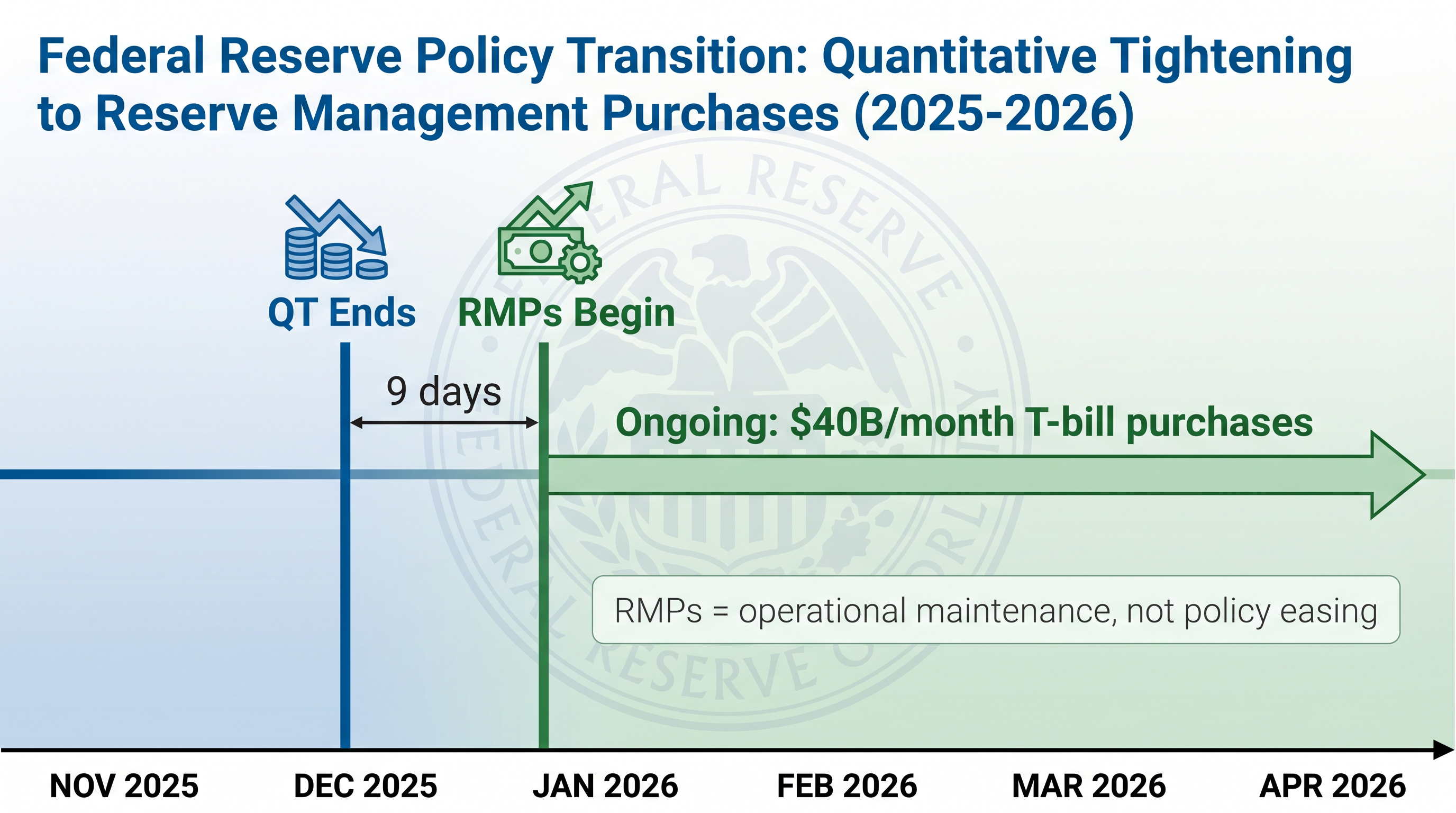
Markets treated the shift as technical necessity rather than policy easing. Longer-maturity Treasury yields showed minimal reaction.
Markets treated the shift from quantitative tightening to reserve management purchases as technical necessity rather than policy easing, demonstrating equity market resilience during concurrent liquidity and energy shocks that historically would have triggered volatility spikes.
Treasury bill purchases expand reserves without affecting longer-duration yields. This keeps the operation targeted. By purchasing only short-dated securities, the Fed avoids signals that could be misread as easing monetary policy or attempting to suppress long-term interest rates. The choice is deliberate, designed to maintain operational flexibility without transmitting unintended policy messages.
Liquidity conditions shape asset prices. Abundant reserves support risk assets by lowering funding costs and improving financial conditions. Liquidity withdrawal creates headwinds, tightening the availability of capital that flows into equities and credit.
The December 2025 transition from quantitative tightening to reserve management purchases was treated as operational by markets. No disruption appeared in equity volatility or Treasury market functioning. The smoothness is itself informative. It suggests the Fed successfully threaded the needle between reducing the balance sheet and avoiding a funding squeeze.
The absence of disruption during the December 2025 policy transition stands in contrast to the energy crisis inflation dynamics and equity market decoupling observed in April 2026, when the Cleveland Fed’s inflation nowcast hit 3.58% while the S&P 500 reached record highs above 7,100.
Historical context clarifies the stakes. In September 2019, overnight repurchase agreement rates spiked above 5%, forcing the Fed to inject emergency liquidity. Reserves had fallen too low. Chair Powell’s framework for ending quantitative tightening in 2025 reflected lessons from that episode.
Chair Powell’s Framework: The approach reflected lessons learned from the 2019 repo market disruption, when reserve levels fell too low.
The information gap on specific Q1-Q2 2026 market responses limits precise conclusions, but the absence of disruption carries weight. Markets absorbed the policy transition without stress.
If future reduction resumes (per the $2.1 trillion scenario outlined in recent Fed research), the liquidity picture shifts. The transmission mechanism operates through multiple channels:
| Policy Action | Liquidity Effect | Typical Equity Impact | Typical Bond Impact |
|---|---|---|---|
| QT (passive runoff) | Reduces reserves | Headwind | Yields rise |
| MBS runoff | Gradual reduction | Modest headwind | Mortgage spreads widen |
| RMPs (T-bill purchases) | Maintains reserves | Neutral to supportive | Minimal yield impact |
Equity valuations that benefited from pandemic-era liquidity could face renewed pressure if another leg of balance sheet reduction materialises. The degree of impact depends on the pace and whether the Fed communicates clearly enough to avoid funding market surprises.
Kevin Warsh’s documented positions on Federal Reserve balance sheet policy favour aggressive reduction. His argument centres on market distortions. Large central bank bond holdings, he has argued, interfere with price discovery and contribute to inflation pressures by keeping financial conditions looser than fundamentals justify.
The Senate Banking Committee confirmation hearing is scheduled for today, 21 April 2026, at 10:00 a.m. ET. Specific testimony details are not yet available, but Warsh’s prior positions are on record. If confirmed as Fed Chair, his philosophy could accelerate balance sheet shrinkage beyond current projections.
Warsh’s known positions include:
The inflation context adds tension. The Consumer Price Index increased 3.3% year-over-year in March 2026, up from 2.4% in both January and February. The uptick complicates any policy that could be perceived as loosening financial conditions, even if balance sheet reduction is technically a tightening measure.
The inflation uptick complicates any policy that could be perceived as loosening financial conditions, particularly given how oil price dynamics reversed Fed rate cut expectations from two projected reductions at the start of 2026 to a 73% probability of no cuts by April.
The Bureau of Labor Statistics Consumer Price Index data showed the March 2026 year-over-year increase of 3.3%, a significant uptick from the 2.4% readings in January and February that complicates any policy move perceived as loosening financial conditions.
CPI Trajectory: The Consumer Price Index increased 3.3% year-over-year in March 2026, up from 2.4% in both January and February.
For investors, the confirmation hearing matters. If Warsh articulates a timeline or framework for renewed reduction, markets will need to price in another phase of liquidity withdrawal. The gap between his reduction stance and rising inflation readings could define the Fed’s next policy chapter.
A Federal Reserve research paper published on 19 April 2026 outlined potential for up to $2.1 trillion in additional balance sheet reduction. This is a research scenario, not announced policy. But it signals internal discussions about renewed reduction are active.
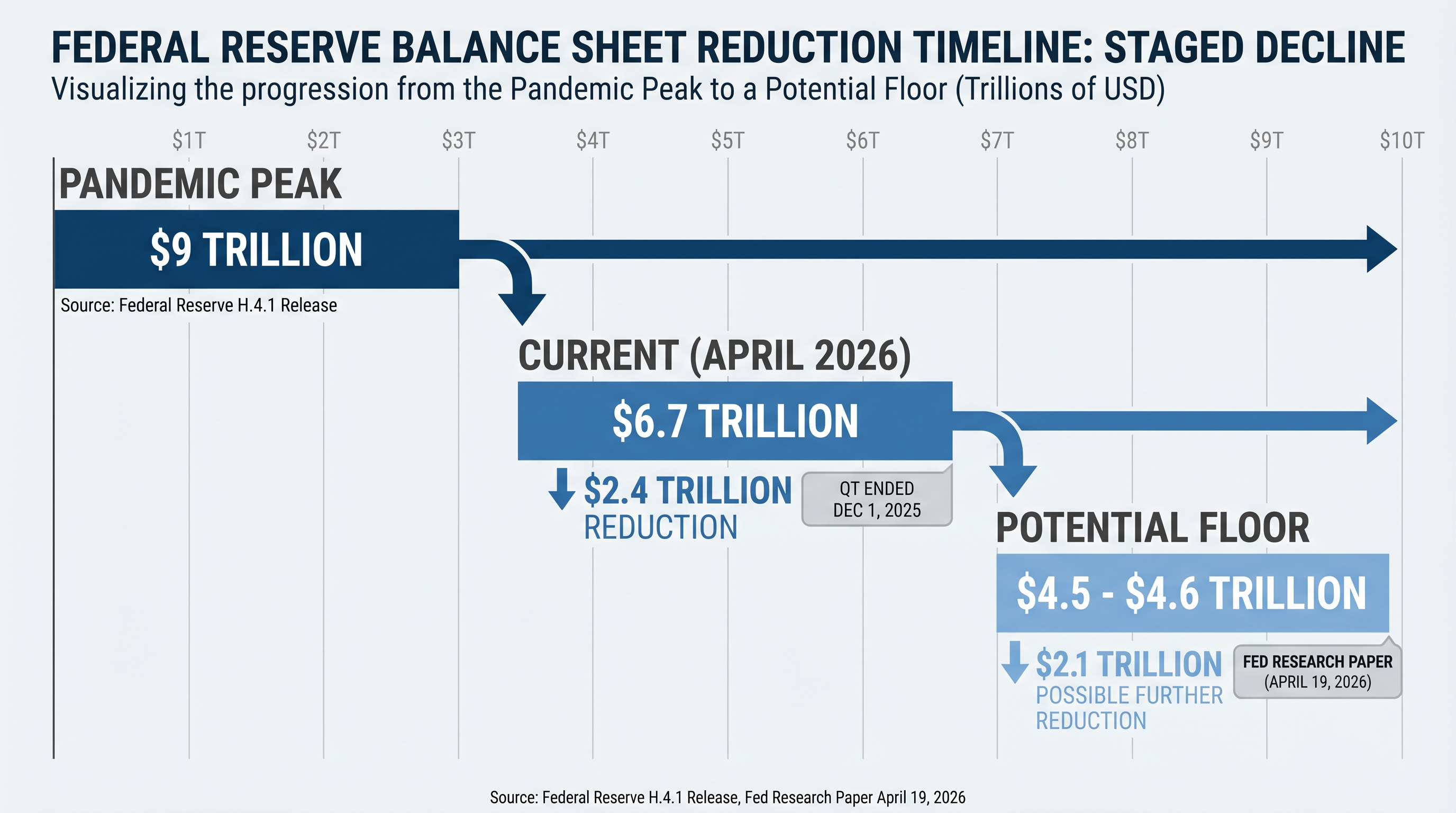
The current balance sheet stands at $6.7 trillion. If the full $2.1 trillion reduction occurred, the steady-state floor would land around $4.5 trillion to $4.6 trillion. That figure is not arbitrary. It represents the Fed’s estimate of reserves needed to maintain ample liquidity under current banking system structure.
The “ample reserves” framework guides the calculus. The Fed will not reduce below levels that risk funding market stress. But that threshold is not fixed. It shifts based on:
The $2.1 trillion figure provides a rough upper bound. If realised over several years, this would represent a sustained liquidity headwind. Investors should factor this into longer-term asset allocation, particularly for rate-sensitive sectors and high-valuation equities that benefited from low discount rates during the pandemic era.
Ample reserves is not a fixed number. It is a range the Fed monitors through money market conditions. When overnight rates spike unexpectedly or the repo market shows stress, reserves are no longer ample. The Fed watches the spread between the federal funds rate and interest on reserve balances, repo market functioning, and Treasury bill yields for signs of reserve scarcity. Structural changes in banking (higher liquidity requirements, shifts in deposit behaviour) move the threshold over time, making it a dynamic target rather than a static rule.
The Federal Reserve has successfully shrunk its balance sheet by $2.4 trillion without triggering market disruption, a significant achievement that validates the gradual approach Chair Powell championed. Yet the policy debate is not settled.
With a Fed research paper floating up to $2.1 trillion in additional reduction and a nominee known for aggressive balance sheet views facing confirmation today, the next chapter remains unwritten. Investors should monitor three signals: Warsh’s confirmation hearing testimony for any commitments on reduction pace, reserve market conditions through the April tax season as a test of reserve management purchase adequacy, and any Fed communication shifting from “maintain ample reserves” to “resume gradual reduction.”
Balance sheet policy operates in the background, but its effects ripple through every asset class. Staying informed on the Fed’s liquidity posture is essential for positioning portfolios through the next phase of monetary policy normalisation.
For investors positioning portfolios through the next phase of monetary policy normalisation, understanding portfolio positioning strategies during liquidity withdrawal phases becomes essential as the Fed’s balance sheet trajectory remains uncertain.
Fed balance sheet reduction, also called quantitative tightening, is the process by which the Federal Reserve shrinks its holdings of Treasury securities and mortgage-backed securities, withdrawing liquidity from the financial system. For investors, this tightening of liquidity conditions can create headwinds for equities and push bond yields higher.
The Fed reduced its balance sheet from a pandemic peak of approximately $9 trillion to $6.7 trillion as of April 2026, a total reduction of roughly $2.4 trillion. Quantitative tightening officially concluded on 1 December 2025 without triggering a funding market crisis.
Reserve management purchases are monthly Treasury bill purchases of approximately $40 billion designed to maintain stable reserve levels through seasonal pressures such as tax outflows, and they are not the same as quantitative easing. Unlike QE, they target only short-dated securities and are intended as operational maintenance rather than economic stimulus.
Kevin Warsh has publicly advocated for aggressive balance sheet reduction, arguing that large Fed holdings distort asset prices and keep financial conditions looser than fundamentals justify. If confirmed, his philosophy could accelerate shrinkage beyond current projections, adding a potential liquidity headwind for rate-sensitive assets.
The ample reserves threshold is not a fixed number but a dynamic range the Fed monitors through money market conditions, including overnight repo rates, the spread between the federal funds rate and interest on reserve balances, and Treasury bill yields. The Fed will not reduce its balance sheet below the level where falling reserves risk triggering funding market stress similar to the 2019 repo crisis.