A stronger dollar is usually read as the market following the Federal Reserve’s lead. This month the order looks reversed. Fed rate repricing has pushed 12-month forward Fed Funds pricing to just below 5%, above even the most hawkish of the 65 forecasters in Bloomberg’s survey, while the US Dollar Index (DXY) sits near 102.
The DXY measures the dollar against a basket of major currencies. Its climb this year has matched the market’s rising rate expectations almost step for step.
Kit Juckes, a strategist at Societe Generale, argued on 13 October that the latest step may be the last. If he is right, the rate engine behind the dollar is running close to empty.
Here is what the data tells you about three things: the three legs of the move, the single data point that could extend it, and the forces that could keep the dollar firm even if rate pricing stalls.
How three waves of Fed rate repricing carried the dollar to 102
12-month forward Fed Funds pricing is the interest rate markets expect the Fed’s benchmark overnight rate to sit at one year from now. It is derived from futures contracts. When that expected rate rises, holding dollars becomes more rewarding relative to other currencies.
The first leg came at the start of the Gulf crisis. Forward pricing jumped from 3.2% to 3.8%, and the DXY broke above 100. A second push to 4.2% carried the index past 101. A third, above 4.5%, took it to roughly 102.
| Leg | 12-month forward Fed Funds pricing | DXY level | Trigger |
|---|---|---|---|
| 1 | 3.2% to 3.8% | Above 100 | Start of the Gulf crisis |
| 2 | 4.2% | Above 101 | Further hawkish repricing |
| 3 | Above 4.5% | Roughly 102 | Further hawkish repricing |
Each rise in rate pricing came first. The dollar followed it.
Today the dollar traded between 102.03 and 102.20 on 15 October, while forward pricing sits just below 5%. That is a long way above the Fed’s current target range of 3.75%-4.00%, set after a 25bp hike in September. The Fed’s median projection reportedly points to 4.1% by year-end, which implies only one more quarter-point move.
The gap between market pricing and the Fed’s median projection is a form of dot plot divergence, and history suggests the more hawkish futures path sometimes proves closer to reality when the FOMC underestimates how long it must stay tight.
Ahead of every economist Market pricing sits about 20bp above the highest forecast in Bloomberg’s survey of 65 forecasters and roughly 50bp above the consensus.
The dollar is already carrying tightening that policymakers have not signalled. For rate-driven gains to continue, you would need fresh evidence that the Fed will go further than even its most hawkish watchers expect.
When big ASX news breaks, our subscribers know first
Why Juckes thinks the latest wave is nearing its end
Juckes set a clear bar. In his view, another lift in terminal-rate pricing would probably need a sizable upside surprise in US core CPI. Core CPI is the consumer price index excluding volatile food and energy prices.
What the CPI print did and did not change
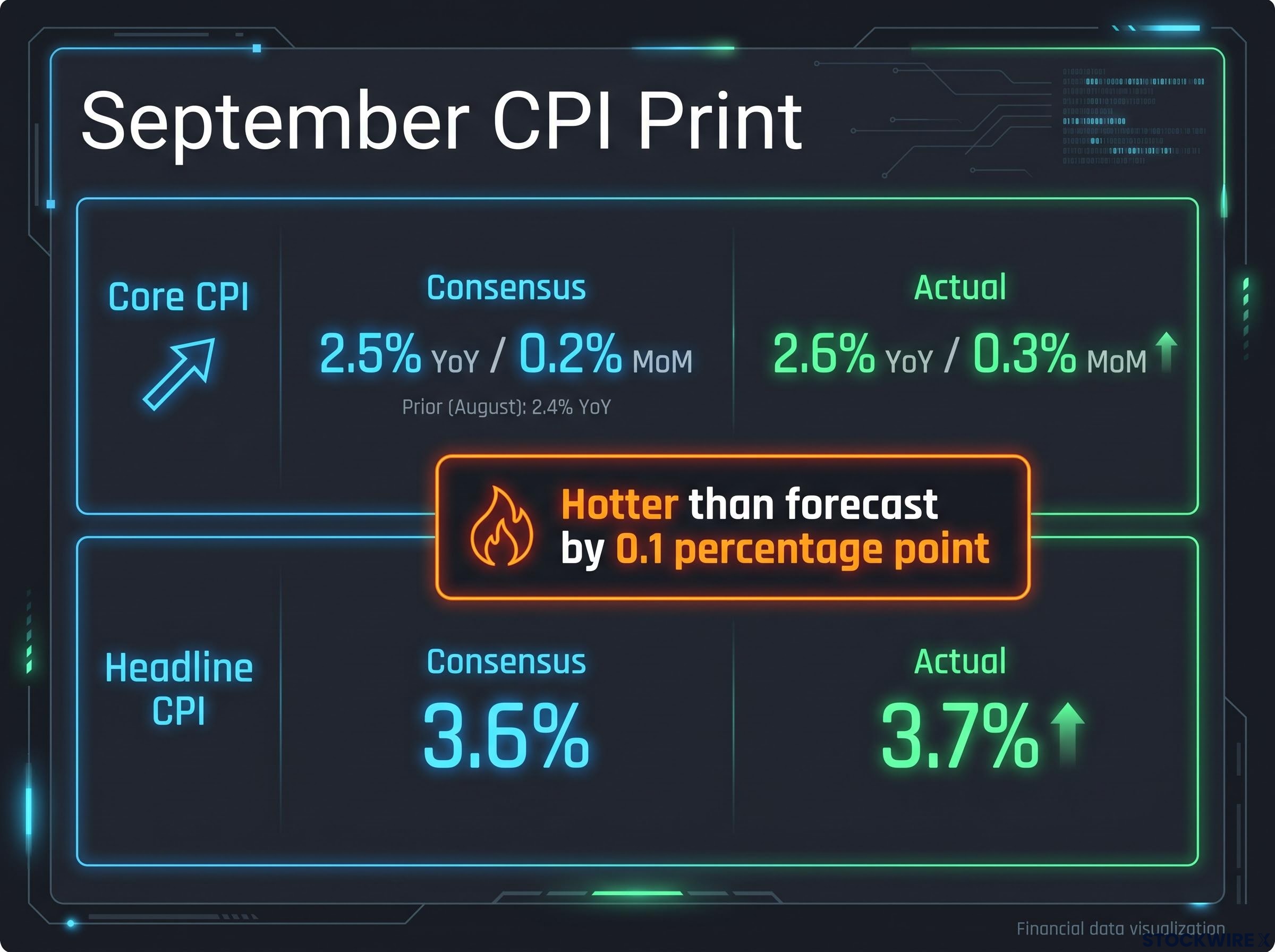
The September figures landed yesterday. According to reported data, they compared with expectations as follows:
- Core CPI consensus: 2.5% year on year, 0.2% month on month
- Core CPI actual: 2.6% year on year, 0.3% month on month
- Core CPI prior (August): 2.4% year on year
- Headline CPI: 3.7%, against a 3.6% consensus
The print came in hotter than forecast, but only by 0.1 percentage point. That supports the hawkish case without clearing Juckes’s bar. Reports also suggest pricing for an October hike had already fallen sharply before the release.
The split between core and headline inflation matters here, since energy and one-off components can inflate headline readings while underlying core pressure stays far more contained.
Read the print as holding current pricing in place rather than pushing it higher. A modest beat confirms what the market already believes. It does not justify another leg.
How higher yields tighten conditions on their own
Bond markets add a second brake. The 10-year Treasury yield reportedly reached around 5.30% after the print, close to a recent peak near 5.34%, the highest since 2002. Sources disagree on intraday levels, so treat any single figure with care.
Higher long-term yields raise borrowing costs across mortgages, corporate debt and equity valuations. Juckes argues they are already doing some of the Fed’s work. If the bond market tightens conditions, the Fed has less reason to hike, so each rise in yields should not be read as a further rise in expected policy rates.
Strategists surveyed in early October reportedly saw the 10-year ending the year at 5.00%, below where it trades now.
What drives the dollar when rates stop doing the work?
If rate pricing has run its course, the obvious conclusion is that the dollar has peaked too. The evidence does not support that conclusion.
The channels supporting the dollar
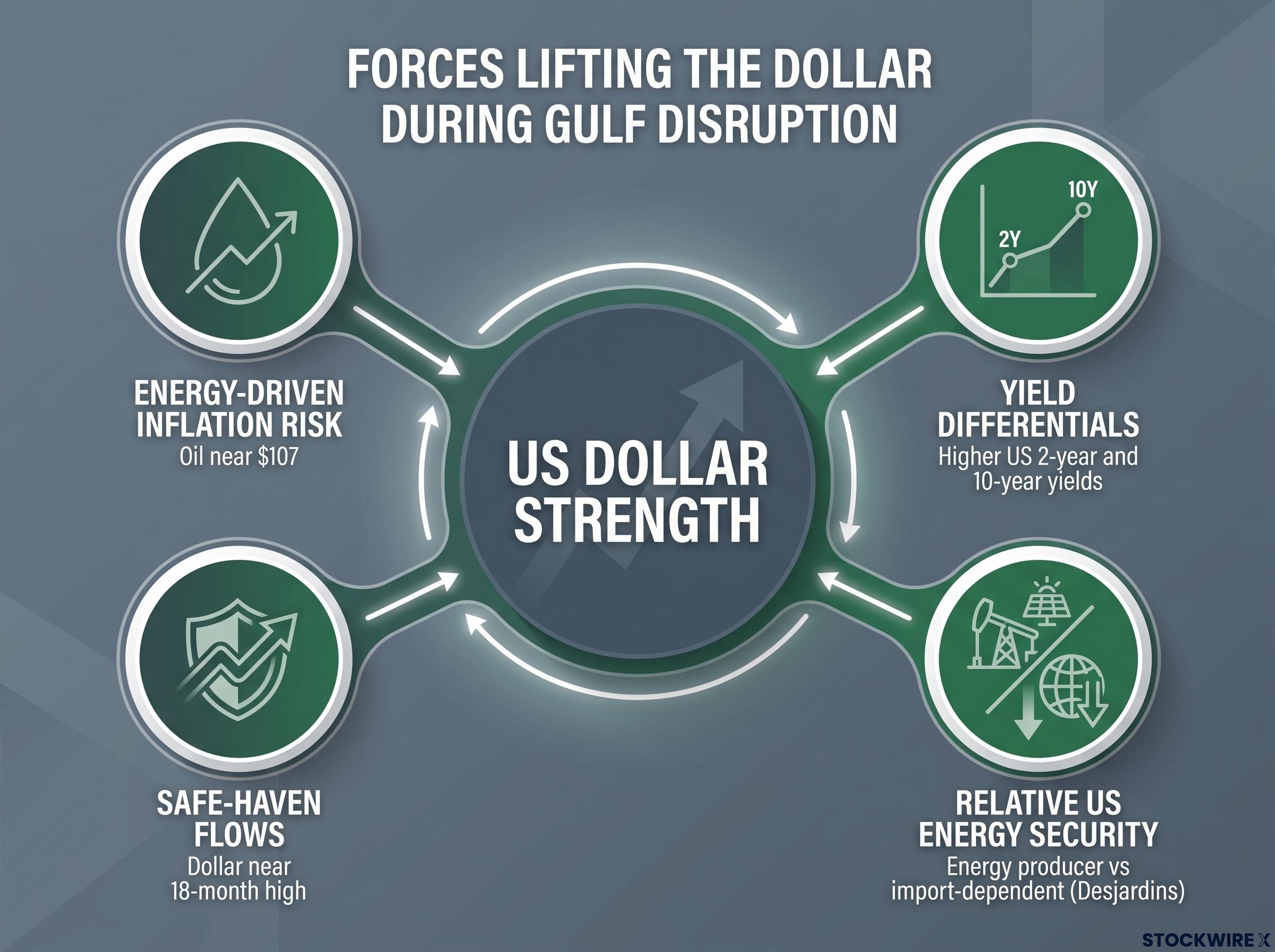
Four separate forces have lifted the dollar during the Gulf disruption:
- Energy-driven inflation risk. Oil reportedly reached near $107, raising US inflation risk and the odds of further Fed tightening.
- Yield differentials. Higher US 2-year and 10-year yields make dollar assets more rewarding than foreign alternatives.
- Safe-haven flows. CNBC reported the dollar near an 18-month high as investors sought safety.
- Relative US energy security. Desjardins argued the US, as an energy producer, takes a smaller hit than import-dependent economies.
These channels have moved together in this episode, which makes them easy to mistake for one story. Lee Hardman of MUFG reportedly observed on 11 October that the dollar strengthened even as investors scaled back near-term hike expectations. That is the safe-haven channel working without help from rates.
Other strategists lean harder on the rate story. Francesco Pesole of ING reportedly framed the bond selloff as a warning to the Fed that would favour the dollar. Chris Weston of Pepperstone pointed to December or January as the next plausible hike window. Verified October notes from the largest US banks were not available.
Where the dollar case can weaken
Oil cuts both ways. If high prices persist, they can erode purchasing power, slow US growth and raise recession risk, which would weigh on the dollar. Desjardins reportedly noted that oil falling toward $80 could unwind a large share of the tightening already priced in.
The gap with the Fed is also wide. BBVA Research reportedly found markets pricing three to four hikes by September 2027 against about one in the FOMC median.
Keep the rate story and the shock story separate. A stall in Fed repricing is a narrower claim than a peak in the dollar, and Juckes is making the narrower one.
What 1984 teaches about high yields and currency markets
A 5% 10-year yield feels extreme to anyone anchored on the past decade. Juckes points further back. In 1984, 10-year notes yielded about 13% and Fed Funds exceeded 15%.
Federal Reserve data reportedly show monthly 10-year averages of about 11.67% in January 1984 and 13.56% in June. The low-rate era is the outlier, not today.
Kit Juckes, Societe Generale Juckes described the low yields after the global financial crisis (GFC) as “every bit as unusual” as the high-yield periods of the early 1990s.
| Period | 10-year yield | Fed Funds | Dollar backdrop |
|---|---|---|---|
| 1984 | About 13% | Above 15% | High-rate era |
| October 2026 | Above 5% | 3.75%-4.00% target range | DXY around 102 |
High yields alone do not guarantee a strong dollar. The currency responds most when credible tightening, persistent inflation risk and global risk aversion arrive together, as they have since the Gulf crisis began.
When yields rise because of fiscal worries or a growing term premium (the extra return investors demand to hold long-dated bonds), the dollar’s response becomes harder to predict. Before drawing a conclusion from any yield level, ask what is pushing it higher.
Part of the bond selloff reflects fiscal deficit anxiety rather than expected Fed tightening, a distinction that matters because yields lifted by supply and term premium do not carry the same signal for policy rates.
What the repricing slowdown changes, and what it leaves open
The rate-driven leg looks stretched. Yesterday’s CPI print beat forecasts without delivering the large surprise Juckes said was needed, and higher yields are already tightening conditions on the Fed’s behalf. Safe-haven demand and oil, however, can still hold the dollar up.
Three markers will tell you which force is winning:
- The next core CPI print: a sizable upside surprise would reopen the rate channel.
- The 10-year yield against its recent peak near 5.34%: a break higher, and its cause, matters.
- Oil relative to $100 and $80: a move toward $80 could unwind priced-in tightening.
A stalled repricing and a peaked dollar are different claims. Watch them separately.
For readers wanting to judge whether the rally has legs, our dedicated guide to reading an overextended dollar rally shows how RSI divergence at structural levels carries more weight than overbought readings alone.
Past performance does not guarantee future results. Financial projections are subject to market conditions and various risk factors. These statements are speculative and subject to change based on market developments.
This article is for informational purposes only and should not be considered financial advice. Investors should conduct their own research and consult with financial professionals before making investment decisions.