Two call purchases hit the tape about four seconds apart in the final minute of a recent session. One was roughly $16 million in Microsoft November $550 calls, and the other roughly $15.3 million in Moderna January $240 calls. The dollar figures nearly match, which makes it tempting to read this large options flow as two equally confident bets.
That reading is wrong. A premium tells you how much someone spent. It tells you nothing about how far the stock has to move before that spending pays off.
Both stocks trade near their 52-week highs, but they took very different routes to get there. Microsoft climbed steadily on AI monetisation. Moderna went nearly vertical on cancer vaccine hopes and index inclusion. One caveat applies throughout: the trade figures come from a single presenter, Tasty Life, and no independent outlet has confirmed the prints.
Here is a short checklist for separating signal from noise in any big options print, tested on two trades that look alike and are not.
What do two $15 million call purchases actually have in common?
On the surface, quite a lot. Both are bullish call purchases worth about $15 million to $16 million, placed seconds apart on stocks trading near their highs. A call option gives the buyer the right to purchase shares at a set price, called the strike, before a set expiry date.
The similarities stop there. Read the table row by row.
| Factor | Microsoft Nov $550 | Moderna Jan $240 |
|---|---|---|
| Premium | ~$16M | ~$15.3M |
| Days to expiry | 31 (13 November 2026) | 94 (15 January 2027) |
| Implied volatility | ~30 | ~87 (IV rank ~82.5) |
| Break-even vs. price | ~$566.88 vs. ~$541 | ~$268.49 vs. ~$214 |
| Position build | 9,494 contracts vs. 272 prior open interest (~35x) | 5,369 contracts added to 2,735 existing |
Implied volatility (IV) is the market’s estimate of how much a stock will swing, built into the option’s price. Higher IV makes options more expensive. Open interest is the number of contracts already outstanding before the trade.
Implied volatility is extracted from live option prices rather than historical data, which is why a reading of 30 versus 87 tells you how large a move the market expects, though never which direction the stock will take.
The break-even gap Microsoft needs to rise about 4.8% for the call buyer to break even at expiry. Moderna needs to rise about 25.6%.
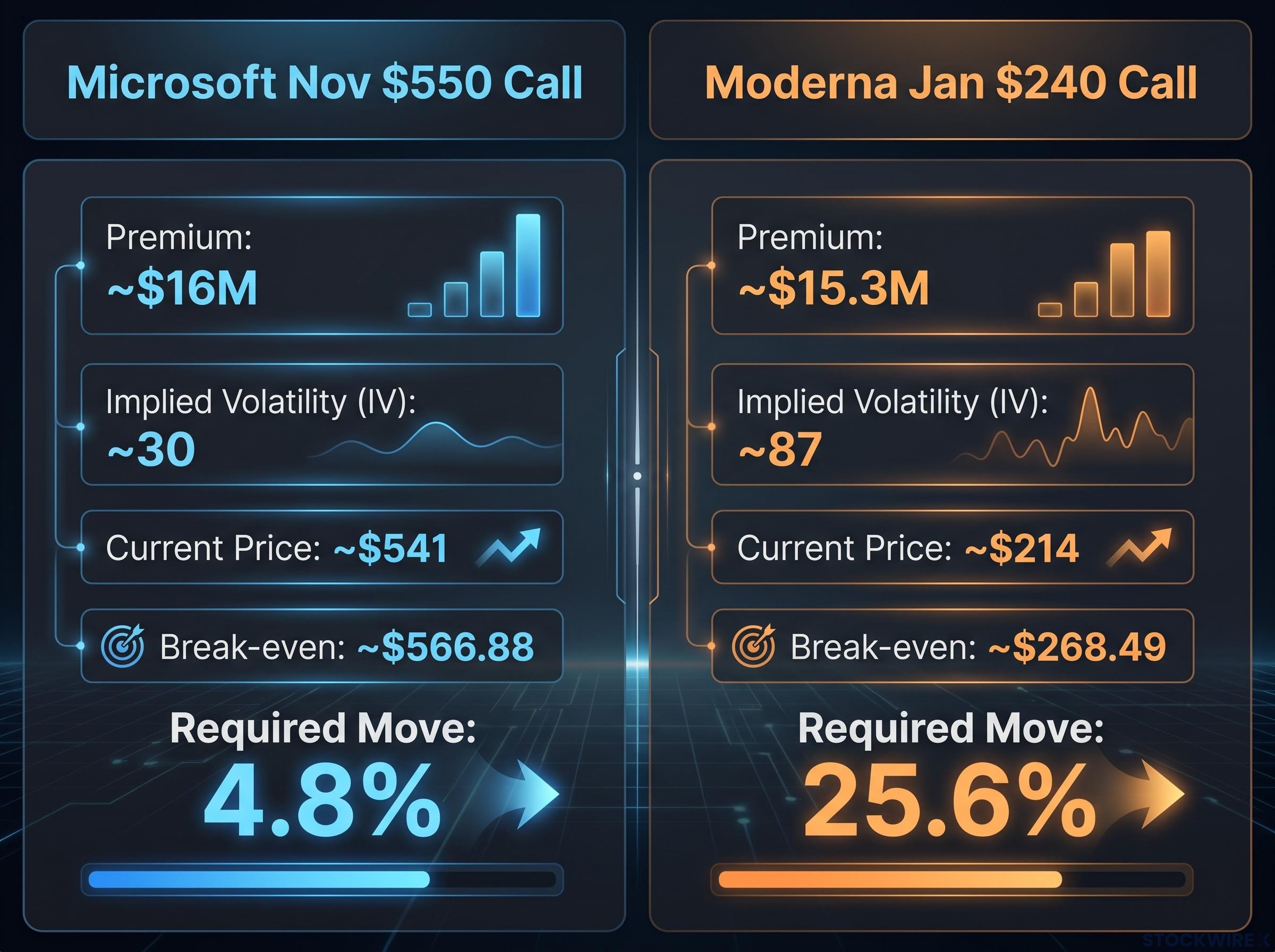
That gap is the real story. The matching premiums are coincidence; the structure is the signal. Before you form any view on a headline print, convert the premium into a required percentage move and check the IV. Those two numbers tell you how much the stock must do, and the dollar figure never will.
When big ASX news breaks, our subscribers know first
How does Microsoft’s modest-move bet compare with its fundamentals and risks?
The case supporting the trade
Microsoft closed at $543.45 on 13 October, inside a 52-week range of $349.20-$553.72, according to Business Insider. The average analyst target sits at $588.56, and both Morgan Stanley and Barclays have set targets of $600. Yahoo Finance shows slightly different figures, $533.69 and a $583.56 median, a gap explained by refresh times and how each service counts analysts.
Break-even versus targets The call’s ~$566.88 break-even sits below the ~$588 average analyst target.
A catalyst also falls inside the option’s life. MarketBeat estimates fiscal Q1 FY2027 earnings on 28 October 2026, after the close, though Microsoft has not confirmed the date. Consensus expects EPS of about $4.72 on revenue of about $90.61 billion, against company guidance of $89.85-$90.95 billion, with Azure guided at roughly 44%-45% growth in constant currency.
The trend helps too. Market capitalisation stands near $4.02 trillion, and shares are up more than 50% from the June low.
Where the risk hides
The stock trades at about 30 times forward earnings, against roughly 19 for the S&P 500. That premium leaves little room for a stumble near a 52-week high. The counterarguments carry real weight:
- Capex monetisation: spending of roughly $175-$190 billion could outpace profitable customer usage (Simply Wall St, Investing.com).
- Margin pressure: Microsoft Cloud gross margin has slipped to about 65% (24/7 Wall St).
- Depreciation and leases: rising charges and data-centre commitments could weigh on free cash flow (Yahoo Finance).
- Azure base effect: holding mid-40s growth gets harder as the business grows larger.
No reliable options-implied earnings move could be found, so the market’s expected swing is unknown. Earnings are a recurring event with a narrower range of outcomes than a clinical readout. Even so, this call needs a gain of roughly 5% plus clean Azure execution, which means a good-but-not-great quarter could still leave you short of break-even.
Earnings-implied moves are prices for risk rather than forecasts of direction, and realised results have landed on both sides of what options priced, which is why Microsoft’s unknown implied swing leaves the real hurdle uncertain.
Why does Moderna’s call carry a different kind of risk?
Microsoft’s risk is execution. Moderna’s is that the good news may already be in the price.
What the stock already reflects
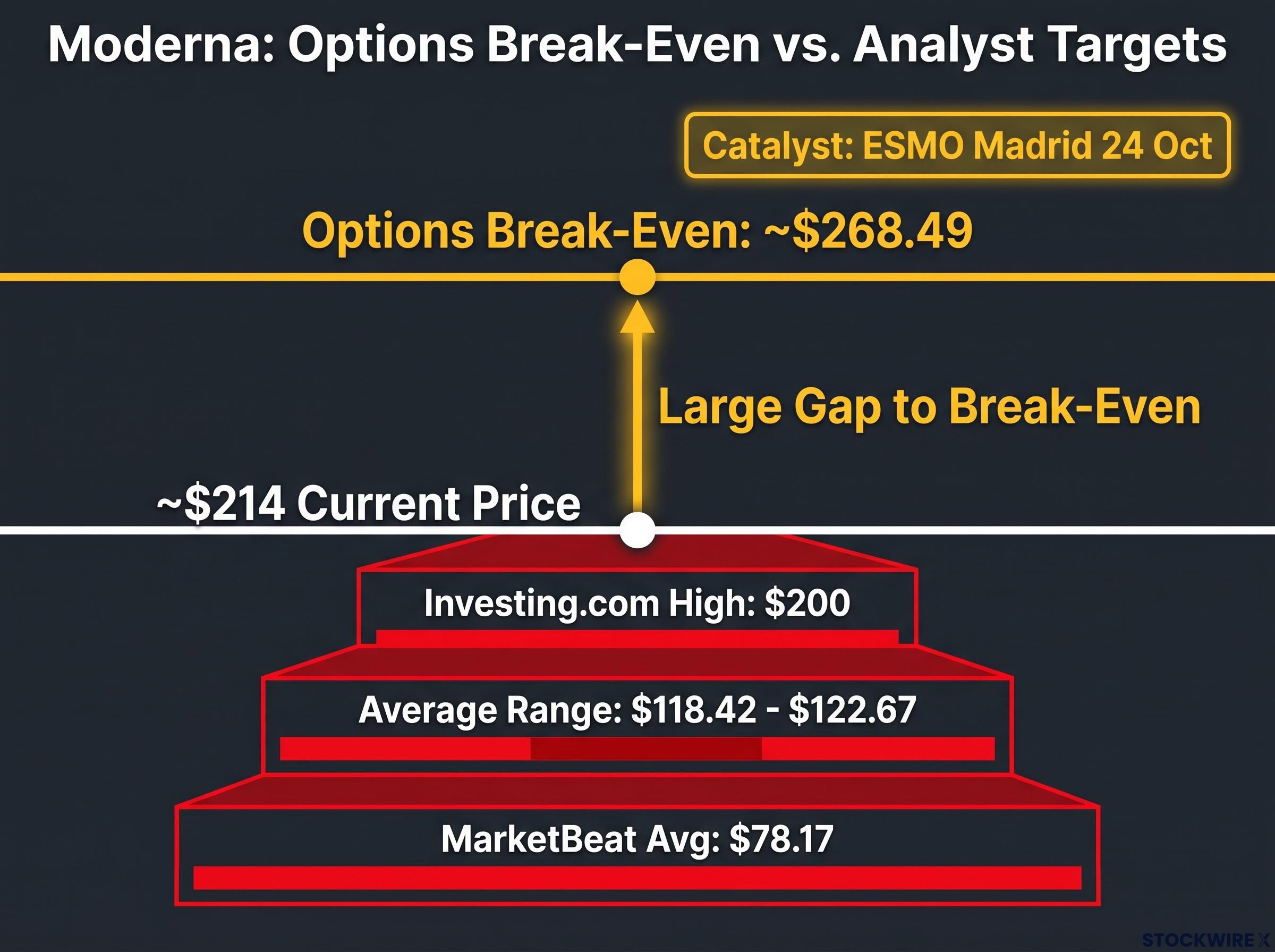
Moderna is up 663% this year, according to the original source. Recent prices range from $216.25 (MarketWatch) to about $226.30 (Investing.com). Average analyst targets sit between $118.42 and $122.67, while MarketBeat shows a consensus Hold and an average of just $78.17.
Four explanations compete for credit, and none has been quantified:
- Positive Phase 3 topline results, with detailed data still pending.
- Nasdaq-100 inclusion, effective 9 October 2026.
- Hopes that oncology diversifies Moderna beyond COVID products, boosted by the 19 August Merck partnership news.
- Short covering, call buying and dealer hedging.
The catalyst arrives soon. Merck said INTerpath-001 Phase 3 melanoma results will be presented as a late-breaking abstract at ESMO in Madrid (23-27 October), with coverage pointing to 24 October. Topline results met the primary endpoint of recurrence-free survival (RFS), meaning time without cancer returning, and the key secondary endpoint of distant-metastasis-free survival (DMFS), meaning time without spread to distant organs. Earlier Phase 2b data showed a 49% reduction in recurrence or death at five years.
Skeptics argue the price assumes commercial success before approval, manufacturing scale-up, reimbursement and durable non-COVID revenue are proven. MarketBeat also flags insider selling. The break-even sits about 58% above the highest target the original source cited (around $170); Investing.com now lists a high of $200, still well below $268.49.
How IV crush can beat a correct call
IV crush in brief Biotech IV commonly climbs before a known catalyst and falls sharply once results land. A long call can lose value even if the stock rises, when the move is smaller than the option had priced.
At about 87 IV, this call is already expensive. Positive data could arrive, the stock could climb, and the option could still shrink as volatility drains out. This buyer needs both a large move and a result strong enough to outrun that collapse, a far narrower path than the “bullish bet” headline suggests.
For readers wanting to match a trade to the volatility regime, our dedicated guide to choosing options strategies with implied volatility explains when IV Rank above 60 favours selling premium instead of buying it.
How do you read large options flow without over-reading it?
Most investors see a big print and assume conviction. Someone spent $15 million, so they must know something. That assumption breaks down quickly.
A single block can be a hedge against shares held elsewhere, a roll from an older contract, one leg of a spread, or a yield trade. DiscoveryAlert notes a call purchase may be paired with a higher-strike call sale that prints separately. OptionsFlow.com points out that blocks show size, not urgency, though trades just before a catalyst are more plausibly event positioning.
Alerts on unusual options activity confirm that abnormal volume occurred at a strike, but they cannot say whether the trade was a directional bet, a hedge, or one leg of a larger structure.
Size shows what was paid, not why.
Other evidence matters more. FlowSeek found that buying concentrated across related strikes says more than an isolated print. RadarPulse warns that market makers may delta-hedge, meaning they buy or sell shares to offset their own exposure, so an early price move can reflect dealer positioning rather than agreement with the buyer.
Run any headline trade through five steps:
- Check the break-even as a percentage above the current price.
- Read the IV and ask whether it is already elevated.
- Compare volume with open interest to judge a fresh build versus an addition.
- Identify the catalyst and whether it falls before expiry.
- Look for offsetting legs at nearby strikes or in the stock.
Applied here, Microsoft’s open interest jump suggests a fresh build ahead of earnings. Moderna’s trade added to existing positioning before a binary event. Neither print alone proves an unhedged view, so if you are tempted to follow either, the trade needs its own risk analysis.
What the matching premiums tell you, and what they never could
Same dollar size, different bets. Microsoft’s call is a modest-move earnings exposure. Moderna’s is a high-IV wager on clinical data that a huge rally has already partly priced.
Two dated events will test the reasoning. Moderna’s ESMO presentation is expected around 24 October, and Microsoft’s earnings are expected around 28 October, a date the company has not confirmed.
Before acting on any large print, convert it to a required move, check the IV, and confirm what remains unverified. Both trades here rest on a single source that no independent outlet has confirmed.
This article is for informational purposes only and should not be considered financial advice. Investors should conduct their own research and consult with financial professionals before making investment decisions. Past performance does not guarantee future results, and forward-looking statements are speculative and subject to change.