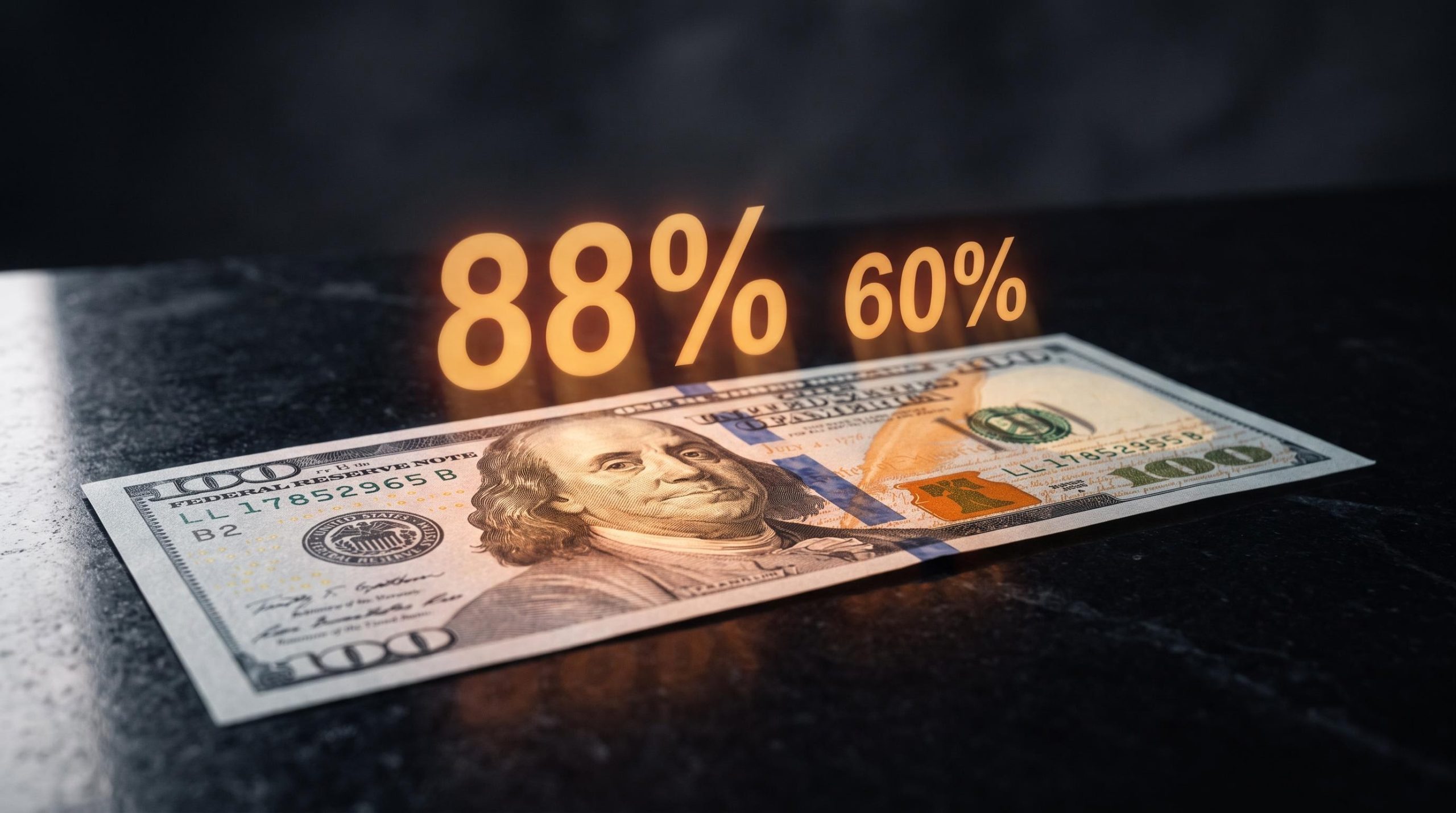
After August’s blowout jobs report, traders rushed to price in a Federal Reserve rate hike that the US Dollar apparently has no interest in celebrating.
Nonfarm payrolls came in at 162,000 in August 2026, roughly triple the 53,000-56,000 consensus. That pushed September hike odds to around 60% and lifted the probability of higher rates by December to 88%. The standard playbook says a hawkish repricing of this scale should lift the Dollar.
Instead, the Dollar Index posted a 0.3% gain on payrolls Friday and has stayed essentially flat since Fed Chair Powell’s Jackson Hole address. That gap between what rate markets are pricing and what the currency is doing is the story.
This analysis untangles why the Dollar is not moving the way the playbook says it should, which mechanisms are most likely driving the divergence, and what the risks look like if the September FOMC meeting delivers exactly what markets expect.
The payrolls print that changed the rate calculus
The August number did not just beat expectations. It obliterated them. Economists had penciled in somewhere between 53,000 and 56,000 new jobs, according to previews from CNBC, Reuters, and TradingEconomics. The Bureau of Labor Statistics (BLS) reported 162,000, the largest monthly gain in five months, with the unemployment rate holding steady at 4.1% and average hourly earnings rising 10 cents versus July.
Rate markets moved fast, but the conviction had been building for a week. This was not a single-day reaction to one surprise.
The Jackson Hole address on 28 August set the immediate backdrop for this divergence: Warsh’s warning that roughly half the PCE basket remains above 3% drove the DXY to an intraday high near 99.73, yet the index subsequently stalled, confirming the rally was more sentiment-driven than structurally sustained.
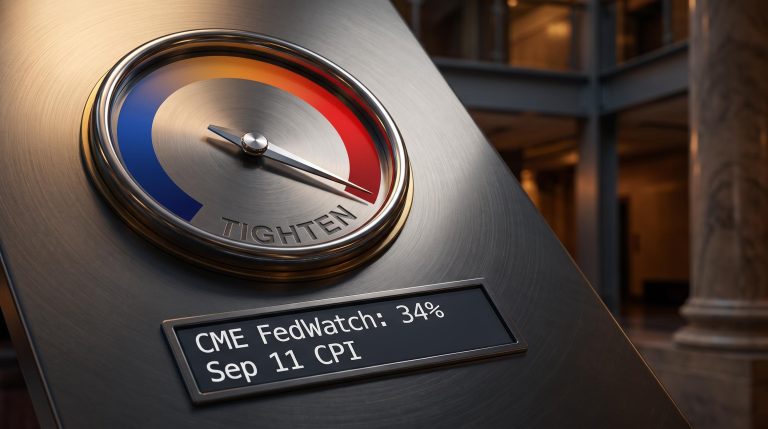
- 26 August 2026: fed funds futures priced roughly 44% odds of a September hike, up from about 36% earlier in the period (Reuters, CME FedWatch)
- 27-28 August 2026: odds jumped toward 60% following the Jackson Hole remarks (Yahoo Finance, referencing FedWatch)
- 31 August 2026: traders priced approximately 62% for a September hike (Reuters, CME FedWatch)
- 4 September 2026: roughly 60% odds post-payrolls, per CNBC’s coverage
The single most striking figure sits at the year-end horizon.
Traders are pricing an 88% probability that rates will be higher by December, according to Reuters, citing CME FedWatch data from 31 August 2026.
Cumulatively, that adds up to about 35 basis points of tightening priced through December, or roughly 1.4 hikes, according to MUFG analyst Lloyd Chan, cited by FXStreet. That number matters more than the September odds alone. It tells you the market is not betting on one hike and moving on; it is pricing a sustained tightening path. Whether that path is credible is exactly the question the Dollar appears to be asking.
What the sector breakdown is telling cautious analysts
The BLS release showed gains concentrated in food services and drinking places and in local government education, both lower-paying sectors by nature. One strong headline month does not automatically confirm sustained labour-market strength, particularly with prior-month revisions still possible. That composition gives cautious analysts a reason to doubt the Fed will deliver every hike the futures curve now implies.
When big ASX news breaks, our subscribers know first
Why a rate-fuelled Dollar rally is harder to deliver than it looks
If the repricing was this large, why has the currency barely moved? The answer is not that the Dollar is ignoring rates. It is that several forces are working against a simple rate-driven rally, and they stack on top of one another.
Start with the discounting problem. Foreign exchange markets respond to changes in the expected terminal rate, the level where the Fed is expected to stop, and to relative policy versus other major central banks. They do not respond mechanically to near-term meeting odds shifting from one-third to 60%. A move that markets had largely anticipated is a move already sitting in the price.
Foreign exchange markets respond to real yield differentials, not nominal rate moves in isolation; a hike that fails to outpace rising inflation expectations often produces little or no sustained dollar strengthening, which is precisely the dynamic making the current repricing so difficult to trade.
Then there is the relative dimension. The Dollar’s interest-rate advantage only widens if the Fed is out-tightening its peers. If other major central banks are also improving or raising, that advantage stays flat, and so does the currency. During parts of the 2015-2018 Fed hiking phase, rising US rates coincided with flat or even weaker Dollar performance when conditions elsewhere improved and risk appetite pulled capital toward non-US assets.
There is also the timing pattern that catches out rate-differential trades: buy the rumour, sell the fact. When the Dollar rallies in anticipation of tightening, the actual delivery of a hike can trigger profit-taking, leaving the currency flat or lower even as rates rise.
Underneath all of it sits a structural drag. Elevated fiscal and current-account deficits erode confidence in the Dollar’s longer-term value, offsetting support that higher yields would otherwise provide.
| Pattern | Mechanism | Historical example | Net Dollar outcome |
|---|---|---|---|
| Relative policy | Rate advantage fails to widen when peers also tighten | Parts of the 2015-2018 hiking phase | Flat to weaker despite rising US rates |
| Buy the rumour, sell the fact | Anticipated hike triggers profit-taking on delivery | Multiple FOMC meetings with pre-priced hikes | Stalls or fades post-decision |
| Twin-deficit drag | Fiscal and external deficits erode long-run confidence | Extended periods of elevated US deficits | Rate support partially offset |
“Dollar bulls remain unconvinced that elevated yields will translate into durable currency gains,” is the framing offered by MUFG analyst Lloyd Chan, as reported by FXStreet.
The 0.3% payrolls-Friday gain, followed by a flat net position since Jackson Hole, tells you the Dollar is pricing the hike but not the durability of the tightening cycle. That distinction is not academic. It separates a currency ignoring rate expectations from one correctly pricing a complicated picture, and if you are positioned on rate-differential trades, the two look identical on a chart but demand very different responses.
The political overlay: how Trump’s pressure compounds the Dollar’s problem
There is one more layer that standard rate-differential models tend to miss, and it is political. It works not through direct interference but through a credibility discount that rational markets apply on their own.
The concept is the policy premium. When investors perceive that a central bank’s tightening path could be cut short by political pressure, they embed a discount in the currency even if a hike is actually delivered. Political pressure from President Trump, including public calls for lower rates and threats over trade deficits, may be weighing on that premium, according to MUFG analyst Lloyd Chan, cited by FXStreet.
The Fed credibility discount the market is applying has a documented institutional dimension: Warsh inherited a chair confirmed by a narrow 54-45 Senate vote against a backdrop of explicit presidential pressure on his predecessor, giving investors concrete reasons to price a non-trivial probability of politically constrained policy reversals.
The market is genuinely split on how much this matters. The disagreement is worth seeing side by side.
- Policy-premium erosion view: overt political interference reduces the perceived independence and credibility of the Fed. If investors fear rates could be held artificially low or reversed early, higher near-term odds carry less weight, and markets focus on the risk of faster future reversals rather than sustained elevated rates.
- Institutional-resilience view: formal arrangements and the Fed’s track record of resisting pressure largely insulate policy from rhetoric. Markets react briefly to political statements, then refocus on data and guidance, limiting net currency impact unless the rhetoric is backed by concrete action.
The weakness in the resilience argument shows up precisely when rhetoric starts to look like it could become action. That is where the near-term focal point matters, with the FOMC meeting set for 15-16 September 2026 (CNBC, Reuters).
Trade threats as a two-way Dollar risk
Tariff threats cut both ways for the currency. They can generate near-term safe-haven demand for the Dollar while simultaneously raising uncertainty about future US growth and the global trading system, which dampens longer-term demand. If investors come to believe there is a deliberate effort to weaken the Dollar to shrink the trade deficit, the entire rate-differential support case is undercut at the source.
Connect that back to the 35 basis points of tightening priced through December. If even partial reversals are seen as possible, the tail of that implied path loses credibility. And if you hold Dollar-denominated assets on the expectation that this tightening flows through to the exchange rate, the political question is the single variable most likely to determine whether that rate premium actually shows up in the currency.
What breaks the stalemate, and which risks are most likely to move the Dollar
So what resolves this? The near-term catalyst is the 15-16 September 2026 FOMC decision, with September hike odds sitting around 60% as of 4 September 2026 (CNBC, CME FedWatch). Three outcomes are on the table, and each points the Dollar in a different direction.
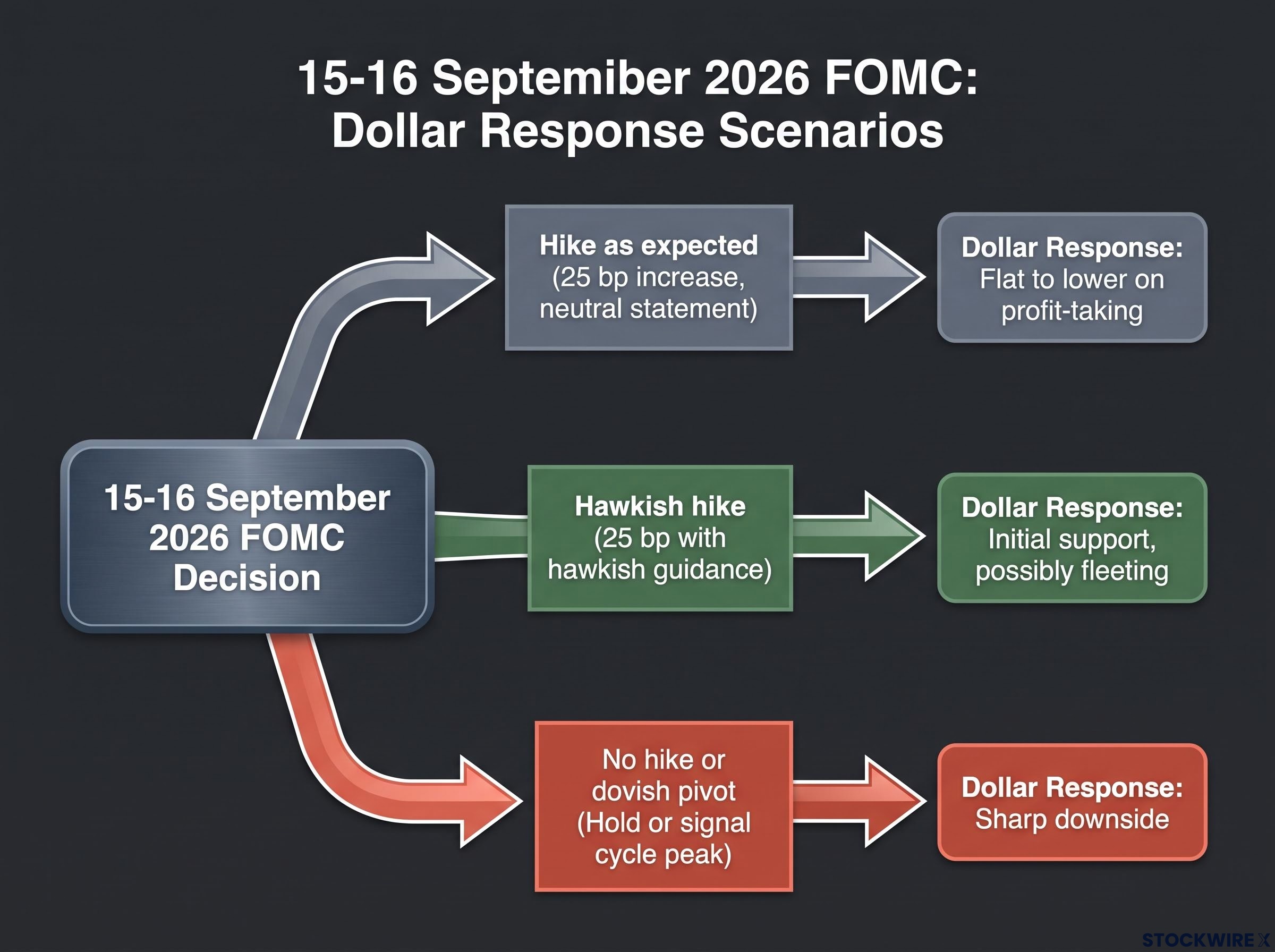
| Scenario | Fed action | Likely Dollar response | Key risk |
|---|---|---|---|
| Hike as expected | 25 bp increase, neutral statement | Flat to lower on profit-taking | News already in the price |
| Hawkish hike | 25 bp with hawkish guidance | Initial support, possibly fleeting | Growth and stability fears |
| No hike or dovish pivot | Hold or signal cycle peak | Sharp downside | Crowded long-Dollar unwind |
The positioning risk deserves emphasis. Heavy speculative long-Dollar positioning amplifies reversal risk. If the Fed under-delivers or signals caution, crowded trades can unwind sharply, pushing the currency lower even while rate expectations stay nominally elevated.
The data between now and 15 September could shift the 60% probability materially, which makes the coming releases as important as the meeting itself. Here is the watchlist, in sequence:
- Inflation data: a softer print would let markets question whether the Fed needs to move at all
- Employment revisions: downward revisions to prior months would undercut the strong August headline
- Fed speaker comments: any signal on the terminal rate or downside risks ahead of the meeting
Remember that the 60% figure reflects market expectations, not a Fed commitment. The Fed remains data-dependent. If subsequent data softens, futures pricing will reprice and the Dollar will need to adjust its implied rate support.
The scenario that most threatens Dollar longs is the one the market currently sees as most likely: a hike delivered exactly as priced. The news is already in, and if the accompanying statement leans toward caution, profit-taking could push the Dollar lower on a day the Fed technically tightened. Understanding these three outcomes leaves you better placed to read the September move than anyone still working from the simple “hike equals stronger Dollar” assumption.
What the Dollar’s silence is actually telling you
Pull the numbers together and the divergence is precise. Roughly 60% odds of a September hike, an 88% chance of higher rates by year-end, about 35 basis points of cumulative tightening priced through December, and a Dollar Index that is essentially flat since Jackson Hole. On the standard playbook, those first three should have lifted the fourth. They have not.
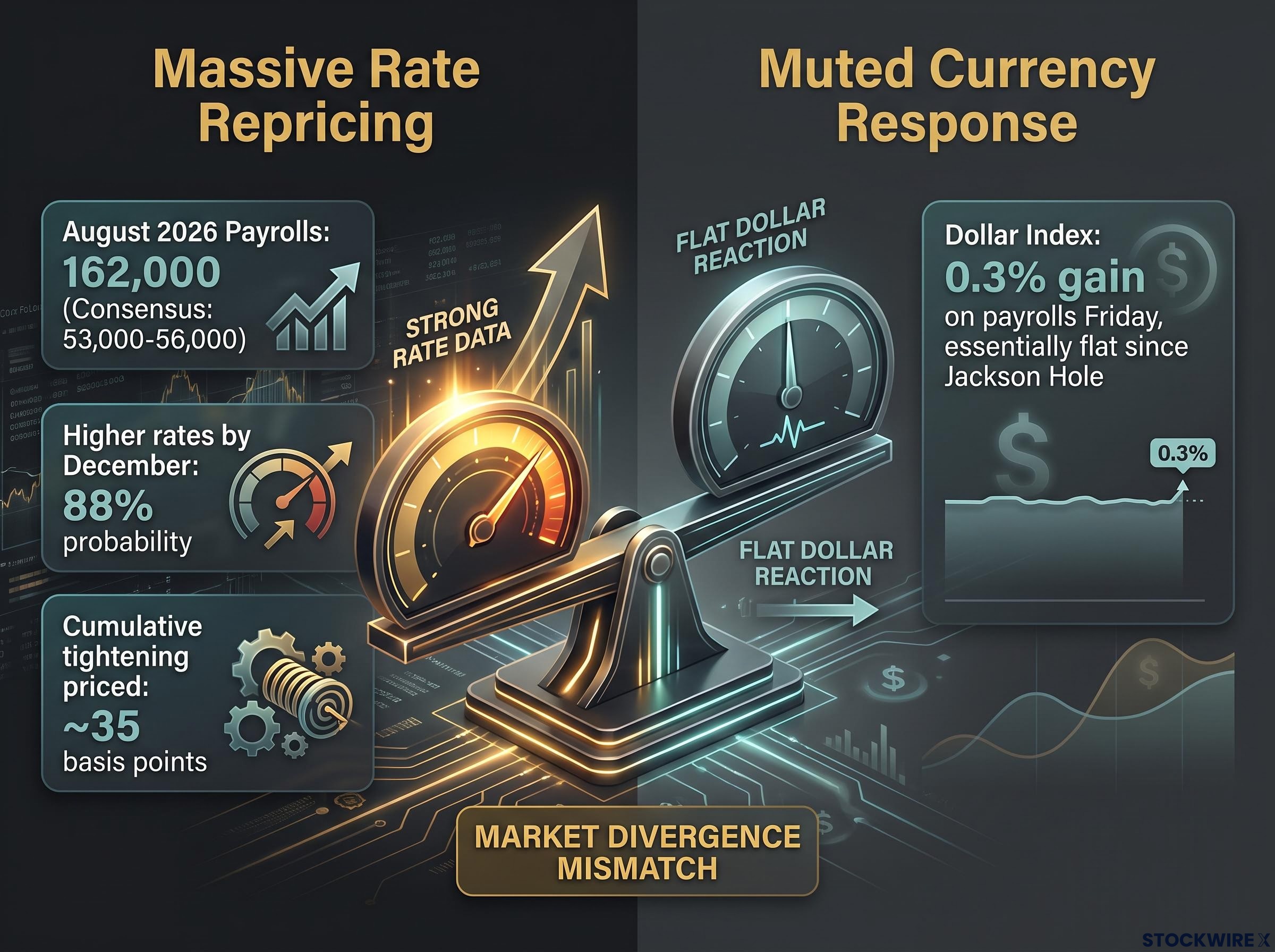
Read that not as confusion but as a judgment. The market is pricing the hike, but it is not pricing the path. That gap reflects legitimate uncertainty about political durability, the quality of the August job gains, and how US policy stacks up against peers. The Dollar’s muted response is a credibility verdict, not a market anomaly waiting to be corrected.
Only one thing would genuinely change the picture: a sustained shift in the expected terminal rate, or a visible widening of the US rate advantage over other major economies. The August payrolls report, strong as it was, did not deliver either on its own.
Sovereign reserve allocation shifts add a longer-horizon layer to the credibility question: the OMFIF 2026 survey marks the first time more central banks plan to reduce rather than increase dollar holdings over the coming decade, with political risk cited as the primary driver, a structural signal that rate differentials alone cannot neutralise.
If the Dollar stays flat or falls on the day of a delivered September hike, that outcome would confirm the market’s current read: this tightening cycle is credibility-constrained, not data-constrained. That signal is worth more than the hike itself.
That is the evaluative lens to carry into 15-16 September. The Dollar’s reaction to the decision will tell you more than the decision will.
This article is for informational purposes only and should not be considered financial advice. Investors should conduct their own research and consult with financial professionals before making investment decisions.
Past performance does not guarantee future results. Financial projections are subject to market conditions and various risk factors. These statements are speculative and subject to change based on market developments and central bank policy.