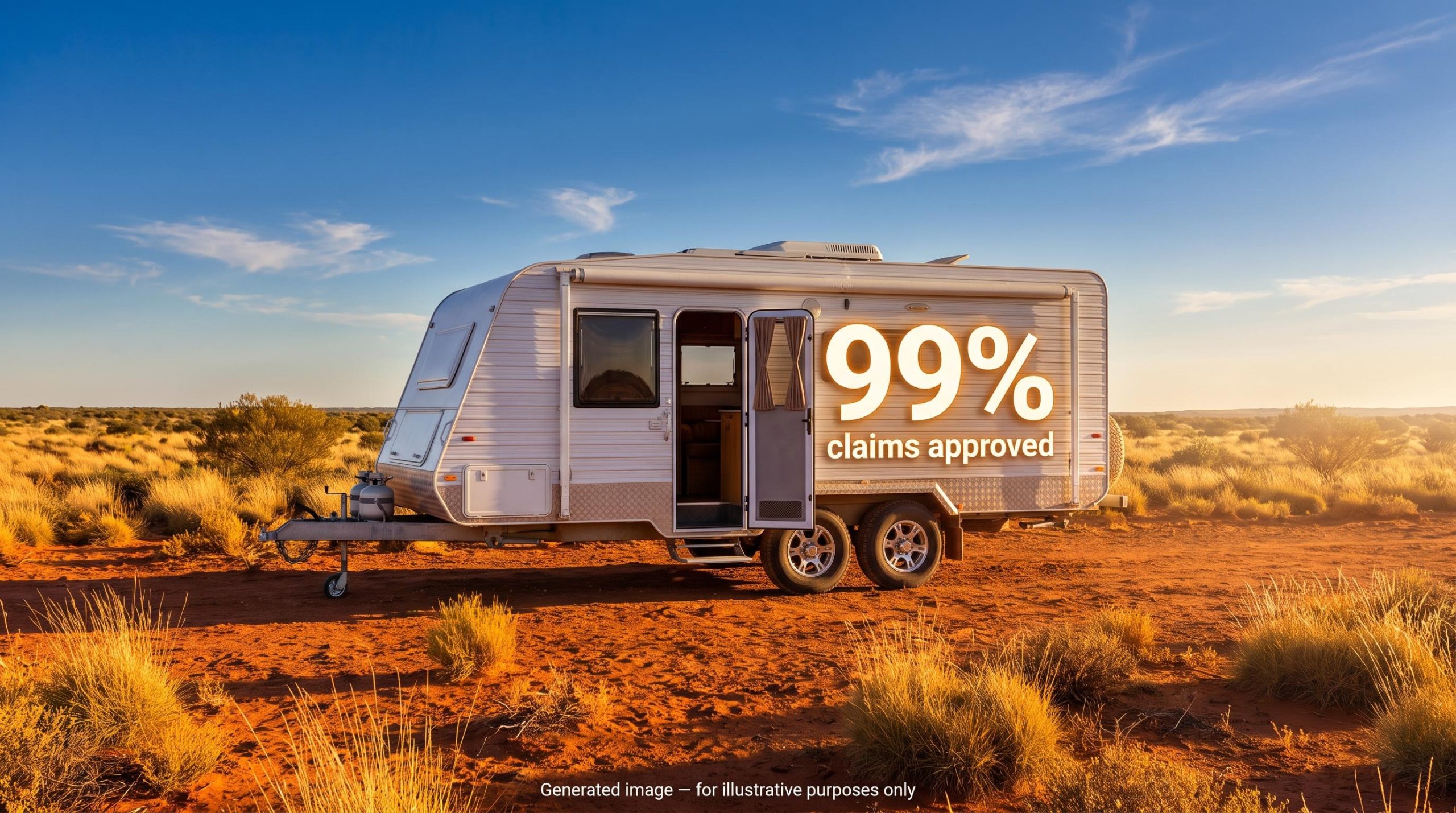
Picture the owner of a caravan they spent three years saving for. They have found Camplify, they have read the listing guide, and they are one click from earning income while the vehicle sits idle between their own trips. Then the insurance question arrives, and the click never happens.
That hesitation is the sharing economy’s most expensive moment. Peer-to-peer rental runs entirely on trust, and trust needs protection, but conventional insurance was built for a completely different ownership relationship: one person, one vehicle, continuous personal use. Rent that asset to a stranger and the whole structure starts to wobble. This is a design problem, and Camplify Holdings (ASX: CHL) answered it with a structural fix called MyWay Mutual.
Here is what this piece gives you: a plain-English read on what a member-owned mutual actually does differently, why MyWay Mutual’s first-year numbers count as evidence rather than marketing, and what the whole model signals about Camplify as one of the more interesting ASX travel stocks to watch right now.
Why the insurance question stops the sharing economy at its most important moment
Start from the owner’s chair. You have a policy you trust, premiums paid, comprehensive cover on a vehicle worth tens of thousands. Then you decide to list it, and without changing a single thing about the caravan itself, your protection quietly stops meaning what you thought it meant.
The mechanism is the commercial-use exclusion. Standard personal auto and caravan policies treat peer-to-peer rental as a commercial activity, which typically voids your cover the moment the vehicle goes on hire. Worse, some insurers can deny the claim and refuse to renew the personal policy altogether once they learn the vehicle has been rented to strangers.
Then the layers pile up. A single rental can involve the owner’s policy, the platform’s protection, and the hirer’s cover, each applying to a different time window: parked versus driven, listed versus booked. When something goes wrong in the gap between those windows, each insurer has a financial reason to read the circumstances in a way that limits its own liability.
Here are the specific ways conventional cover fails a peer-to-peer participant:
- Commercial-use exclusions that void personal policies the instant a vehicle is on hire
- Multi-policy gaps where owner, platform, and hirer cover apply to different windows and leave seams between them
- High deductibles, sometimes up to $3,000, that leave owners paying real repair costs despite believing they were fully covered
- Claims adversarialism, where every party’s incentive is to minimise its own payout
This is not a personal risk-management failure on the owner’s part. It is a genuine market-design problem, and it stops curious owners from becoming active ones at the exact moment trust matters most.
When platform protection still leaves owners exposed
You might assume a purpose-built platform protection plan solves this. Often it does not, because many of those plans are still administered by third-party insurers whose financial incentive remains the same: minimise payouts.
The exposure shows up in the fine print. Steep deductibles and common exclusions, such as off-road use or an unauthorised driver, mean owners can still shoulder substantial costs while genuinely believing they held comprehensive cover. Same structural flaw, different label.
When big ASX news breaks, our subscribers know first
What a member-owned mutual actually does differently
So what changes when you own the fund instead of buying a policy from it? Everything about who the fund is built to serve.
A discretionary risk mutual is a fund owned and governed by its own members. Its purpose is to protect those members, not to generate profit for external shareholders, and claims are assessed on that basis. That single fact reverses the incentive that makes conventional insurance adversarial.
The BCCM principles for discretionary mutual funds confirm that member ownership and board-level member representation are foundational to how these structures operate, reinforcing why the incentive alignment in a DMF differs structurally from a conventional insurer governed by external shareholders.
In Australia, this sits inside a specific regulatory frame. MyWay Mutual Holdings Ltd (ACN 684 595 757) operates as a Discretionary Mutual Fund (DMF), regulated by the Australian Securities and Investments Commission (ASIC) under the Corporations Act. It sits outside the Australian Prudential Regulation Authority’s (APRA) prudential rules and issues discretionary protection rather than guaranteed insurance under the Insurance Contracts Act. That is a meaningful structural distinction, not a semantic one: claims are paid at the board’s discretion under the mutual’s rules.
The mutual is member-owned, services Australia and New Zealand, is backed by a global Mutual Capital Instrument, and carries reinsurance through Windward Insurance PCC Limited. Cover spans damage, theft, malicious damage, storms, flood, fire, owner contents up to $2,000, plus legal and public liability for personal injury and third-party property damage. Membership is automatically embedded in Camplify’s Premium, Personal, and Flexible tiers, with an opt-out path for members holding qualifying commercial insurance.
Then comes the design detail that makes the incentive alignment concrete.
Shared-risk design: Camplify itself pays the first $10,000 excess on approved claims. That directly ties the platform’s own money to fair, fast resolution rather than to denial.
The contrast between the two models is what you should hold onto here.
| Feature | Conventional insurer | Member-owned mutual |
|---|---|---|
| Incentive structure | Profit rises as payouts fall | Exists to protect members, not external shareholders |
| Claims authority | Insurer interprets policy against its own liability | Board assesses against member-protection purpose |
| Excess design | Owner bears high deductible | Camplify pays first $10,000 on approved claims |
| Regulatory framework | APRA-regulated guaranteed insurance | ASIC-regulated discretionary cover |
For an investor comparing Camplify with other ASX travel stocks, note that most sharing-economy platforms have not built anything like this. The regulatory, capital, and operational complexity is a real barrier, and Camplify chose to absorb it. That is a structural differentiator, not a marketing line.
What the first year of data actually shows
Numbers settle arguments that adjectives cannot. Here are the four MyWay Mutual metrics from its first full operating year, all company-reported for FY26:
- $2.7 million paid out
- 2,447 individual member claims
- 99% approval rate on decided claims
- 68% loss ratio, within management’s target range
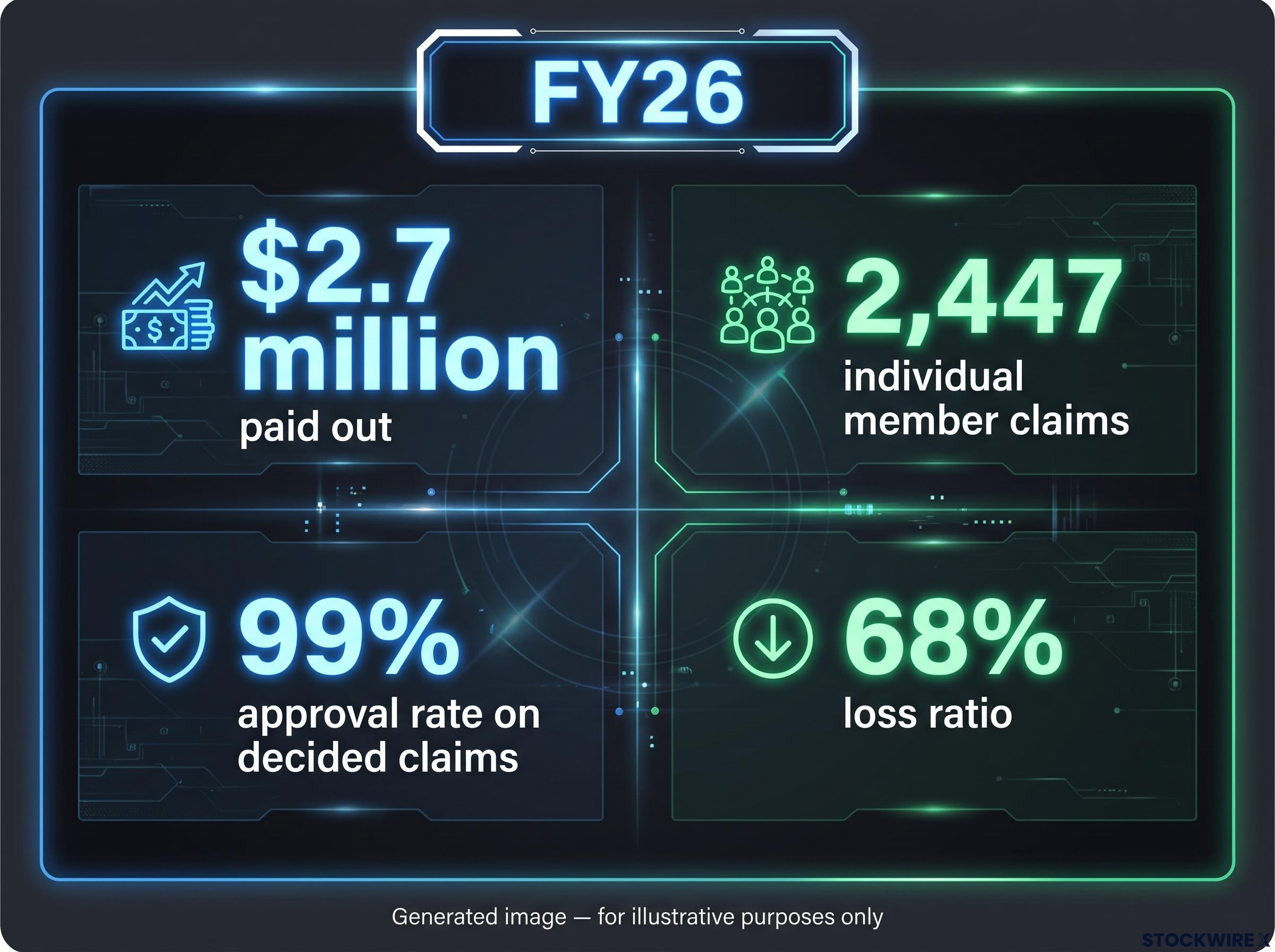
Take the loss ratio first. A loss ratio is simply the proportion of collected funds paid back out as claims, so 68% tells you the fund paid claims genuinely while keeping enough in reserve to stay financially sustainable through its first fully funded year. Management cited it as landing inside the range they were aiming for.
Now the approval rate. In a discretionary model, where the board is not legally compelled to pay, a 99% approval rate is an operational signal, not just a headline. It says the fund’s assessment criteria are actually aligned with its stated purpose of protecting members.
The two figures together are the point worth dwelling on. A 99% approval rate alongside a 68% loss ratio means the fund was neither paying out so freely that it burned through reserves, nor tightening approvals to protect its own balance sheet. That balance is exactly what a member-owned model is supposed to deliver, and in year one it delivered it.
Company-reported: MyWay Mutual generated approximately $2 million in annual savings for Camplify versus its previous external insurance model, while broadening member cover and enabling faster, direct claims control.
For anyone tracking this as a turnaround story, that saving is not a rounding detail. It is recurring, it drops through to the operating line, and it creates leverage as the member base grows.
How MyWay Mutual fits into Camplify’s broader FY26 recovery
Put that $2 million saving next to the headline swing. Camplify moved from a prior-period EBITDA loss of $10.4 million to a full-year group EBITDA of $0.3 million positive in FY26. The mutual’s cost efficiency is one of the ingredients in that shift.
Camplify’s FY26 full-year results show the EBITDA swing in fuller detail, including the gross margin expansion from 58% to 63% that MyWay Mutual’s in-house structure drove across the second half of the year.
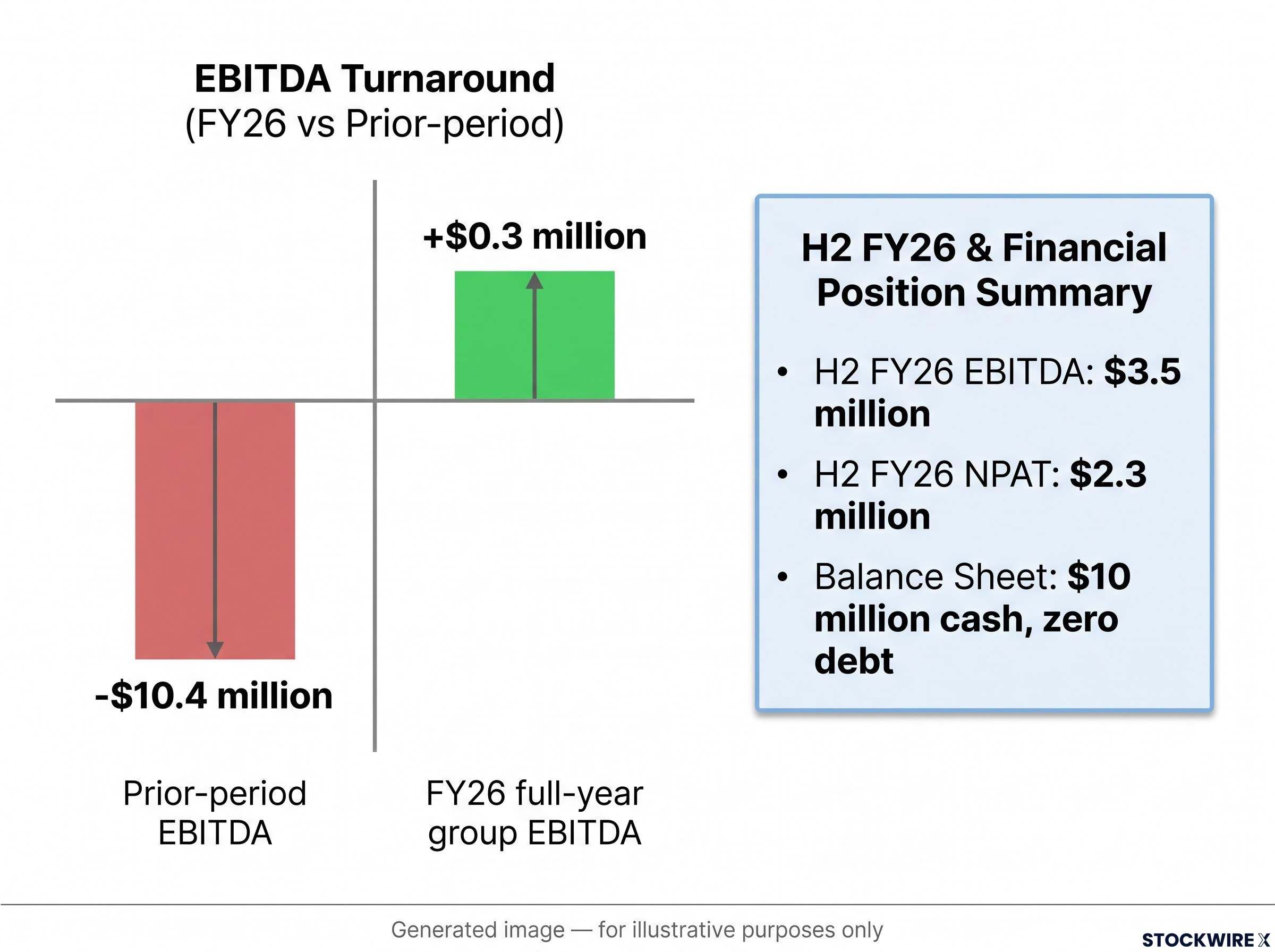
The cleaner read on momentum sits in the second half. H2 FY26 delivered EBITDA of $3.5 million and net profit after tax of $2.3 million, a sharper picture of underlying direction than the full-year statutory result.
The H1 FY26 results established the early evidence base for that recovery, with MyWay Mutual posting a 49.6% loss ratio in its first half of operation and operating cash flow swinging positive by $13.95 million.
The balance sheet gives the model room to work. Camplify closed FY26 with $10 million in cash and zero debt, the kind of capital foundation that lets MyWay Mutual scale without immediate funding pressure. Past performance does not guarantee future results, and financial projections remain subject to market conditions.
What the mutual model signals for the sharing economy’s next chapter
Step back from Camplify’s single-year numbers and ask the bigger question: why has almost nobody else done this?
The answer is that running a mutual alongside a marketplace is genuinely hard. It demands regulatory expertise, self-imposed capital adequacy in the absence of APRA rules, and operational overhead most platforms would rather avoid. Camplify’s willingness to carry that weight is precisely why the model functions as a differentiator rather than something rivals can copy overnight.
That said, the discretionary structure carries real risks, and an honest read names them:
- Correlated claim spikes. Without APRA’s prudential backstop, a severe weather event concentrated in one RV-heavy region could strain reserves. The reinsurance arrangement through Windward Insurance PCC Limited is the mechanism designed to absorb that shock.
- Consumer misunderstanding. Members must clearly grasp the difference between discretionary cover and guaranteed insurance, because the two are not the same promise.
- Governance discipline at scale. As the member base grows, the capital and governance standards have to grow with it, and that discipline is self-imposed rather than externally mandated.
The scale ambition is real. Camplify already spans seven markets: Australia, New Zealand, the United Kingdom, Spain, Germany, Austria, and the Netherlands. Its three-year revenue compound annual growth rate of 71% into FY24 shows the growth trajectory the mutual must eventually serve.
Here is the broader thesis worth holding. The next growth constraint for the sharing economy is not platform technology or marketing reach. It is the trust infrastructure sitting underneath the marketplace, and a member-owned protection model is one structural answer to that constraint.
The question of trust infrastructure in sharing platforms extends well beyond the RV market; Uber’s response to autonomous vehicle disruption illustrates how platform-layer trust mechanisms, including insurance and liability frameworks, become the defensible moat when underlying supply commoditises.
For you as an investor, the question is not whether year one worked. The data says it did. The question is whether the model scales across seven markets and a growing member base without the governance and capital discipline eroding, and that is the variable worth tracking over the next one to two reporting periods.
What MyWay Mutual’s first year tells investors about where Camplify is headed
The central argument comes down to one choice. The trust infrastructure beneath a sharing-economy marketplace is not a product feature you bolt on; it is a structural decision. Camplify’s decision to build a member-owned mutual rather than rent a conventional third-party policy is what makes the FY26 turnaround legible as something durable rather than a single good year.
The forward-looking question is clean. The first-year data establishes that MyWay Mutual works at current scale. What you track from here is whether the governance, capital discipline, and member trust hold as the platform expands across its seven-market footprint and a growing owner base.
Return to that owner standing over the caravan they saved years for. The most honest answer their insurance question has ever had is a 99% approval rate across 2,447 real claims in a single year. On the evidence, the protection model is working as intended.
For investors wanting to stress-test the broader structural case before committing capital, our full explainer on sharing-economy investment risk examines how survivorship bias and asymmetric downside exposure affect the way platform-based business models are typically presented to retail investors.
This article is for informational purposes only and should not be considered financial advice. Investors should conduct their own research and consult with financial professionals before making investment decisions.