A Cleveland Fed president delivered firmly hawkish inflation warnings on Thursday, scored 7.4 out of 10 on the FXS Speechtracker, and the dollar moved 0.14%. That gap between the tone of the message and the size of the market response is the real story here.
Beth Hammack, president of the Cleveland Federal Reserve, spoke on 24 September 2026 at the bank’s annual inflation conference. Her remarks landed in the middle of the Fed’s continued effort to pull inflation back to its 2% target, with headline CPI still running at 3.4% year-over-year and core PCE holding above 3%. Heading into the speech, markets already priced roughly a 71% chance of a rate increase at the October FOMC meeting.
So a hawkish official reinforced a hawkish path, and almost nothing moved. This is a forensic breakdown of why. After reading this, the investor watching the Fed’s next move will understand not just what Hammack said, but why the market shrugged, what the shift in CME FedWatch probabilities actually signals, and which variables to track before the committee meets in October.
What Hammack actually said, and why it scored hawkish
Hammack’s speech was methodical rather than alarmed. She built her case around a familiar set of Fed concerns and delivered them with the measured tone of someone reinforcing an existing position rather than breaking new ground.
Her core positions, as reported by Reuters, covered four points:
- Price stability sits at the centre of what a central bank is responsible for delivering.
- Inflation remains elevated even as economic output and consumer demand stay solid.
- Supply shocks pose a particularly significant challenge for current monetary policy.
- The longer inflation runs above target, the harder it becomes to bring price growth back down.
That third point carried the most analytical weight.
Hammack identified supply shocks as a particularly significant challenge for current monetary policy, cautioning that the longer inflation stays elevated, the more difficult the return to target becomes.
None of this was new. That is precisely what makes it significant: Hammack was reinforcing the Fed’s established narrative, not shifting it. The independent calibration came from the FXS Speechtracker, which scored the speech 7.4 out of 10, firmly hawkish but slightly below the historical average of 7.6. The FXS Fed Sentiment Index, meanwhile, slipped 0.46 points to 148.18, still well above the neutral benchmark of 100.
Here is what that slight dip tells you. Even within the hawkish camp, Hammack was not pushing at the aggressive edge of the recent communication spectrum. She was hawkish and holding steady, not hawkish and escalating.
Hammack herself was among the three dissenters who voted for an immediate hike at the July 2026 meeting, so her September remarks carry the additional signal of someone whose hawkish dissent is already on the public record, giving her current posture more institutional weight than a first-time hawkish statement would carry.
For investors positioning around FOMC decisions, that distinction is the whole game. The difference between an official ratcheting up the pressure and one simply restating the consensus is the difference between repositioning now and waiting for harder data. Hammack gave the market no reason to do the former.
When big ASX news breaks, our subscribers know first
Why the dollar barely moved on a hawkish speech
The US Dollar Index (DXY) sat near 101.25 on 24 September 2026, up roughly 0.14% on the day and trading in a tight 101.0-101.3 intraday range. By any measure, that is a modest move for a speech scored as firmly hawkish.
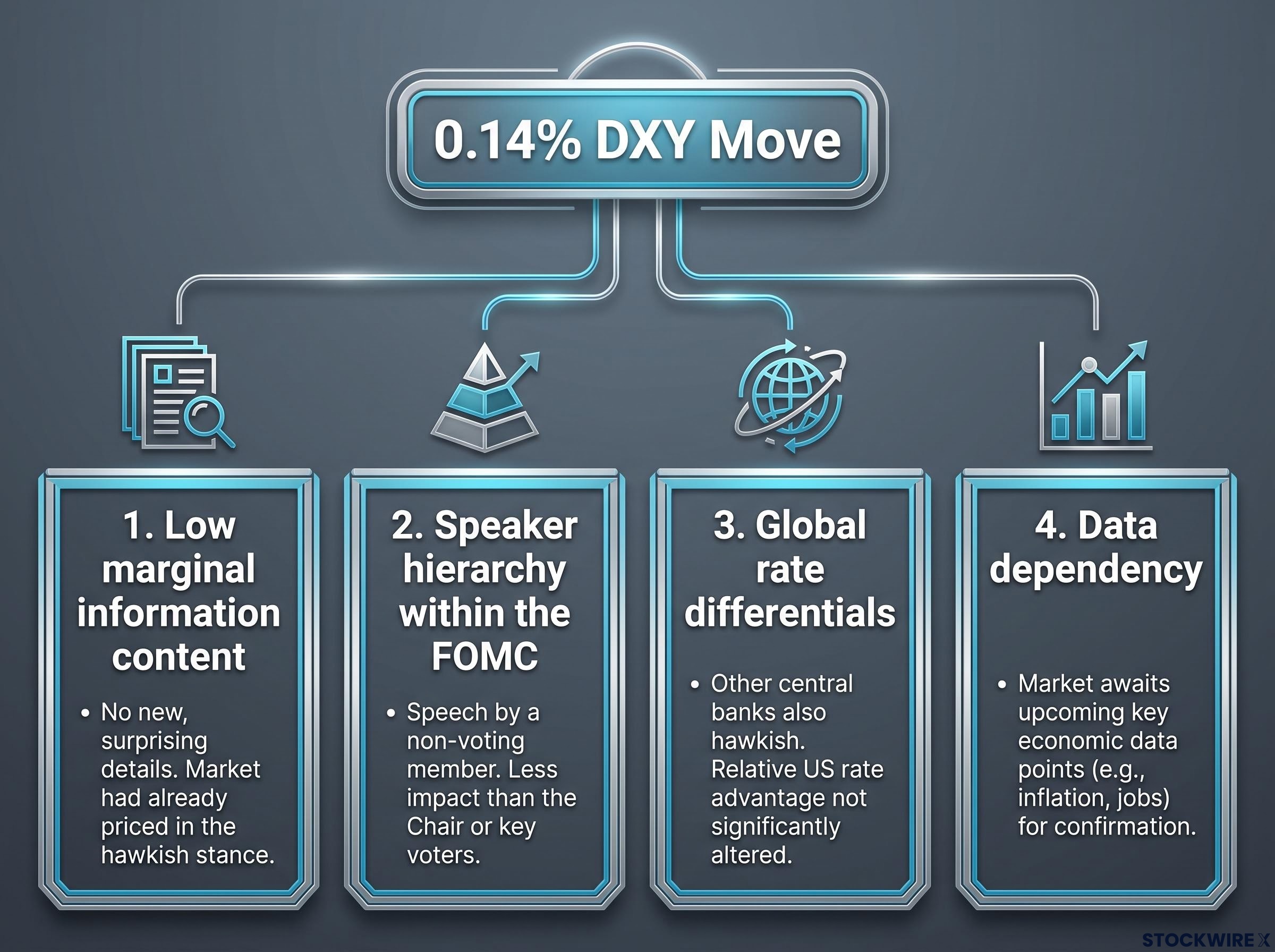
The muted reaction is not a puzzle once you see the framework behind it. Four structural reasons explain why hawkish speeches like this one stop moving markets, and together they make the 0.14% figure look entirely predictable.
The four reasons hawkish speeches stop moving markets
The first is low marginal information content. Research teams at Goldman Sachs and JPMorgan have long argued that markets react sharply only when Fed guidance surprises consensus. When an official repeats known concerns about inflation and upside risk, the dollar and short-end yields barely register it.
The second is speaker hierarchy within the FOMC. Fed watchers including Ian Shepherdson of Pantheon Macroeconomics and Krishna Guha of Evercore ISI have stressed that markets weight the Chair, Vice Chair, and key Board governors far more heavily than individual Reserve Bank presidents, unless a president clearly signals a shift in the committee’s centre of gravity. Hammack did not.
The third is global rate differentials. FX strategists including Marc Chandler of Bannockburn Global Forex and Kit Juckes of Societe Generale have pointed out that when other major central banks lean restrictive too, or when growth worries cap US yields, the dollar’s response to incremental hawkish Fed rhetoric stays subdued because the relative rate gap moves little.
The fourth is data dependency. Market participants watch incoming inflation and labour data, plus the next FOMC statement, far more closely than any single speech. Absent a decisive break in the numbers, hawkish remarks read as part of an ongoing communication strategy rather than a firm new commitment.
| Reason | Description | Market Implication | Historical Precedent |
|---|---|---|---|
| Low marginal information | Official restates an already-priced hawkish path | Modest moves in DXY and short-end yields | 2015-16 telegraphed liftoff |
| Speaker hierarchy | Regional president carries less weight than the Chair or Board governors | Market discounts the remarks | Recurring across FOMC cycles |
| Global rate differentials | Other central banks also restrictive; US yields capped | Relative rate gap moves little, so dollar is stable | Multi-central-bank tightening episodes |
| Data dependency | Markets prioritise data and the FOMC statement over speeches | Rhetoric read as jawboning until data confirms | Jackson Hole 2022 (data-led repricing) |
The muted reaction is itself the signal. It tells you the hawkish path is already substantially priced, and that fresh repricing will require either a data surprise or a communication shift from higher up the FOMC hierarchy. If you mistake a quiet DXY session for a dovish pivot, you are misreading the tape. The more useful read is that the market believes the hawkish path is locked in until the data says otherwise, so look upstream, at the Chair, the Board governors, and the incoming CPI and PCE prints, before concluding anything has changed.
What inflation data is actually telling the Fed right now
Hammack’s hawkishness is not personal preference. The data underneath it gives her legitimate cause for concern, and understanding where the persistence hides is more useful than tracking the headline alone.
Start with the primary anchor. The August 2026 CPI release, published on 11 September 2026, showed headline CPI up 0.4% month-over-month and 3.4% year-over-year. Core CPI, which strips out food and energy, rose 0.3% on the month and 2.4% over the year. Core PCE, the Fed’s preferred gauge, has been running near 3.3% year-over-year in recent releases.
| Gauge | Latest Reading (YoY) | Distance from 2% Target |
|---|---|---|
| Headline CPI | 3.4% | 1.4 points above |
| Core CPI | 2.4% | 0.4 points above |
| Core PCE | ~3.3% | ~1.3 points above |
The composition matters more than the top-line numbers. Goods inflation has cooled, but services and shelter costs remain stubborn. Analysts at Morgan Stanley and Bank of America point to shelter, rent and owners’ equivalent rent, as a major source of persistence, reflecting limited housing supply, zoning constraints, and high construction costs. That is exactly why Hammack’s focus on supply shocks and prolonged above-target risk is grounded in the data rather than being reflexively hawkish.
The shelter and services stickiness visible in the current data is not a cyclical anomaly but a symptom of deeper structural forces; inflation persistence across 150 years of data tends to move in generational regimes rather than mean-reverting quickly, which is precisely the long-run risk Hammack’s supply-shock framing is tracking.
There is genuine debate about what drives the persistence. The three competing interpretations break down roughly as follows:
- Demand-centric: Only sustained below-trend growth and some loosening in the labour market will durably tame inflation.
- Supply-centric: As production, logistics, and energy markets normalise, inflation can fall without a deep demand shock.
- Adaptive expectations: Firms have learned they can pass through price rises and consumers have accepted them, so even modest shocks turn persistent.
Here is the read that matters. The gap between headline CPI at 3.4% and the 2% target is not closing fast enough on its own to give the committee cover to pause. That is the real reason Hammack’s posture carries credibility beyond her personal view. For anyone holding rate-sensitive assets, knowing that shelter and services are the sticky components, not the fading ones, tells you whether the Fed genuinely has more work to do. Right now, the data says it does.
What the CME FedWatch shift signals for October and beyond
The clearest read on institutional conviction is not a speech. It is the futures market.
CME FedWatch probabilities are the most visible real-time signal, but the gap between futures-implied pricing and the Fed’s own dot plot projections has widened to levels that demand a clear framework for deciding which signal to act on.
CME FedWatch priced roughly a 71% chance of a rate increase at the October 2026 FOMC meeting, up from around 55% just one week earlier. That leaves roughly a 30% chance of no change.
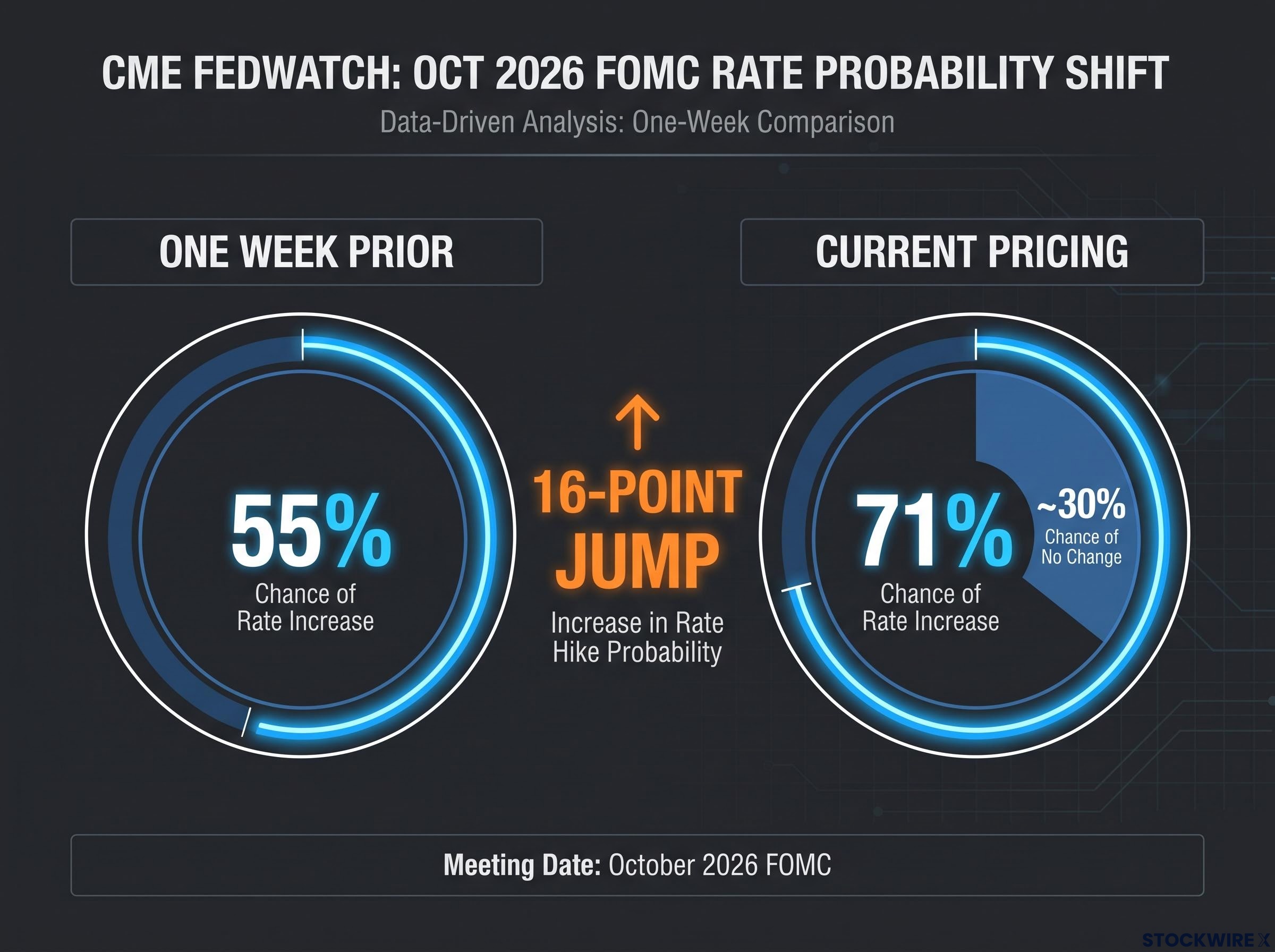
The direction of travel is the tell. That 16-percentage-point jump happened before Hammack spoke, which means it represents a building market consensus rather than a reaction to one official’s remarks. Looking further out, forward pricing implied only a 6.5% chance of rates staying unchanged through December, with meaningful probability of cumulative 25 or 50 basis point hikes by year-end.
History shows what it would take to move these numbers dramatically, and current conditions do not meet the bar.
- 2015-2016 liftoff. The Fed telegraphed its first hike for months, so the December 2015 move was largely pre-priced. When it arrived, the dollar and rates reacted only modestly, illustrating the diminishing marginal impact of a well-anticipated policy shift.
- Jackson Hole 2022. Chair Powell’s “pain” speech blindsided a market that had begun pricing a pivot, triggering a sharp repricing of rate expectations and a significant dollar rally. The lesson: surprise hawkishness moves markets, consistency does not.
- 2013 Taper Tantrum. Bernanke’s signal on tapering asset purchases spiked yields and lifted the dollar even though the actual policy change was gradual, a reminder that communication altering the expected path can jolt markets on its own.
The 55% to 71% shift over a single week tells you the October hike is becoming the base case, not a tail risk. Positioning decisions should reflect that before the meeting, not after it. A 16-point move in one week deserves considerably more of your attention than a single regional Fed speech.
Three variables that could reprice October expectations before the meeting
- Incoming inflation data. Any CPI or PCE print that diverges meaningfully from expectations, in either direction, would reset the probability quickly.
- Labour market readings. Jobs and wage data shift the Fed’s dual mandate calculus and can strengthen or weaken the case for a hike.
- Higher-hierarchy communication. A statement from Chair Powell, a key Board governor, or the FOMC statement language itself carries far more institutional weight than a regional president’s speech.
What the inflation persistence debate means for dollar positioning now
Pull the threads together and a practical framework emerges. The dollar’s current position is the product of an already-hawkish pricing environment, which means the next significant move needs a data catalyst, not more rhetoric from regional officials.
The medium-term picture is mixed, which reinforces the point. The DXY was up roughly 2% over the prior month but down about 0.32% over three months, a sign that no clean directional trend is in place. The market is waiting.
The risk here is asymmetric, and it cuts three ways:
- Data surprises to the upside: Repricing from 71% toward near-certainty would drive a meaningful dollar move higher.
- Data comes in line: Status quo holds, and moves stay muted as the hawkish path simply confirms itself.
- Data softens: The unwind of hawkish positioning could be sharp as traders reprice the October meeting lower.
Sitting behind all of this are the tail risks that cap sustained dollar strength. Economists at the Brookings Institution and Fed alumni warn that policy works with long lags, so aggressive hikes risk overshooting into recession just as inflation naturally recedes. The Bank for International Settlements has flagged financial-stability strains in commercial real estate, private credit, and leveraged sectors.
The Volcker era of the early 1980s remains the high-water mark for aggressive, credible anti-inflation policy backed by decisive action. It strengthened the dollar sharply, but at the cost of severe recessions, which is precisely the outcome today’s Fed is trying to avoid.
For dollar-exposed investors, the current setup rewards precision over conviction. The hawkish path is priced, the asymmetry favours upside data surprises, but the overshooting risks mean building aggressive long-dollar positions into October carries real structural hazards. The practical takeaway is not a directional call. It is a risk calibration: knowing whether you are positioned for a data-driven repricing or simply riding existing momentum should change how you size and hedge your exposure.
This article is for informational purposes only and should not be considered financial advice. Investors should conduct their own research and consult with financial professionals before making investment decisions. Past performance does not guarantee future results, and financial projections are subject to market conditions and various risk factors. These statements are speculative and subject to change based on market developments.
The October FOMC meeting as a live test of the Fed’s inflation credibility
The core finding holds together cleanly. Hammack’s remarks were hawkish and analytically grounded, but the muted market response correctly reflected that a regional Fed president reinforcing an existing narrative adds little to the known probability distribution.
October is where the positioning bets get resolved by actual committee action rather than commentary. With CME FedWatch pricing roughly 71% for a hike and about 30% for no change, the meeting becomes a genuine credibility test for an institution that has staked its communication strategy on holding hawkish discipline until the data decisively turns.
The yield curve steepening that followed the July 2026 FOMC meeting, long yields rising while short yields fell, embedded a credibility tax into the term structure that persists as context for how markets are interpreting Hammack’s hawkish posture in September.
The signal from the outcome will be sharp either way. If the Fed hikes with inflation still at 3.4% and the FXS Fed Sentiment Index at 148.18, investors will have clear evidence that the tightening cycle has more runway. A hold at these probabilities would raise immediate questions about whether the hawkish communication was credible or merely performative.
Watch these before the meeting:
- The August PCE release, expected late September 2026.
- Any statements from Chair Powell or key Board governors.
- Labour market data, particularly jobs and wages.
How the committee acts relative to current pricing will tell you far more about the Fed’s real reaction function than any individual speech, however hawkish it scores.