Starbucks just posted a quarter that most turnaround stories would kill for. Non-GAAP earnings per share of $0.85 in Q3 FY26 beat consensus of $0.66 by nearly 30%, and global comparable sales climbed 7.9%. By any operational measure, the company is executing.
Yet the stock tells a different story. As of late September 2026, SBUX trades within a few percent of the mean analyst target, meaning the market has largely priced the recovery in. That is the tension every investor evaluating Starbucks as a recovery play has to sit with: a company doing the hard work well, at a price that already assumes it will keep doing so.
The engine behind the operational improvement is the Green Apron initiative, a deliberate move away from the mobile-order, transactional model Starbucks drifted into. It is backed by a labour commitment of more than $500 million, and it is not a marketing repositioning. It is an operational restructuring with real margin consequences the Street is still arguing about. Here is a structured way to judge whether the progress in the numbers is genuinely durable, or already fully reflected in a stock that has rallied hard, before you decide whether to take a position.
What the numbers actually show after two years of Green Apron execution
The clearest way to read this recovery is to follow the margin line quarter by quarter, because the shape of that line answers the question most investors care about: was the labour investment a one-off drag or a permanent tax on profitability?
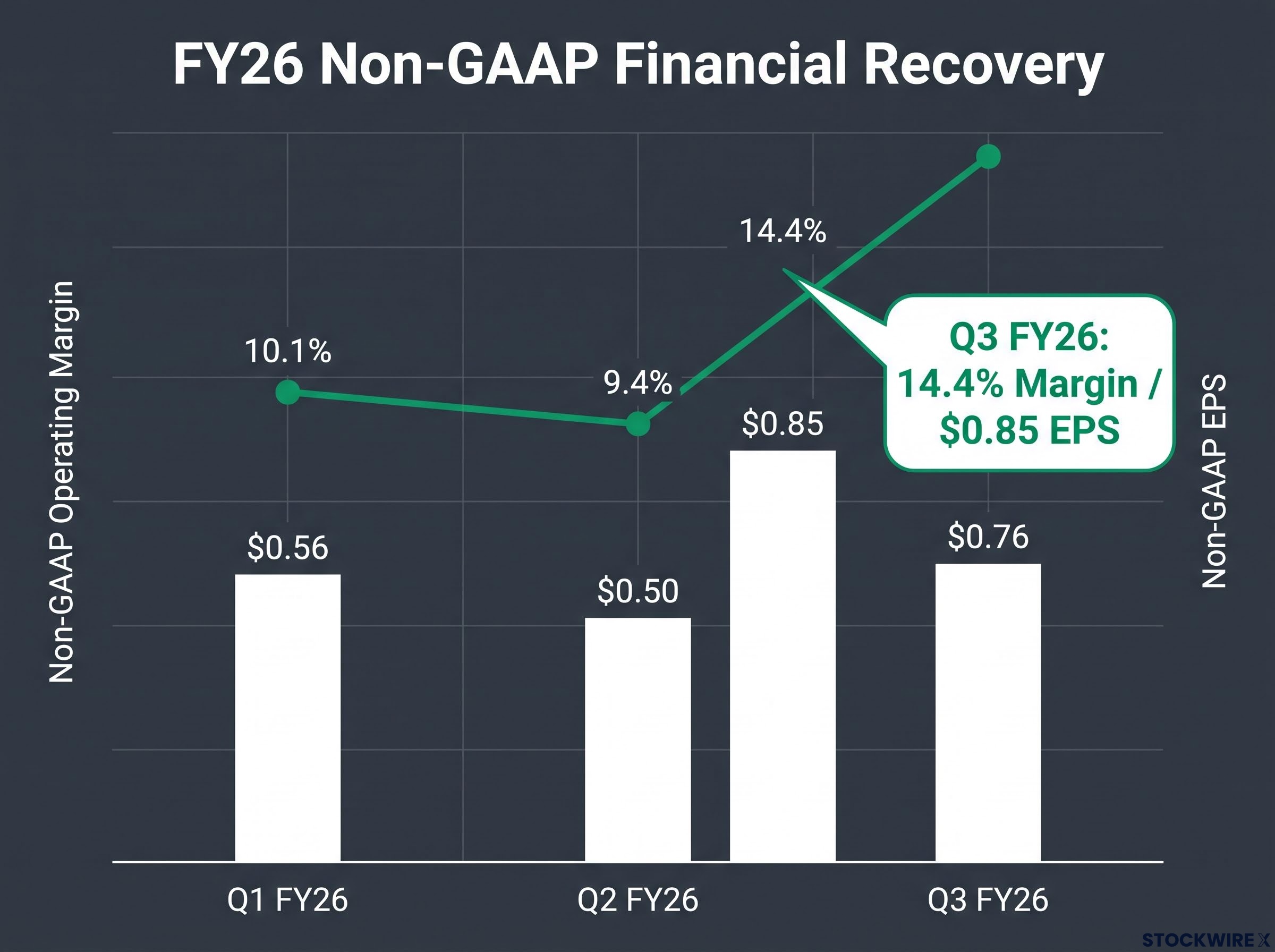
Q1 FY26 was the pain. GAAP operating margin came in at 9.0%, contracting 290 basis points year on year as front-loaded labour investment collided with higher coffee prices and tariffs. Non-GAAP EPS fell 19% to $0.56. On its own, that quarter looked like exactly the margin erosion sceptics feared.
Then the inflection began. Q2 FY26 delivered global comps of 6.2% and GAAP operating margin of 8.7%, up 180 basis points year on year. The pressure was easing.
The Q2 FY26 results that preceded the Q3 beat were themselves a turning point, with U.S. comparable sales growing 7.1% and adjusted EPS of $0.50 clearing consensus by a meaningful margin, the first clear signal that the Green Apron labour model was converting into revenue rather than simply compressing margins.
By Q3 FY26, the trajectory had turned into a genuine payoff. Non-GAAP operating margin reached 14.4%, up 430 basis points year on year, and the comp growth of 7.9% was not a single-lever story. Transactions grew 4.2% and average ticket grew 3.5-3.6%, meaning more people came in and each spent more.
The Starbucks Q3 FY26 SEC filing, submitted to EDGAR on 29 July 2026, provides the primary financial statements underlying these figures, including the GAAP and non-GAAP reconciliations that separate the tariff-refund contribution from the core operating margin result.
| Quarter | Global Comps | GAAP Operating Margin | Non-GAAP Operating Margin | Non-GAAP EPS |
|---|---|---|---|---|
| Q1 FY26 | Not specified | 9.0% (down 290 bps) | 10.1% (down 180 bps) | $0.56 (down 19% YoY) |
| Q2 FY26 | +6.2% | 8.7% (up 180 bps) | 9.4% (up 120 bps) | $0.50 (up 22% YoY) |
| Q3 FY26 | +7.9% | 10.5% (up 60 bps) | 14.4% (up 430 bps) | $0.85 (up 70% YoY) |
The beat that reset expectations Q3 FY26 non-GAAP EPS of $0.85 landed nearly 30% above the $0.66 consensus, a signal that Street models simply were not built for this pace of recovery.
Here is what that Q1-to-Q3 arc tells you. If the labour costs were permanently additive, margin could not have snapped back to 14.4% on a non-GAAP basis, even with tariff refunds helping. The pain was sequenced, not structural, and that distinction is the foundation for everything that follows.
When big ASX news breaks, our subscribers know first
How Green Apron is designed to make labour a revenue lever, not just a cost line
The obvious objection writes itself: paying for more staff costs more money, so how does spending $500 million on labour produce higher margins rather than lower ones? That is the right instinct, and it is worth understanding the mechanism before deciding whether it is working.
The commitment, confirmed by CFO Cathy Smith on the 29 July 2025 earnings call as more than $500 million in labour hours across company-owned cafés, is not a one-time outlay. It is an ongoing staffing model with several distinct components:
The turnaround strategy context that preceded Green Apron included store innovation, digital engagement, and a revamped rewards program, each of which set the conditions that allowed the labour-intensive hospitality model to land on a customer base already primed for re-engagement rather than one in active churn.
- Additional labour hours across company-owned cafés
- New assistant store manager roles
- Barista retraining focused on personalised in-store service
- Earlier store openings to capture more of the day
- Smart Queue queue-management technology
The theory is that hospitality generates incremental transactions and higher ticket. This is deliberately not an automation or AI-efficiency play where the goal is to cut labour out. The bet is the opposite: that more human contact earns more sales.
Why throughput speed is the financial fulcrum of this strategy
The pivot from cost to revenue runs through one number. Smart Queue targets a four-minute fulfilment goal, and by the Q3 2025 earnings call, more than 80% of in-café orders were being completed within that window.
Speed is where the labour investment converts into leverage. Every order processed faster means more orders per hour per store without adding a single square foot of floor space, which spreads a fixed-cost base across more revenue.
That is what separates Green Apron from a straightforward hospitality upgrade. The technology layer makes it a capacity-expansion play as much as a service improvement, and rising delivery-platform volume gives the expanded staffing model another demand channel to absorb.
So the real question for you as an investor is whether Starbucks is buying traffic or earning it. Smart Queue hitting the four-minute target on 80% of orders suggests the throughput gain is real, which gives the labour model an operational rationale beyond optics. Watch two things going forward: if throughput metrics hold and ticket growth continues, the labour-as-lever thesis stays intact. If either stalls, that cost structure turns from asset to liability.
The margin debate Wall Street has not resolved
The recovery data is not really in dispute. What Wall Street cannot agree on is what Starbucks’ cost structure should look like at scale once the recovery matures, and that is a genuine analytical question rather than a simple bull-versus-bear split.
The two camps start from opposite readings of the same evidence. Optimists believe the labour investment is front-loaded and will be absorbed by sales leverage and operational simplification. Sceptics believe wage inflation and traffic volatility expose a semi-fixed cost layer that caps how high margins can go.
The margin recovery debate between Evercore and more conservative analysts centres on a single assumption: whether North America incremental margins can clear 50% in FY2027 once reinvestment costs cycle out, a bar that requires the labour model to generate operating leverage well beyond what Q3 FY26 alone can confirm.
The constructive case
Goldman Sachs carries a Buy rating with a target around $110-plus over roughly 18 months if execution holds, pointing to domestic operational improvement as the primary value driver. This camp sees the labour-heavy spend as part of a broader reset that restores the café experience and drives durable leverage on a large fixed-cost base.
The sceptical case
Morgan Stanley sits at Hold with a target range of approximately $95-115, explicitly flagging wage pressure and traffic volatility. Its core argument is that the stock already discounts consensus earnings growth, so a labour-intensive model leaves margins exposed if traffic slows even slightly.
Where the Street actually sits (August 2026) 12 buys, 4 outperforms, 17 holds, 2 underperforms, 1 sell. Mean target $112, median $112, against a then-current price of $108.49.
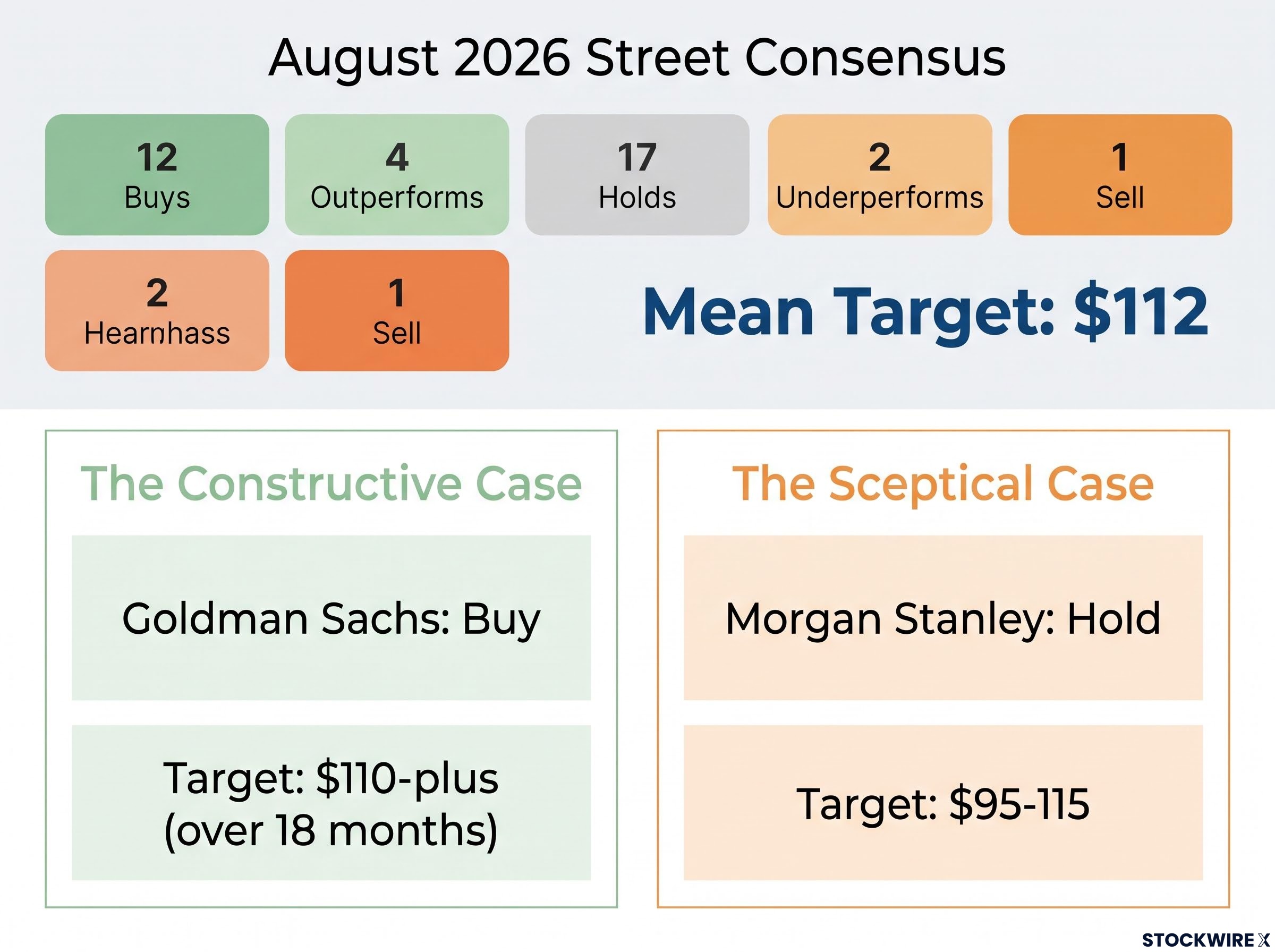
Those 17 holds are the tell. They are not analysts who think the operational story is fake. They are analysts who think it is real and already in the price, and that is precisely the tension you have to resolve for yourself before entering.
What the tariff tailwind adds to the uncertainty
There is a complication buried in the Q3 margin. Management cited tariff refunds, alongside sales leverage, as a contributor to that 14.4% non-GAAP operating margin, which means the reported figure likely overstates the clean run-rate Green Apron produces on its own.
That hands the sceptics a legitimate question. Once tariff benefits normalise, does a labour-heavy model sustain mid-teens non-GAAP margin, or does it settle lower? Until a few quarters of ex-tariff data arrive, neither camp can prove its case.
Six risks investors should price before taking a position
Treat the following not as boilerplate caution but as your actual decision checklist. Each risk has a specific mechanism by which it could break the thesis.
- Labour and wage-cost risk. Sustaining elevated staffing may require investment beyond the initial $500 million-plus, and Morgan Stanley’s named concern is that higher wages cap margin expansion if comps slow.
- Traffic volatility and demand sensitivity. Early transaction gains might reflect novelty rather than structural change, and softer consumer spending could reverse them quickly.
- Macro headwinds. Q1 FY26 showed how fast inflationary coffee costs and tariffs compressed margin, contracting GAAP operating margin 290 basis points in a single quarter.
- Competitive pressure. Independent cafés and quick-service chains competing on convenience and differentiated experience keep eroding the in-store advantage Starbucks is trying to rebuild.
- Execution risk at scale. Coordinating more labour hours, larger rosters, earlier openings and Smart Queue across thousands of stores invites inconsistent training and uneven deployment.
- Valuation and limited upside. Mean target of $112 against a spot near $108-109 implies roughly 0-3% upside, leaving almost no margin of safety at current prices.
The Dutch Bros growth model offers a contrasting lens on what the competitive threat actually looks like: aggressive store expansion, strong brand loyalty, and a customer engagement approach that prioritises throughput and repeat visits over the elevated in-store experience Starbucks is now investing heavily to restore.
The risks are not symmetric, and that matters for how you weight them. Execution risk and valuation risk are present-tense concerns, live right now regardless of what happens next. Macro and competitive risks are conditional on external developments you cannot control.
The valuation point is the sharpest. At 0-3% implied upside from mean targets, the market is not offering meaningful cushion, so execution would need to keep running ahead of expectations for the stock to appreciate from here.
What the recovery is worth at current prices, and what would change that
Strip away the operational story for a moment and look at the entry point cold. As of 23 September 2026, the consensus price target sits at $109.32, essentially in line with the spot price after a strong year-to-date rally.
That figure reframes the whole decision. Buying today is not a bet on a re-rating from depressed levels. It is a bet on execution continuing ahead of what the Street already models, which is a far higher bar than picking up a broken stock cheap.
Two variables would change that math, and they are the watchlist worth keeping:
- Sustained comps above 6%, proving the traffic recovery is structural rather than a novelty spike
- Non-GAAP operating margin holding above 13% excluding tariff benefits in future quarters
Clear both and the bull case strengthens toward Goldman’s scenario. Miss either and Morgan Stanley’s base case reasserts itself.
The bull case anchor Goldman Sachs sees SBUX reaching $110-plus over roughly 18 months, but only if operational execution holds.
Morgan Stanley’s Hold, with its $95-115 range and its argument that the stock already discounts consensus growth, captures the more likely base case where current prices simply reflect probable execution. At 0-3% implied upside, SBUX is a conviction trade, not a consensus one. Owning it here means holding a differentiated view on comp durability or margin expansion beyond what analysts are willing to underwrite.
This article is for informational purposes only and should not be considered financial advice. Investors should conduct their own research and consult with financial professionals before making investment decisions. Past performance does not guarantee future results. Financial projections are subject to market conditions and various risk factors.
A people-first bet in a margin-obsessed market
Three threads tie this analysis together. Green Apron is producing measurable operational gains, verified by the Q3 FY26 numbers. The structural margin question remains genuinely open, with the Goldman and Morgan Stanley cases still unresolved. And the stock price has already moved to reflect a successful recovery.
The single clearest signal that execution has outpaced the Street, at least once, is that Q3 FY26 non-GAAP EPS of $0.85 against $0.66 consensus. But the $500 million-plus commitment is still in active deployment, which means the costs keep coming and the revenue offset has to keep scaling to justify them.
This thesis fits a specific investor: one with a differentiated read on wage-cost trajectory, consumer spending resilience, and Starbucks’ ability to hold above-consensus comps. It is not a momentum entry, and with a mean target of $112 against a spot near $108-109, it is not a value entry either.
Over the next two to three quarters, watch comp durability and ex-tariff margin. Those two numbers will tell you whether the bull case is strengthening or the base case is quietly winning.