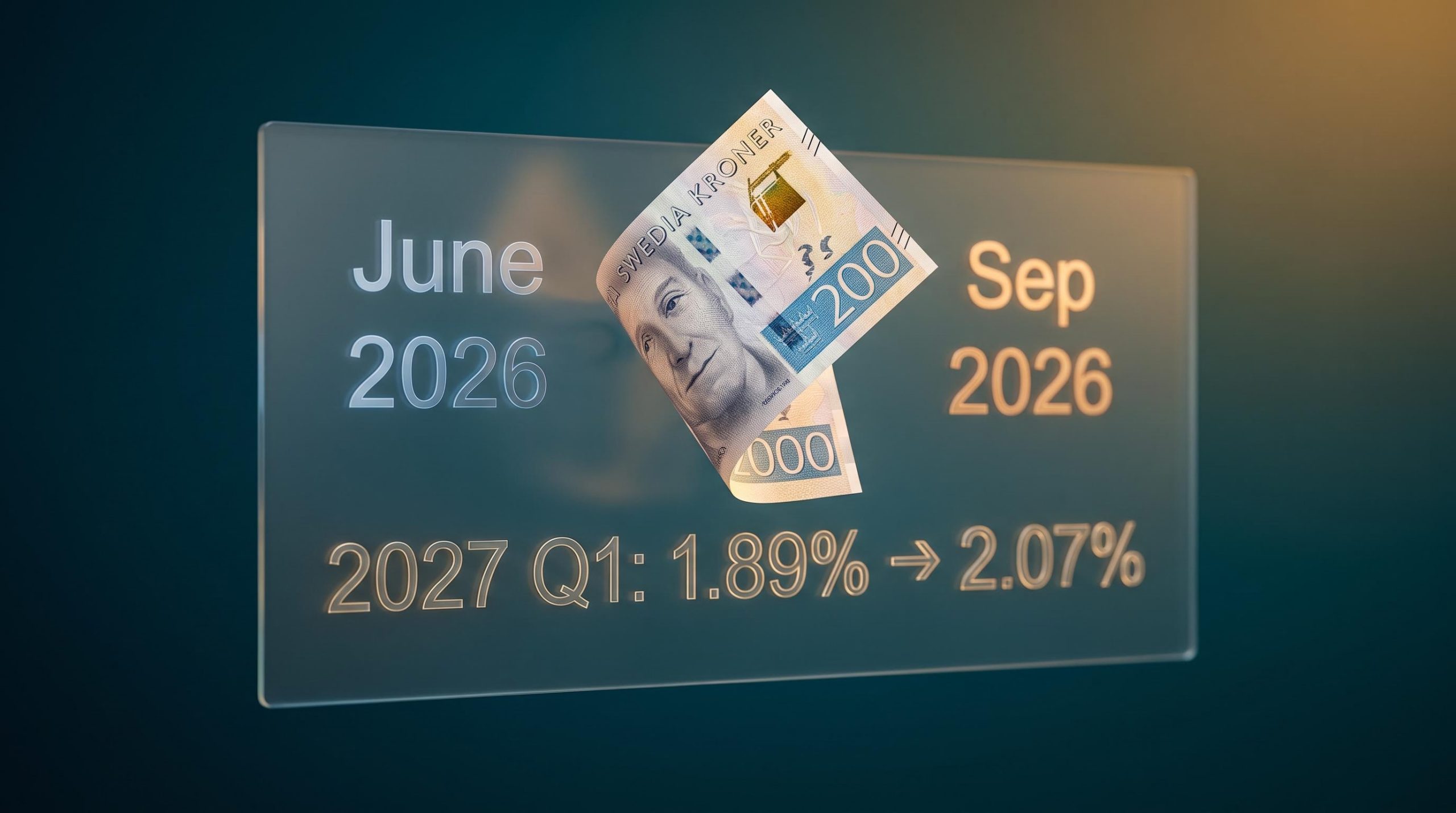
Most investors watch a central bank meeting waiting for one thing: the rate decision. If the rate moves, the currency moves. If it holds, nothing happens. That is the assumption, and it is wrong.
On 24 September 2026, the Swedish central bank, the Riksbank, held its policy rate unchanged at 1.75%, the eighth consecutive meeting without a change. The Swedish Krona (SEK) still appreciated against most major currencies. The rate did not move, but the currency did.
That gap is where central bank forward guidance lives. Alongside its hold decision, the Riksbank published a materially steeper rate-path forecast than in June, and markets repriced the Krona on the projection, not the decision. What follows uses that live event to give you a working framework for reading rate-path signals, so you understand why a hold can be more bullish for a currency than a hike everyone already expected.
Why the future path matters more than today’s rate
Here is the counterintuitive truth: by the time a central bank hikes, the currency has usually already moved. Currency markets are forward-looking instruments. They price the expected future path of interest rates, not the rate sitting on the table today.
The organising principle is the interest-rate differential. Traders want to hold currencies where future yields will be higher relative to the alternatives, and they position for that expected gap continuously, not on decision day. So a rate held unchanged but projected to climb steeply can be more bullish for a currency than a rate hiked once and then expected to plateau.
The mechanism behind currency appreciation is the same one that simultaneously reprices bonds, equities, and gold: interest rate differentials between countries determine where yield-seeking capital flows, and those flows begin moving the moment expectations shift, not when the rate change is formally delivered.
That is exactly what the Riksbank delivered. The rate stayed at 1.75%, but the projected path rose, and the SEK strengthened on the signal alone.
- Scenario one: A central bank hikes 25 basis points, but markets had fully priced that hike weeks earlier. The currency barely moves, because the news was already in the price.
- Scenario two: A central bank holds the rate but revises its projected path sharply higher. The currency appreciates immediately, because the future differential just widened.
The lesson for your own positioning is direct: if you wait for the hike before acting, you are almost always too late.
How rate differentials get repriced before the hike arrives
Traders in interest-rate futures and currency forwards update their positions every time a central bank speaks. Each speech, minutes release, and projection nudges the expected path.
By the time the actual hike lands, the currency move that hike would justify has often already happened across the weeks of guidance that preceded it. According to Pomegra’s analysis of how central banks affect currencies, when Federal Reserve Chair Jerome Powell signals rates will stay higher for longer, traders price that into the dollar immediately, no concurrent hike required.
When big ASX news breaks, our subscribers know first
What the Riksbank’s September 2026 revision actually showed markets
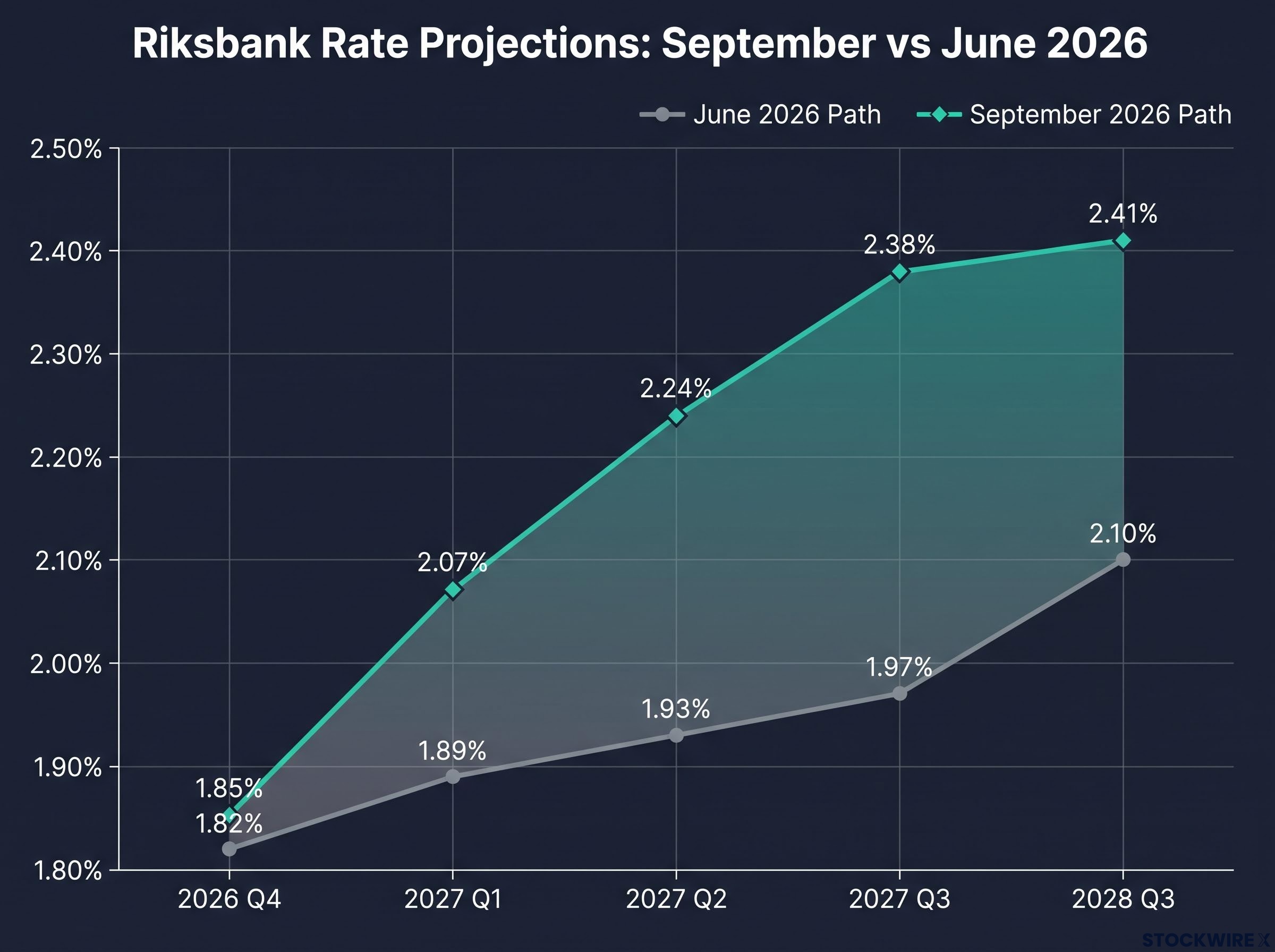
The headline was the hold. The signal was the table. When the Riksbank published its September Monetary Policy Report, it laid its new quarterly rate projections directly alongside the June figures, and the direction was unambiguous.
The Riksbank September 2026 Monetary Policy Report is the primary source for the rate-path table used throughout this article, publishing the new quarterly projections directly alongside the June figures so markets could calculate the hawkish revision in basis points without interpreting a single adjective.
| Period | New Path (Sep 2026) | June 2026 Path |
|---|---|---|
| 2026 Q4 | 1.85% | 1.82% |
| 2027 Q1 | 2.07% | 1.89% |
| 2027 Q2 | 2.24% | 1.93% |
| 2027 Q3 | 2.38% | 1.97% |
| 2028 Q3 | 2.41% | 2.10% |
Follow the numbers across. The near-term shift looks modest at 2026 Q4 (1.85% against 1.82%), then the gap widens with each quarter, reaching 2.24% versus 1.93% by 2027 Q2. The Executive Board was telling markets the whole trajectory had steepened.
“The policy rate needs to be raised more than projected in June for inflation to stabilise around 2%.”
Elias Haddad of Brown Brothers Harriman, cited by FXStreet, characterised the revision as roughly 75 basis points of additional tightening over twelve months relative to the June path. Treat that as an analyst approximation. The Riksbank’s own table numbers are the primary reference, and they are where your informational edge sits, because most people register only the hold.
The gap between market pricing and the Riksbank’s projection
Here is the wrinkle. At the time of the September decision, the BBH analysis noted markets were already pricing around 125 basis points of hikes, still ahead of the Riksbank’s revised path.
Bloomberg-surveyed economists expected the rate to reach 2% before year-end, while overnight index swaps priced roughly 45 basis points of hikes by end-2026, with about a 50% probability of a November move and a more firmly indicated December hike. The guidance shift narrowed the distance between the central bank and the market, but it did not close it. That remaining gap partially caps how far the SEK could appreciate on the news.
The surprise component: why the gap between expectation and announcement drives the move
Now step back from Sweden and ask the general question: what actually made that revision move the Krona? It was not the absolute hawkishness. It was the surprise. Forward guidance moves a currency to the extent it deviates from what markets had already priced, and no further.
The clearest proof comes from empirical work. The EIEF study “Forward Guidance and the Exchange Rate” examined Federal Reserve projection revisions and found that an unexpected 25-basis-point increase in the median one-year-ahead federal funds rate projection is associated with roughly 36 basis points of USD appreciation against a basket of currencies within one hour.
A 25-basis-point hawkish surprise from fed-funds futures implies approximately 1% appreciation of the USD versus the EUR within 30 minutes.
The same study found the effect is immediate and strong but shows no anticipation or persistence effects. The move gets absorbed intraday. That is a critical detail: the mechanism lives in the surprise, and the surprise is spent almost as fast as it arrives.
Apply that back to the Riksbank. The June-to-September revision mattered because the new path diverged materially from the prior forecast in a direction markets had not fully anticipated. Had the Riksbank simply confirmed what was already priced, the SEK reaction would have been muted, and superficially hawkish language can even weaken a currency if it disappoints an already-hawkish market.
For a revision to maximise its FX impact, three conditions must hold:
- The new path must deviate meaningfully from prior market pricing, not just confirm it.
- The central bank must be viewed as credible enough to deliver the projected path.
- The macro backdrop must be risk-on enough for yield-seeking capital to dominate the flow.
The skill this hands you is simple to state and hard to practise: track what is already in the price, not just what the central bank says. That is what separates a genuine catalyst from a non-event.
How different central banks signal rate paths, and why it matters for FX legibility
The Riksbank was not a random choice for this walkthrough. It sits at the most transparent end of the communication spectrum, and that transparency is precisely why its guidance events produce such clean FX reactions.
| Central Bank | Guidance Type | FX Legibility |
|---|---|---|
| Riksbank | Explicit numeric rate-path table, revised vs prior forecast | Highest: hawkishness measurable in basis points |
| Federal Reserve | Dot plot via Summary of Economic Projections | Intermediate: explicit but multi-contributor and non-binding |
| ECB | Qualitative, state-contingent language | Lower: requires interpretation, no numeric path |
| Bank of England | Qualitative characterisations (“gradual and limited”) | Lower: flexible but mechanically opaque |
The Riksbank publishes a full numerical forecast in each Monetary Policy Report, with the new path set beside the old one. Markets can measure the exact hawkishness of any revision without interpreting a single adjective.
The Fed’s dot plot occupies the middle ground. Individual Federal Open Market Committee member projections are treated as de facto guidance, and the EIEF study confirms measurable USD reactions to median shifts. But those dots come from many contributors and bind no one, unlike the Riksbank’s single institutional forecast.
Fed forward guidance has its own documented failure modes: the 2013 taper tantrum and the 2021-2022 transitory inflation episode both originated from the gap between prior guidance and subsequent action, illustrating that credibility risk accumulates precisely when central banks over-promise on a projected path.
The ECB and Bank of England lean on qualitative, state-contingent language instead. That preserves their flexibility, but it strips out the mechanical transparency, so their FX signalling is harder to read at the moment of release.
Why numerical rate paths produce sharper FX reactions
A numeric path lets you calculate the change instantly. You subtract the old projection from the new one and read the surprise directly in basis points, with no room for interpretive dispute.
That is what makes the Riksbank the ideal teaching case. The same pattern shows up elsewhere: hawkish Reserve Bank of New Zealand (RBNZ) revisions that raise the terminal rate or pull hikes forward have historically strengthened the NZD when they surprise markets. When the Riksbank or RBNZ speaks, the reaction function is more mechanical and easier to anticipate than when the ECB or Bank of England issues qualitative guidance, giving you a cleaner signal-to-noise ratio.
When forward guidance fails to move a currency: the limits of the mechanism
None of this makes forward guidance a reliable lever you can pull at will. The conditions that make it work also define when it fails, and an honest mental model needs both.
Start with the Riksbank’s own limitation. Markets were pricing around 125 basis points of hikes while the revised path projected less. Some of the appreciation potential was already used up before the announcement even landed.
Then there is durability, or the lack of it.
The EIEF study found no evidence of anticipation or persistence effects: the FX impact is absorbed intraday and does not last without subsequent reinforcing data or policy action.
A hawkish path is a signal to monitor, not a trade outcome to assume will hold. Four conditions in particular limit or reverse the effect:
Forward guidance removal creates the opposite condition to the Riksbank case: when the Fed under Kevin Warsh scrapped its projection regime in June 2026, every data release immediately carried more pricing weight because no central bank path existed to buffer market interpretation.
- Guidance already fully priced: if the market has already moved further than the central bank, incremental hawkishness disappoints.
- Credibility in doubt: if investors question the will or ability to deliver the path, the impact is muted or reversed.
- Global risk-off: safe-haven flows can overwhelm rate-path effects, and the SEK is not a safe-haven currency, so it is exposed when sentiment sours.
- Data divergence: rate paths are conditional projections, not commitments, and weak inflation or growth data can override the move entirely.
Read the September SEK appreciation for what it is: a live signal that the tightening story has strengthened, not a durable trend you can bank on without incoming data confirming the path.
What the Riksbank case tells you about reading any central bank event
Treat this as the start of a skill, not the end of a lesson. The Riksbank was transparent enough to make the mechanics visible, but the framework travels to every central bank once you know which guidance instrument each one uses.
Four steps carry you through any guidance event:
- Identify what the new rate path projects versus the prior path.
- Assess how far that new path deviates from current market pricing.
- Evaluate whether the central bank has the credibility and macro conditions to actually deliver it.
- Treat the initial FX reaction as a signal to monitor, not a durable trend.
Run the Riksbank through it and the logic clicks. The 2027 Q1 projection rose to 2.07% from June’s 1.89%, a clear hawkish revision (step one). Markets were pricing roughly 45 basis points of hikes by end-2026, so part of the shift was already absorbed (step two). The Riksbank’s track record of credible numeric communication supports delivery (step three). And the SEK move is one to watch against incoming data, not assume (step four).
This is for informational purposes only and should not be considered financial advice. Conduct your own research and consult a financial professional before making investment decisions. Past performance does not guarantee future results, and rate-path projections are conditional and subject to change.
The November and December 2026 Riksbank decisions as the next test
The September guidance pointed to hikes before year-end, with roughly 50% probability priced for a November move and a more firmly signalled December hike. Bloomberg economists put the rate at 2% before year-end.
Those meetings are the live test. Forward guidance is a conditional projection, not a promise, and the coming inflation and growth data will decide whether the Riksbank delivers the path it drew, or whether markets reprice the Krona all over again.
For readers wanting to apply these four steps to the November and December Riksbank meetings specifically, our dedicated guide to reading central bank meetings covers the sequencing of OIS pricing, CFTC positioning, and risk-reversal skew as leading indicators of whether an announcement has already been absorbed.