The euro had its best session against the dollar among the major currencies on Tuesday, and almost none of the reasons came from Europe. EUR/USD pushed to roughly 1.1225 because oil fell on reports of progress toward renewed US-Iran talks. That makes this a currency forecast question tied to a diplomatic headline that nobody has officially confirmed.
The timing matters. WTI crude is trading near $100 a barrel, the US 10-year Treasury yield sits around 5.08%, and the Federal Reserve and European Central Bank (ECB) meet between 27 and 29 October. With those decisions so close, a single reversal in the headlines could reprice the pair within hours.
Here is a framework for reading how oil, yields and the dollar feed into the euro. It also sets out the price levels and risks that will decide whether this move holds or fades before the central banks speak.
What actually moved EUR/USD on Tuesday, and how reliable is the trigger?
The price action itself was clean. EUR/USD reached about 1.1223-1.1225, and the US Dollar Index (DXY), which measures the dollar against a basket of six major currencies, slipped to around 101.76. Treasury yields changed only modestly, while oil moved lower.
Sources differ on the exact figures. The original FXStreet report by Vishal Chaturvedi put the 10-year yield near 5.11% and WTI at $96-$99, while later data showed about 5.08% and $100. The gap most likely reflects intraday timing, so read these numbers as approximate rather than exact.
The cross-currency picture shows what kind of move this was. The euro was roughly flat or slightly higher against the Canadian, Australian and New Zealand dollars and the Swiss franc, and it slipped slightly against sterling. This was a dollar story, not a euro story.
The trigger is less solid than the price move. Qatar and Pakistan reportedly put a compromise proposal to Washington and Tehran, and Israel’s Channel 12 said Pakistan’s army chief delivered it to senior Iranian officials.
| Reported element | Status | Confidence level |
|---|---|---|
| Qatar-Pakistan channel | Reported US approval, preliminary Iranian consent | Moderate; no final agreement |
| Frozen funds in Qatari banks | About $6 billion | Reported, not officially confirmed |
| Interest arrangement | Iran would receive the interest, not necessarily the principal | Reported, not officially confirmed |
| IAEA visit | Confidential inspection (Channel 12 citing a Qatari report) | Low; unannounced by design |
| Official Qatari position | Talks are ongoing | Confirmed |
The IAEA is the International Atomic Energy Agency, the United Nations nuclear watchdog. The only element confirmed on the record is the narrowest one in the table:
Official confirmation Qatari Foreign Ministry spokesman Majed al-Ansari said talks between Iran and the US are ongoing, with both sides still engaged despite fears of renewed fighting.
Everything else rests on reports. You should treat 1.1225 as conditional rather than a new floor, because a rally built on an unconfirmed proposal can fade as quickly as it arrived.
Traders treating the proposal as real would normally wait for a series of verification steps, including a signed agreement, independent monitoring and a resumption of insurance underwriting, none of which the reported Qatar-Pakistan channel has delivered.
When big ASX news breaks, our subscribers know first
How oil, yields and the dollar transmit a geopolitical headline into EUR/USD
On a trading screen, the sequence looked simple: oil down, dollar down, euro up. Behind it sits a chain of cause and effect that you can apply well beyond this one headline.
The de-escalation path
When oil falls on credible diplomacy, the effect runs through five links:
- Cheaper oil eases inflation pressure.
- Easing inflation lowers the odds of further Fed tightening, meaning interest rate rises.
- Lower expected US rates pull down Treasury yields (the return investors earn on US government debt), shrinking the dollar’s yield advantage over the euro.
- The dollar’s energy advantage matters less, because the euro area imports much of its oil and gas.
- Calmer sentiment reduces safe-haven demand, which is buying of assets seen as low-risk in a crisis, such as the dollar and Treasuries.
The asymmetry comes from geography. The US is a net energy exporter while the euro area depends on imports, so the euro can gain even without a hawkish ECB.
The reverse path
The chain runs both ways. Reuters reported on 13 October that higher oil had supported the dollar for exactly this exporter-versus-importer reason, with oil-driven inflation lifting expectations of tighter US policy.
The September-October episode shows how hard that reverse path can bite. FXStreet noted on 1 October that the 10-year yield climbed above 5.30% during the oil shock, compared with about 5.08% now. ING said the dollar would likely stay supported through October absent a US-Iran breakthrough, and Macquarie’s Thierry Wizman warned that a slower pace of ECB tightening would create further EUR/USD downside.
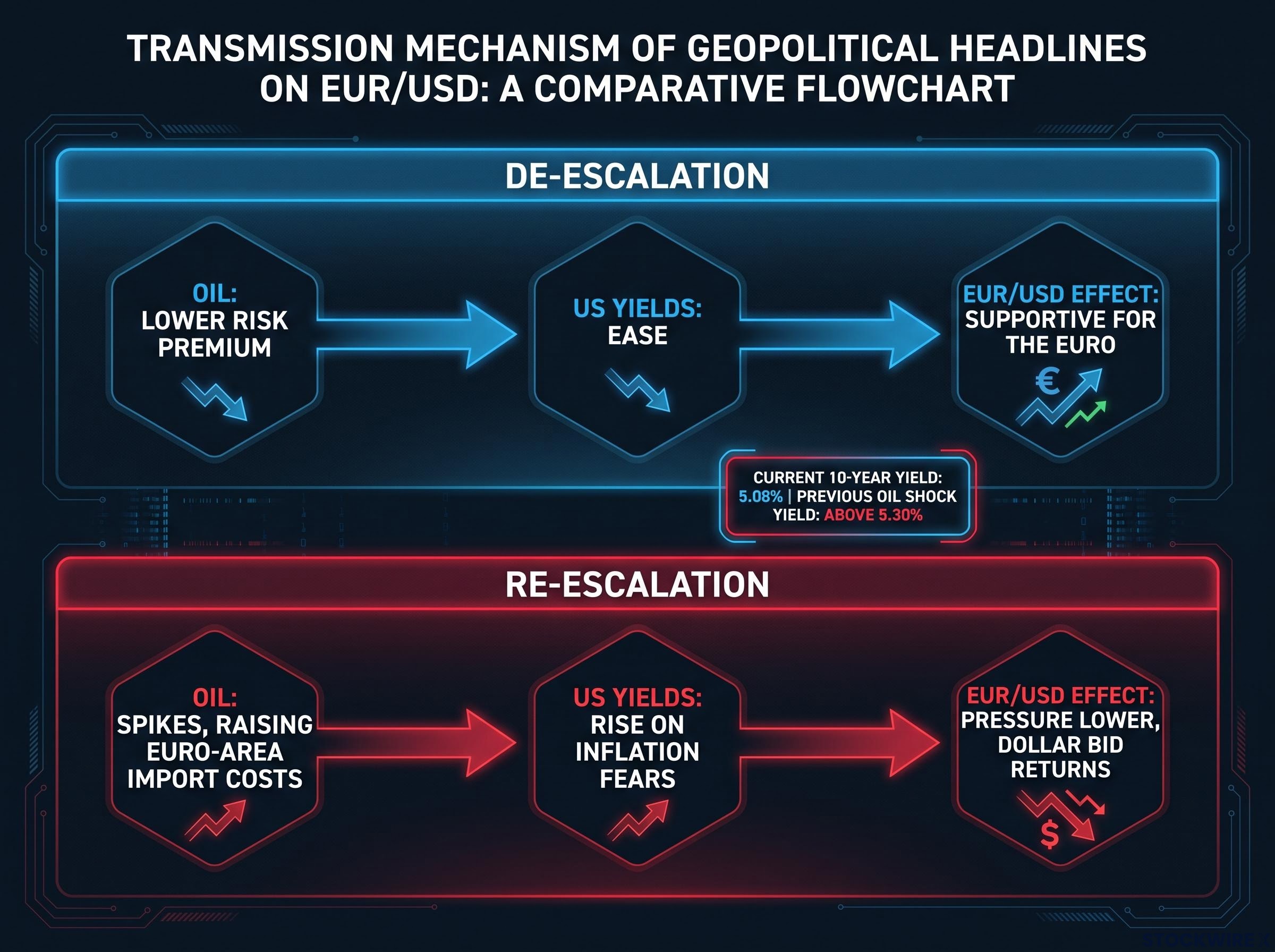
| Scenario | Oil | US yields | Likely EUR/USD effect |
|---|---|---|---|
| De-escalation | Lower risk premium | Ease | Supportive for the euro |
| Re-escalation | Spikes, raising euro-area import costs | Rise on inflation fears | Pressure lower, dollar bid returns |
For you, the practical takeaway is that oil acts as a leading indicator for this pair. Watching crude and the 10-year yield will usually warn you of a turn earlier than watching the euro itself.
The same chain explains the earlier dollar rally, and recent DXY analysis shows the euro’s weight of roughly 57.6% in the index means the dollar’s direction is largely a euro trade.
The levels that frame the EUR/USD forecast into the Fed and ECB meetings
If oil drives the direction, price levels tell you how far a move can run. Different sources measure these levels in different ways, yet their numbers keep landing in the same zones.
| Level type | Price | Source | Date |
|---|---|---|---|
| Resistance | 1.1270, then 1.1379 | Investing.com | 19 Oct |
| Support | 1.1178, then 1.1083 and 1.0888 | Investing.com | 19 Oct |
| Alternative range | Resistance 1.1254-1.1290; support 1.1113 | Perplexity Finance summary | 19 Oct |
| Recent-low based | Support 1.1151-1.1153; resistance about 1.1277-1.1303 | TradingKey, TMGM | 19 Oct |
Support is a price where buying has tended to halt declines, and resistance is a price where selling has tended to cap rallies. Across these measures, support gathers around 1.1150-1.1178 and resistance around 1.1270-1.1300.
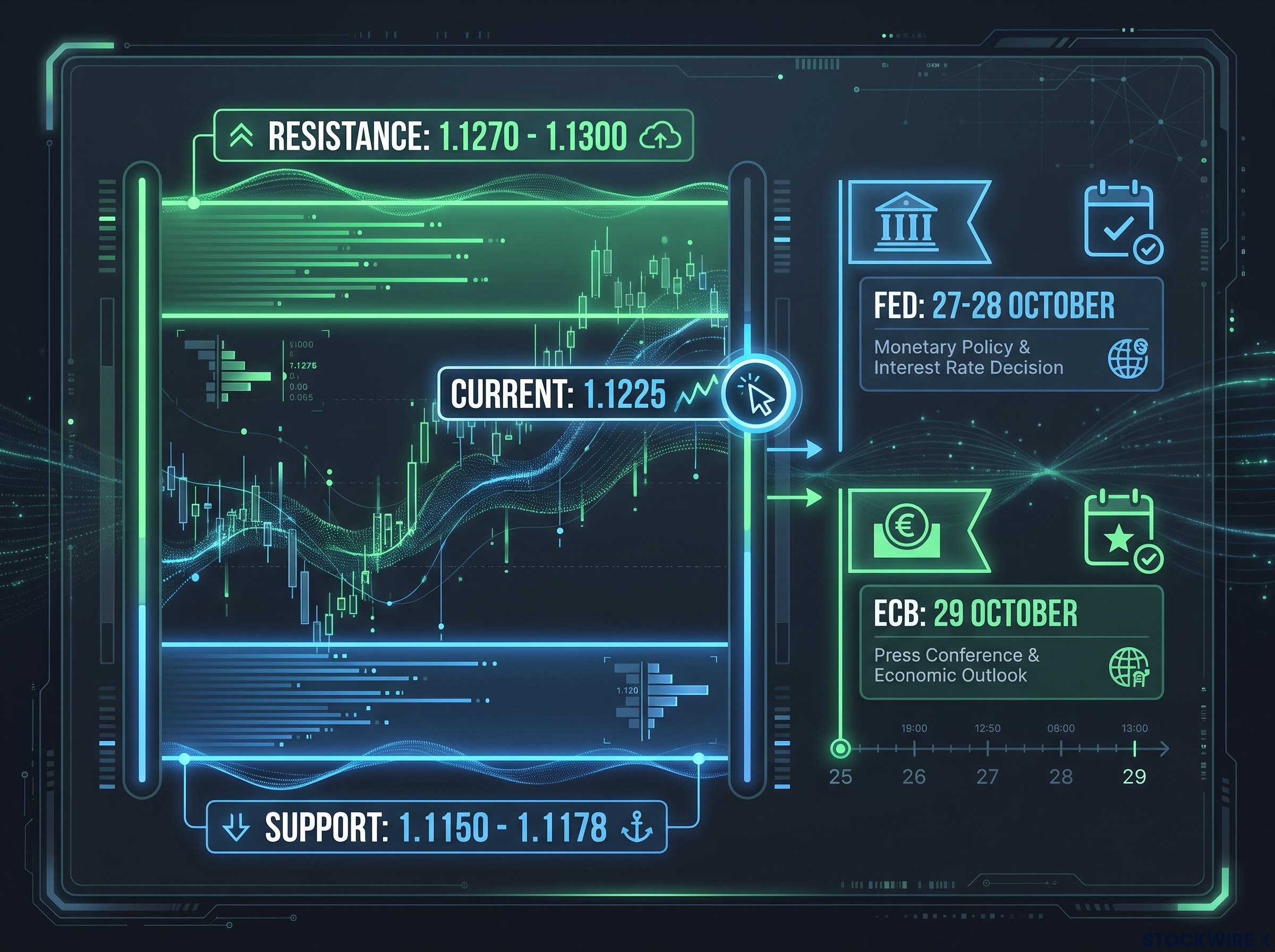
At about 1.1225, the pair sits nearer the top of that band than the bottom. Your risk-reward therefore depends heavily on whether you expect the talks to hold.
Two dates could break the range:
- Fed, 27-28 October: Reuters reported roughly an 80% probability of a hold, with substantial later tightening still priced in. A hawkish signal would revive the dollar’s yield edge.
- ECB, 29 October: ING noted that much of the expected ECB support is already priced, which limits the upside from a hawkish surprise.
Markets price expected paths rather than current settings, so the interest rate differential between the Fed and ECB can move the pair well before either bank speaks, which is why the 27-29 October meetings may matter less than the signals leading into them.
The longer view is split. The cyclical case favours the dollar on high yields, while a structural case argues for gradual dollar weakness if confidence in US fiscal policy erodes. ING sits between the two, forecasting about 1.13 for Q4 2026 and Q1 2027 while flagging a possible short-term test of 1.11. These are third-party projections, not guarantees, and past performance does not guarantee future results.
What could reverse the move: Hormuz, Houthi attacks and the inflation loop
The diplomatic optimism is real, and it pulled oil lower. The shipping data tells a far less settled story.
| Date | Development | Source |
|---|---|---|
| 7 Oct | At least 12 tanker attacks around Hormuz during 28 Sep-5 Oct, the highest weekly count since the Iran war began | Reuters |
| 8 Oct | Only seven commodity vessels transited Hormuz, the lowest in over two months | Reuters |
| 14 Oct | Two ships sank: GFS Pride and Cape Dao | Reuters |
| 19 Oct | Houthi claims on Yanbu, Shaybah, and Riyadh and Abha airports; tanker fire after a reported naval mine strike | Yahoo Finance, citing regional reports |
| 19 Oct | Regional crude flows fell to about 8.5 million bpd from more than 20 million bpd the previous week | Kpler via Yahoo Finance |
Read those numbers together. Barrels per day (bpd) flowing through the region fell by more than half in a week, at the same time as oil prices eased.
That gap matters. The fall in oil reflects a smaller risk premium, meaning the extra price traders pay to insure against disruption, not supply coming back online.
The oil decline you are trading rests on sentiment rather than barrels. One escalation headline could restart the oil-yield-dollar chain and unwind the euro’s gain faster than diplomacy can lock it in.
The triggers to monitor, ranked by likely speed of impact:
- Talks collapse or the proposal is rejected.
- Further attacks on Hormuz shipping.
- Houthi strikes on Saudi energy infrastructure.
- Inflation re-accelerates, pushing the Fed towards tighter policy.
- A euro-area growth shock from higher energy costs.
These scenarios are speculative and subject to change as events develop.
Reading the EUR/USD forecast without overreaching on one headline
The move to about 1.1225 reflects lower oil, softer yields and fading safe-haven demand. Every one of those depends on diplomacy that remains unconfirmed.
The order of signals matters. Watch oil first, then the 10-year yield, then price action around 1.1150-1.1178 below and 1.1270-1.1300 above.
A sustained break of either zone would tell you the headline has become a trend. The Fed on 27-28 October and the ECB on 29 October are the next real tests, and swings across this range in either direction remain plausible until then.
For readers wanting to anticipate the 29 October meeting, our comprehensive walkthrough of ECB policy tools explains why moves versus what the futures curve has already priced drive the euro.
This article is for informational purposes only and should not be considered financial advice. Investors should conduct their own research and consult with financial professionals before making investment decisions.