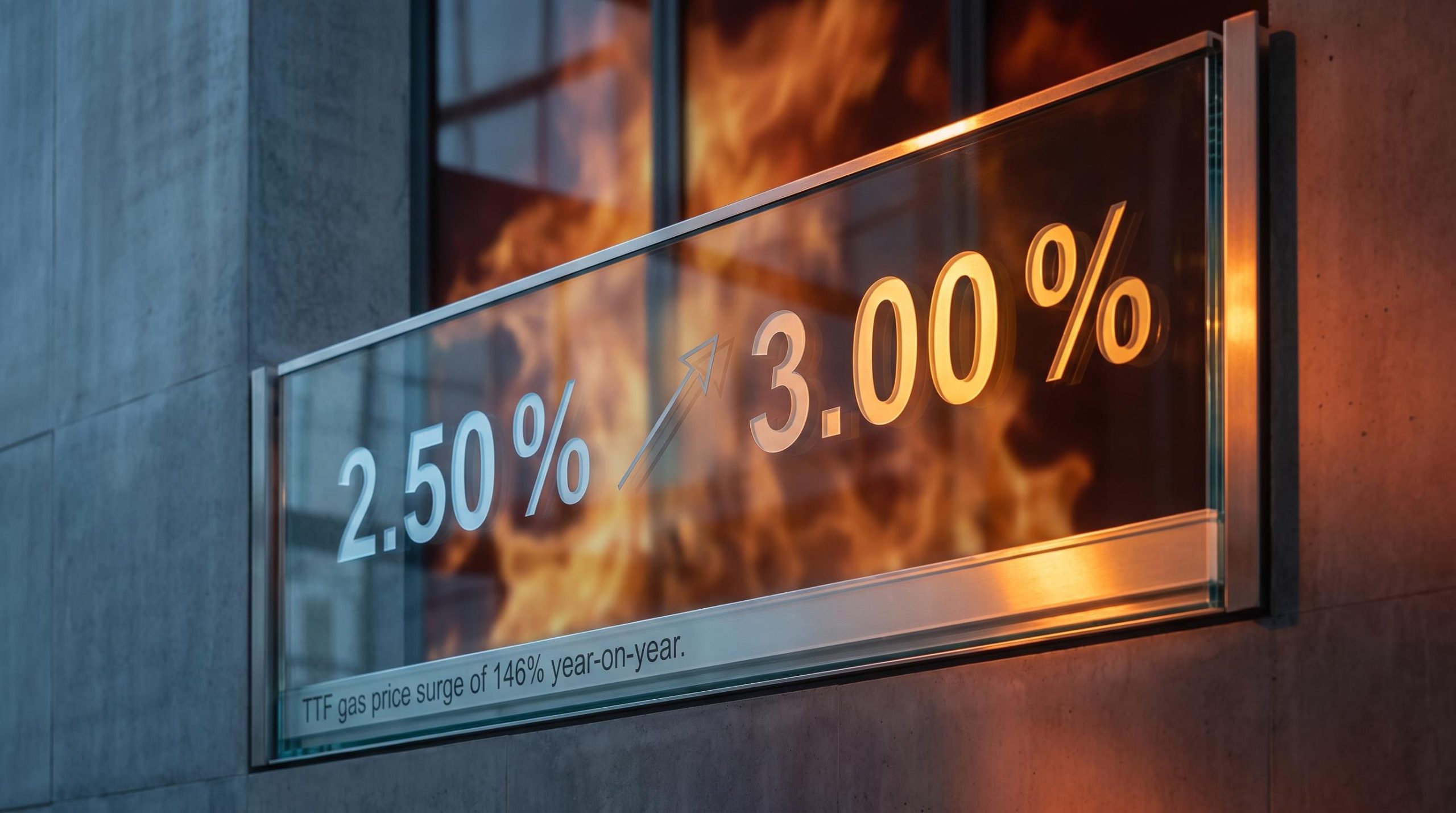
The European Central Bank’s decision on 10 September 2026 to lift its deposit facility rate to 2.50% was never going to be routine. What it has done is split the professional forecasting community down the middle on where policy heads next.
That divide matters because a fresh surge in energy prices has dragged euro area inflation back up to 3.2% in August 2026, well above the ECB’s 2% target. Central bankers now face an awkward choice: tighten harder against a shock they cannot directly control, or hold their nerve and risk letting price pressures spread.
This is a read on the ECB rate outlook that maps out the two competing camps, the peak-rate scenarios each implies, and the specific inflation data that will decide which one is right. By the end, you should be able to time the likely 2027 pivot and position your fixed-income exposure before the broader market repositions around it.
Rabobank’s baseline scenario for a December peak
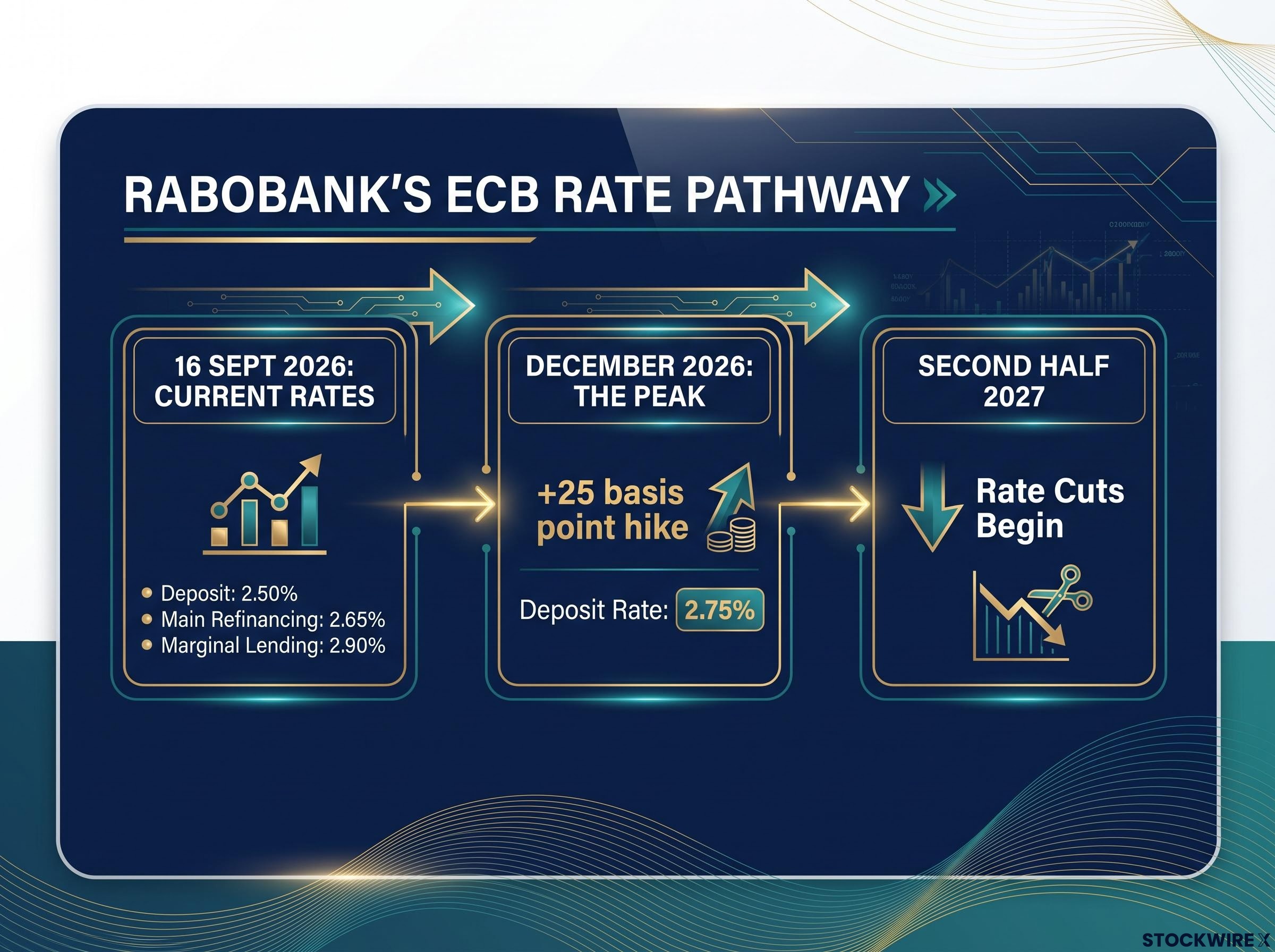
Rabobank strategists Bas van Geffen and Elwin de Groot have staked out one of the more precise calls on the market. In coverage dated 18 September 2026, they argue for exactly one more move: a single 25 basis point hike in December 2026, taking the deposit facility rate to 2.75%.
That is the peak. No March 2027 hike sits in their baseline.
The reasoning turns on lags. Monetary policy takes time to bite, and by the time a March decision would actually influence the economy, Van Geffen and De Groot expect policymakers to be looking straight past the tail end of the energy surge. Hiking again in spring would fight a fire that is already burning out.
Crucially, Rabobank frames anything above the current 2.50% as temporary rather than a permanent step toward a tougher structural stance. They expect energy inflation to begin fading from around March 2027, which then clears the way for the December top-up to be reversed in the second half of that year.
For context, here is where the ECB’s key rates stand following the September decision, effective 16 September 2026:
The deposit facility rate is the operative anchor in this debate precisely because of how the ECB’s three-rate corridor functions: the marginal lending and main refinancing rates float above it, but it is the floor rate that reprices the overnight cost of money for every bank in the system and transmits into broader financial conditions.
- Deposit facility rate: 2.50%
- Main refinancing operations rate: 2.65%
- Marginal lending facility rate: 2.90%
The ECB’s own September staff projections offer some support for the transitory view. They show headline inflation averaging 3.0% in 2026 before cooling to 2.5% in 2027 and 2.1% in 2028.
Here is what this timeline means for you directly. If Rabobank is right, the window of peak yields will be unusually short, a matter of months rather than years. That points toward locking in duration or positioning for a pivot well ahead of where consensus currently sits, because waiting for confirmation could mean missing the move entirely.
When big ASX news breaks, our subscribers know first
How the ECB separates energy shocks from structural inflation
To understand why Rabobank’s call holds together theoretically, you need to know how the ECB categorises inflation in the first place. Not all price rises are treated equally.
The distinction that drives everything is between first-round and second-round effects. A first-round effect is the direct hit: energy costs jump, and that feeds straight into headline inflation. According to ECB analysis on energy supply shocks, this alone does not justify a full monetary policy response.
A second-round effect is where it gets dangerous. This is when the initial shock spills into wage demands, firms’ pricing decisions, and long-term inflation expectations, making higher inflation broad-based and sticky rather than temporary.
The logic behind initially looking through energy shocks is blunt. Interest rates cannot drill for oil or pump more gas. Raising the cost of borrowing does nothing to lower a supply-driven spike in energy prices, so central banks focus instead on whether the shock threatens to unanchor expectations or bleed into core inflation.
The supply constraint behind August’s 14.3% energy HICP print is not a futures market phenomenon: refinery capacity destruction in the Gulf region has knocked roughly 3.52 million barrels per day offline, creating a physical bottleneck that monetary policy cannot address and that takes years to repair regardless of how aggressively the ECB tightens.
The current data suggests it has not, at least not yet. The energy component of the euro area’s Harmonised Index of Consumer Prices (HICP), the standard measure of consumer inflation across the bloc, surged 14.3% year-on-year in August 2026. Yet core inflation, which strips out energy and food, eased modestly to 2.4% over the same month.
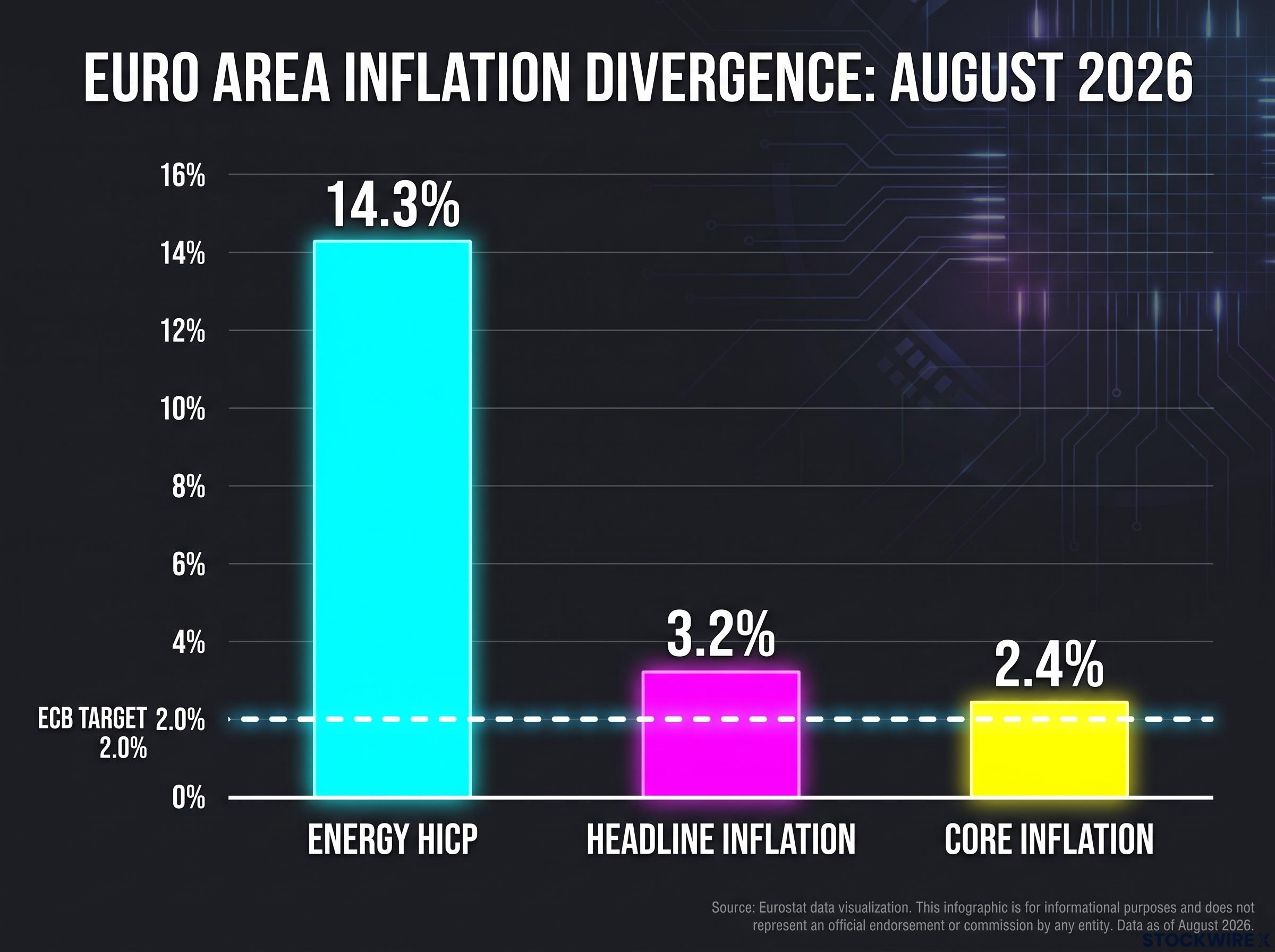
That gap is the whole story. Headline is screaming while core drifts lower, exactly the pattern of a supply shock that has not spread.
The ECB’s June 2026 meeting account confirmed there was no evidence so far of second-round effects via higher wage growth, with wage developments consistent with inflation returning to target over the medium term. President Christine Lagarde reinforced this in July, stating the ECB is scrutinising second-round effects but is not yet seeing them.
Why this matters for you is straightforward. Your ability to predict the next ECB move depends entirely on reading this divergence correctly. If core stays contained while energy runs hot, the transitory thesis lives. If core starts climbing, everything changes.
A divided market on the 2027 terminal rate
Here is where the consensus fractures. Almost everyone agrees a December hike is coming. Where they split is on what happens after, and how high rates ultimately climb.
On one side sits the transitory overshoot camp: Rabobank, ING, and UBS. This group sees any rate above roughly 2.50% as a temporary insurance measure, sufficient to anchor expectations while the energy shock burns out. UBS Global Wealth Management’s Chief Investment Officer Mark Haefele has warned against assuming rates will approach 3.00% without far stronger economic justification than currently exists.
On the other side sits the higher-for-longer cohort: Goldman Sachs, Citigroup, Barclays, and Deutsche Bank. Goldman now forecasts the December hike to 2.75% but flags genuine risk of a 3.00% peak, with rate cuts pushed back to late 2027. Citigroup goes further, pencilling in two more hikes, December 2026 and March 2027, that would take the deposit rate close to 3.00%.
The fault line runs through March 2027. That single meeting is the difference between the two worlds.
| Institution | Projected peak rate | Expected rate cut timeline |
|---|---|---|
| Rabobank | 2.75% (December 2026) | Second half of 2027 |
| Goldman Sachs | 2.75%, risk toward 3.00% | Late 2027 |
| Citigroup | Around 3.00% | End-2027 or later |
| UBS | 2.50%, sceptical of 3.00% | Data-dependent |
Some ECB policymakers lean toward the hawkish end. Reuters quoted Peter Kazimir and Martins Kazaks in mid-September 2026 warning that surging natural gas prices pose upside risks, with Kazaks stressing that rates may need to move into restrictive territory above 2.50% and that no fixed ceiling limits how far they can rise.
Nordea’s baseline calls for two further hikes to 3.00% by March 2027, placing policy firmly into restrictive territory at a moment when TTF spot prices are already at or beyond the ECB’s own adverse scenario assumptions, a trajectory that makes the higher-for-longer camp’s case materially stronger than it appeared before the September meeting.
What this divergence tells you is that volatility around every upcoming inflation print will be amplified. When institutional forecasts sit this far apart, each new data release forces a sudden repricing as one camp gets validated. For European bond and currency allocations, that is both a risk to manage and, if you read the data ahead of the crowd, an opportunity.
Key data triggers that could disrupt the base case
Rabobank’s thesis is elegant, but it rests on one conditional assumption: that energy inflation fades from March 2027 without contaminating the broader price basket. Several tripwires could break that.
The first is already visible in the ECB’s own numbers. September staff projections show headline inflation potentially climbing toward 3.6% in Q4 2026, driven not only by energy but by higher non-energy industrial goods and food components. That broadening is the early signature of a shock escaping its origin.
The second is stubborn core. The ECB projects core inflation at 2.6% in 2027, above target and pointing to more persistent underlying pressure than a purely energy-driven story would predict.
Van Geffen and De Groot acknowledge this directly. If faster wage growth or stronger services inflation appears, they concede the ECB may be forced to tighten beyond their single-hike baseline.
These are the indicators worth watching over the coming months:
- Core HICP inflation, for any sign it is drifting higher rather than holding steady
- Wage settlement data and negotiated pay agreements across major member states
- Services inflation, a sensitive gauge of domestic price pressure
- The non-energy industrial goods component, where broadening first shows up
The risk of historical repeat
The precedent that haunts this decision is the 2021 to 2022 episode. According to SUERF and Banca d’Italia research, energy shocks accounted for roughly 60% of headline inflation deviations from baseline in late 2022. The ECB initially looked through that shock, then tightened rapidly once inflation broadened, a costly catch-up.
A Cambridge study on the 1970s oil shocks tells a similar cautionary tale: policy that stayed accommodative too long let inflation become entrenched, forcing a harsher, growth-damaging correction later.
The counter-risk is just as real. Tighten aggressively against a shock that proves genuinely temporary, and the ECB simply damages growth without touching the energy prices that caused the problem.
Watch core inflation and wage data above all else. If those metrics tick higher, Rabobank’s 2027 rate cut scenario evaporates, and a fixed-income strategy built around an early pivot would need to reverse quickly.
Navigating the European rate environment into 2027
The two camps are not really arguing about December. They are arguing about how deep and how durable the energy shock proves, and that argument gets settled by data, not opinion.
Rate path uncertainty of this magnitude also reshapes sovereign spread dynamics within the bloc: France’s 10-year yield has already overtaken Italy’s for the first time since roughly 2005, driven by a widening France-Germany spread that reflects fiscal credibility concerns layered on top of the shared rate environment every eurozone borrower faces.
Rabobank sees a swift resolution: a final hike to 2.75%, a peak that lasts only months, and cuts arriving in the second half of 2027. The higher-for-longer group sees a peak near 3.00% and cuts delayed past year-end. The ECB itself has committed to strict data-dependence, which makes the December meeting the critical waypoint.
For your own positioning, the decision framework comes down to one question. If Q4 2026 inflation prints show structural wage contamination and rising core, lean toward the higher-for-longer scenario and keep duration shorter. If the prints stay purely energy-driven noise while core holds, Rabobank’s early-pivot case strengthens, and extending duration ahead of consensus becomes more attractive.
This article is for informational purposes only and should not be considered financial advice. Investors should conduct their own research and consult with financial professionals before making investment decisions.
Past performance does not guarantee future results, and these forecasts are speculative and subject to change based on incoming data and market developments.