Two forecasts of Eurozone inflation cannot both be right, and the gap between them is wider than usual. Official forecasters expect price growth to drift back toward the European Central Bank’s target through 2027. Rabobank’s energy-revised models see it spiking to roughly 4.4-4.5% in early 2027, close to double the ECB’s own projected path for that year.
That is not a routine forecast disagreement. If Rabobank is right, the ECB has not finished tightening; it is somewhere in the middle of the cycle.
The context sharpens the stakes. The ECB raised its deposit facility rate to 2.50% effective 16 September 2026, with headline inflation already running at 3.2% in August and the energy component up 14.3% year-on-year. Consensus forecasts cluster around 2.3-2.8% for 2027, which makes the Rabobank projection a genuine outlier, and an outlier with policy consequences.
This piece lays out a framework for judging who is likely right, which variables will settle the debate, and what an extended ECB hold at 2.50% through 2028 would mean for the Eurozone investment environment. Read to the end, and the January 2027 inflation print stops being a surprise and starts being something you can anticipate.
Why Rabobank sees inflation spiking where others see it falling
Start with the numbers Rabobank’s strategists Bas van Geffen and Elwin de Groot are working with. Their models project Eurozone headline inflation to average 3.1% in 2026 and 3.5% in 2027, an upward revision of roughly 0.5 percentage points across both years.
The peak is the part that turns heads: approximately 4.4% year-on-year in January and February 2027, with a risk scenario nudging that toward 4.5% if Q4 2026 economic activity holds firm.
Set that against the official baselines and the divergence becomes concrete. The ECB’s own September 2026 staff projections put headline inflation at 3.0% for 2026, 2.5% for 2027, and back to 2.1% by 2028. The Survey of Professional Forecasters median for 2027 sits even lower, at 2.2%.
The ECB September 2026 staff projections formalise that baseline, placing headline inflation at 3.0% for 2026, 2.5% for 2027, and 2.1% by 2028, figures derived from the same Governing Council session that confirmed the deposit facility rate increase to 2.50%.
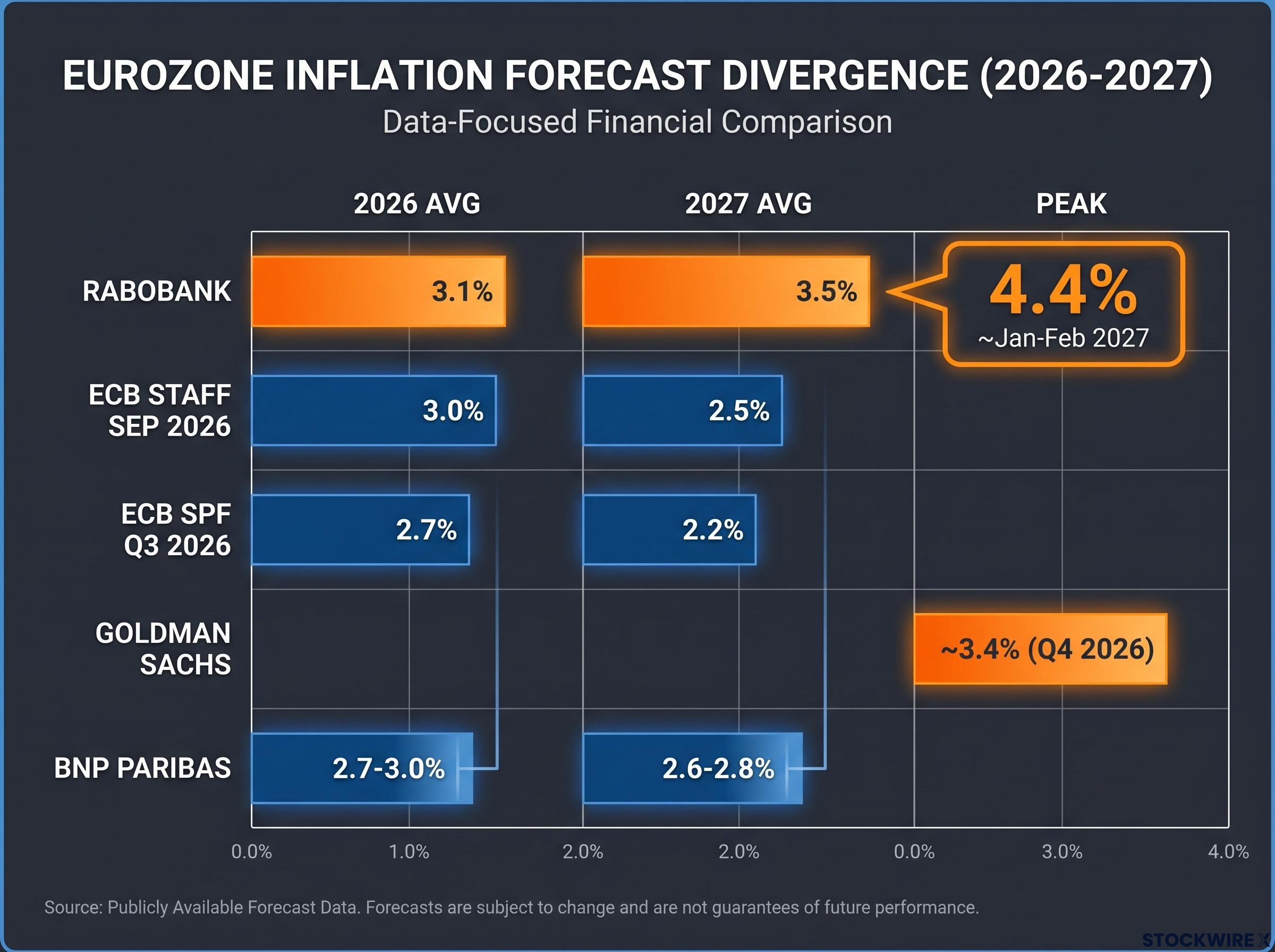
| Forecast source | 2026 average | 2027 average | Peak estimate |
|---|---|---|---|
| Rabobank | 3.1% | 3.5% | ~4.4% (Jan-Feb 2027) |
| ECB Staff (Sep 2026) | 3.0% | 2.5% | Not specified |
| ECB SPF (Q3 2026) | 2.7% | 2.2% | Not specified |
| Goldman Sachs | Not specified | Not specified | ~3.4% (Q4 2026) |
| BNP Paribas | 2.7-3.0% | 2.6-2.8% | Not specified |
Here is the detail that unlocks the whole picture. Rabobank revised its core inflation forecast upward by only 0.1 percentage points. This is not a thesis about broad-based, entrenched price pressure. It is almost entirely an energy story.
A precise HICP component breakdown shows why the energy weight of roughly 9% of the basket caps even a severe energy spike’s direct contribution to headline at around 1.8 percentage points, which is why the gap between Rabobank’s 4.4% peak and the ECB’s 2.5% annual average is almost entirely an argument about indirect effects and transmission lags, not the energy line itself.
The gap that matters Rabobank sees a peak of 4.4-4.5% in early 2027. The ECB expects 2.5% for the whole of that year. The distance between those two numbers is almost entirely explained by differing energy price assumptions.
That is the analytical takeaway for you. The single most consequential variable in any 2027 Eurozone inflation forecast right now is not the current print or the core reading; it is the energy price assumption baked into each institution’s model. Understand that assumption, and you can interrogate any forecast on the shelf, including whether markets are pricing ECB rate cuts too early.
When big ASX news breaks, our subscribers know first
How an energy price shock becomes a broader inflation problem
The signal is visible on any trading screen. The benchmark Dutch TTF front-month gas contract sat at approximately €79/MWh in mid-September 2026, up roughly 145% year-on-year and near three-year highs.
Rabobank’s energy note forecasts TTF at €72/MWh for Q4 2026, easing to €58/MWh by Q1 2027 and into the mid-€40s later in the year. The ECB’s baseline is gentler still, assuming gas at €60/MWh and Brent crude at US$88 per barrel for Q4 2026. In a severe Middle East escalation scenario, the ECB models oil at US$130 per barrel and gas at €130/MWh.
A gas price is easy to dismiss as a commodity story. The reason it lands in the services bill you pay months later is the transmission mechanism.
Energy cost pass-through operates through channels that headline indices systematically undercount: war-driven fuel costs embedded in airfares and logistics appear in the goods and services categories rather than the energy line, meaning the true inflationary footprint of a supply shock is consistently larger than the energy component alone suggests.
How price spikes travel through the economy
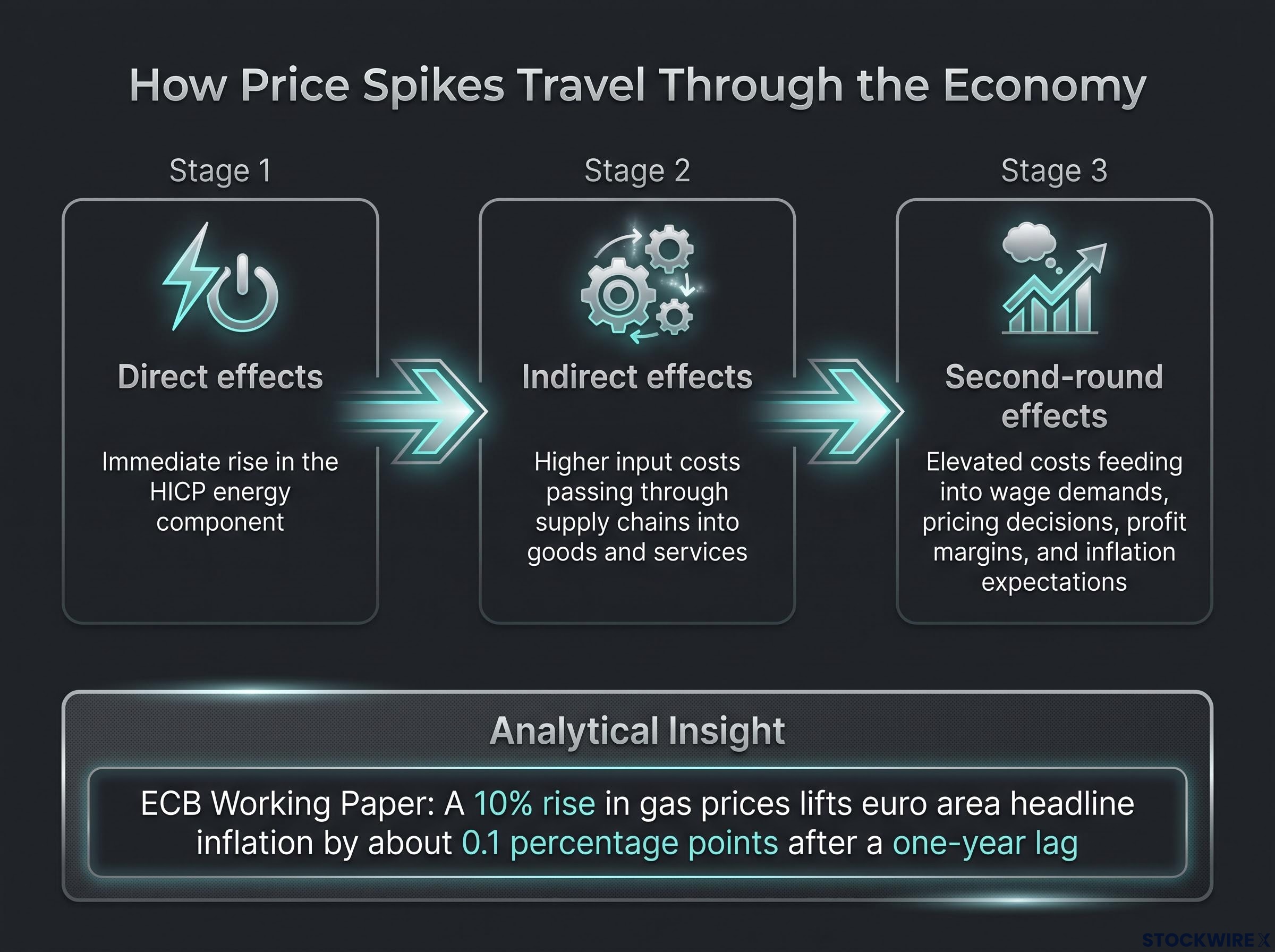
Energy shocks reach broader inflation in three stages:
- Direct effects: the immediate rise in the HICP energy component, the most visible and fastest-moving channel.
- Indirect effects: higher input costs passing through supply chains into the prices of goods and services that use energy to produce or transport.
- Second-round effects: elevated costs feeding into wage demands, firm pricing decisions, profit margins, and inflation expectations.
According to an ECB Working Paper, a 10% rise in gas prices lifts euro area headline inflation by about 0.1 percentage points after a one-year lag. ECB and SUERF studies of the 2022 shock found energy accounted for roughly 60% of headline inflation and 20-30% of core inflation during that episode.
That lag is the whole point. The peak Rabobank projects for early 2027 is not really a prediction of future events. It is a description of what today’s gas price has already set in motion, working its way through supply chains and pricing decisions on a delay.
For the ECB, that changes everything. It cannot simply wait for energy prices to fall before adjusting policy, because by the time the peak prints in early 2027, the pressure will have been embedded in supply chains and wage talks for months. The disinflation clock and the policy clock are not synchronised.
The second-round risk that keeps the ECB from looking away
The reassuring part first. The 2021-2023 Eurozone energy shock did not produce the wage-price spirals that defined the 1970s. Anchored inflation expectations and institutional wage-setting mechanisms did their job, and the extreme feedback loops of that earlier era stayed absent.
That track record is real. It is also why the current situation deserves a closer look rather than a shrug.
Rabobank’s warning turns on a specific condition. If Eurozone economic activity holds firm through Q4 2026 while headline inflation runs near 4.4-4.5%, workers face genuine erosion of their real wages, and they gain both the economic footing and the incentive to demand compensation.
A risk the ECB shares Rabobank describes the risk of second-round wage effects as “non-negligible” if Q4 2026 activity stays resilient. The ECB’s own upside-risk framework flags wages and profit margins directly, confirming this is not a fringe worry.
The current data shows why comfort is narrowing rather than disappearing. August 2026 headline HICP came in at 3.2%, with services at 3.0% and core at 2.4%. The ECB flags three categories of upside risk to inflation:
Eurostat HICP data for the euro area confirms that August 2026 headline inflation reached 3.2%, with the energy component posting the highest sub-index rate at 14.3% annually, providing the statistical foundation against which Rabobank’s projected 2027 peak must be measured.
- Energy and geopolitics: Middle East conflict and the Russia-Ukraine war as supply-side wildcards.
- Wages and margins: persistent core inflation, sustained corporate margins, and delayed wage demands.
- Climate and food: extreme weather events pressuring food prices.
The 1970s lesson lurks underneath all of it. Central banks then let real interest rates turn negative, which unanchored expectations and forced harsh tightening later. The pass-through channel today is diluted, not dead: energy still accounted for 20-30% of core inflation in 2022.
The read for you is straightforward. The difference between a temporary energy shock and a structural inflation problem comes down to whether the wage negotiation cycle absorbs the spike or pushes back against it. That is the variable to watch in Eurozone labour market data over the next two quarters, and it is the threshold that separates a manageable overshoot from one that forces the ECB into a genuinely restrictive posture beyond 2028.
What the ECB’s constrained position means for rates through 2028
The ECB has long relied on a doctrine of “looking through” temporary supply shocks. The logic is sound: hiking aggressively into an energy shock deepens recessions without durably lowering inflation, especially when higher bills are already draining consumer demand. ECB President Christine Lagarde has made exactly this point.
The supply shock policy dilemma is not new to this cycle: when Eurozone headline inflation reached 3.2% in May 2026 on the back of a 10.9% energy price surge, analysts were already debating whether rate increases could cool price pressure rooted in geopolitical disruption rather than excess demand.
The problem is that the current shock is neither small nor short. Governing Council members have signalled that given its magnitude, “looking through may no longer be an option,” and Lagarde has stressed the need to monitor wages and inflation expectations closely.
That is the bind. The tool that worked in 2021-2023 is under real pressure precisely because the scale and duration of this shock stretch the definition of “temporary.”
The rate path Rabobank sees from here
Rabobank’s call is that the deposit facility rate holds at 2.50% through at least 2028, with cuts below that level unlikely before then. The reasoning is slow core disinflation combined with persistent wage risk.
Rabobank sees three conditions as necessary before any easing becomes credible:
- Durable core disinflation: core prices need to show sustained, not temporary, softening.
- Wage growth stabilisation: the labour market must demonstrate that second-round pressures are not building.
- Energy price normalisation: TTF and oil need to settle back toward baseline assumptions.
Not everyone agrees on direction. Reuters polls and BNP Paribas leave the door open to at least one further hike if energy-driven inflation threatens to unanchor expectations. The debate, notably, is between “hold” and “hike,” not “hold” and “cut.”
For anyone holding Eurozone fixed income or watching ECB-sensitive assets, the practical implication is direct. Pricing in rate cuts before 2028 looks premature, and the rate environment is likely to remain a headwind for longer than consensus currently reflects. Put plainly: 2.50% is not a ceiling being tested on the way down. It is a floor being held against upward pressure. That reconfigures the calculus across bond duration, equity discount rates, and credit spreads compared with what markets priced six months ago.
Past performance does not guarantee future results. Financial projections are subject to market conditions and various risk factors.
What investors and analysts should watch as the 2027 peak approaches
Rather than waiting for the January 2027 HICP print to settle the argument, three variables will resolve the Rabobank-versus-consensus debate in real time over the next two to three quarters.
- TTF gas price trajectory through Q4 2026: Rabobank’s baseline is €72/MWh for the quarter. Prices holding above that, or spiking on a supply disruption, tilt the odds toward the higher inflation path. Prices falling faster than forecast undercut the peak scenario.
- Eurozone labour market data: watch wage growth and employment resilience. Firm activity and rising wage demands into a 4%-plus inflation reading would validate the second-round risk. A softening labour market drains it.
- ECB communication signals: the Governing Council meets in October and December 2026. Language leaning toward “looking through may no longer be an option” points to a longer hold or a hike; dovish framing suggests the ECB sees the shock fading.
Sitting behind all three are the geopolitical wildcards the ECB itself flags: Middle East conflict and the Russia-Ukraine war remain the primary supply-side risks that could push energy prices well beyond baseline.
Track these, and you will spot ahead of the consensus whether the Rabobank peak scenario is materialising or fading. The judgment you can now make is the one that matters: whether the current ECB rate environment is an equilibrium, or a stepping stone to further tightening.
For investors wanting a practical framework for the data tracking ahead, our dedicated guide to reading German HICP releases explains which sub-components carry the most forward-looking policy weight and how to separate energy-driven headline moves from the core re-acceleration signals that would change ECB communication.
The Rabobank call in context: a forecast worth taking seriously, not as certainty
The Rabobank projection is best understood as neither alarmism nor obvious truth. It is the most internally consistent energy-driven scenario currently available, and consistency is not the same as certainty.
Real risks could invalidate it. A sharp slowdown in Chinese or US demand would weaken the whole inflation picture. So would euro appreciation or faster-than-expected LNG supply.
The downside scenarios are worth naming clearly:
- External demand weakness: an abrupt slowdown in major trading partners curbing aggregate demand.
- LNG surplus: ING’s 2026 Energy Outlook projects TTF could average around €30/MWh if new US and Qatari export capacity pushes the global market into surplus, well below Rabobank’s assumptions.
- Euro appreciation: a stronger currency lowering imported energy and goods costs.
- Fiscal consolidation: tighter budgets in member states suppressing demand.
Even if the exact 4.4% peak proves off, the directional logic holds: ECB cuts before 2028 look unlikely, and markets pricing earlier easing are carrying model risk they may not have fully accounted for.
The deeper point is about method. The discipline needed to evaluate this scenario, reading energy transmission lags, wage dynamics, and doctrine constraints together, is the same discipline needed to interpret any major central bank decision in an energy-sensitive economy. The question for your own framework is not whether Rabobank is precisely right. It is whether the energy-driven inflation path deserves more weight than the consensus currently gives it.
This article is for informational purposes only and should not be considered financial advice. Investors should conduct their own research and consult with financial professionals before making investment decisions. These statements are speculative and subject to change based on market developments and central bank policy decisions.