Market pricing for a Bank of Canada rate hike at the October 28 decision has moved from below 10% to roughly 60% in the span of two weeks. That is not a gradual drift. It is a repricing event, and it has not yet fully reached the attention of most Canadian borrowers and investors.
The catalyst is several forces converging at once: the U.S. Federal Reserve’s first rate increase since 2023, elevated energy prices threatening to bleed into broader consumer prices, and a resilient domestic labour market that is giving the central bank less reason to stay on hold. RBC economist Nathan Janzen has flagged that while the bank’s baseline still calls for hikes beginning in Q1 2027, the balance of risks has shifted materially toward earlier action. What the market now prices and what Canada’s major banks forecast are no longer telling the same story.
This piece maps the competing forecasts, explains the specific inflation mechanism driving the concern, and gives you a clear framework for reading how October 28 and Governor Tiff Macklem’s upcoming Halifax remarks are likely to land. Whether you hold a variable-rate mortgage, fixed-income exposure, or Canadian dollar positions, understanding what is actually driving this shift matters more than tracking the headline probability alone.
How market pricing moved from 8% to 60% in two weeks
Earlier in September, the market barely entertained the idea of a hike. LSEG Data & Analytics showed more than 92% probability of a hold, making an increase the clear minority view. The consensus was that the Bank of Canada would sit tight, as it had since holding its policy rate at 2.25% in October 2025.
Then the Fed moved.
The repricing followed a tight sequence:
- 16 September 2026: The U.S. Federal Reserve raised its federal funds target range to 3.75%-4.00%, its first increase since 2023.
- 16 September 2026: LSEG’s implied probability of an October hike surged from below 10% to roughly 60% on the same inflection date.
- The coming Monday: Governor Macklem is scheduled to deliver remarks on economic conditions in Halifax, the next signalling opportunity before the decision.
The Fed’s move left the Bank of Canada holding a rate a full 175 basis points below its U.S. counterpart, the widest divergence since 2022. That gap is the mechanical driver behind the repricing.
The NBC analysts’ case against current BoC hike pricing rests on a specific objection: OIS markets implicitly treat Canada-U.S. trade resolution as the base case, a premise the underlying trade data does not yet support.
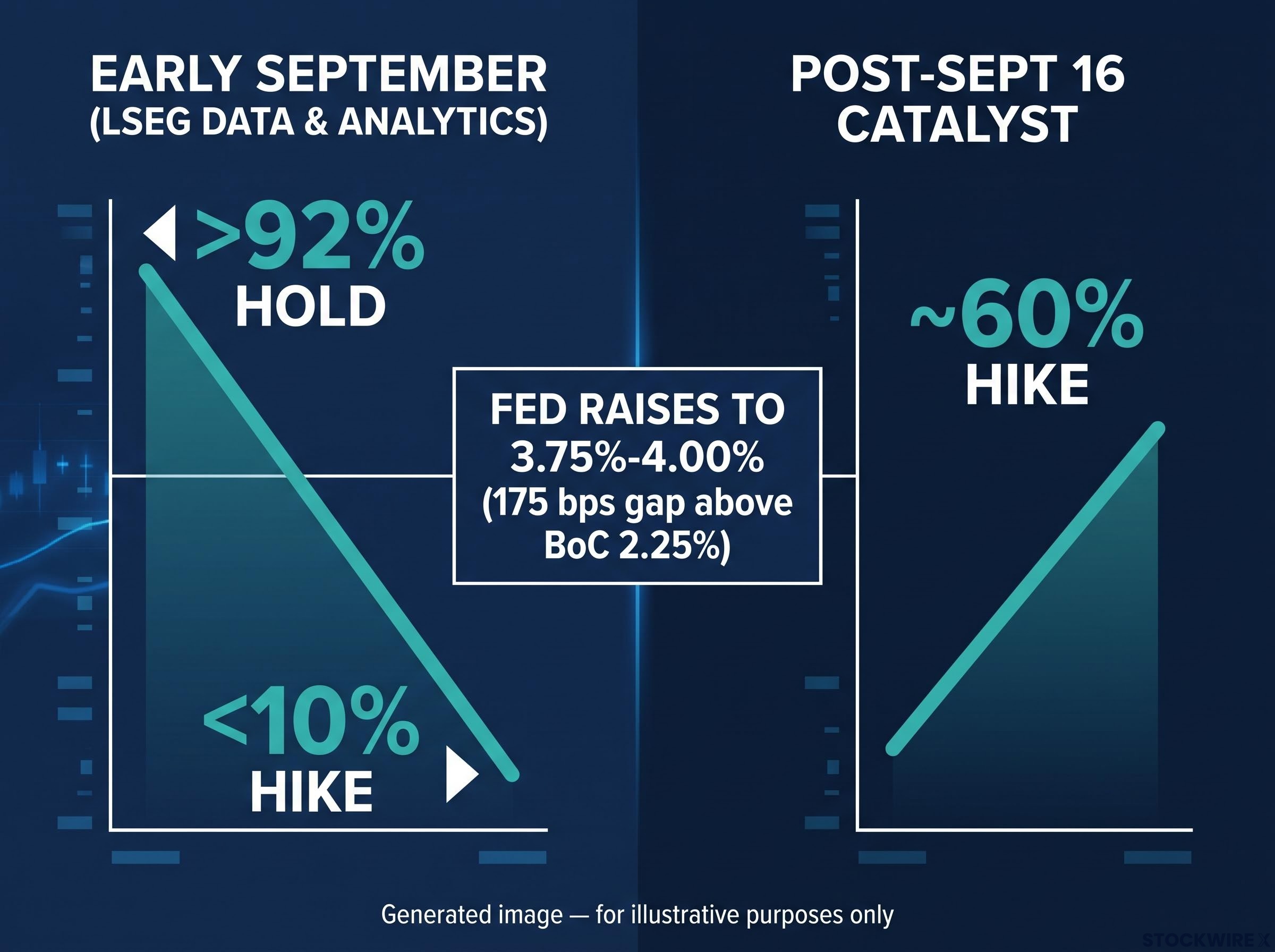
The market’s live verdict: roughly 60% implied probability of an October 28 hike, up from a near-consensus hold two weeks earlier.
Here is what that divergence means for you. A 175-basis-point gap puts the Bank of Canada in historically unusual territory. According to National Bank analysis, since 1995 the bank has spent about 25% of the time with its rate at least 75 basis points below the Fed’s, but divergence beyond 100 basis points is the exception rather than the rule. This gap alone exerts downward pressure on the Canadian dollar and upward pressure on Canadian bond yields, regardless of what the bank decides on October 28.
The speed of the move matters as much as the direction. If you track Canadian fixed-income, mortgage rates, or currency exposure, you are already operating in a different risk environment than you were a fortnight ago, before the bank has acted at all. Macklem’s Halifax remarks are the next event the market will use to confirm or challenge that repricing.
When big ASX news breaks, our subscribers know first
Where Canada’s major banks disagree, and what each camp is watching
The banks are not looking at different data. They are drawing different conclusions from the same picture, and that is what makes the current uncertainty genuine rather than a matter of competing models.
RBC sits in the middle. Its baseline, held by economist Nathan Janzen, calls for the first hike in Q1 2027, underpinned by an expectation of roughly 1% real GDP growth in 2026. But RBC is explicit that the balance of risks has tilted toward earlier action, with elevated energy prices and a resilient labour market as the primary factors.
TD and BMO anchor the cautious end. Both forecast a hold at 2.25% through late 2026 and into 2027, treating the current rate as the neutral rate itself, the bottom of the 2.25%-3.25% neutral range. Their argument rests on subdued core inflation and growth headwinds.
The TD Securities rate path through 2026 and into 2027 rests on a specific sequencing argument: trade-related data covering export volumes, business investment, and GDP effects would not be available for BoC assessment until November 2026 at the earliest, making any earlier hike decision information-constrained.
Scotiabank is the outlier on the hawkish side, projecting 50 basis points of tightening across the second half of 2026, with hikes potentially starting in Q3 2026.
| Institution | First Hike Call | Rate at First Hike | Key Condition Being Watched |
|---|---|---|---|
| RBC | Q1 2027 (risks tilted earlier) | 2.25% base, rising incrementally | Energy passthrough, labour resilience |
| TD / BMO | Hold through late 2026 into 2027 | 2.25% (neutral rate floor) | Core inflation, growth headwinds |
| Scotiabank | Q3 2026 | +50bps across H2 2026 | Firming growth, stabilising core inflation |
The disagreement is not about whether the bank will eventually hike. It is about whether the conditions for hiking have already been met, or will arrive earlier than the consensus assumed. If Scotiabank is right, the first hike lands within months rather than quarters, which is a meaningfully different planning horizon than the TD and BMO hold scenario. For you, the useful move is watching the variables each camp watches, not picking a bank to follow.
The variable that could resolve the disagreement before October 28
Macklem’s Halifax remarks are the near-term event most likely to move one or more camps. Listen for two specific things.
First, whether he frames current energy-driven inflation as temporary or as a risk to the bank’s target. Language that treats the gasoline effect as something to “look through” is a hold signal. Language that flags broadening price pressure is hawkish.
Second, whether he references the Fed divergence directly. If Macklem signals discomfort with the 175-basis-point gap and its currency effects, the market will read that as movement toward the Scotiabank end of the spectrum.
Why energy passthrough is the specific mechanism the BoC is tracking
The Bank of Canada is honest about what it cannot do. It has no direct ability to influence standalone crude oil prices. So the policy-relevant question is never the oil price itself. It is whether energy costs are bleeding into broader, persistent price pressure that the bank can, and would, respond to.
That transmission happens in two stages:
- Direct effects: Energy shows up straight away in the gasoline and energy components of CPI. Statistics Canada recorded energy prices up 13.1% month-over-month in March 2026 (3.9% year-over-year), rising to 19.2% year-over-year by April 2026.
- Second-round effects: Energy costs embed themselves in transportation, air travel, and other energy-intensive sectors. Federal Reserve research estimates that a 10% permanent increase in oil prices lifts core CPI by roughly 0.1% at its peak, adding about 0.15 percentage points to headline inflation through these knock-on effects.
BoC research indicates a 75% long-run passthrough from crude oil price growth to ex-tax retail gasoline prices, so the direct channel is strong. The second-round channel, on current estimates, is far weaker.
That distinction shapes the bank’s read right now. Headline CPI has hovered around 3%, driven mainly by gasoline. But inflation excluding gasoline was recorded at 2.2% in July, with core measures sitting close to the 2% target.
Canada’s core inflation measures, CPI-trim sitting near 1.8% and CPI-median near 1.9% as of August 2026, are both running below the Bank of Canada’s own quarterly MPR projections, which is precisely the data point the hold camp uses to argue that policy is already tighter than the bank intends.
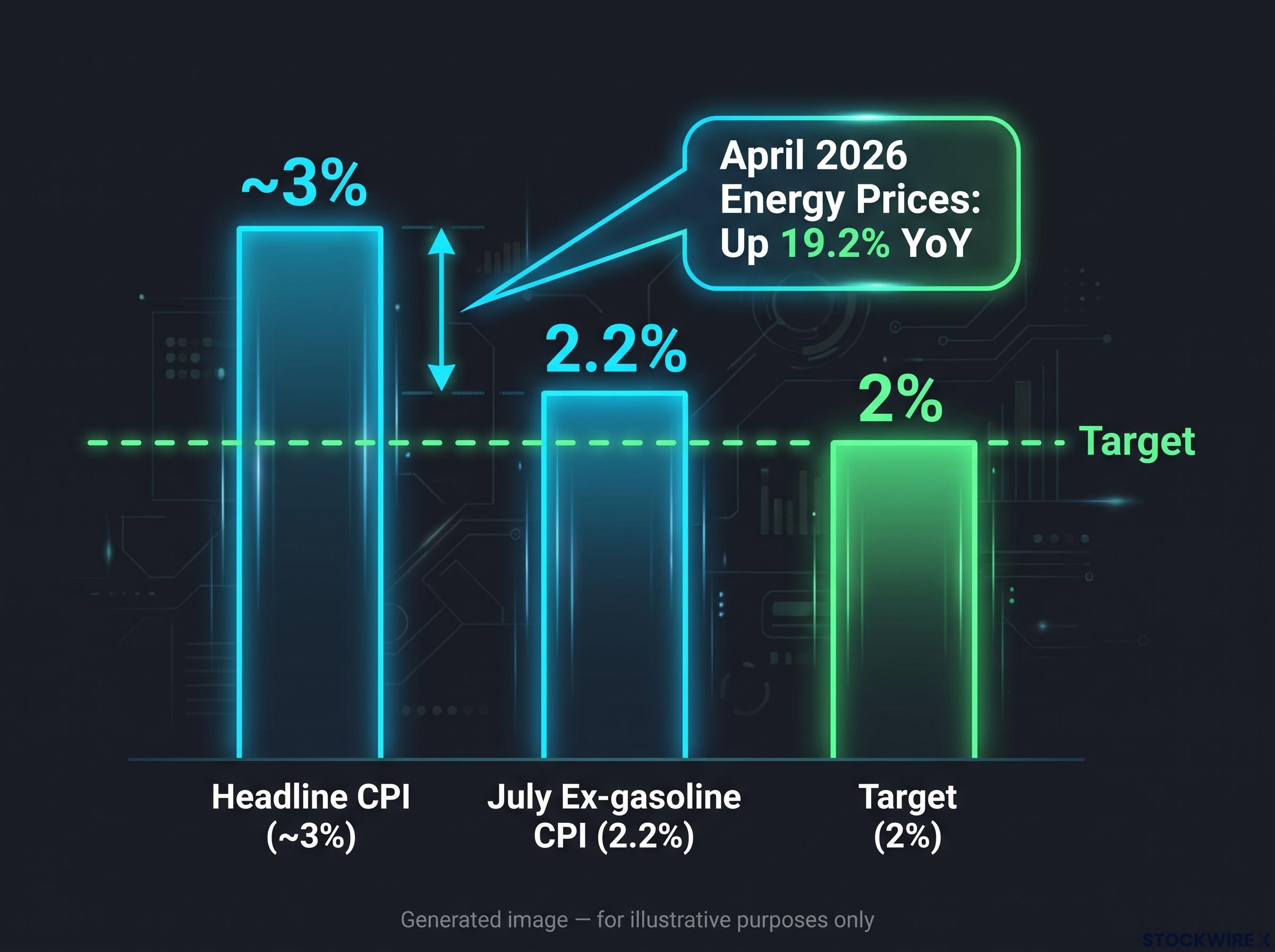
The Bank of Canada has stated it will “look through” near-term energy shocks, but is prepared to raise rates if energy costs produce broad-based, persistent inflation.
That single sentence is the most policy-consequential position the bank holds. The gap between the 3% headline figure and the 2.2% ex-gasoline figure is doing most of the analytical work. As long as that gap reflects energy rather than broad price pressure, the case for holding stays intact.
For you, this changes which number to watch. The monthly CPI release and its energy-stripped components are now more useful signals than the headline figure, because that is exactly the data the bank itself is using to calibrate its response. A headline print of 3% tells you little. An ex-gasoline print drifting above 2.5% would tell you a great deal.
What earlier tightening would mean for borrowers and markets
Hiking while core inflation sits near target and growth is modest is a different exercise from hiking into a genuine inflationary breakout. The margin for error is narrower than the headline probability suggests, because over-tightening risks stalling Canada’s already modest growth trajectory, particularly with trade and tariff uncertainty in the mix.
For households, the transmission is concrete. BoC staff analysis found that unexpected mortgage payment increases from past rate hikes reduced borrowers’ consumption by roughly 2.8% on average by April 2024. Further BoC analysis suggests that without income growth, the median borrower may need to devote up to 4% more of pre-tax income to mortgage payments by the end of 2027 as fixed-rate mortgages renew at higher levels.
That renewal wave is the key point. If you hold a fixed-rate mortgage renewing in 2026 or 2027, higher rates arrive on a schedule set by your original mortgage terms, not by when you feel ready for them. An earlier tightening cycle compounds that pressure before the renewal pipeline clears.
| Scenario | BoC Action | Mortgage Impact | CAD Pressure | Core Inflation Read |
|---|---|---|---|---|
| Hold through 2026 | Rate steady at 2.25% | Renewal pressure builds gradually | Persistent, driven by Fed gap | Near 2% target, gap stays energy-led |
| Hike Q3/Q4 2026 | +50bps (Scotiabank scenario) | Renewal shock compounds sooner | Eases as divergence narrows | Risk of broadening beyond energy |
The counter-argument keeps the debate live. Labour market resilience means the economy continues gaining ground despite trade and energy headwinds, and that is precisely the basis on which both RBC and Scotiabank argue earlier hikes would be defensible.
The currency and bond yield channel
Sustained divergence between the Bank of Canada and the Fed pulls capital toward higher U.S. yields, which weakens the Canadian dollar. A weaker loonie makes imported goods more expensive, feeding imported inflation risk back into the very price pressures the bank is trying to contain.
There is a second channel that hits before the bank acts. Canadian bond yields track U.S. Treasuries closely, so yields can rise in anticipation of hikes. Because fixed mortgage rates are priced off those yields, your fixed borrowing costs can climb well before October 28, regardless of what the bank formally decides.
For readers wanting to understand why fixed mortgage rates move before the Bank of Canada acts, our full explainer on bond yield and mortgage rate mechanics shows how Canadian fixed borrowing costs are priced off government bond yields rather than the overnight rate, using worked examples from mid-2026 market conditions.
Past performance does not guarantee future results. Financial projections are subject to market conditions and various risk factors.
What October 28 will and will not resolve
The decision itself is one input into a longer cycle, not the resolution of it. A hold on October 28 would narrow the Scotiabank early-tightening scenario without eliminating it. A hike would validate the market’s repricing but bring the over-tightening risk into sharper focus. Neither outcome closes the debate.
Three data points will matter most between now and the following decision: core inflation stripped of energy, labour market data, and any shift in Macklem’s public language. The institutional disagreement is real, the variables are identifiable, and you now have the mechanism-level understanding to read each release for yourself rather than waiting for a headline to interpret it for you.
The practical takeaway is a monitoring posture. Identify which of those three variables sits closest to your own exposure, whether that is ex-energy CPI, the jobs numbers, or the tone of the Governor’s remarks, and watch that one closely.
This article is for informational purposes only and should not be considered financial advice. Investors should conduct their own research and consult with financial professionals before making investment decisions.