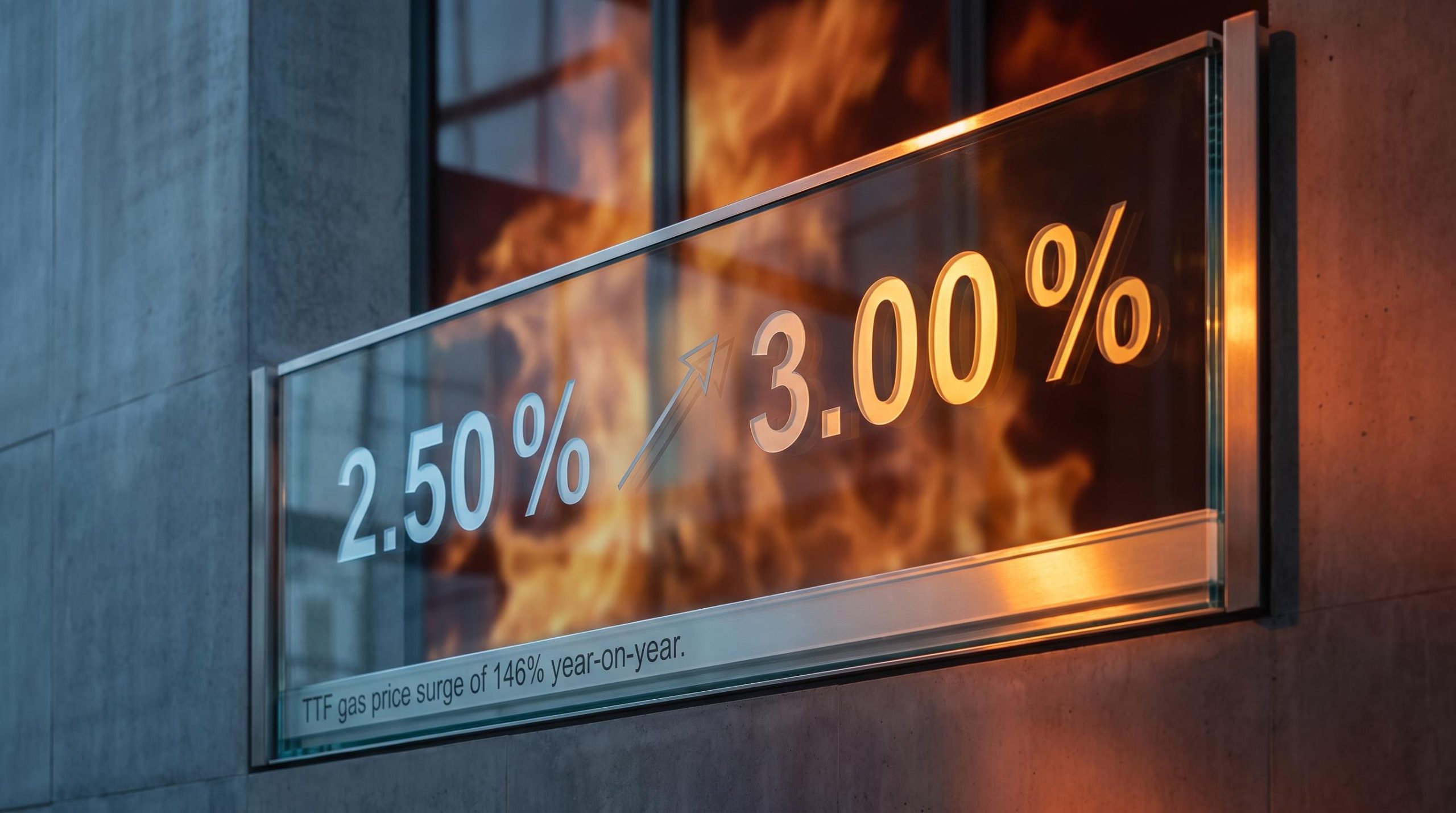
European gas prices have climbed 146% year-on-year, with the front-month TTF contract touching €83.96/MWh on the morning of 15 September 2026. That is not merely an energy market story. It is a monetary policy problem, and it now sits directly on the European Central Bank’s desk.
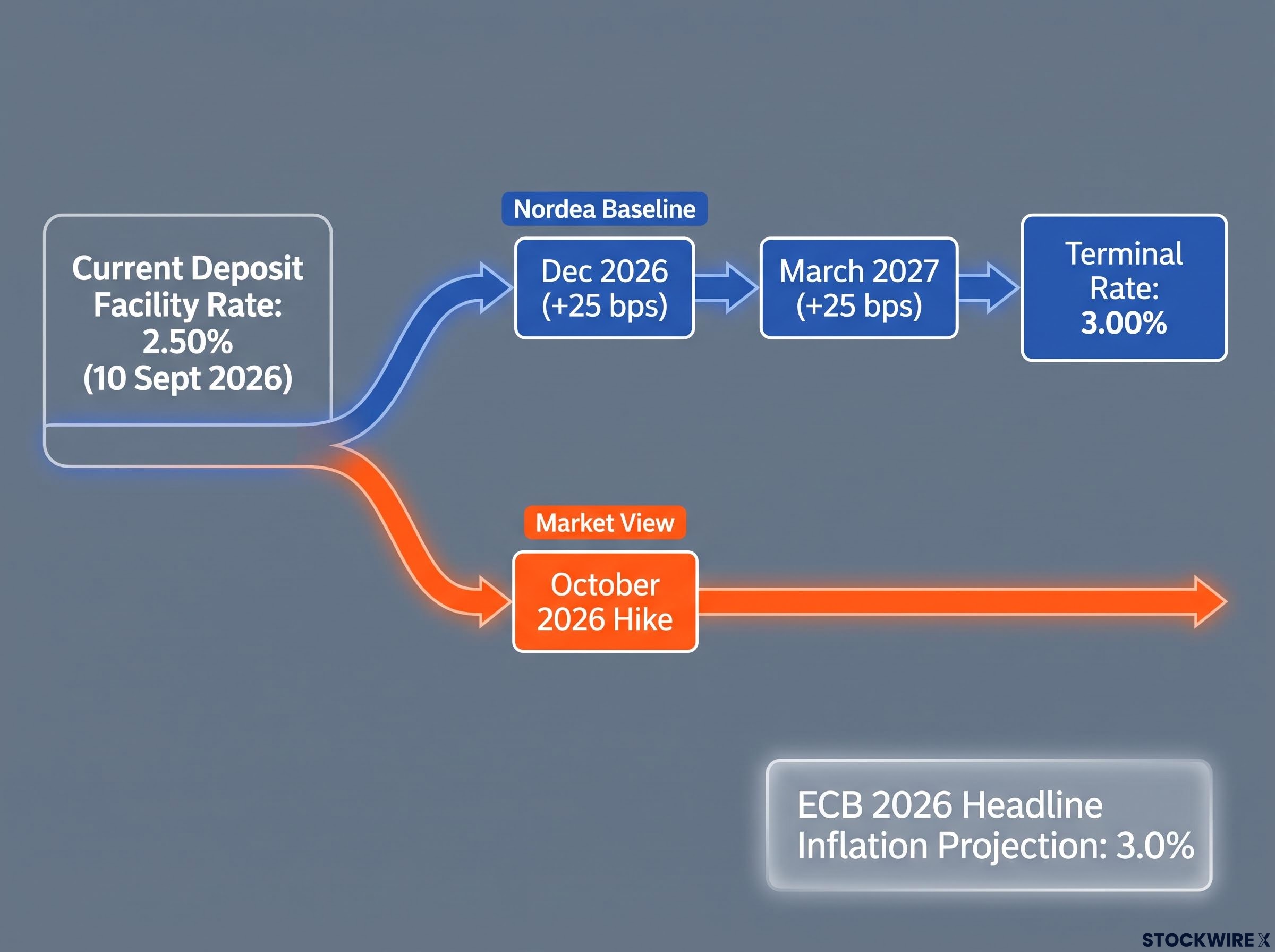
The ECB raised its deposit facility rate to 2.50% on 10 September 2026, its second hike of the year. Nordea, one of Europe’s most-cited rate forecasters, expects only two more, in December 2026 and March 2027, taking the rate to 3.00%. Markets disagree. Pricing has moved toward at least one additional hike as early as October, a move Nordea explicitly calls premature. The October meeting is weeks away, not quarters.
That gap between the official forecast and market pricing is where the risk currently lives. What follows here gives you a clear basis for judging which view the evidence better supports, and what the answer means for rate-sensitive positions across bonds, equities, and housing before the ECB next meets.
Nordea’s two-hike baseline and why the market thinks it is too cautious
Nordea’s position is precise and internally consistent. Analysts Jan von Gerich and Tuuli Koivu, writing on 10 September 2026, expect two further 25 basis point hikes: one in December 2026, one in March 2027. That takes the deposit facility rate from 2.50% to 3.00% and stops there.
The September rate decision itself, which lifted the deposit facility rate to 2.50% on 10 September 2026, was accompanied by upwardly revised staff projections placing headline inflation above target in every year of the forecast horizon, a revision that gives the market’s hawkish repricing a firmer statistical footing than the bare rate announcement implied.
The reasoning behind the caution is straightforward. The ECB has deliberately avoided committing to a preset path, and Nordea reads its communication as containing no signal of urgency. Underlying inflation and growth data, on Nordea’s assessment, do not justify accelerating beyond a quarterly cadence, and the threshold for faster tightening remains high. The ECB’s own September 2026 staff projections put headline inflation at 3.0% for 2026 before it eases as the energy shock fades.
Here is where the tension becomes real. Markets have moved substantially above that baseline, pricing at least one hike as soon as October 2026.
Nordea characterises the market’s pricing for an October move as premature relative to its assessment of underlying inflation and growth.
The market’s logic is that energy-driven inflation is now moving fast enough that a quarterly rhythm leaves the ECB behind the shock. That is not a minor calibration difference. It signals that investors have concluded the bank’s own communication cadence has already fallen behind events, and if you hold rate-sensitive exposures, that is an active risk rather than background noise. A hawkish surprise in October would reprice quickly and disproportionately.
| Indicator | Current level | Nordea forecast end-point |
|---|---|---|
| ECB deposit facility rate | 2.50% | 3.00% |
| ECB main refinancing rate | 2.65% | Implied ~3.15% |
| ECB marginal lending facility rate | 2.90% | Implied ~3.40% |
| Projected headline inflation 2026 | 3.0% | Easing toward target by 2028 |
Neither view looks obviously wrong. That is precisely what makes the coming weeks worth watching.
When big ASX news breaks, our subscribers know first
How a Middle East conflict sends a gas bill to the ECB
To see why a 70% gas price gain since early July is more than an energy story, follow the chain from a geopolitical shock to a line in the euro-area consumer price index. It moves in three steps.
- Geopolitical shock to supply routes. Escalating U.S.-Iran tensions raise the risk of disruption to LNG shipments through the Strait of Hormuz, tightening global gas balances and forcing Asia and Europe to compete for the same cargoes.
- Wholesale energy repricing. That competition drives up the TTF benchmark, Europe’s reference price for wholesale gas, and lifts the marginal cost of gas-fired electricity generation.
- Pass-through into consumer prices. Higher wholesale costs feed household heating and power bills directly, then filter into energy-intensive goods, food, services, and eventually wage expectations as workers seek compensation for rising living costs.
The oil and gas price divergence matters here because the two commodities are responding to entirely different supply mechanisms: Brent’s premium reflects a logistical routing problem that diplomacy could resolve within weeks, while the TTF surge reflects structural LNG capacity damage with a repair timeline measured in years, making the persistence of European gas inflation categorically different from a crude oil spike.
The scale gives the mechanism real stakes. The front-month TTF contract closed at €79.52/MWh on 11 September 2026 and traded intraday at €83.96/MWh in the following week. That is up 35.4% month-on-month, 146% year-on-year, and over 70% since early July 2026.
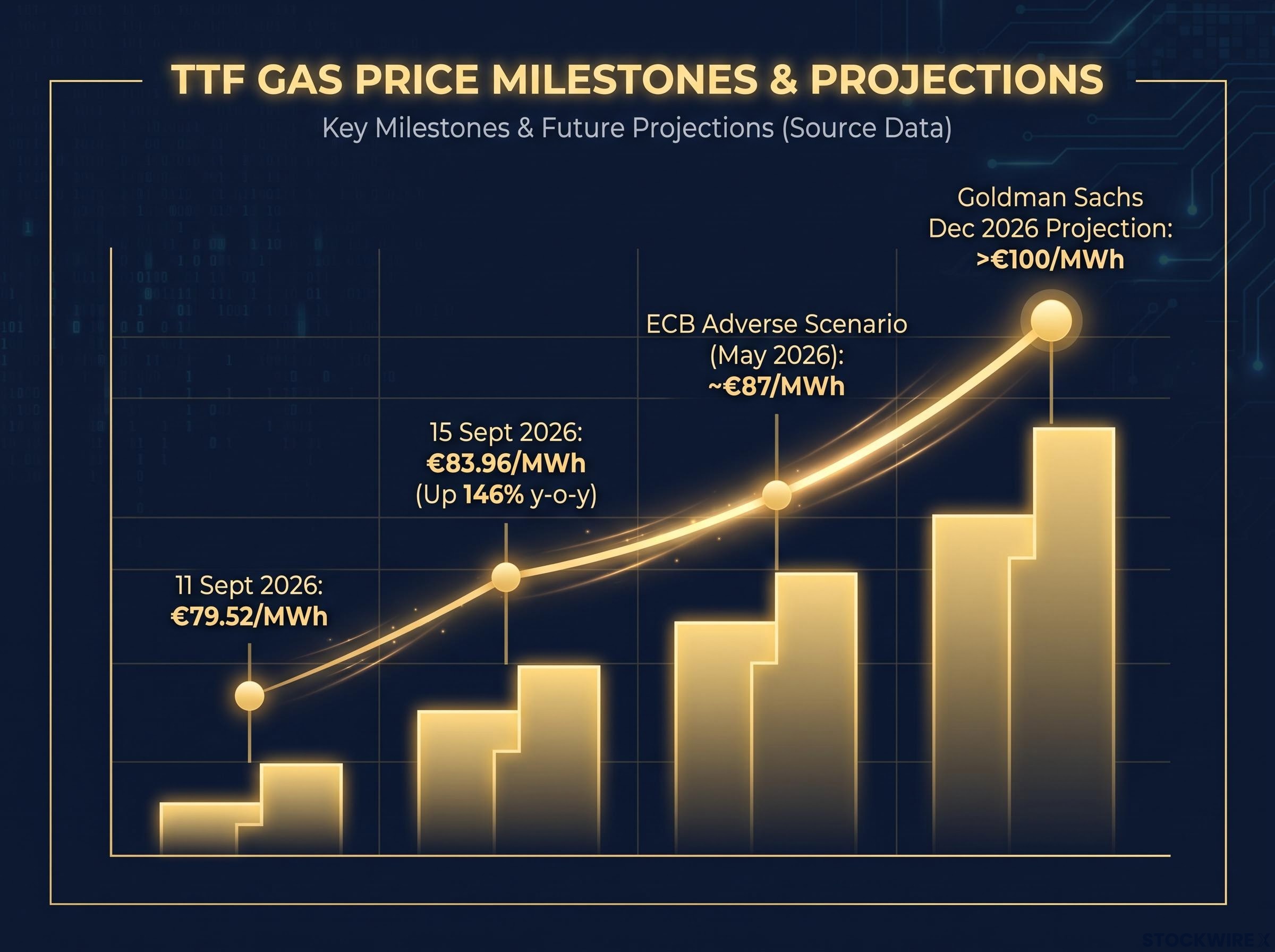
The forward picture is the part markets have begun to price. Goldman Sachs has suggested that if Middle East exports normalise only gradually, December 2026 TTF could need to move above €100/MWh to balance the market. For context, the ECB’s own adverse scenario, laid out in a May 2026 speech, assumed gas at roughly €87/MWh. Current spot prices are already testing that boundary, with energy inflation having hit 10.9% year-on-year in April 2026.
With spot TTF at or beyond the ECB’s own adverse threshold, the question is no longer whether an energy shock is happening. It is whether the pass-through to services and wages arrives fast enough to force the bank’s hand before December.
Where the pass-through story can break down
The mechanical chain is not the whole picture, and several buffers weaken the hawkish case at the margin.
Europe enters this episode with high gas storage levels and a more diversified LNG import portfolio than in earlier crises. That caps the physical supply impact of any Hormuz disruption, meaning realised household bills and CPI may move less dramatically than headline TTF swings imply. Futures prices react instantly to geopolitical news; average energy bills do not.
The GECF annual gas market report documents how European gas storage levels and LNG import diversification evolved through 2025, providing the baseline against which the current TTF surge must be measured; those structural shifts are precisely what separates this episode from the supply crises of 2021 and 2022.
The IMF’s position reinforces the caution. In its 2025 euro-area assessment, the Fund argued that temporary energy-driven spikes in headline inflation do not warrant major policy pivots, provided core inflation is converging and expectations stay anchored.
These points soften the case for October. They do not eliminate it. The buffers reduce the physical risk, but they do nothing to stop second-round effects if wages and services begin to respond, which is exactly what the ECB is watching for.
What Nordea’s caution shares with history, and where history does not fully apply
Nordea’s measured approach is not caution for its own sake. It draws on two episodes that still shape how the ECB talks about energy shocks.
The first is 2011, when the ECB hiked into the run-up to the sovereign debt crisis and later had to reverse course. The second is the 2022-23 tightening cycle, when rapid moves during an energy shock pressured housing markets and strained real incomes across the bloc. Both animate the ECB’s repeated emphasis on data dependence.
The arguments that flow from those analogies are worth setting against the case for earlier action.
- For the quarterly cadence: over-tightening into an energy shock risks demand destruction and a policy reversal that itself destabilises markets; the ECB’s scenario analysis distinguishes contained energy shocks from broader inflation persistence; the IMF supports patience while expectations stay anchored.
- For earlier action: the September 2026 hike, aimed at quelling energy-driven inflation, has already fuelled bets on an October move; unchanged staff forecasts for core inflation look increasingly hard to defend against surging energy futures; ECB bulletins show inflation staying above target well into 2027.
The complication is that the analogies do not fully transfer. In 2022-23, tightening followed an already-hot post-pandemic economy. Today, gas prices sit at or beyond the ECB’s adverse scenario assumptions while the bank is still early in its hiking cycle. The room to wait and see is smaller than it looked in either prior episode.
The ECB’s own language points the same way. Its July 2026 press conference flagged upside inflation risks and warned of second-round effects on wages and prices. The Economic Bulletin, Issue 5 of August 2026, stressed that the full inflationary impact of the energy shock has yet to play out, with inflation expected above target into the first half of 2027.
Peter Kazimir, an ECB Governing Council member, has said his focus has shifted from oil and fuel prices toward gas and electricity prices, warning that inflation could turn out higher than the bank’s already-raised forecasts.
That is the strongest on-record dissent from inside the Council. Taken alongside the August Bulletin’s language on unfinished pass-through, it suggests the window for a data-dependent pause may be closing faster than Nordea’s quarterly cadence assumes. History justifies caution as a principle. The current data configuration questions how durable that patience can be.
Rate-sensitive assets and the fork in the ECB road
The outlook now branches. If Nordea is right, one set of outcomes holds. If the market is right and October delivers a hike, another set breaks. The asymmetry is what matters for positioning.
Start with European government bonds. Faster-than-expected hikes push yields higher and prices lower, with the long end most exposed. If the pace accelerates beyond quarterly increments, fragmentation risk, the widening of spreads for lower-rated sovereigns, could re-emerge as it did in earlier tightening episodes.
Equities face a broad valuation hit from higher discount rates, but the pain is uneven. Utilities, real estate investment trusts, and high-leverage firms carry a double burden: rising funding costs and expensive energy inputs at the same time. Consumer-facing and cyclical sectors are vulnerable if energy costs erode household real incomes.
Rate-sensitive sectors including commercial real estate, private credit, and regional banking carry the additional burden of a two-to-three year lag between rate hikes and peak financial stress, meaning the tightening that began in mid-2022 is still working its way through balance sheets even before any acceleration in the current ECB cycle adds a second pressure wave.
Housing and mortgages sit close to the policy rate. Euro-area mortgage rates track policy and swap rates tightly, so an earlier hike path raises borrowing costs, cools demand, and lifts credit-risk concerns in more leveraged markets, echoing the strain seen in 2022-23.
| Asset class | Nordea baseline (two hikes, quarterly) | Market upside (October hike, faster pace) |
|---|---|---|
| European government bonds | Gradual yield drift, orderly repricing | Sharp long-end selloff, fragmentation risk returns |
| Equities | Contained valuation pressure | Broad derating, acute pain for utilities and REITs |
| Mortgages and housing | Manageable rise in borrowing costs | Faster demand cooling, rising credit-risk concerns |
The ECB’s July 2026 press conference characterised risks to inflation as tilted to the upside and warned of second-round effects on wages and prices, the most direct official signal of the hawkish asymmetry.
There is a further wrinkle. If the ECB stays behind the curve, longer-term yields could rise anyway as markets price in a higher terminal rate and a fatter inflation premium. That steepening would harm rate-sensitive assets even before any formal hike arrives.
The practical read for you is this. Even a “Nordea is right” outcome still means two more hikes in eight months. The question is not whether rates rise further. It is whether your portfolio is positioned only for the base case, or also for the risk that the base case understates the pace.
What Nordea’s caution does, and does not, settle for investors
Nordea’s two-hike baseline deserves to be treated as the central scenario, not dismissed as conservative. It is grounded in ECB communication that stresses data dependence and a high bar for deviating from the quarterly path, and the bank is genuinely not on autopilot toward October.
What remains unresolved is whether the energy shock has enough persistence to force the ECB’s hand before December. With TTF at roughly €79-84/MWh, already brushing the ECB’s adverse assumption of around €87/MWh, that question is live rather than theoretical. Three variables will settle it.
- TTF price trajectory into November. If prices hold above €80/MWh, the hawkish case strengthens; a retreat hands the argument back to Nordea.
- Flash October euro-area CPI. Evidence of second-round effects building in services would tip the balance toward the market; a soft reading supports patience.
- ECB communication at and around the October meeting. Language signalling urgency points to an earlier move; measured tone confirms the quarterly cadence.
The task right now is not to pick a side between Nordea and the market. It is to calibrate the asymmetry: whether the cost of being under-hedged if October arrives outweighs the cost of being over-hedged if the December cadence holds. If you carry euro-area duration, equity valuations, or floating-rate liabilities, map the portfolio impact of both scenarios before the meeting rather than treating measured forecasts as licence for complacency.
For investors wanting to translate the two-scenario framework into concrete fixed income positioning, our comprehensive walkthrough of bond duration management covers how institutional managers are calibrating curve exposure in a normalised rate environment, with specific guidance on the 1-5 year segment as the yield-versus-sensitivity trade-off zone.
This article is for informational purposes only and should not be considered financial advice. Investors should conduct their own research and consult with financial professionals before making investment decisions. Past performance does not guarantee future results, and financial projections are subject to market conditions and various risk factors. These statements are speculative and subject to change based on market developments.