The European Central Bank has raised interest rates twice in three months, moving to counter an inflation rate now running more than 60% above its own 2% target. And yet its most hawkish voice is still asking a question that sounds absurd on the surface: has the central bank actually tightened policy at all?
That tension sits at the heart of ECB monetary policy right now, and it is not academic hair-splitting. Whether the ECB has genuinely restrained the economy, or merely returned rates to a resting level that neither helps nor hurts, determines whether more hikes are coming or whether markets are correctly pricing a pause.
The answer shapes everything downstream: eurozone bond yields, the euro’s trajectory against every major currency, and how investors position across equity sectors from banks to utilities.
This piece walks through what the neutral rate actually is, where the ECB sits relative to it as of September 2026, and what Bundesbank President Joachim Nagel’s warning means in practical terms for anyone holding European assets. By the time you finish, you will have a framework for reading the ECB’s next move before it is officially announced.
What the ECB actually does, and the tools it uses to do it
Most people know the ECB as the institution that sets interest rates for Europe. That is true, but it undersells the machinery involved and obscures the specific lever that was pulled twice this year.
The ECB is the central bank for the eurozone, headquartered in Frankfurt and led by President Christine Lagarde. Its primary mandate is price stability, which it defines as inflation close to 2% over the medium term. That target is symmetric, meaning the ECB treats overshoots and undershoots as equally unwelcome.
The ECB mandate in one line Inflation of 2% over the medium term, symmetric, treating too-high and too-low with equal seriousness.
The bank does not set a single interest rate. It sets three, each doing a distinct job in the plumbing of the banking system:
- Deposit facility rate (currently 2.50%): what commercial banks earn on reserves they park at the ECB overnight. This is the floor for interbank borrowing costs.
- Main refinancing operations rate (currently 2.65%): what banks pay to borrow from the ECB on a short-term basis. This is the anchor rate around which most lending is priced.
- Marginal lending facility rate (currently 2.90%): the emergency overnight borrowing cost when a bank needs cash immediately. This is the ceiling.
These levels took effect on 16 September 2026, following the Governing Council’s decision on 10 September 2026 to lift all three by 25 basis points.
The three-rate structure forms what economists call an ECB rate corridor, a floor-anchor-ceiling arrangement that has been the operational spine of eurozone monetary policy since the financial crisis and now carries an additional layer of complexity as AI investment begins to factor into structural neutral rate estimates.
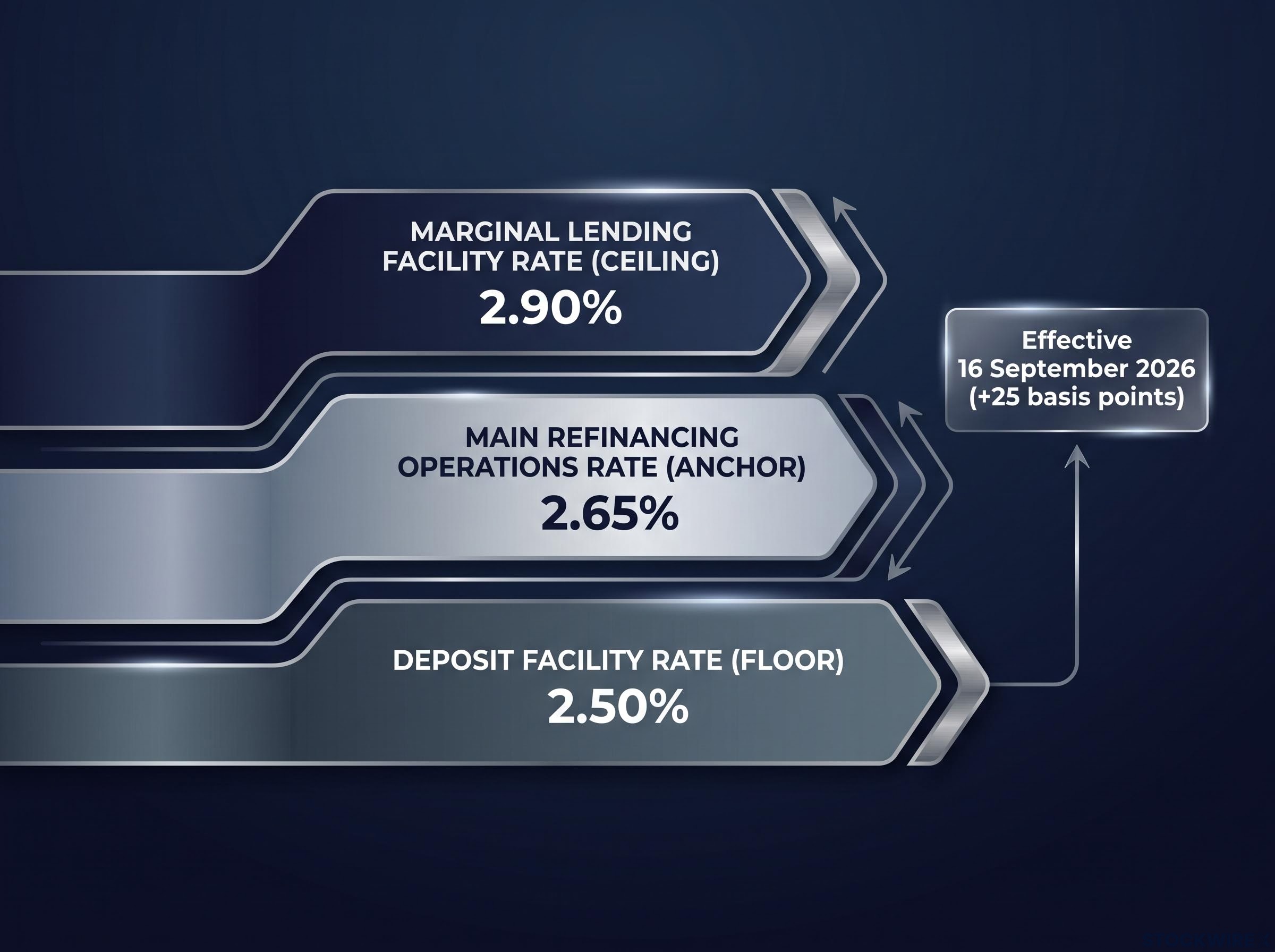
The three-rate structure is not bureaucracy for its own sake. Together they form a floor, an anchor, and a ceiling for what banks charge each other across the eurozone, which means a small adjustment ripples into mortgage rates, corporate borrowing costs, and currency flows across 20 member economies at once. That is why a single decision in Frankfurt reaches a homeowner in Spain and an exporter in Germany in the same breath.
Policy is set at eight scheduled Governing Council meetings per year. Nagel, as Bundesbank President, is a voting member, which is why his public remarks carry weight beyond his own opinion.
Beyond rates: how QE and QT extend the ECB’s reach
Rates are not the only tool. The ECB also has two heavier instruments it reaches for when rate changes alone are not enough.
Quantitative easing (QE) is the ECB buying bonds using newly created currency, which injects cash into the financial system. It tends to weaken the euro and is generally treated as a last-resort stimulus. The ECB deployed it during the sovereign debt crisis, again in 2015 to fight persistently low inflation, and once more during the COVID-19 pandemic.
Quantitative tightening (QT) is the reverse. The ECB stops buying and stops reinvesting the proceeds from bonds as they mature, allowing its balance sheet to shrink. This is broadly supportive of a stronger euro and is typically switched on once a recovery has taken hold and inflation is climbing, which describes the current environment well.
When big ASX news breaks, our subscribers know first
Where eurozone inflation stands now, and why energy is the pressure point
To understand why the ECB moved in September, you have to follow the shape of the inflation data through 2026, not just glance at the latest number.
A year ago, the ECB looked to be exactly where it wanted. Euro area annual HICP inflation, the Harmonised Index of Consumer Prices that is the ECB’s headline measure, sat at 2.0% in August 2025, right on target.
Then it climbed. By March 2026 it had reached 2.6%, then 3.0% in April and 3.2% in May. A modest retreat followed, with June easing to 2.8% and July at 2.9%. That looked like the beginning of a return to target.
August ended that hope. Inflation climbed back to 3.2%, according to Eurostat’s release dated 17 September 2026, leaving it 1.2 percentage points above the ECB’s 2% goal. The monthly HICP rate for August was 0.4%.
The Eurostat euro area HICP data series underpins every figure in the table above, providing the official harmonised methodology that allows meaningful comparisons across all 20 member economies rather than relying on nationally defined inflation measures.
| Period | Annual HICP rate |
|---|---|
| August 2025 | 2.0% |
| March 2026 | 2.6% |
| April 2026 | 3.0% |
| May 2026 | 3.2% |
| June 2026 | 2.8% |
| July 2026 | 2.9% |
| August 2026 | 3.2% |
The number that forced a decision Inflation of 3.2% in August 2026, sitting 1.2 percentage points above the 2% target after two months of retreat.
The August return to 3.2% tells you the disinflationary impulse of early summer was not self-sustaining. That is precisely why the ECB moved again in September, and why Nagel’s remarks on the neutral rate carry genuine forward-guidance weight rather than being idle commentary.
Nagel has attributed the overshoot primarily to rising energy prices, which he linked to geopolitical tensions. Euronews framed the September hike explicitly as a response to an “energy shock” driven by conflict in Iran, forcing the second increase in three months.
How energy prices spread through the wider economy
Energy prices do not stay in the energy aisle. They radiate outward through the whole economy, which is what makes an energy shock so difficult for a central bank to ignore.
The first effect is direct. Higher wholesale gas, electricity, and fuel prices feed straight into the energy component of HICP through household bills and transport costs, mechanically lifting the headline figure.
The second is pass-through. Energy is an input for almost everything a business makes or moves, so rising energy costs push up the price of goods and services far beyond the energy category itself. Supply-chain interactions in chemicals, metals, and logistics amplify this further.
The third, and most dangerous for policymakers, is wage dynamics. When energy prices squeeze household incomes, workers push for higher pay to protect their purchasing power. If those settlements outpace productivity, they add a fresh layer of inflation that outlives the original shock.
Here is the caveat economists keep raising. Once these second-round effects embed, treating inflation as purely an energy story becomes misleading, because repriced contracts and wages can sustain it even after wholesale energy costs normalise. And tightening monetary policy onto a supply-side shock carries its own risk: it compresses demand in an economy already absorbing a real income loss, potentially without resolving the underlying pressure.
The supply-side inflation dilemma is not new to this cycle: when the June 2026 hike was being debated, analysts argued that rate increases cannot produce more energy supply or reopen disrupted shipping lanes, a structural critique that has only sharpened as August data confirmed the overshoot was still energy-led.
What “neutral” means, and why Nagel’s warning changes the policy calculus
This is the concept that turns two rate hikes into an open question. The neutral rate is where the entire debate lives.
The neutral rate, often written as r*, is the policy rate at which monetary policy neither stimulates nor restrains the economy. It is the setting consistent with output at its potential and inflation steady at 2%. The awkward part is that it cannot be observed directly. Nobody can point to it on a screen. It has to be inferred from economic models, and different models produce different answers.
For the euro area, ECB Chief Economist Philip Lane and others have stressed this uncertainty repeatedly. Model estimates broadly point to a low real neutral rate near zero, implying a nominal neutral rate somewhere in the region of 2% to 3% once the 2% inflation target is added on.
That range is the whole problem. Some economists put nominal neutral near 2%, which would make the current 2.50% deposit rate already mildly restrictive. Others put it closer to 3%, which would mean rates are roughly neutral and may need to climb higher.
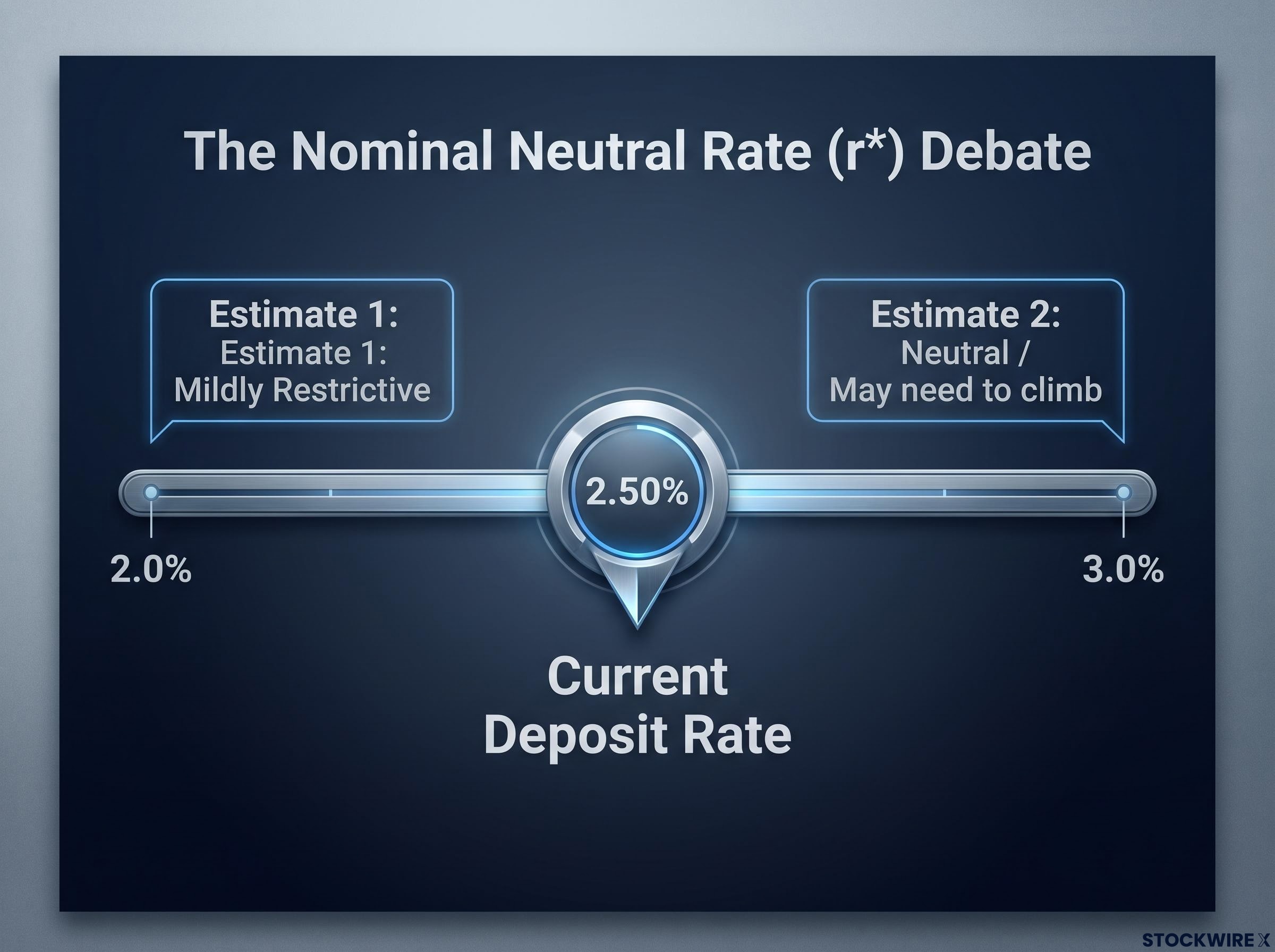
Nagel’s characterisation Current rates are in neutral territory, with a shift toward mildly restrictive territory something that cannot be entirely ruled out.
Nagel has described the ECB as operating with deliberate ambiguity rather than explicit forward guidance, while suggesting markets have reasonable clarity on the factors driving policy. That framing is the pivot on which the next decision turns.
The case for moving to mildly restrictive
- Inflation is still 1.2 percentage points above target, and a clear restrictive signal may be needed to bring it down in reasonable time.
- Credibility and expectations anchoring require the ECB to demonstrate resolve, so wage bargainers and markets do not doubt its commitment.
- The neutral rate may have structurally risen due to demographics, fiscal expansion, or higher global real yields, making a buffer above the current estimate prudent.
The case for holding at neutral
- The growth outlook is fragile, and the full effect of hikes already enacted has not yet worked through the economy.
- Higher rates risk financial stability and fragmentation strains in more indebted member states, along with corporate refinancing difficulties.
- Monetary tightening is a blunt instrument for a supply-driven shock, arguably better addressed through fiscal and structural measures.
The 2011 episode under then-President Jean-Claude Trichet is the cautionary precedent hanging over this. The ECB raised rates into an energy-driven inflation shock, then reversed sharply as the sovereign debt crisis deepened, a costly demonstration of what happens when neutral is mis-read.
For readers wanting to stress-test the hawkish case with a specific forecast model, our deep-dive into Rabobank’s eurozone inflation projections examines why the bank sees headline HICP peaking near 4.4–4.5% in early 2027, nearly double the ECB’s own staff forecast, and what that gap means for rate cut pricing through 2028.
Here is the practical upshot for you. If you accept the 2% neutral estimate, the ECB is already restraining growth, and the argument is about whether to tighten further into a slowing economy. If you accept the 3% estimate, the ECB has not done enough yet, and Nagel’s remarks are a signal that more is coming. That single variable decides whether the next move is a hold, a hike, or the start of an eventual cut cycle.
What this means for the euro and investor positioning across asset classes
The same ambiguity that makes the Governing Council’s job difficult creates a specific set of positioning decisions for anyone holding European assets. Start with the currency reaction.
On the day of Nagel’s London remarks, the euro was broadly softer, even as he signalled potential further tightening. Its sharpest relative weakness came against the New Zealand dollar and Swiss franc, with marginal outperformance only against the Canadian dollar.
| Currency pair | EUR move (%) |
|---|---|
| EUR/USD | -0.14% |
| EUR/JPY | -0.13% |
| EUR/NZD | -0.35% |
| EUR/CHF | -0.22% |
| EUR/CAD | +0.08% |
| EUR/AUD | -0.11% |
| EUR/GBP | -0.03% |
That broad softness, despite a hawkish signal, tells you markets are processing two things at once: the rate-differential support that tighter policy usually gives a currency, and the growth damage risk that further hikes threaten. That tension is exactly where positioning becomes genuinely difficult.
Rate-differential positioning explains only part of the euro’s reaction function: a rate pause combined with continued QT remains a net-restrictive policy stance, and EUR/USD responds to the gap between what the ECB delivers and what Euribor and OIS curves had already priced, making the futures curve as important a monitoring tool as the meeting calendar itself.
For anyone with European exposure, the decision breaks down into four sequential layers:
- Bonds: With policy moving from neutral toward potentially restrictive, the conventional response is to reduce long-duration euro-denominated bond exposure, since those are most sensitive to further rate increases. Expect initial curve flattening, with the possibility of bull steepening later if growth risks materialise and markets begin pricing cuts.
- Equities: In a mildly restrictive regime, analysts favour companies with strong balance sheets and pricing power, including some energy and utilities names and globally diversified exporters, over highly leveraged or domestically demand-sensitive firms.
- Inflation-linked instruments: HICP-linked bonds offer a hedge against upside inflation surprises while the neutral rate debate remains unresolved.
- FX hedging: Rate differentials alone do not decide the euro’s direction when growth concerns are live, so currency hedging decisions need to weigh both forces rather than assuming higher rates automatically lift the euro.
The cost of overshooting neutral The Federal Reserve’s late-2018 episode, when markets judged it had pushed past neutral, produced corrections in equities and credit and was followed by a policy reversal. It is the reference point for what mis-calibrating the stopping point can cost.
The deeper problem is Nagel’s deliberate ambiguity. Without explicit forward guidance, market participants cannot confidently price where the hikes stop, and that uncertainty itself adds volatility to euro-denominated assets. Nagel’s remarks do not just shape the next meeting; they define the regime European assets trade in until the neutral rate question is settled.
Reading the next ECB move before it is announced
The specific facts of this episode will age. The lens for interpreting the ECB will not, so it is worth leaving with a framework rather than a snapshot.
Three variables will determine whether the ECB shifts from neutral to mildly restrictive at its next Governing Council meeting:
- The HICP trajectory: Watch whether the August return to 3.2% holds, accelerates, or resumes falling toward the 2% target. A further climb strengthens the hawkish case sharply.
- Wage settlement data: Nagel’s stated condition for patience is a calm labour market, so accelerating wage settlements across the euro area would be the clearest signal that his tolerance is running out.
- Energy prices and geopolitical risk: Because the overshoot is energy-led, a reversal in energy prices could dissolve the case for restrictive territory almost entirely.
Deliberate ambiguity means the data flow matters more than any single speech. With the ECB officially withholding explicit forward guidance, each Governing Council member’s public commentary between meetings becomes a piece of that guidance in disguise, so weighting hawkish versus dovish signals is the nearest substitute you have for an official steer.
The asymmetric risk If wages accelerate and core inflation embeds, the window to act at neutral closes fast. If energy prices reverse, the debate shifts from whether to tighten to how long rates hold at neutral before a cut cycle begins.
Two lessons pull the Governing Council in opposite directions. The 2011 memory of tightening into a supply shock and reversing shapes the dovish resistance, while the post-2022 experience of acting too slowly on inflation shapes the hawkish preference for a buffer above neutral.
For you, the practical value is independence. Reading these signals yourself lets you interpret ECB communications before the consensus media view arrives, which usually lands after markets have already moved.
This article is for informational purposes only and should not be considered financial advice. Investors should conduct their own research and consult with financial professionals before making investment decisions. Past performance does not guarantee future results, and financial projections are subject to market conditions and various risk factors. Forward-looking statements regarding ECB policy are speculative and subject to change based on economic developments.