Glanbia Surges 9% After Q1 Volumes Triple Analyst Forecasts
6 hrs ago


South Korea’s Korea Fair Trade Commission declared Bom Kim the definitive controlling figure of Coupang on Wednesday, citing his brother’s active governance role to trigger a sudden regulatory strike. This immediate intervention subjects the e-commerce titan to a rigorous new layer of supervisory scrutiny as of 29 April 2026. Investors are now assessing how the specific mechanics of this Coupang regulation will impact corporate operations and international trade dynamics.
The ruling shifts the legal status of the chief executive under regional corporate laws, fundamentally altering how the organisation must report its internal operations. The sheer scale of the corporation’s valuation amplifies the materiality of this intervention, catching the attention of global institutional investors. What follows is a clear breakdown of the regulatory mechanisms at play, the company’s planned administrative legal counteroffensive, and why top financial analysts believe daily commerce will remain unaffected.
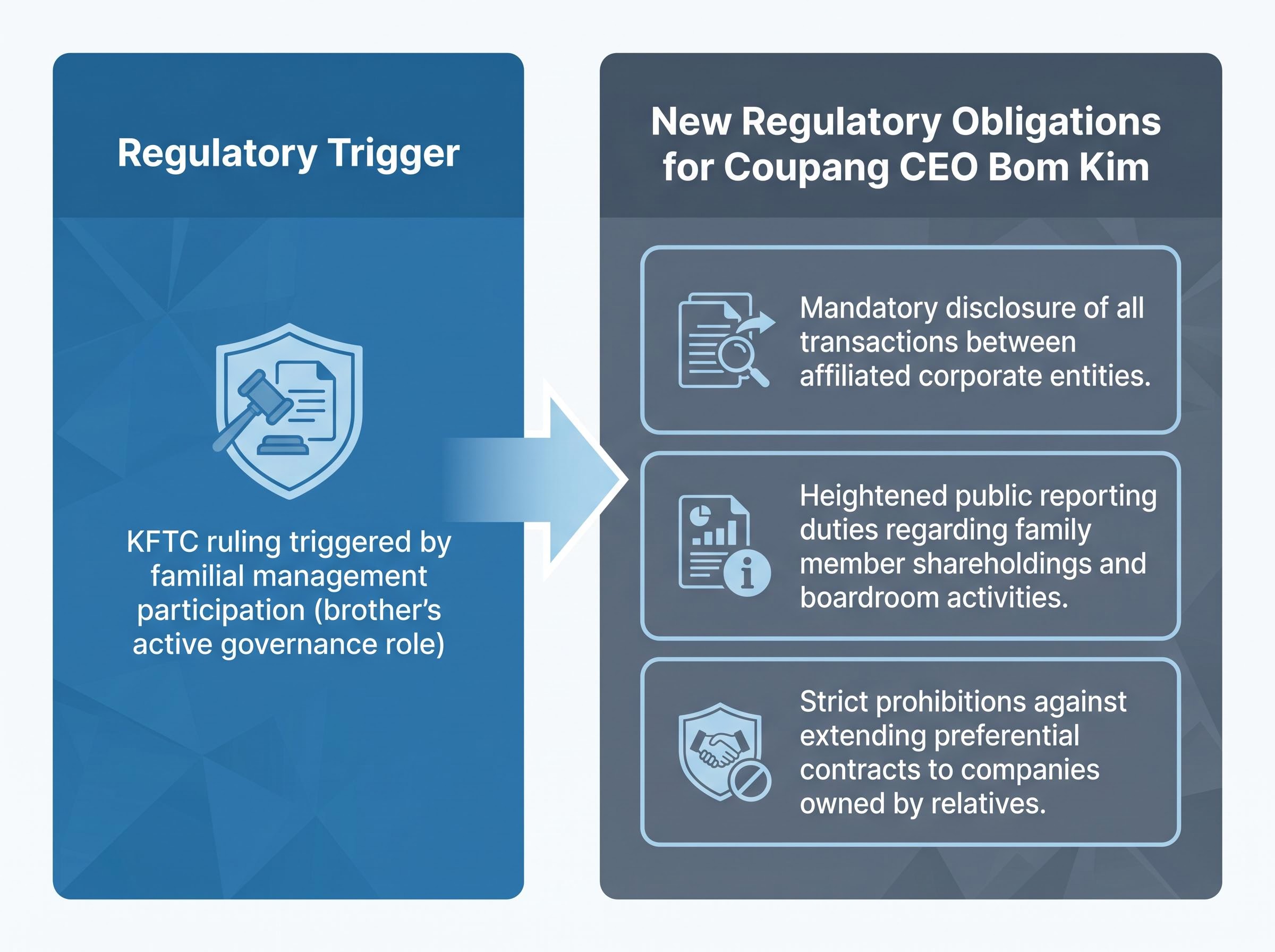
Physical workplace inspections conducted by the Korea Fair Trade Commission recently uncovered internal operational dynamics that prompted regulators to reclassify the corporate hierarchy. Regulators focused heavily on a specific revelation regarding the primary owner’s brother, who was found actively participating in organisational strategy. This familial involvement tipped the scales for the regulatory body, altering the chief executive’s legal standing under regional corporate law.
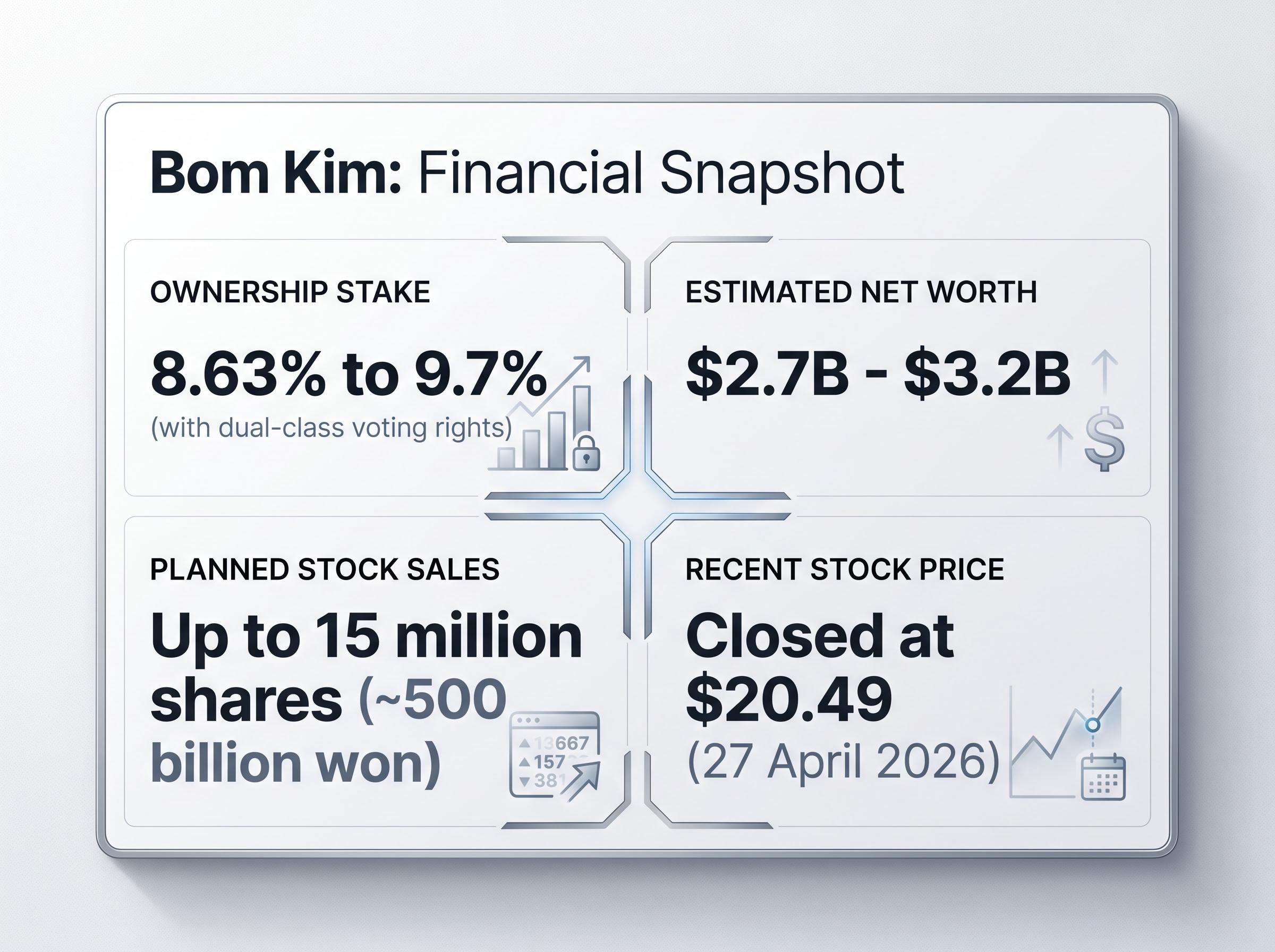
Chief Executive Officer Bom Kim holds an ownership stake ranging from 8.63% to 9.7%. His controlling interest is solidified by dual-class voting rights, supporting an estimated net worth between $2.7 billion and $3.2 billion. Historically, Kim has mapped out significant stock transactions, including planned sales of up to 15 million shares valued at approximately 500 billion won based on previous valuations.
The KFTC determined that this financial structure, combined with familial management participation, legally constitutes absolute corporate control. Investors must examine this trigger to assess whether it represents an isolated compliance event or signals systemic governance risks. The chief executive now faces immediate regulatory obligations resulting from this designation.
The KFTC issued mandatory share disclosure orders immediately following the classification, requiring the executive to submit detailed documentation regarding both his personal holdings and any equity controlled by his extended family.
Mandatory disclosure of all transactions between affiliated corporate entities. Heightened public reporting duties regarding family member shareholdings and boardroom activities. * Strict prohibitions against extending preferential contracts to companies owned by relatives.
The regulatory environment in South Korea includes specific mechanisms designed to monitor massive domestic resources and prevent monopolistic abuses. When an enterprise crosses a designated financial line, the government automatically applies large conglomerate designation duties to ensure fair market competition. This framework separates standard enterprises from massive commercial organisations based purely on domestic asset accumulation.
The current enforcement, taking effect in April 2026, activates when a corporation reaches the 5 trillion won total corporate holdings threshold. Crossing this financial boundary triggers a completely different set of corporate rules, requiring extensive operational transparency. This educational context allows international readers to grasp why a seemingly standard internal management structure suddenly attracts intense government scrutiny.
| Regulatory Status | Asset Threshold Required | Resulting Compliance Burden |
|---|---|---|
| Standard Enterprise | Under 5 trillion won | Standard financial reporting and basic corporate governance disclosures |
| Large Conglomerate | 5 trillion won or above | Mandatory affiliate transaction disclosures and strict family holding oversight |
The overarching intent behind these laws is to regulate massive domestic resources systematically. By understanding this asset threshold, international investors can accurately price the compliance burden associated with doing business at scale in the region.
Company representatives have initiated a rigorous legal counteroffensive, issuing a complete rejection of the governmental findings. The digital retail corporation plans to challenge the ruling through formal judicial channels, specifically preparing an administrative lawsuit to reverse the KFTC classification. According to news coverage from Reuters, the corporate legal strategy centres on challenging the regulator’s assumptions regarding the actual internal management hierarchy.
The company recently confirmed administrative lawsuit preparations in response to the designation, signaling a protracted legal battle over how South Korean authorities interpret domestic management hierarchies within multinational retail operations.
Corporate Rejection Statement A company spokesperson, as detailed in recent news coverage, stated that the organisation completely rejects the regulatory findings and intends to challenge the internal management structure classification through formal administrative legal proceedings.
The planned use of formal administrative legal proceedings requires the company to submit extensive documentation detailing its operational hierarchy. Shareholders should note that this regulatory designation is not settled law until these judicial channels are exhausted. The company is actively deploying significant legal resources to fight the classification and defend its existing governance structure.
The KFTC oversight has escalated beyond domestic policy, shifting the corporate dispute onto the international stage and creating diplomatic tension between Washington and Seoul. United States lawmakers have formally intervened, urging South Korean officials to end regulatory practices they view as discriminatory against American-led technology firms. They argue that applying these stringent governance labels to foreign-led entities disproportionately penalises international investment.
This intervention contextualises the corporate event as a potential geopolitical risk, showing investors how domestic compliance issues can quickly escalate into international trade disputes. The diplomatic friction highlights the complexities multinational corporations face when operating across distinct regulatory jurisdictions.
Such diplomatic disputes over corporate governance are increasingly intersecting with broader macroeconomic threats, complicating matters for international investors who are already hedging against elevated US recession risk tied to global energy and supply chain shocks.
South Korea possesses a documented history of scrutinising foreign leadership within domestic commercial operations. The current regulatory designation draws direct parallels to the earlier regulatory precedent set by the OCI Lee Woo-hyun case. In that instance, regulators similarly expanded their oversight of foreign-led companies operating within the region.
The historical context explains why United States lawmakers are expressing acute concerns regarding current trade dynamics. They view the recent enforcement actions as part of a broader pattern of restrictive policies targeting international leadership. Investors must account for this geopolitical layer when evaluating the company’s long-term operational viability in the region.
Financial professionals maintain measured expectations, contrasting sharply with the severe regulatory headlines dominating international trade discussions. Anticipated reports from institutions such as Bank of America have not yet been published regarding whether everyday commerce and consumer deliveries will face operational disruption. The market appears to view this development as a compliance awareness prompt rather than a structural threat to the digital retail platform.
Prior to the announcement, the company’s stock closed at $20.49 on 27 April 2026. At press time, there is a lack of explicit post-announcement trading volume shifts, suggesting institutional investors are waiting for further legal filings before adjusting their positions. Major institutional financial analyses assessing the specific operational impacts of the decision remain pending.
Investors should monitor specific upcoming milestones, particularly the formal filings for the administrative lawsuit and any further diplomatic statements from United States trade officials. The tension between the immediate legal friction and the underlying stability of the e-commerce operations remains the defining dynamic for shareholders. While the governance label has changed, the retail platform’s domestic dominance remains functionally unchallenged.
For investors monitoring how global macroeconomic conditions might constrain broader e-commerce demand, our detailed coverage of the current US economy outlook examines the draining of personal savings and explains why surface-level retail data hides deep vulnerabilities in consumer spending.
This article is for informational purposes only and should not be considered financial advice. Investors should conduct their own research and consult with financial professionals before making investment decisions. Past performance does not guarantee future results. Financial projections are subject to market conditions and various risk factors.
The Korea Fair Trade Commission designated CEO Bom Kim as Coupang's definitive controlling figure due to familial governance, subjecting the company to stricter conglomerate oversight. This new regulatory status takes effect in April 2026.
The ruling mandates extensive operational transparency, including mandatory share disclosures for family holdings and strict prohibitions against preferential contracts with affiliated companies. Coupang plans to challenge this through an administrative lawsuit.
US lawmakers view the regulation as potentially discriminatory against American-led technology firms and an example of restrictive policies targeting international leadership in South Korea, raising diplomatic tensions.
Financial professionals currently expect daily commerce and consumer deliveries to remain unaffected by the Coupang regulation, but investors are monitoring upcoming legal filings for potential operational impacts.
In South Korea, a corporation reaches large conglomerate designation when its total corporate holdings cross the 5 trillion won threshold, activating a different set of corporate rules and extensive transparency requirements.