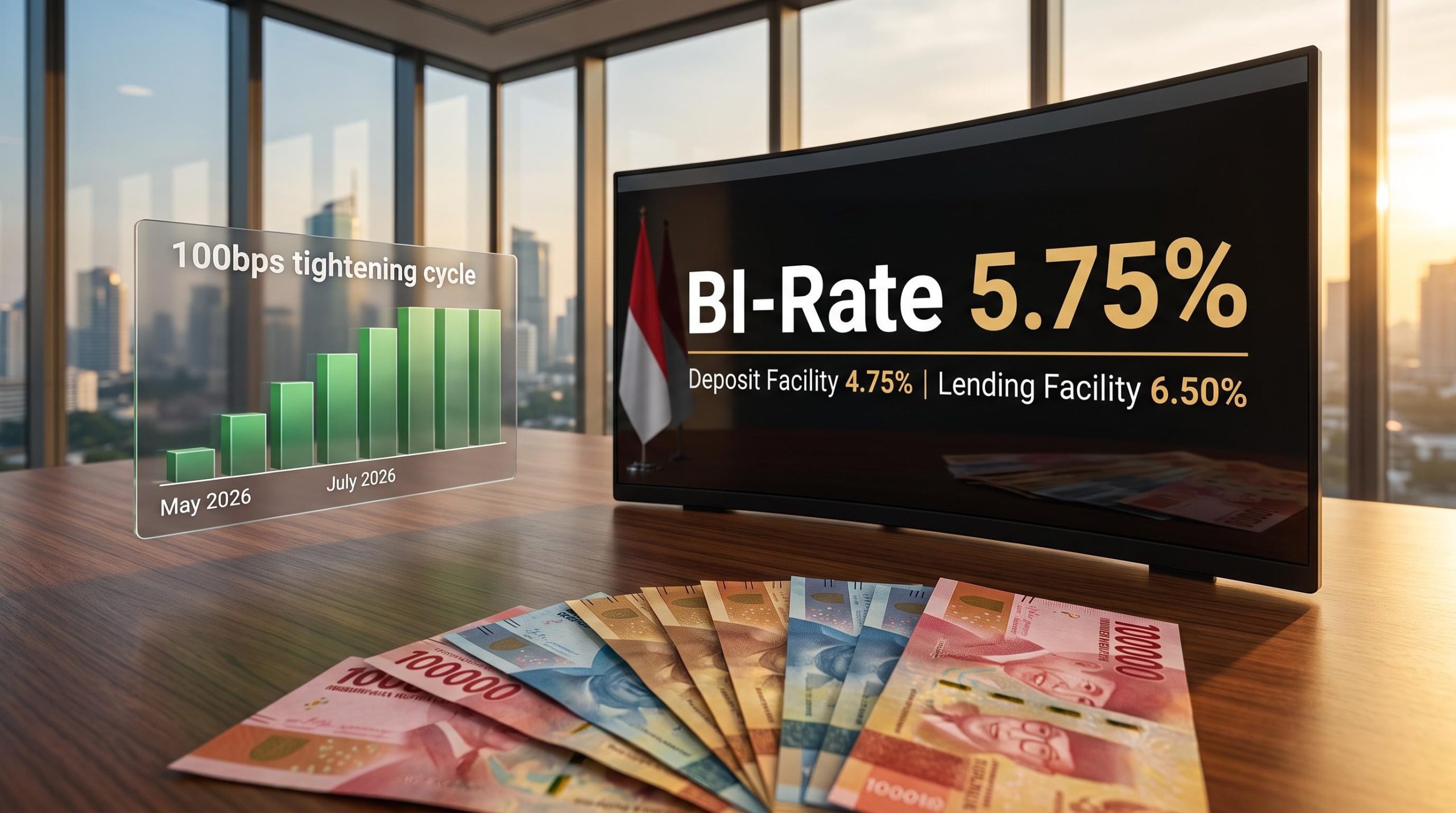
Bank Indonesia is widely expected to keep its benchmark interest rate at 5.75% on 19 August 2026, marking a second straight meeting without adjustment. That much is priced in. What is not routine is the person chairing the decision: Destry Damayanti, the acting governor who assumed the role in late July, following Perry Warjiyo’s surprise departure from the post. A consensus-aligned hold, delivered by a leader whose permanent appointment has not yet been confirmed by parliament, is a different proposition from the same hold delivered by the governor who built the tightening cycle it concludes.
The backdrop sharpens the stakes. A 100 basis point tightening cycle, launched in May to defend the rupiah and anchor inflation expectations, has moved into pause mode. The governor who designed that cycle is gone. His deputy, now sole presidential nominee for the permanent role, presides over her first meeting with parliamentary approval still pending.
Here is a clear read on what the rate hold signals about the policy path ahead, what Damayanti’s leadership tells you about how Bank Indonesia (BI) will behave under pressure, and which asset classes stand to benefit most from the current setup, along with the specific conditions that could disrupt it.
From tightening to pause: what 100 basis points of rate rises actually achieved
The tightening cycle began at the 19-20 May 2026 meeting, when BI raised the BI-Rate by 50 basis points to 5.25%, lifting the Deposit Facility (DF) to 4.25% and the Lending Facility (LF) to 6.00%. The trigger was a combination of heightened global turmoil and pre-emptive inflation management. Subsequent increases brought the policy rate to 5.75%, with the DF and LF rising to 4.75% and 6.50% respectively, as BI shifted its focus to persistent rupiah weakness.
The 19-20 May decision that launched the Asian tightening cycle was driven explicitly by rupiah defence rather than domestic inflation, a distinction that shaped every subsequent BI communication and explains why the July pause was framed around stability rather than demand management.
By the 21-22 July meeting, the cumulative adjustments had taken effect. BI held all three rates steady, marking the transition from active tightening to consolidation. Inflation had eased back within the 1.5%-3.5% target band, removing the emergency pressure that had justified rapid-fire hikes and giving the central bank room to pause without losing credibility.
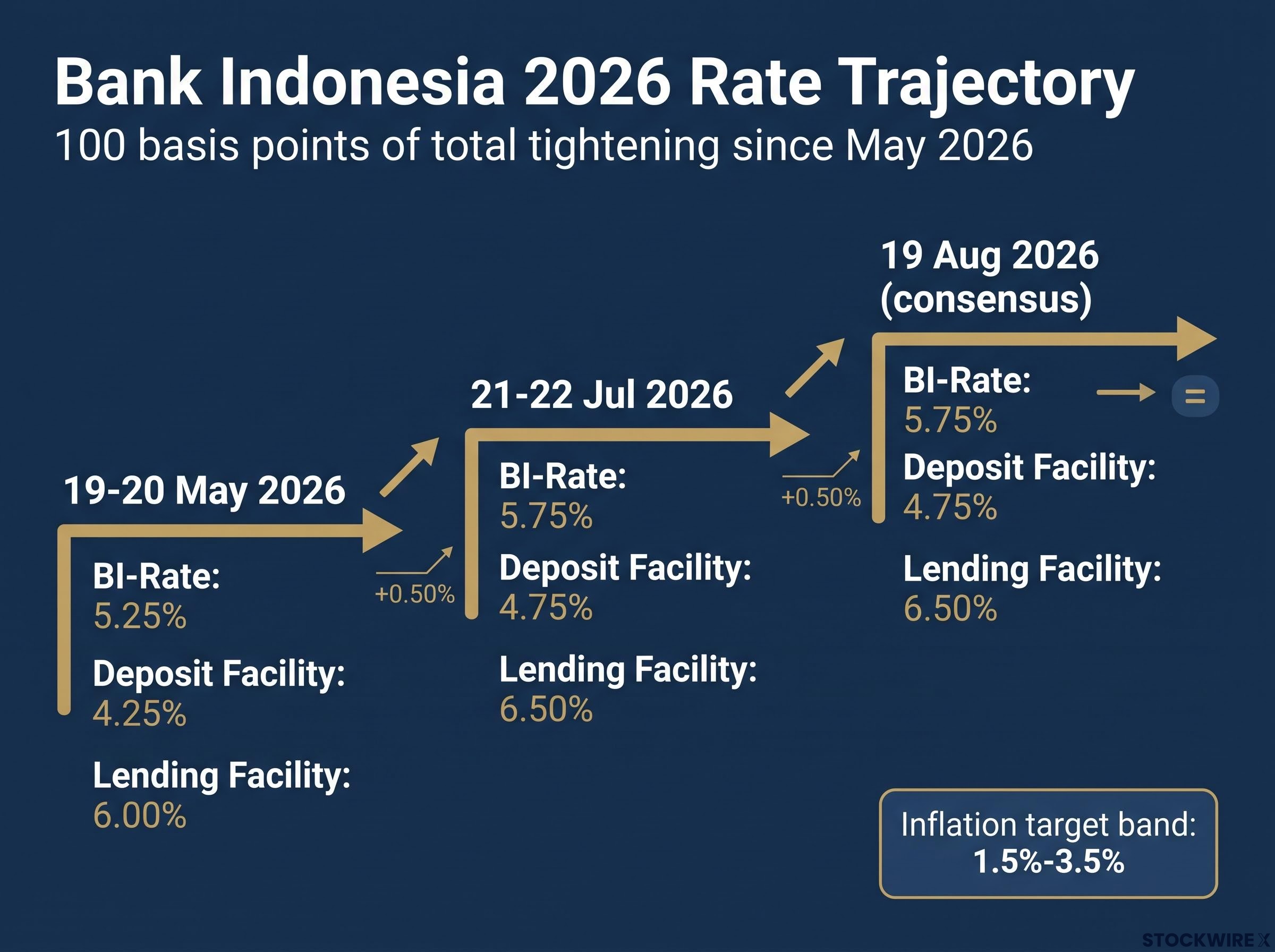
A cumulative 100 basis points of rate increases delivered since May 2026, with policy now entering a consolidation phase.
The 19 August decision, where consensus expects another hold at 5.75%, confirms the cycle’s resting point rather than signalling inaction. The rate is sitting at a level designed to anchor expectations, not to keep climbing indefinitely.
| Meeting date | BI-Rate | Deposit Facility | Lending Facility | Key driver |
|---|---|---|---|---|
| 19-20 May 2026 | 5.25% | 4.25% | 6.00% | Global turmoil, pre-emptive inflation management |
| 21-22 Jul 2026 | 5.75% | 4.75% | 6.50% | Rupiah weakness, cumulative tightening takes effect; hold |
| 19 Aug 2026 | 5.75% (consensus) | 4.75% | 6.50% | Consolidation; inflation within target band |
For investors with Indonesian exposure, the phase of maximum policy uncertainty is behind you. The question has shifted from “will BI keep hiking” to “how long does the plateau last, and what breaks it.”
When big ASX news breaks, our subscribers know first
How the rupiah reads this decision
The July hold already did its work on the currency. Following the full tightening sequence, rupiah depreciation pressures moderated and markets regained confidence in the direction of BI’s policy. A consensus-aligned hold on 19 August is fully priced in, which means the headline rate itself is unlikely to move the exchange rate in either direction.
What will move it is the post-meeting statement. A BI-Rate of 5.75% with a DF/LF corridor of 4.75%-6.50% supports attractive returns on short-tenor rupiah instruments, a carry trade is a strategy where investors borrow in lower-yielding currencies and invest in higher-yielding ones. That dynamic sustains foreign demand for Indonesian bonds and, by extension, supports the currency. But the tone of BI’s communication now matters more than the number on the rate.
The rupiah carry trade dynamic has been reinforced by the retreat from July’s all-time high of 18,279 in USD/IDR to the 17,760-17,803 range, a move partly attributed to the removal of the leadership uncertainty premium that had weighed on the currency since Warjiyo’s departure was announced.
Three scenarios for the rupiah after August 19
- Stability-supportive: BI signals clearly that the pause will extend while it remains vigilant against external shocks. This confirms the real yield advantage and policy predictability, reinforcing rupiah stability.
- Dovish risk: Overtly dovish language or early hints of rate cuts would narrow the yield differential and weigh on the rupiah, particularly if global dollar strength resumes.
- Tightening risk signal: Any reference to renewed pressure from capital outflows or weaker export demand would be read as rupiah-negative and raise expectations of further tightening or more aggressive currency-management measures.
Elias Haddad of Brown Brothers Harriman (BBH) has argued that the diminishing strain on the rupiah lessens the case for additional rate increases, a view that sits squarely within BI’s current consolidation posture. For rupiah positioning, the question you need to answer is not whether rates moved but what the post-meeting statement signals about BI’s tolerance for future currency weakness. That tolerance level sets the floor for how aggressively BI will defend the currency if global conditions shift.
Who is Destry Damayanti, and what does her appointment signal to markets
Perry Warjiyo stepped down from the governorship in late July 2026, stating personal reasons for the decision. His exit came with roughly two years still remaining in his second five-year mandate. The departure was unexpected, and unexpected governor exits at emerging-market central banks are a known trigger for currency volatility.
What contained that risk was the speed and clarity of the succession. The Board of Governors met on 26 July 2026 and appointed Destry Damayanti as acting governor, transferring all gubernatorial duties immediately. Her profile is precisely the kind of appointment that limits market uncertainty:
- Sworn in as Senior Deputy Governor (SDG) in August 2019
- Reappointed for a second five-year SDG term in August 2024
- Served as Warjiyo’s principal deputy throughout his tenure
- Nominated by President Prabowo Subianto as sole candidate for permanent governor, approximately 10 August 2026
- Parliamentary approval pending as of 17 August 2026
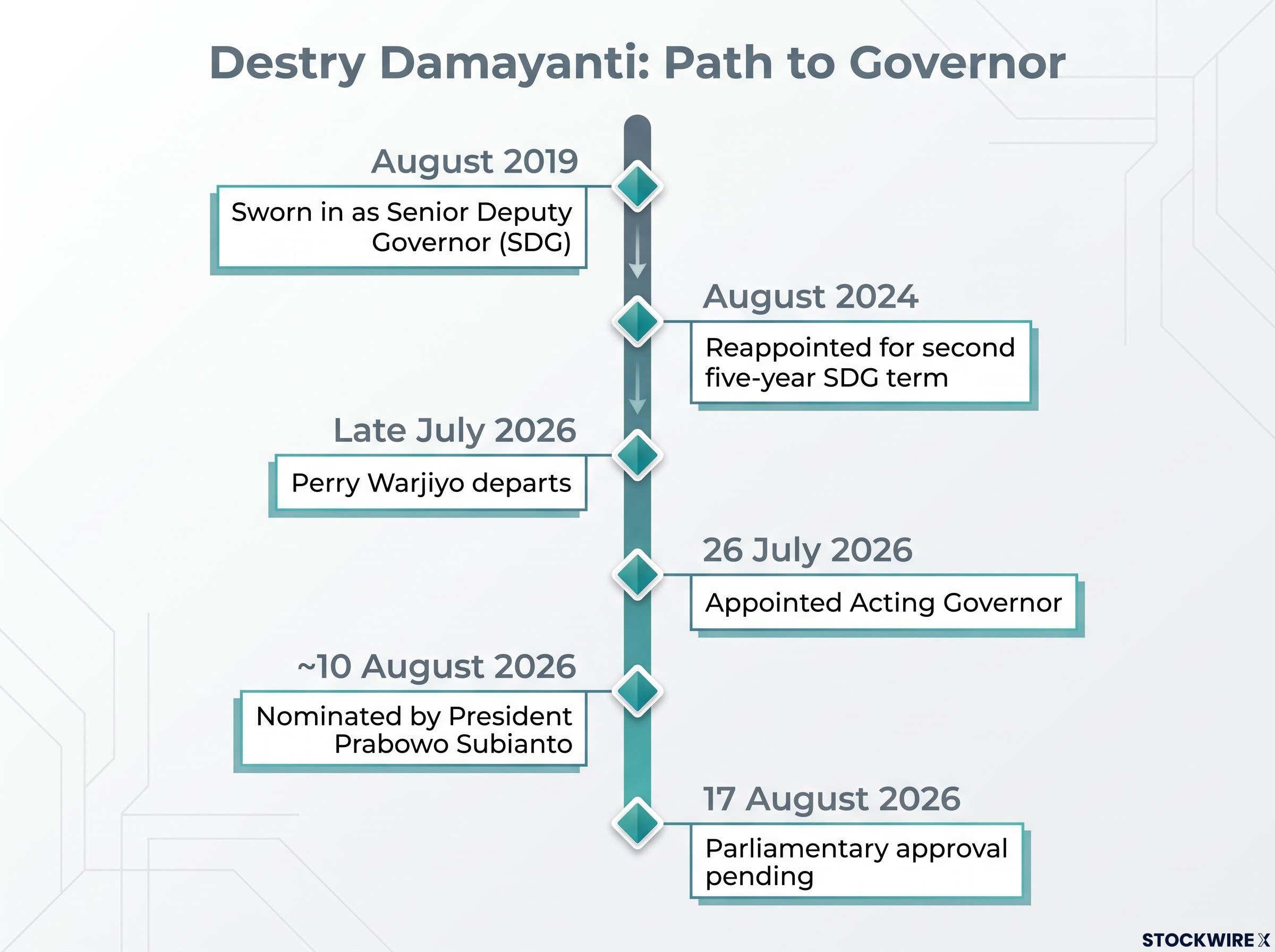
Damayanti has been embedded inside BI’s policy and communications framework continuously since 2019, giving her uninterrupted proximity to every major decision of the Warjiyo era.
Her appointment is the market-friendly outcome of an otherwise market-unfriendly event. The speed of nomination contained the volatility risk that typically accompanies unexpected leadership transitions at emerging-market central banks. But “pending” parliamentary approval means a small residual tail risk persists until confirmation lands. Smooth approval is the consensus expectation; the risk is low but live.
The distinction matters for investors in emerging-market central bank risk: this is a leadership transition that preserves policy direction, not one that changes it. Damayanti’s profile strongly suggests continuity with the data-dependent, exchange-rate-stability framework that defined Warjiyo’s tenure.
Central bank independence is the institutional variable that markets are re-pricing across multiple jurisdictions in 2026, with the Fed’s credibility under Kevin Warsh representing the most consequential test case for how political proximity to a central bank governor affects market risk premiums on currency and fixed income.
What the rate plateau means for Indonesian bonds, equities, and the risks that could break it
The bond case is the clearest. A BI-Rate of 5.75% with inflation contained within the 1.5%-3.5% target band produces favourable real yields relative to peers. Foreign demand for Indonesian government bonds is sustained by the combination of policy predictability and attractive carry. BI’s July framing of the hold as a strategy to “strengthen stability” while supporting growth reinforces the fixed-income anchor.
Bond yield normalisation in developed markets, with US 30-year Treasuries at approximately 5.1%, has compressed the spread advantage that emerging-market fixed income needs to attract and retain foreign capital, making BI’s 5.75% rate hold a more active defence of Indonesian government bonds’ relative value than it might appear in isolation.
Equities sit further along the risk spectrum and require a separate thesis. Indonesian stock performance depends more on domestic growth, earnings in cyclical and commodity-linked sectors, and broader emerging-market risk appetite than on small shifts in BI’s policy stance. The consolidation phase removes a headwind, but it does not create a tailwind on its own. If you are looking at Indonesian equities, the rate plateau is a necessary condition for the opportunity, not a sufficient one.
| Asset class | Policy plateau impact | Key condition for outperformance | Primary risk |
|---|---|---|---|
| Indonesian government bonds | Directly supportive; real yields attractive | BI holds at 5.75% through end-2026 | Fed tightening or dollar surge forcing BI’s hand |
| Rupiah carry | Supportive via DF/LF corridor (4.75%-6.50%) | Stable or weaker US dollar | Risk-off capital flow reversal |
| Indonesian equities | Removes uncertainty; not a direct catalyst | Domestic earnings growth, commodity demand | Global EM risk appetite shift |
External risks that could force BI’s hand
- U.S. Federal Reserve and dollar strength: A more prolonged restrictive stance by the Fed, or a resurgence of dollar strength, could re-ignite rupiah pressure and force markets to re-price the BI-Rate path. This is the single largest external variable.
- Global risk-off sentiment: A broad shift away from emerging-market assets could reduce capital flows to Indonesia, testing BI’s commitment to stability and potentially forcing a choice between defending the currency and supporting growth.
- Leadership formalisation delay: Any complication in confirming Damayanti as permanent governor could momentarily unsettle confidence. Current indications point to smooth resolution, but the risk is live until parliamentary approval lands.
Bonds and rupiah instruments are the clearest beneficiaries of the current setup. Equities require a separate growth-and-earnings case. Both are vulnerable to the same external shock: a prolonged Fed tightening or dollar surge that forces BI to choose between currency defence and growth support.
What to watch after August 19 lands
The most actionable insight from this meeting is not the rate number. That is priced in. It is the tone of Damayanti’s first post-meeting statement as acting governor. How she frames the trade-off between FX stability and growth priorities will give investors an early read on BI’s reaction function for the rest of the year. Her language choices on 19 August set the baseline for market expectations about how BI responds to the next external shock.
Brown Brothers Harriman’s Elias Haddad has assessed that receding rupiah stress removes much of the immediate impetus for BI to raise rates further, a conclusion that supports the hold-through-end-2026 base case.
Three forward variables to monitor in order of immediacy:
- Damayanti’s communication tone on 19 August: Does she emphasise currency defence, growth support, or balance the two? The emphasis reveals BI’s priorities under new leadership.
- Parliamentary approval timeline: Smooth confirmation is the base case. Until it lands, a small tail risk on leadership continuity persists. This is binary: it resolves or it creates uncertainty.
- Fed and dollar trajectory through end-2026: Further hikes by BI remain in play only if global conditions deteriorate markedly. The Fed’s path is the primary external variable that could shift BI from consolidation back to tightening.
Knowing what to monitor after a consensus-aligned decision is more valuable than the decision itself. Investors who listen carefully to how Damayanti frames the currency-versus-growth trade-off will have an early read on BI’s stance before the rest of the market catches up.
The plateau holds, but the real test is still ahead
Two stories are running simultaneously at Bank Indonesia: a tightening cycle that has reached its natural resting point, and a leadership transition that has so far been handled in the most market-friendly way possible. Both point toward near-term stability.
Damayanti’s credibility will not be measured at this consensus-aligned meeting. It will be measured at the next global shock, where she faces the same currency-versus-growth trade-off that defined Warjiyo’s most difficult moments. The base case is stability through end-2026. But the value for investors is not in being reassured by the plateau; it is in being calibrated for the specific conditions under which that stability would be tested.
This article is for informational purposes only and should not be considered financial advice. Investors should conduct their own research and consult with financial professionals before making investment decisions. Forward-looking statements regarding Bank Indonesia’s policy path are subject to change based on market developments, global monetary conditions, and domestic political processes.