
Since 1999, Australia’s 50% capital gains tax discount has functioned as an invisible hand guiding retail investors toward a single dominant strategy: buy assets, hold them, and let compounding and a favourable tax structure do the rest. That logic expires on 1 July 2027.
The 2025-26 Federal Budget decision to replace the CGT discount with inflation-adjusted indexation reshapes not just the tax treatment of capital gains but the underlying economics of how Australian investors construct, hold, and rotate their equity portfolios. With 14 months until implementation, markets are still pricing assets under the old regime, but advisers and institutional commentators are already reframing portfolio strategy for the post-discount world. The reform introduces a 30% minimum tax floor on capital gains, removes the discount for individuals, trusts, and partnerships, and ring-fences negative gearing on established investment property acquired after 12 May 2026.
What follows is an analysis of what this structural shift means for ASX equity positioning, covering three interconnected themes: expected capital reallocation from property into equities, the erosion of the passive buy-and-hold default, and the emerging sectoral rotation toward yield and franking. It also covers the concrete actions investors can take before the regime changes.
What the 2027 CGT overhaul actually changes for equity investors
Under the current framework, any individual holding a CGT asset for longer than 12 months receives a flat 50% discount on the nominal capital gain at disposal. That single rule made long holding periods the rational default: every additional year preserved the discount while deferring a liability that would only ever be half-sized on exit. The incentive was to buy, hold indefinitely, and realise as late as possible.
From 1 July 2027, the discount is removed for individuals, trusts, and partnerships. In its place, cost bases will be adjusted for inflation using an indexation method, meaning only real gains above inflation are taxed. A 30% minimum tax floor on capital gains also takes effect, closing the strategy of timing gain realisations into low-income years.
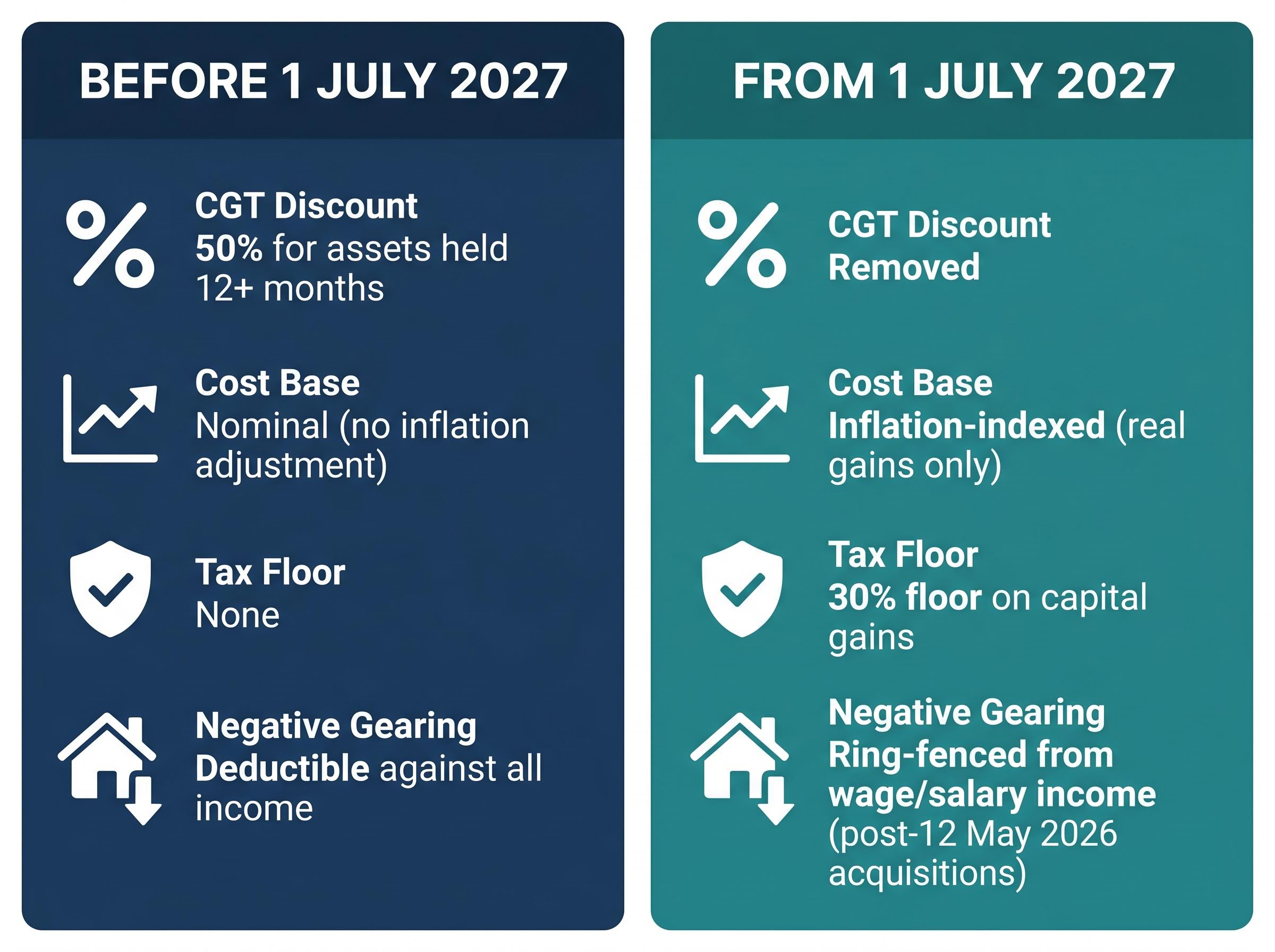
| Feature | Before 1 July 2027 | From 1 July 2027 |
|---|---|---|
| CGT discount | 50% for assets held 12+ months | Removed |
| Cost base treatment | Nominal (no inflation adjustment) | Inflation-indexed (real gains only) |
| Minimum tax floor | None | 30% floor on capital gains |
| Negative gearing (established property) | Deductible against all income | Ring-fenced from wage/salary income (post-12 May 2026 acquisitions) |
Assets acquired before 1 July 2027 will receive transitional treatment, with gains apportioned between pre-change and post-change accrual periods.
The 2026 Federal Budget tax reforms package three structural changes with a combined $77 billion revenue impact over the decade: the CGT discount removal, the negative gearing restriction on established properties, and a 30% minimum tax on discretionary trust distributions, each with different implementation timelines and grandfathering windows.
The method for splitting pre- and post-change gains remains unconfirmed by Treasury. Whether a time-based or valuation-based approach is adopted is the most consequential unresolved technical detail for investors with long-held positions.
When big ASX news breaks, our subscribers know first
Why property capital may not simply stay in property
The combined effect of the CGT discount removal and the negative gearing restriction represents a structural deterioration in the after-tax economics of investment property. Post-2027, capital appreciation on an investment property will be taxed at close to full marginal income tax rates, with no discount. Property investors purchasing established dwellings after 12 May 2026 simultaneously lose the ability to deduct negative gearing losses against salary and wage income.
The logical expectation is a pre-2027 listing and divestment cycle as some property investors crystallise gains under the current, more favourable regime. What happens after that cycle clears is the more consequential question. New residential property receives a deliberate carve-out under the reform design, signalling that the government is using tax architecture to differentiate between speculative existing property investment and new housing supply.
The negative gearing restriction applies only to established properties acquired after 12 May 2026, and the distinction between established and new-build treatment is not incidental: it is the structural mechanism through which the government is attempting to redirect investment capital toward new housing supply while simultaneously improving after-tax returns on equities relative to existing property.
From policy intent to market expectation
Commentary from Quill Group and DLA Piper flags that the broad-based impact on asset allocation extends well beyond property to all investable asset classes. The expectation among advisers is selective, quality-focused reallocation into equities rather than a blanket flood of capital into any ASX name.
This distinction matters. The evidence base for large-scale capital reallocation remains expectational commentary, not confirmed flow data:
- No APRA mortgage flow data changes directly attributable to the reform have been published
- ASX ETF subscription and fund flow data showing rotation is not yet available
- Property transaction volume changes tied specifically to the Budget have not been confirmed
The direction of travel appears well-founded. The magnitude remains unproven.
The end of the buy-and-hold default
The 50% CGT discount created a structural bias toward indefinite holding. The logic was straightforward, and it operated in sequence:
- Buy an asset. The clock starts on the 12-month qualifying period.
- Hold past 12 months. The discount activates, halving the nominal gain at disposal.
- Continue holding. Every additional year defers a liability that will only ever be 50% of the nominal gain. There is no incremental tax benefit to realising and redeploying; the discount does not improve with time, but the deferral compounds.
- Realise only when necessary. Selling triggers a tax event; not selling preserves optionality under a permanently favourable rate.
Remove the discount, and step three changes entirely. Without the flat 50% reduction, the cost of holding an unrealised gain versus realising and redeploying into a higher-conviction position is recalibrated. The new indexation system provides shelter from purely inflationary gains, but in a moderate-inflation environment it provides less protection than the old flat discount for growth assets held over decades.
Commentary from MLC and Quill Group flags that the rational default will shift from accumulation to more active management. The expected structural outcomes include greater turnover, shorter average holding periods, and elevated volatility in growth-oriented names as taxable investors begin treating gain realisation as a routine portfolio management decision rather than a last resort.
A less-discussed consequence of higher effective CGT rates is the lock-in effect on portfolio reallocation: when the tax cost of exiting a position rises materially, investors facing large embedded gains are discouraged from redeploying into higher-conviction positions even when fundamentals justify the switch, a dynamic that may partially offset the government’s stated goal of directing capital toward productive uses.
The ASX sectors likely to reprice under the new regime
The structural characteristics that become more rewarding in the post-discount environment are identifiable: high fully franked dividends, mature cash generation, capital-light compounding, and low dependence on terminal-value growth. The sectors that lose are those where the investment case rests on distant earnings, multiple expansion, or speculative capital appreciation.
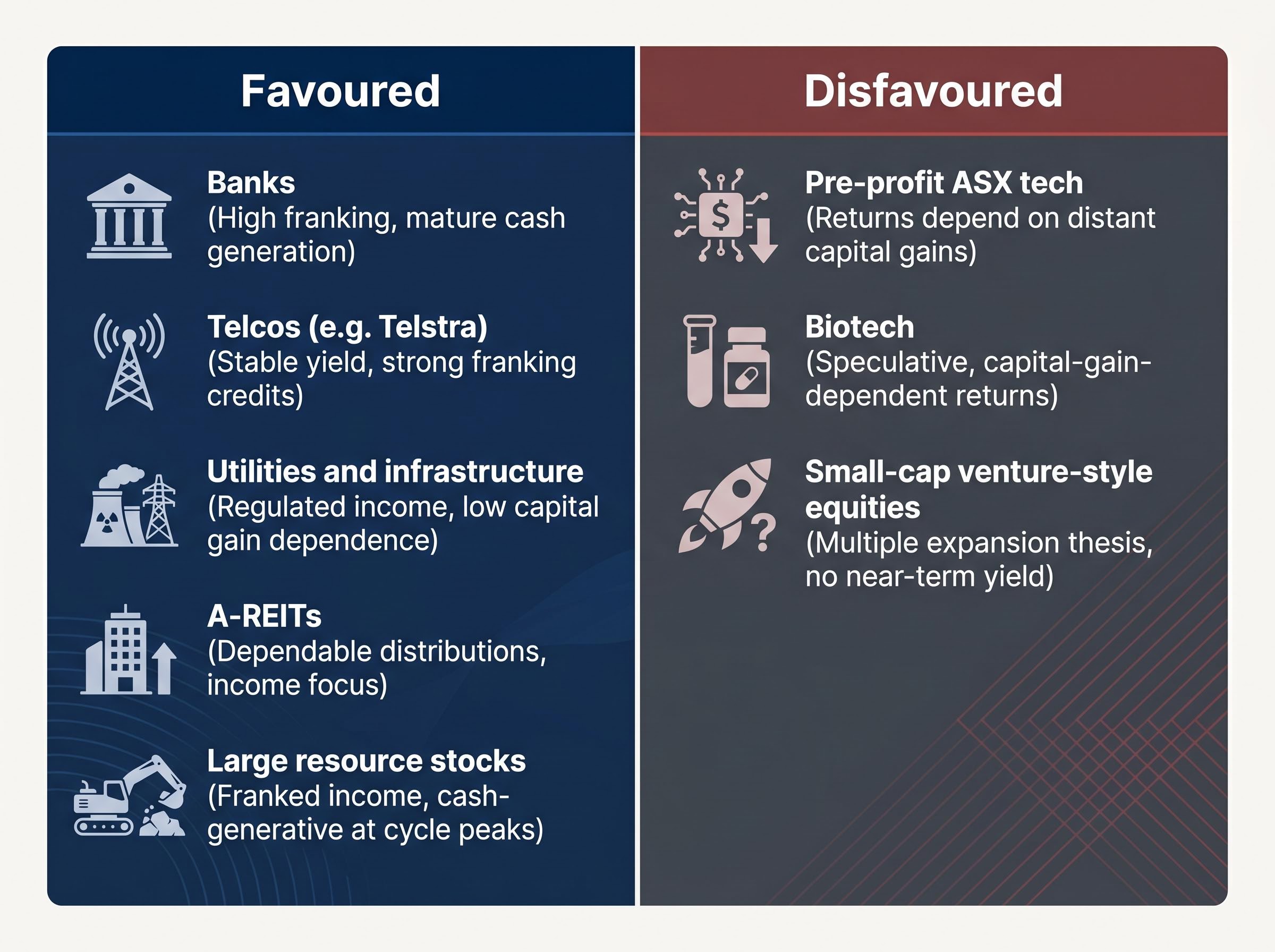
| Sector / Style | Favoured or disfavoured | Key characteristics |
|---|---|---|
| Banks | Favoured | High franking, mature cash generation |
| Telcos (e.g. Telstra) | Favoured | Stable yield, strong franking credits |
| Utilities and infrastructure | Favoured | Regulated income, low capital gain dependence |
| A-REITs | Favoured | Dependable distributions, income focus |
| Large resource stocks | Favoured (when dividends strong) | Franked income, cash-generative at cycle peaks |
| Pre-profit ASX tech | Disfavoured | Returns depend on distant capital gains |
| Biotech | Disfavoured | Speculative, capital-gain-dependent returns |
| Small-cap venture-style equities | Disfavoured | Multiple expansion thesis, no near-term yield |
The 30% floor compounds the disadvantage for growth-stock investors by eliminating the strategy of timing gain realisations into low-income years, a tactic previously used to soften the tax cost of exiting speculative positions.
KPMG and DLA Piper commentary points to this sectoral rotation as one of the most predictable market-level consequences of the reform. However, one area of residual uncertainty persists.
The venture capital and start-up community has mounted the most organised pushback against the reform. The government has committed to consult on the interaction of the CGT changes with early-stage investment. The outcome of that consultation could modify the sectoral picture for innovation-related names on the ASX.
The mechanics of franking credits in a post-discount world
A franking credit (also called an imputation credit) is a tax credit attached to dividends paid by Australian companies that have already paid corporate tax on their profits. It prevents the same income from being taxed twice: once at the company level, and again in the hands of the shareholder. The mechanics flow in a clear sequence:
Franking credit mechanics operate through the corporate tax imputation system, where tax already paid at the company level passes through to shareholders as a direct offset against personal liability; for SMSF investors in pension phase, the credit exceeds the personal tax owed and is refunded as cash, converting a $70 dividend back to $100 of after-tax value at the standard 30% corporate rate.
- An Australian company earns a profit and pays 30% corporate tax on it.
- The company declares a dividend from that after-tax profit and attaches a franking credit representing the tax already paid.
- The investor receives the dividend and declares the grossed-up amount (dividend plus franking credit) as assessable income.
- The franking credit is applied as a tax offset against the investor’s personal tax liability. If the investor’s marginal rate is below 30%, the excess credit is refunded.
Why the imputation premium grows when CGT efficiency shrinks
The substitution logic is direct. When the CGT discount halved the effective tax rate on capital gains, the after-tax gap between gain-based returns and dividend-based returns was relatively narrow for investors in the 30%-47% marginal tax brackets. Remove the discount, and the after-tax cost of gain realisation rises materially while the after-tax value of fully franked dividend income remains unchanged.
Commentary from MLC and KPMG identifies this as a structural incentive for investors in taxable accounts to tilt toward franked income over capital gain. Portfolio types that benefit include yield-focused listed investment companies, income funds, and dividend ETFs.
The effect is particularly pronounced for self-managed superannuation fund (SMSF) investors in pension phase, who receive full franking credit refunds, making fully franked income one of the most tax-efficient return pathways available in the Australian system.
Three practical moves before 1 July 2027
The 14-month window before the regime changes is finite. Three actions have been consistently flagged by professional advisers as worth evaluating.
- Obtain formal valuations on long-held assets. Crystallising cost bases at current market values before 1 July 2027 can shelter historical gains from the new regime’s indexation methodology. Pre-1985 (pre-CGT) assets require particular attention, as they become subject to taxation on post-2027 gains for the first time. Caveat: the apportionment methodology for splitting pre- and post-change gains remains unconfirmed, making strong valuation evidence at or near the change date advisable.
- Review entity and account structures. The logic of holding long-term growth assets inside superannuation strengthens under the new regime, while high-turnover strategies should be moved out of taxable accounts before the discount disappears. Baker McKenzie and KPMG commentary emphasises entity structure review as a priority. Discretionary trusts face a 30% minimum tax rate from July 2028, making trust structure review urgent alongside CGT planning.
- Upgrade cost base record-keeping. Cost base accuracy, dividend reinvestment plan (DRP) records, and apportionment documentation will carry greater consequences under indexation than under the old flat-discount regime.
Advisers warn against automatic selling before 2027. Premature realisation can trigger current tax liabilities that may exceed the benefit of acting early. The right action depends on marginal rate, entity structure, and expected future growth of the asset.
This article is for informational purposes only and should not be considered financial advice. Investors should conduct their own research and consult with financial professionals before making investment decisions.
The portfolio that emerges on the other side of 2027
Three structural shifts are converging on a single conclusion. Capital is expected to move selectively from property into quality equities. The buy-and-hold default loses its tax rationale. And the relative after-tax value of fully franked income rises against capital gain as the primary return pathway for taxable investors.
KPMG and MLC commentary frames the resulting environment in direct terms: after-tax return optimisation replaces pre-tax nominal appreciation as the central portfolio metric. The post-2027 ASX is likely to reward investors who are precise about structure, entity selection, and tax awareness rather than those following the old passive accumulation default.
The thesis carries three identifiable risks that could modify its trajectory:
- The apportionment methodology for transitional assets remains unconfirmed by Treasury
- The VC and start-up consultation outcome could introduce carve-outs that alter the growth-stock picture
- Superannuation treatment is still being finalised in legislation and should be verified against final drafting
Macro conditions, particularly the path of interest rates and inflation, will independently influence sectoral rotation regardless of tax reform. The direction of travel appears well-supported by the policy mechanics and by adviser commentary. The pace and magnitude of the shift will depend on variables that remain, for now, unresolved.
Past performance does not guarantee future results. Financial projections are subject to market conditions and various risk factors.