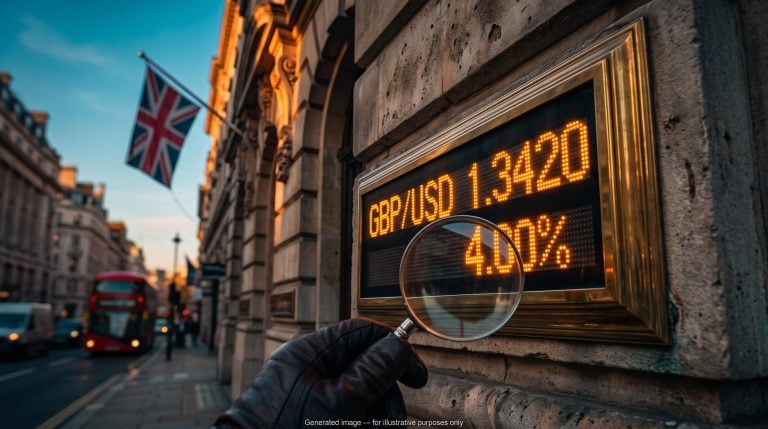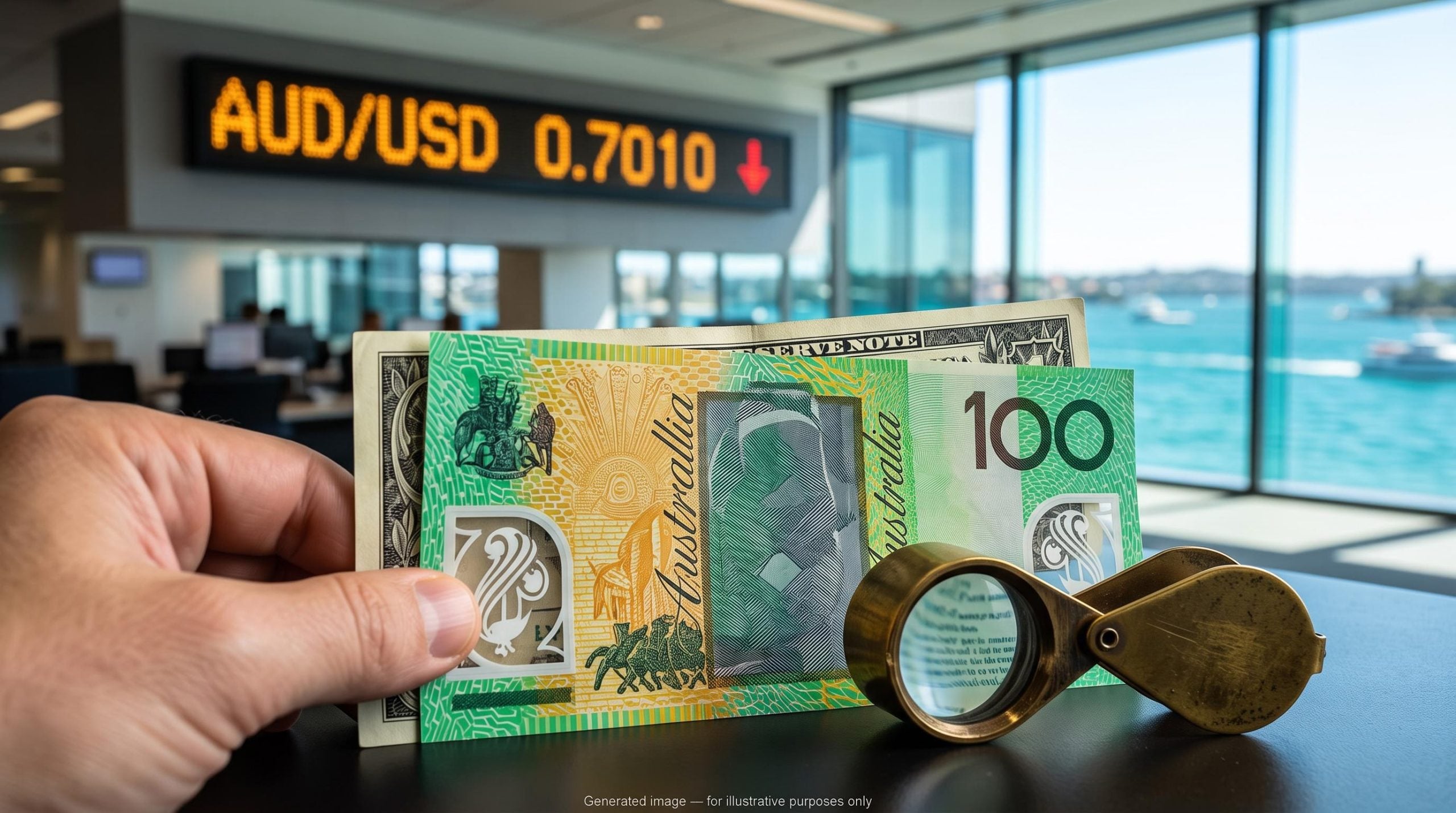
The Australian dollar slipped on Monday, 2 November 2026, even as the US dollar softened. On the surface that looks backwards. Many traders treat a weaker greenback as an automatic lift for the Aussie, and Monday showed why that shortcut can mislead an AUD/USD forecast.
The pair drifted toward the 0.70-0.703 area. FXStreet reported it near 0.7010, down 0.33% on the day, while the Reserve Bank of Australia (RBA) set its official reference rate at 0.7023.
The timing matters. Markets expect the RBA to lift the cash rate by 25 basis points to 4.85% on Tuesday. A basis point is one hundredth of a percentage point, so 25 basis points equals 0.25%. Quoted levels vary a little by source and time of day, and the reasons are covered below.
You will come away with a working method for reading rate expectations, commodities and the dollar together. You will also know which specific events this week are most likely to decide the pair’s next move.
Why is the Aussie falling when the US dollar is soft?
Start with what the screen showed on Monday. FXStreet placed the US Dollar Index (DXY), a measure of the greenback against a basket of major currencies, near 101.65 and close to one-week lows. Yet the Aussie weakened against every major peer and held its ground only against the Japanese yen.
That pattern points to Australian factors, not dollar strength. Four drivers explain the gap:
- The hike is already priced. Market-implied odds of a Tuesday move ranged from 79% to 90% across recent snapshots, inviting “buy the rumour, sell the fact” profit-taking. Under that pattern, traders buy ahead of an expected event and then sell once it arrives.
- The rate path outweighs the rate level. If traders decide 4.85% is the peak, the Aussie can weaken even as rates rise.
- Risk sentiment is fragile. The Aussie tends to move more sharply than other currencies when global mood shifts, and an AI-led tech sell-off weighed on demand.
- The DXY is the wrong yardstick. The euro and other majors dominate the index, so it reveals little about any single pair.
Howard Du of TD Securities put the pricing problem plainly:
TD Securities on hike pricing With markets pricing roughly 80% odds of a hike, Du said the incremental currency benefit of the decision itself is limited.
The lesson for you is direct. When a central bank move is already in the price, the currency trades on what is said next, not on the move itself.
Price levels and why sources differ
Earlier in the Asian session, Saxo, OANDA and Mitrade reported the pair near 0.703, only 0.03%-0.04% lower. FXStreet’s 0.7010 reading came later, after the pair had slipped further. The RBA’s 4:00 p.m. reference rate of 0.7023 is the most defensible official benchmark.
When big ASX news breaks, our subscribers know first
How central bank expectations drive a currency pair
Once the dollar index is set aside, the real driver comes into view. Currencies respond to the gap between two countries’ interest rates, known as the interest rate differential. More precisely, they respond to where traders expect that gap to head.
The interest rate differential between Australia and its peers sets the baseline for capital flows, yet the gap between what the RBA delivers and what markets priced in often matters more than the level itself, which is why a widely expected hike can leave the currency flat.
The RBA setup illustrates the point. A move from 4.60% to 4.85% would be the fifth hike this year and would take the cash rate to its highest level since 2008. Hotter inflation forced the issue: the Australian Bureau of Statistics reported on 28 October that headline inflation rose to 4.3% and the trimmed mean reached 3.6%. The trimmed mean strips out the most extreme price moves to show the underlying trend, and both sit above the RBA’s 2%-3% target.
Major institutions agree on Tuesday’s move but differ on what comes after it:
| Institution | View | Implication for AUD/USD |
|---|---|---|
| Rabobank | Hike widely anticipated; Bullock’s tone is the key driver | Durable rally unlikely from the hike alone |
| CBA | 4.85% seen as the likely destination for this meeting | Guidance decides whether another move is priced |
| Westpac | Further hike not the base case, but risk has risen, especially in February | Technical resistance near 0.7067 |
| ANZ | Economist Madeline Dunk said strong data keeps the focus on inflation | Supports a firm tone |
| NAB | 4.85% sits about 150 bp above its neutral estimate | High bar for an extended series of hikes |
| ING | Raised short-term objective on attractive carry | 0.71 target; no quick return to 0.72 |
New Zealand offers a fresh precedent. The Reserve Bank of New Zealand surprised markets with a 4-3 vote to hold at 2.75% when a hike was expected, which shows how guidance and surprise can outweigh the rate level itself.
Past decisions suggest a recurring pattern:
- Unexpectedly hawkish hike or guidance: the currency tends to strengthen.
- Expected hike with no further signal: positions often unwind and the currency sells off.
- Unexpected hold with hawkish guidance: the currency can still strengthen.
- Hike paired with weakening activity: initial gains can reverse.
What Bullock’s tone could change
According to Rabobank, tightening expectations would rise if Governor Michele Bullock stresses inflation risks and fall if she emphasises economic headwinds. The bank also links the rate path to oil prices after the US midterm elections. A hawkish message could carry the pair toward 0.7067, while a “one-and-done” signal could push it lower despite the hike. For you, the statement and press conference wording are the real trade.
Oil, China and risk sentiment: the cross-currents
Bullock’s tone is only one force on the pair. Several outside signals pulled in different directions on Monday.
Oil fell more than 4%, with Brent down roughly 3.7%-4.0% and WTI down roughly 3.8%-4.2%. The trigger was diplomacy. Iran’s President Pezeshkian said the government had been granted negotiating powers, and Axios reported that President Trump favoured more time for talks. US Vice President JD Vance reportedly reached out to senior Iranian security official Mohsen Rezaei, and Iran said it could reopen the Strait of Hormuz if its conditions were met.
Australia is not mainly an oil exporter, yet cheaper crude can still weigh on the Aussie. Lower oil prices cool inflation expectations and soften sentiment toward resource currencies, and Saxo described the pair as softening under risk-off pressure.
| Factor | Latest reading | Likely AUD effect | Reversible? |
|---|---|---|---|
| Oil | Down more than 4% | Negative via inflation and commodity sentiment | Yes, if Iran talks fail |
| RatingDog PMI | 52.0 | Mildly supportive | Mixed signal |
| Official NBS PMI | 49.3 | Negative for demand outlook | Mixed signal |
| AI-led tech sell-off | Risk-off mood | Negative for a high-beta currency | Yes |
China: two PMIs, two stories
A purchasing managers’ index (PMI) surveys factory activity, and any reading above 50 signals expansion. The RatingDog PMI came in at 52.0, ahead of the 51.6 expected and marking an 11th month of growth, though slightly below the prior 52.1. The official NBS gauge fell to 49.3, into contraction.
Even the stronger survey showed export orders slowing and business confidence at a nine-month low. That matters because Chinese industrial demand is Australia’s main external channel. Mixed data and reversible oil moves make a weak basis for a one-way bet, so give these signals less weight than the RBA’s guidance.
The Fed and US data: what could shift AUD/USD this week
Australia controls only one side of the differential. The other side sits in Washington.
The Federal Reserve held its target range at 3.75%-4.00% last week. Investing.com reported a 10-2 vote, with both dissenters preferring a hike, which leaves the next US move unclear. Meanwhile, lower Treasury yields after the tech sell-off kept pressure on the dollar ahead of the midterms.
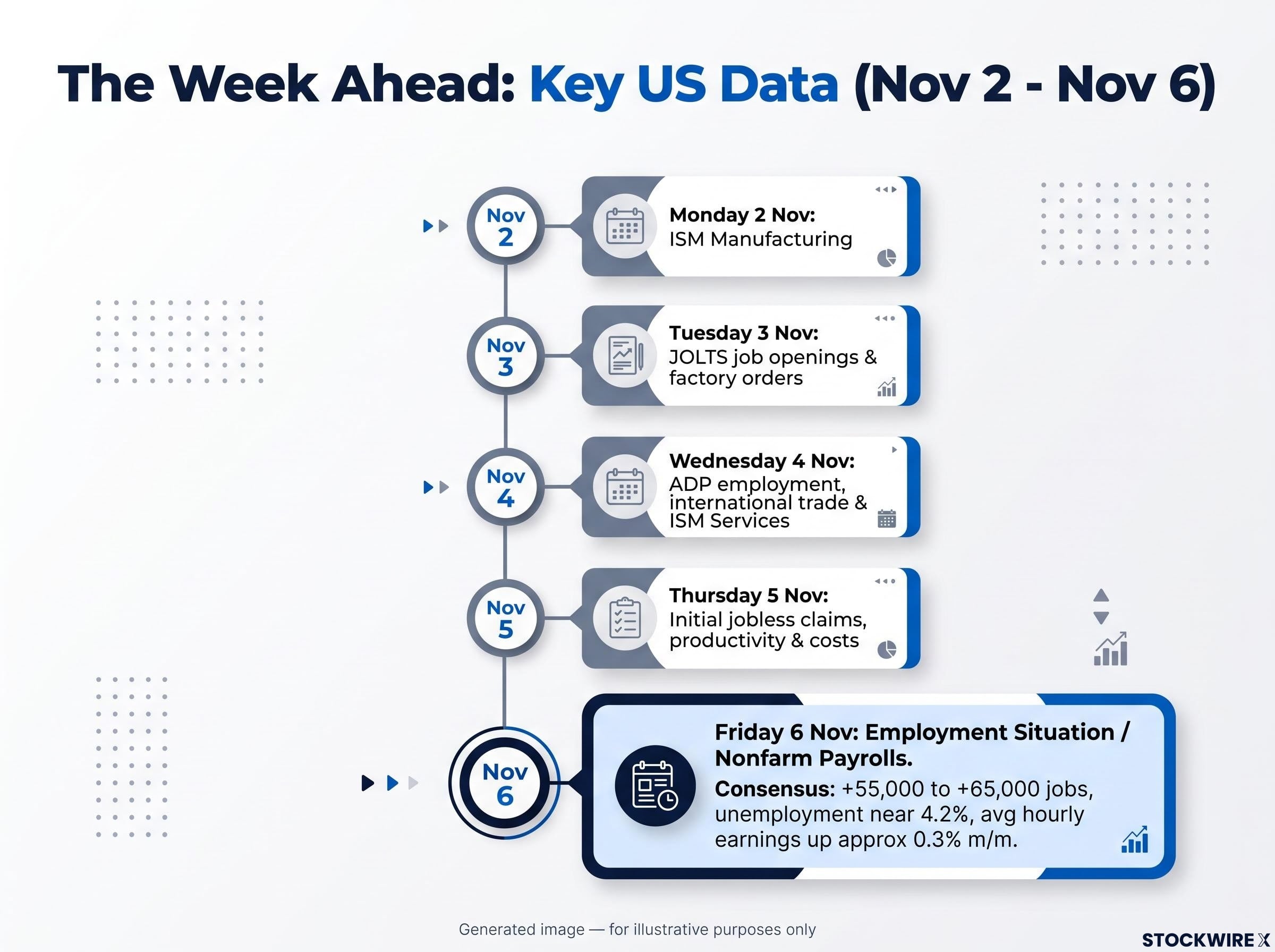
The week’s US calendar runs in order:
- Monday 2 November: ISM Manufacturing.
- Tuesday 3 November: JOLTS job openings and factory orders.
- Wednesday 4 November: ADP employment, international trade and ISM Services.
- Thursday 5 November: Initial jobless claims, plus productivity and costs.
- Friday 6 November: Employment Situation report, including nonfarm payrolls.
October payrolls consensus About +55,000 to +65,000 jobs, unemployment near 4.2% and average hourly earnings up about 0.3% month on month.
A hawkish read on the Fed would support the US dollar and cap the pair. Weak payrolls could revive expectations of US rate cuts and give the Aussie some relief. For you, Friday’s numbers may matter as much as Bullock’s press conference.
Fed forward guidance can matter more than the decision itself, because a priced-in move leaves the press conference tone as the real catalyst, and a narrowing then re-widening spread can leave the net differential close to unchanged.
Reading the AUD/USD forecast beyond Tuesday’s decision
The pieces now fit together. The hike is largely priced, so guidance is the swing factor. China and oil send mixed and reversible signals, and the Fed holds the other half of the differential.
The upside case rests on a hawkish Bullock, which could test Westpac’s resistance near 0.7067, with ING’s 0.71 objective as a further reference point. The downside case is a one-and-done message paired with softening activity, where the Aussie falls despite the hike.
Rate decisions also feed through to bank net interest margins, where deposit competition and forward guidance shape how the domestic equity market absorbs each RBA move alongside the currency.
Three variables deserve your attention:
- Bullock’s guidance on whether further tightening is possible.
- Oil after the US midterms, which feeds both inflation and the RBA’s path.
- Friday’s payrolls, which shape the Fed side of the gap.
This is analysis of the drivers, not a prediction of where the pair will trade. Past performance does not guarantee future results, and these scenarios may change as market conditions develop.
This article is for informational purposes only and should not be considered financial advice. Investors should conduct their own research and consult with financial professionals before making investment decisions.