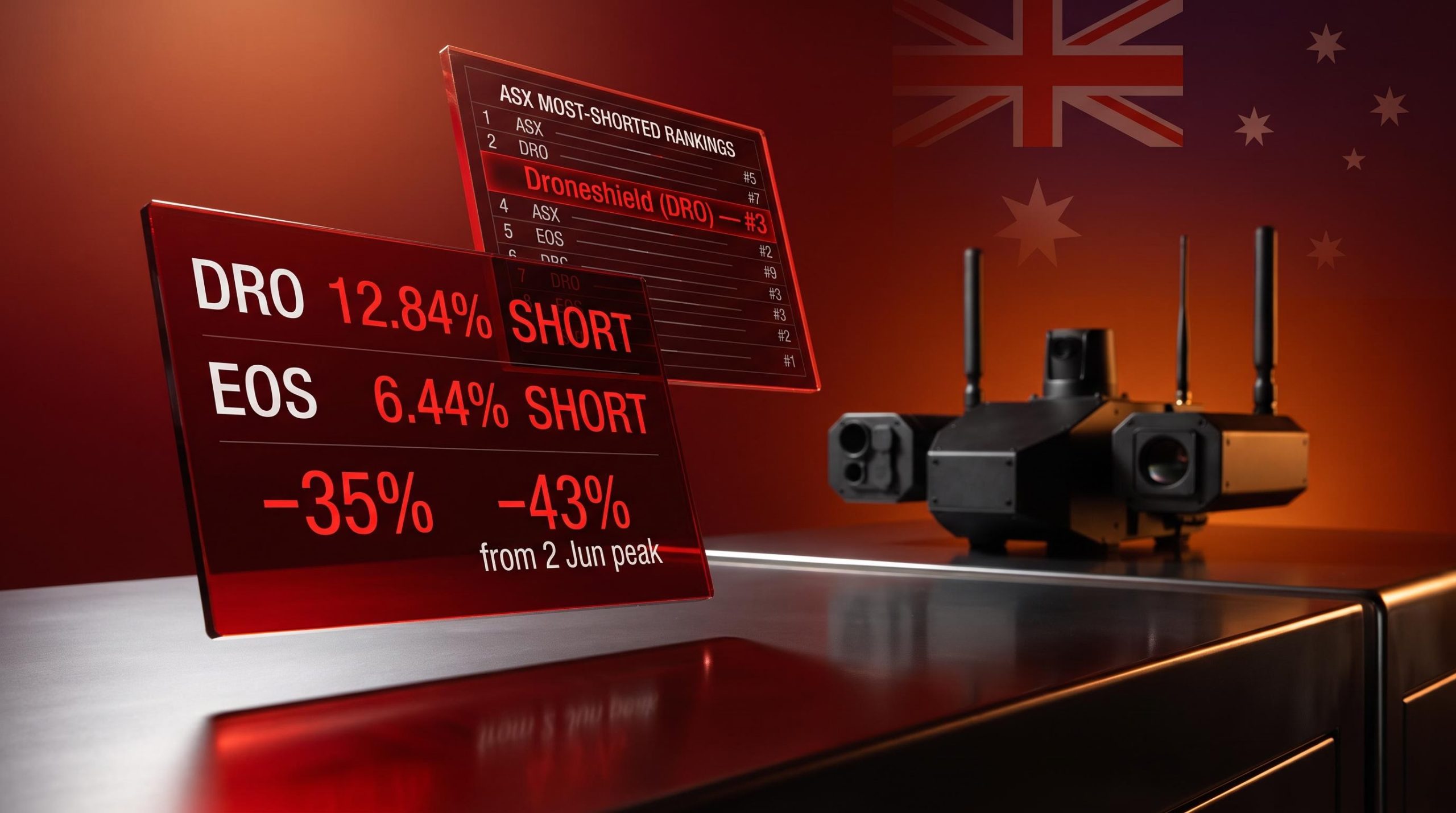
Two ASX defence stocks that were market darlings as recently as early June have just hit all-time highs in short interest. Droneshield (ASX: DRO) is now the third most-shorted stock on the entire exchange at 12.84%, while Electro Optic Systems (ASX: EOS) has reached a record 6.44%. EOS has fallen roughly 43% from its 2 June 2026 peak. The contrast between the enthusiasm that drove both names to record highs six weeks ago and the bearish positioning building against them right now is sharp.
The defence sector has been one of the strongest thematic stories on the ASX over the past 18 months. Rising allied defence budgets, geopolitical pressure, and a growing focus on sovereign capability drove sustained inflows into both stocks. Record short interest in this specific cohort is not routine. It tells you that a meaningful group of professional investors has formed a bearish thesis precisely where retail conviction remains strongest.
Here is the specific data behind the short surge, what record short positions actually mean in practice, and how to read the signal without overreacting in either direction.
From sector darlings to record short targets in six weeks
Both Droneshield and Electro Optic Systems peaked on the same calendar date: 2 June 2026. Since then, both stocks have shed significant ground, with Droneshield retreating around 35% from that peak and EOS giving back close to 43%.
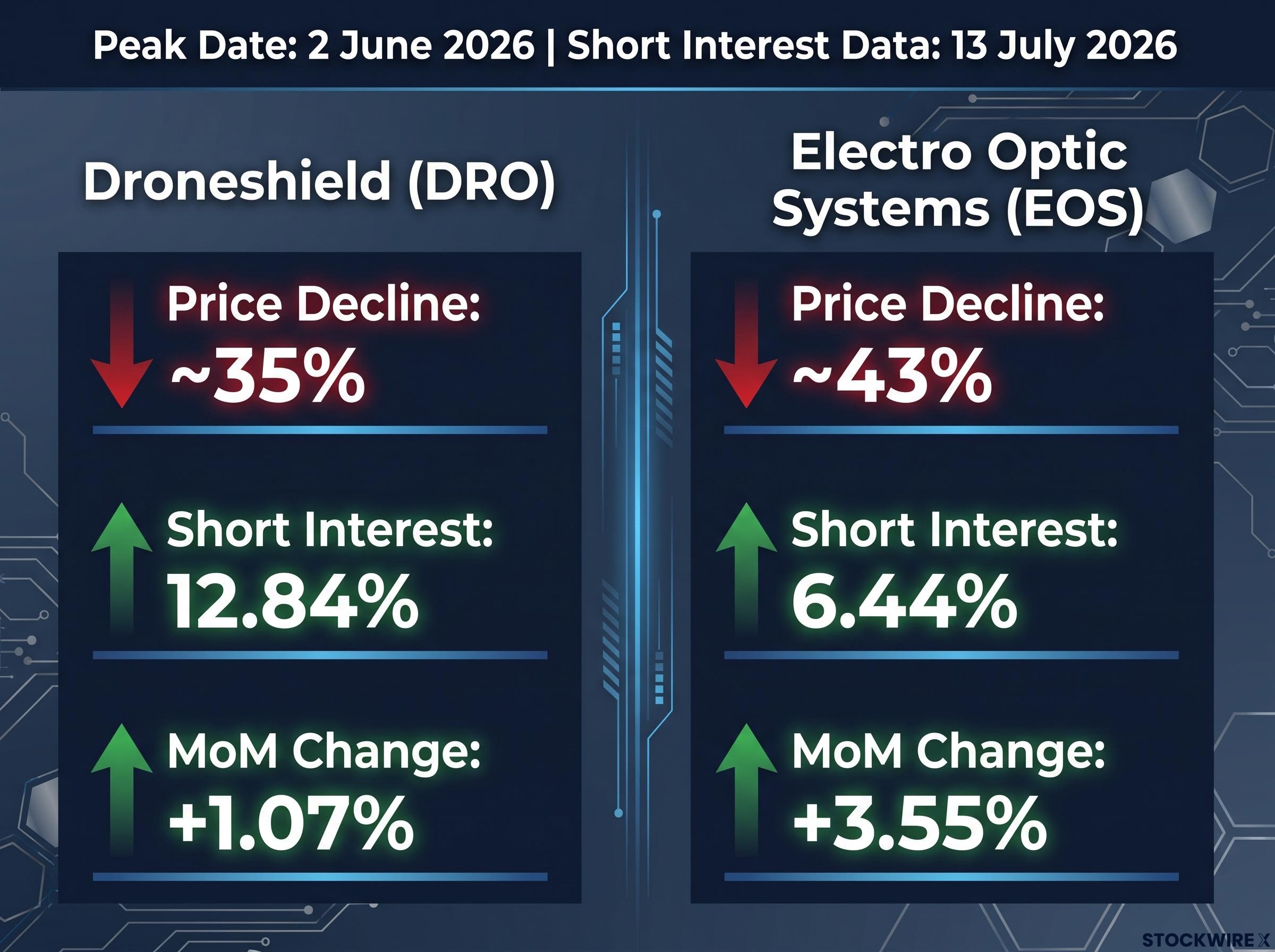
The short interest figures as of 13 July 2026 show that bearish positioning is not just elevated but actively building. Droneshield’s 12.84% short interest is up 0.90% week-on-week and 1.07% month-on-month. EOS recorded 6.44%, up 1.78% week-on-week and 3.55% month-on-month, each figure representing an all-time high for the respective stock.
| Stock | Short Interest (13 Jul 2026) | WoW Change | MoM Change | Price Decline from 2 Jun Peak |
|---|---|---|---|---|
| Droneshield (DRO) | 12.84% | +0.90% | +1.07% | ~35% |
| Electro Optic Systems (EOS) | 6.44% | +1.78% | +3.55% | ~43% |
The fact that both stocks peaked on the same date and both are now seeing accelerating short interest is not coincidence. It points to a coordinated repricing of the sector’s risk profile by professional investors, not stock-specific noise. The rate of change matters more than the absolute level here: both names show acceleration, which tells you bearish conviction is intensifying rather than stabilising.
When big ASX news breaks, our subscribers know first
Where these two stocks sit in the broader ASX short-selling landscape
Droneshield’s 12.84% short interest places it third on the ASX most-shorted list for the week ending 13 July 2026. The only stocks above it are Lotus Resources at 22.80% and Domino’s Pizza Enterprises at 13.84%, both well-established short targets. EOS sits outside the top ten but has reached a record high in its own right.
| Rank | Stock | Short Interest | WoW Change | MoM Change |
|---|---|---|---|---|
| 1 | Lotus Resources (LOT) | 22.80% | -0.01% | -0.07% |
| 2 | Domino’s Pizza Enterprises (DMP) | 13.84% | -0.02% | -0.64% |
| 3 | Droneshield (DRO) | 12.84% | +0.90% | +1.07% |
| 4 | 4DMedical (4DX) | 12.00% | +0.52% | +0.71% |
| 5 | Flight Centre (FLT) | 11.81% | +0.38% | +0.36% |
| 6 | Telix Pharmaceuticals (TLX) | 11.72% | -0.18% | -1.22% |
| 7 | Boss Energy (BOE) | 11.71% | -0.06% | -2.67% |
| 8 | CAR Group (CAR) | 11.63% | +0.31% | -0.34% |
| 9 | Paladin Energy (PDN) | 11.48% | +0.09% | +0.71% |
| 10 | Elders (ELD) | 10.75% | +0.54% | +1.82% |
Source: Market Index Short Seller Series, Kerry Sun, week ending 13 July 2026. Note: short-selling data carries an approximately four-calendar-day lag due to ASIC’s three-business-day disclosure requirement.
Sitting third on this list means Droneshield is now in the company of stocks that professional short sellers consider structurally challenged, not just temporarily overvalued. A 12.84% short interest in a stock known for volatile thematic momentum carries different implications than the same figure in a defensive business with stable cashflows. The ranking context matters.
What changed in the rankings this week
Elders entered the top ten at position 10 with a 1.82% month-on-month rise, a signal that bearish interest is spreading beyond the technology and resources cohort. Telix Pharmaceuticals moved from fourth to sixth place, surrendering two spots, while Treasury Wine Estates fell off the list altogether. The list remains dynamic: short positions are not permanent verdicts, and their movement week to week is part of the signal itself.
What drove ASX defence stocks to record highs, and why the repricing has been so sharp
The rally that carried both stocks to their 2 June peaks was built on genuine tailwinds:
- Rising allied and global defence budgets, with multiple nations committing to sustained spending increases
- Elevated geopolitical tensions driving urgency in procurement cycles
- A growing focus on sovereign capability in Australia and among allied nations
- Specific technology niches with genuine global demand: Droneshield in counter-drone and electronic warfare, EOS in directed-energy and targeting systems
These tailwinds have not disappeared. What changed is the risk layer underneath them.
For Droneshield specifically, the weight of the bearish positioning reflects identifiable concerns:
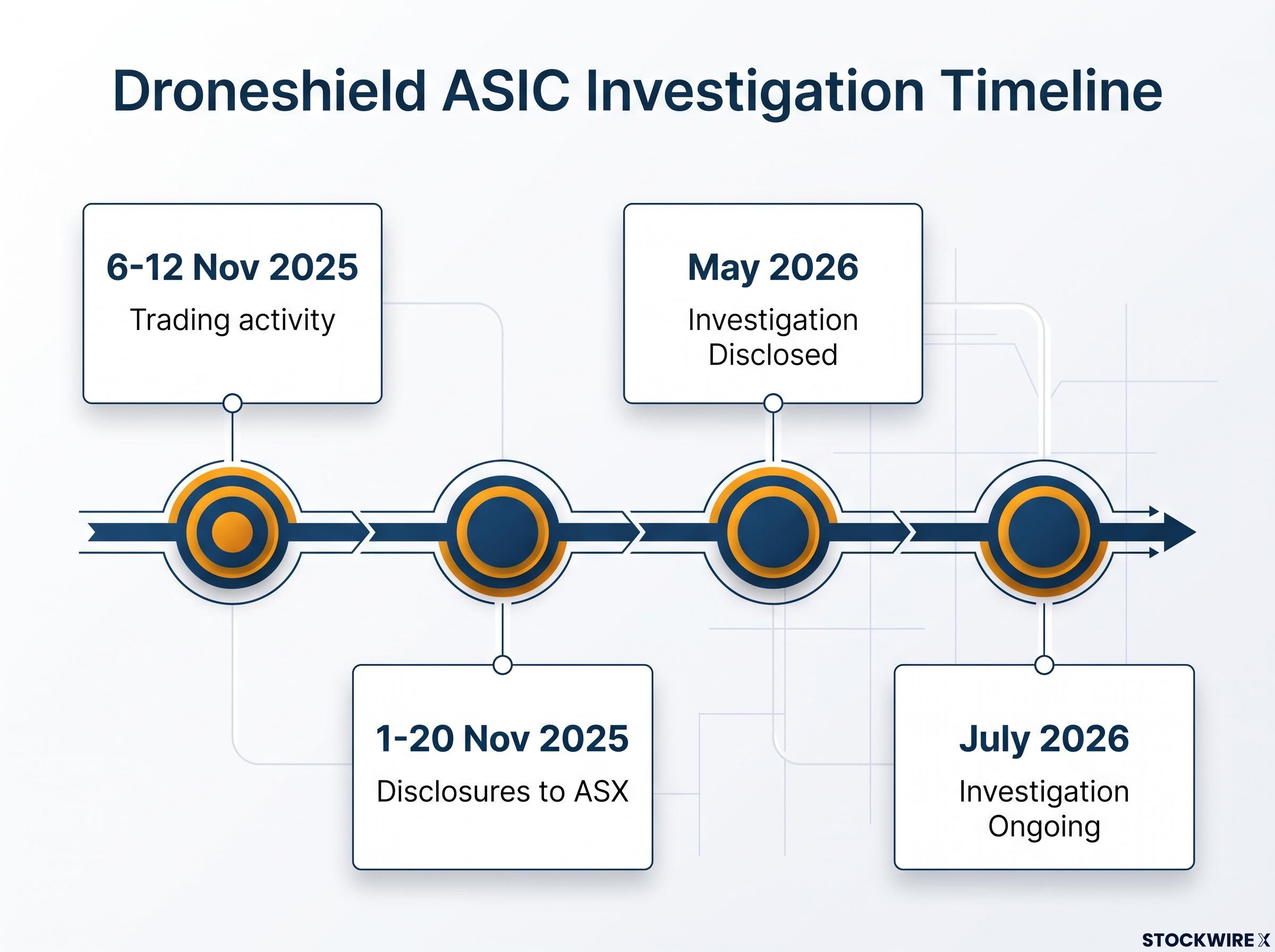
- An open ASIC (Australian Securities and Investments Commission) investigation into communications and disclosures made to the ASX between 1-20 November 2025, covering trading activity between 6-12 November 2025. The investigation was disclosed in May 2026 and remains ongoing as of July 2026.
- Valuations that ran well ahead of current earnings and contract delivery timelines during the June peak, leaving the stock structurally exposed to any delays or re-allocation.
- A momentum reversal that turned the same retail enthusiasm that drove the rally into a vulnerability as sentiment shifted.
The ASIC investigation into Droneshield covers a period in November 2025 that included a retracted $7.6 million deal, approximately $70 million in executive share sales, and a 48% monthly share price decline, all of which formed the basis for the formal notice disclosed in May 2026.
The 35% and 43% declines in Droneshield and EOS respectively look more consistent with the removal of a speculative premium than a fundamental collapse in the business thesis. But the ASIC investigation overhang is not priced as a known cost; it is priced as an unknown one. That kind of uncertainty typically commands a sustained discount until resolution, which is why short interest has kept building rather than plateauing.
The speculative premium in ASX defence stocks is visible in the Boresight listing case, where a company growing revenue at 57% annually but reporting a widening net loss listed at a mid-teens revenue multiple within days of the same 2 June peak that marked Droneshield’s and EOS’s highs, suggesting the broader sector re-rating was already fully priced at the moment of maximum retail enthusiasm.
How to read a short interest figure without misreading it
Short selling is the practice of borrowing shares, selling them on market, and aiming to buy them back later at a lower price. The difference between the sale price and the repurchase price is the short seller’s profit. Short interest, expressed as a percentage, measures how much of a company’s total shares on issue have been sold short.
Here is what high short interest tells you:
- A sizeable cohort of investors, typically institutional, has formed a bearish view and committed capital to it
- The market is pricing in some combination of valuation concern, regulatory risk, or execution risk
- Crowded short positions can amplify volatility in both directions
Here is what it does not tell you:
- When further price declines, if any, will materialise; short positions can persist for months before resolving
- That the stock will definitely fall further; the direction is not guaranteed by the positioning
- How large any future move will be; magnitude is a separate question from direction
The short squeeze dynamic: If positive news arrives for a heavily shorted stock, such as a large contract win, regulatory clearance, or upgraded guidance, short sellers must buy shares to close their positions. That forced buying drives the price up sharply, often faster than the decline that preceded it. Record short interest creates the conditions for the sharpest rallies precisely because the crowding is most extreme. Market commentators have flagged this risk specifically in relation to Droneshield.
Short squeeze signals on the ASX, including short interest above 10% of issued shares, limited daily liquidity relative to the total short position, and a credible positive catalyst, were all present in the Polynovo and Guzman Y Gomez episodes of May 2026, when both stocks surged double digits intraday on no material operational news.
One data note worth understanding: published short interest figures reflect a structural reporting delay, as ASIC does not require disclosure until three business days after a trade, which translates to roughly four calendar days of lag by the time data reaches the public. This means published figures are directional indicators, not real-time snapshots. Provider variation also exists; ShortInterest.au reports 12.84% for Droneshield on 13 July versus ASIC-derived commentary citing 11.9% for the same reference date. This tight-band variation is normal and does not change the directional conclusion.
For you, the honest read is that record short interest raises the probability of further downside pressure but simultaneously increases the energy behind any potential rally. The risk is asymmetric in both directions, which is the detail most often missed.
Droneshield and EOS in the context of the high-momentum thematic trade
Droneshield and EOS are not isolated cases. They fit a recognisable ASX pattern: high-conviction thematic stocks attract concentrated flows during a narrative build, run to stretched valuations, and then become prime short-selling targets once momentum reverses.
Look at who else sits on the most-shorted list:
- Boss Energy (BOE): Uranium thematic at 11.71% short interest
- Telix Pharmaceuticals (TLX): Biotech and nuclear medicine at 11.72%
- 4DMedical (4DX): Health technology at 12.00%
None of these are conventional value stocks with high short interest. All are thematic plays where short sellers are positioning against a narrative premium. The cohort pattern is the signal: when multiple high-momentum names show elevated and rising short interest simultaneously, it maps where professional bearish conviction is concentrated across the market right now.
Why the pace of EOS short interest build deserves specific attention
EOS’s month-on-month short interest increase of 3.55% is proportionally more aggressive than Droneshield’s 1.07% MoM move, particularly given EOS started from a lower base. A 3.55% monthly rise that reaches a record high suggests the bearish thesis is gaining new converts rather than being maintained by existing positions.
This is the metric worth monitoring over the next reporting periods. If EOS short interest continues to accelerate at this pace, it tells you the repricing thesis is broadening, not narrowing.
What this positioning tells long-term investors about the defence sector right now
The structural case for Australian defence technology companies has not been dismantled. Allied spending commitments remain in place. Sovereign capability programmes continue. Both Droneshield and EOS occupy technology niches with genuine global demand.
What the record short interest is pricing in is a set of near-term risks that are specific and identifiable: regulatory uncertainty for Droneshield, stretched valuations across both names, and the mechanical unwinding of a momentum trade that ran too far, too fast.
The distinction that matters is your time horizon. If you are trading around a near-term position, the short interest data is directly actionable. It tells you where professional capital is positioned and which direction the near-term pressure is likely to come from. If you are investing on a multi-year view, the more important variables are different. Watch for:
The early warning value of short interest data was visible in the Lotus Resources case, where institutional short sellers had already lifted positions to approximately 11% in the weeks before the stock fell 34% on 30 April 2026, confirming that the four-day publication lag does not erase the signal, it just compresses the window available to act on it.
- The outcome of the ASIC investigation into Droneshield’s November 2025 disclosures
- Contract announcement cadence for both companies over the next two quarters
- The direction of short interest in the next two to four weeks as an indicator of whether bearish conviction is peaking or still building
This data snapshot gives you a clear picture of where professional sentiment sits today. It is not a prediction of where these stocks will be in six months. Acting on it well requires knowing which of those two questions you are actually trying to answer.
This article is for informational purposes only and should not be considered financial advice. Investors should conduct their own research and consult with financial professionals before making investment decisions. Past performance does not guarantee future results.