
A CEO spent $5.09 million of his own money buying his own company’s shares three weeks after that stock fell 7.7%.
That was the headline act in a week where four ASX 200 directors bought into weakness. Every one of those purchases landed at prices well below where the stock traded before the August reporting season. The week’s only insider sale, by the Sims Limited CEO, looks at first like the counter-signal, until you trace what happened to his holding in the three weeks before it.
Here is what each transaction actually signals, and how the analyst community reads the same companies right now. By the end, you should be able to decide how much weight to give insider buying as a conviction indicator, rather than treating every purchase as an automatic buy.
Mario Verrocchi’s $5 million bet on post-merger Sigma
Start with the scale. Mario Verrocchi, chief executive of Sigma Healthcare, spent roughly $5.09 million buying shares at $2.55 on 18 September 2026, a price the stock had not seen since November 2024.
What makes the outlay unusual is who made it. Verrocchi is already Sigma’s largest individual shareholder, and the purchase nudged his stake up just 0.08% to 22.14%. This is not someone building a position. This is someone with a very large position choosing to make it larger.
Read the sequence, because it matters. Weeks before the on-market buy, management confirmed Verrocchi intended to keep his shares once escrow restrictions lifted. He then went further and added personal capital at a multi-year low. The confirmation was the words; the purchase was the money behind them.
The price was where it was because of the market’s reaction to Sigma’s first full-year result since merging with Chemist Warehouse. The stock fell 7.7% on the FY26 result date of 27 August 2026, despite beats on most lines:
- Revenue rose 15.5% to $10.8 billion, roughly 1% below Macquarie’s estimate
- Normalised NPAT grew 22.3% to $732.3 million, again about 1% below Macquarie’s estimate
- The fully franked dividend of 4.0 cents per share came in around 5% above Macquarie’s forecast
Chemist Warehouse like-for-like sales rose 13.4% in FY26, just shy of the 13.7% estimate. Morgans analyst Scott Power upgraded Sigma from Accumulate to Buy after the result.
“Overdone.” That was how Morgans’ Scott Power characterised the post-result sell-off, arguing the merger benefits and FY26 numbers supported a more positive view.
Morgan Stanley holds an Overweight rating with a $3.30 target, and consensus sits near $3.20 (Buy), implying about 24.5% upside from late-September levels. The legitimate risks remain: the Gance family holds roughly 24% and has signalled it may sell up to 20% of that combined position post-escrow (around 4.7-4.8% of issued capital), and gross margin held at ~18.1% only because procurement gains offset the margin-dilutive growth in GLP-1 weight-loss drugs. Weigh those against the signal. When someone with CEO-level information and 22% of the register adds $5 million at a discount two brokers call significant, this ranks among the strongest conviction buys of the week.
The Gance family’s signalled intention to sell up to 20% of their combined Sigma position once restrictions lift is an escrow expiration supply risk that academic research suggests markets absorb more gradually than headline figures imply, with the average abnormal return around lockup dates running closer to -1.5% than the crashes commonly cited.
When big ASX news breaks, our subscribers know first
Two NEDs buy into earnings weakness at Credit Corp and SGH
Look past the individual names and a pattern appears: two non-executive directors, both buying with personal capital, both at post-result prices, at two very different companies.
The structural similarity is the story. The differences in scale and context are what tell you how much each signal is worth.
At Credit Corp Group, independent non-executive director Lyn McGrath bought 8,882 shares at $13.633 on 21 September 2026, roughly $121,085 in total. This was her first substantial holding. She chose to establish it about 7% above the result-day low, after the stock had partly recovered from its ~7% fall on the 4 August 2026 result date. Credit Corp posted a record FY26 NPAT of $105.5 million, up 12% and about 1% ahead of consensus, but the sell-off came from cautious FY27 guidance: PDL acquisition guidance of $200-280 million sits roughly 22% below the $309 million consensus at the midpoint.
At Seven Group Holdings, non-executive director Rachel Argaman bought 2,500 shares at $36.75 on 18 September 2026, a $91,875 outlay that lifted her holding 5.3% to 50,000 shares. That price was 21% below the pre-result close. Her prior purchase, in December 2024, came at $46.25, close to where SGH traded before this result. So this is not a first position; it is an add at a large discount, consistent with how she has bought before. SGH fell about 10.9% on its 11 August 2026 result day, with underlying NPAT of $920 million landing roughly 3% below consensus and FY27 EBIT guidance of flat to low single-digit growth undershooting the 3.7% consensus estimate.
| Company | Insider | Purchase price | Decline vs pre-result | Broker target (high) / implied upside |
|---|---|---|---|---|
| Credit Corp (CCP) | Lyn McGrath (NED) | $13.633 | ~7% premium above result-day close | Morgans $18.25 / ~34% |
| Seven Group (SGH) | Rachel Argaman (NED) | $36.75 | ~21% below pre-result close | Morgans $48.00 / ~31% |
Both are non-executive directors, which matters. Their information access is narrower than an executive’s, so the signal quality is lower. But the read still holds: buying personal capital into a stock 21% below its pre-result price, and establishing a first stake in a record-NPAT company with a consensus target roughly 20% above the purchase price, tells you these directors do not regard current levels as fair value. Both companies were punished for guidance rather than profit, a common source of post-result mispricing, which is precisely the setup where director buying tends to carry more weight.
What insider transactions actually signal, and when to discount them
Insider buying is not the clean bullish signal it is often made out to be. The evidence supports it, but only within limits, and some of this week’s transactions sit closer to those limits than others.
Start with what the research says. Work by Nejat Seyhun on the US market, and the paper “Are Insider Trades Informative?” by Lakonishok and Lee (2001), finds that clusters of insider buying, especially after price weakness, tend to precede above-average returns. On-market purchases that require an outlay of personal capital are treated as the most informative kind of insider activity.
Lakonishok and Lee (2001) on insider trade informativeness establishes that on-market purchases carry significantly more predictive power than sales, and that the signal is strongest in smaller firms where information asymmetry between insiders and the market is greatest.
Net insider buying, particularly following poor stock-price performance, has historically shown predictive power for future returns. That is the underlying principle. It is a supporting signal, not a standalone reason to buy.
The evidence comes with four caveats worth applying deliberately:
- Scale relative to remuneration. A purchase worth tens of thousands can be about optics or share-ownership rules rather than genuine conviction.
- Non-valuation motivations. Directors may buy to meet minimum-shareholding expectations, or to respond to reputational pressure after a weak result.
- Blackout-window timing. Executives can only trade in windows that open after results, so purchases cluster post-earnings because that is when trading is allowed, not necessarily when prices are most attractive.
- Information limits for NEDs. Non-executive directors know less than executives, so their buys carry a lower information signal.
Post-reporting season buying clusters are a calendar-driven structural feature of the ASX rather than a coordinated signal: blackout periods for August results expired simultaneously for a large cohort, releasing pent-up demand into a narrow window where all trades were made on fully public information.
Where the week’s transactions sit on the conviction spectrum
Apply the caveats and the week’s activity separates cleanly. The small buys are easy to discount: McGrath’s $121,085 is modest against Credit Corp’s ~$1.4 billion market cap, and the two purchases with no available rationale, Andrew Lancaster’s $29,474 at Nine Entertainment and Fiona Murdoch’s $23,760 at Ramelius Resources, are small enough that optics is a plausible explanation.
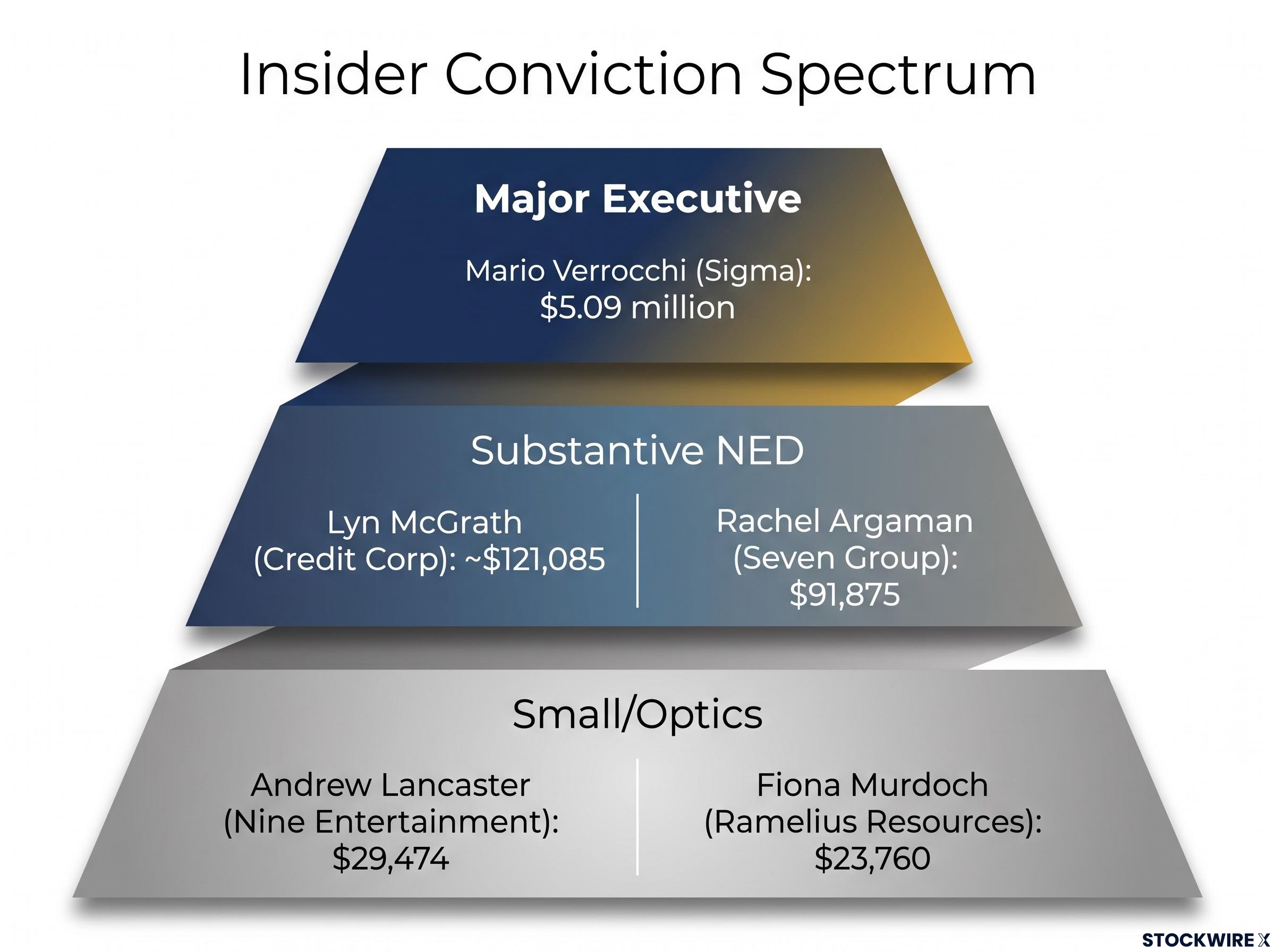
The harder ones to wave away are Verrocchi’s $5.09 million at a multi-year low, backed by CEO-level information and a 22.14% stake, and Argaman’s $91,875 at a 21% discount, consistent with how she has bought before. The useful move is to place each purchase on that spectrum from optics to conviction, rather than treating every insider buy as the same green light.
The Sims CEO sale that is not what it looks like
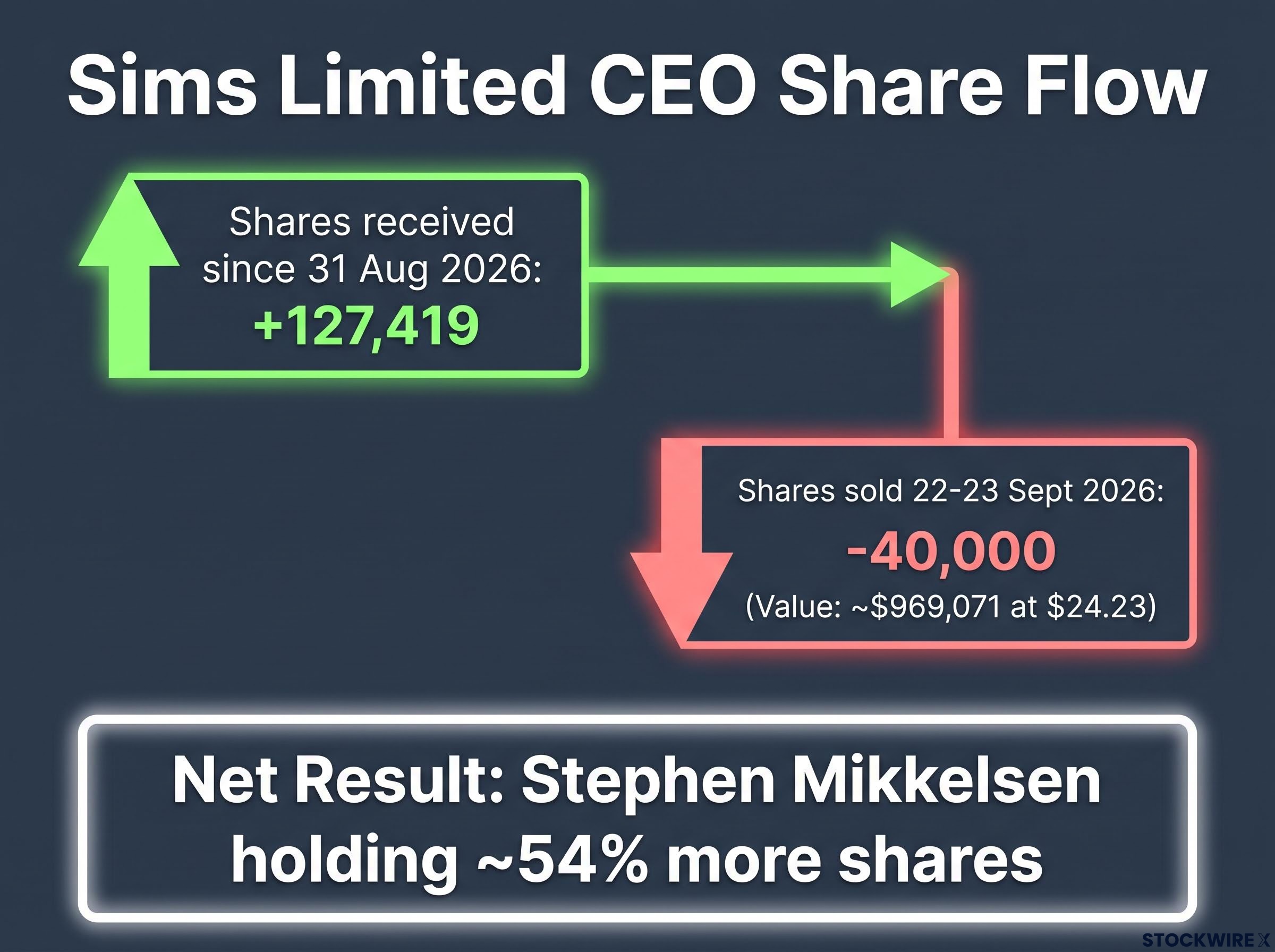
The week’s only insider sale reads, at first glance, as the contrarian data point. Stephen Mikkelsen, chief executive of Sims Limited, sold 40,000 shares at $24.23 across 22-23 September 2026, realising roughly $969,071 and cutting his holding by 13.8%.
Then the timeline dismantles that reading. Since 31 August 2026, Mikkelsen had received 127,419 shares through incentive schemes before selling any. Even after the sale, he holds roughly 54% more shares than he did before those allocations began.
- Incentive shares received since 31 August 2026: 127,419
- Shares sold on 22-23 September: 40,000
- Net change: still holding around 54% above the pre-allocation level
The result context reinforces the point. Sims posted a FY26 underlying EBIT of $468 million, up 167.6% and about 10% above the $426.9 million consensus, with underlying NPAT up 247.9% to $289.1 million. The stock still fell 11-12.8% on the 18 August 2026 result day, because revenue missed and a prior guidance upgrade had already priced much of the beat in. It then recovered to about $24.24 by the time Mikkelsen sold.
His forward commentary is not that of someone losing faith. He attributed first-half FY27 softness in the SLS division (guided to $75-90 million EBIT) to delayed data centre refresh cycles rather than structural decline, and flagged GPU repurposing as a growth avenue.
Mikkelsen described the GPU repurposing opportunity as “an order of magnitude higher” in complexity than the DDR4 and DDR5 opportunities, framing it as potentially larger.
Read together, this is routine liquidity management after a large equity windfall, not a bearish call. The headline (CEO sells nearly a million dollars of stock) and the reality (his stake is 54% larger than a month ago) point in opposite directions. It is the practical case for why raw insider data needs context before it can inform your view, and a reason to recalibrate the default assumption that CEO selling is inherently negative.
The interpretive gap between headline and reality in the Mikkelsen transaction is the same gap that makes any director share sale difficult to read without a structured checklist: the raw Appendix 3Y disclosure shows the number sold, not the net position change after incentive allocations.
Reading the week as a whole: what the pattern tells you heading into October
Step back from the individual trades and the shape is clear. Five purchases, one sale, and three of the six transactions were directors buying after earnings-driven declines of 7% to 22%, concentrated in the weeks right after the August reporting season opened trading windows.
The August 2026 reporting season produced a wider-than-normal gap between backward-looking beat ratios and forward guidance cuts, with nearly half of all ASX 200 constituents moving more than 5% on their result day, precisely the kind of volatility that creates the post-result mispricing where director buying tends to carry more analytical weight.
The week produced three conviction tiers. There is the major executive purchase (Verrocchi). There are the substantive NED buys with clear post-result context (Argaman, McGrath). And there are the small director buys with no available rationale (Lancaster, Murdoch). Sorting them this way tells you far more than counting purchases.
| Company | Insider | Transaction / value | Price | Key October catalyst |
|---|---|---|---|---|
| Sigma (SIG) | Verrocchi (CEO) | Buy / ~$5.09m | $2.55 | AGM trading update, $100m synergy target |
| Credit Corp (CCP) | McGrath (NED) | Buy / ~$121,085 | $13.633 | Not confirmed |
| Seven Group (SGH) | Argaman (NED) | Buy / $91,875 | $36.75 | Not confirmed |
| Sims (SGM) | Mikkelsen (CEO) | Sell / ~$969,071 | $24.23 | Not confirmed |
October is the verification event. Sigma’s AGM trading update is expected to address domestic same-store sales and reaffirm the $100 million synergy target. And SGH’s momentum at WesTrac and Boral, against Morgans’ $48.00 target versus the $36.75 purchase price (around 31% implied upside), will test Argaman’s read.
All four buying companies carry a Buy or Outperform rating from at least one major broker. That convergence of insider and analyst conviction into post-earnings weakness is what makes September 2026 a directional signal worth tracking, rather than a set of coincidences to note and forget. The October data points will tell you whether the insiders were right.
This article is for informational purposes only and should not be considered financial advice. Investors should conduct their own research and consult with financial professionals before making investment decisions. Past performance does not guarantee future results, and any forward-looking statements are subject to market conditions and various risk factors.