
The headline number looked like a gift for anyone hoping Norway’s rate hikes are finished. September inflation came in at 3.4%, below the 3.6% economists expected. Yet the underlying measure that Norges Bank actually targets landed above the central bank’s own forecast, and that detail matters more than the miss for where the krone goes next.
The central bank raised its policy rate to 4.50% on 23 September 2026. According to Brown Brothers Harriman (BBH), swaps markets now price roughly even odds of one more hike to 4.75% by year-end.
At the same time, softer oil prices are pulling the currency the other way. The krone sits between two competing signals: rate support on one side and crude weakness on the other.
Here is how to read a gap between inflation and a central bank’s forecast, how to interpret a swaps-implied probability, and how to weigh both against oil when you judge the currency’s next move.
Why a mixed CPI print leaves the hiking door ajar
On first read, Friday’s release from Statistics Norway (SSB) handed the doves a win. Headline CPI rose 3.4% year-on-year, up only slightly from 3.3% in August and a clear two-tenths below consensus. It also undershot Norges Bank’s 3.5% projection.
Then look one line down.
CPI-ATE, which is consumer prices adjusted for tax changes and excluding energy, rose 3.0% year-on-year and 0.2% month-on-month. That was below the 3.1% consensus but above the Bank’s 2.9% forecast. It was also the second consecutive month at 3.0%, which is still a full percentage point above the 2% target.
The Statistics Norway CPI release confirms the underlying picture: CPI-ATE held at 3.0% year-on-year for a second month, which means the revised August figure and the September print point to stalling rather than accelerating disinflation.
| Measure | Actual | Consensus | Norges Bank forecast |
|---|---|---|---|
| Headline CPI (y/y) | 3.4% | 3.6% | 3.5% |
| CPI-ATE (y/y) | 3.0% | 3.1% | 2.9% |
Source: Statistics Norway; consensus and forecast figures via BBH. Some data providers showed August CPI-ATE at 3.1%, but SSB’s official figure is 3.0%.
Why the underlying gap carries more weight
Consensus tells you whether traders were surprised. The Bank’s forecast tells you whether policymakers were surprised, and only the second shapes the next rate decision. Norges Bank uses CPI-ATE as its main gauge of underlying inflation, so a miss against its own projection carries far more weight than a miss against economists.
The Bank’s Monetary Policy Report, published on 24 September, described CPI-ATE as slower and lower than projected. That comment pre-dates the September release, so it should not be read as a verdict on this print.
A 0.1 percentage point overshoot on the preferred measure tells you disinflation is not running ahead of schedule. One soft headline number does not close the case for hikes.
When big ASX news breaks, our subscribers know first
What Norges Bank has said, and what swaps markets are pricing
That overshoot lands on top of guidance that already leans two ways. On 23 September, the Monetary Policy and Financial Stability Committee lifted the rate from 4.25% to 4.50%, effective 25 September.
Norges Bank’s rationale The Committee judged that “a somewhat tighter monetary policy stance is needed to return inflation to target within a reasonable time horizon.”
The accompanying rate path is more restrained than that language suggests. It shows the policy rate holding near current levels for a period before declining somewhat, with inflation reaching 2% in 2029. Further hikes are not the baseline, although the Bank has stressed the path is a forecast, not a commitment, and that it stands ready to adjust.
Markets are less settled. Per BBH, swaps imply about 50% odds of a 25bps hike to 4.75% by year-end.
How to read a 50% swaps probability
A swap is a contract where two parties exchange fixed and floating interest payments, so its price reveals where traders expect rates to average. A reading near 50% describes a balanced spread of outcomes. It is not a forecast that a hike is half-delivered.
These probabilities move with every data release and speech. Yesterday’s CPI-ATE overshoot is exactly the kind of input that keeps the hawkish half of the distribution alive.
Analyst views show how wide the spread can be:
- Sticky inflation camp: BBH argues underlying inflation running above the Bank’s projections leaves room for more tightening, which supports the krone.
- Disinflation camp: SEB expected cuts in late August, including a move to 4.25% and a year-end rate of 3.85%. Norges Bank hiked instead, a reminder of how quickly a consensus can flip.
No public hike odds from Nordea, DNB, Danske, ING or Reuters polls were available, so the swaps reading is the clearest market gauge for now.
A coin-flip in pricing means the next CPI release and the 5 November decision could swing the krone’s rate support sharply either way. Treat the 4.75% scenario as live but unconfirmed.
The same hike that keeps swaps pricing balanced has also repriced the USD/NOK outlook, with the dollar side of the pair adding its own variable through expected Federal Reserve easing.
How oil and rate expectations pull the krone in different directions
The krone’s rate support is only half of its story. The other half is oil, and the popular view treats NOK as little more than a barrel of crude with a currency code.
The logic runs like this. Norway exports oil, so higher prices lift export revenue and improve its terms of trade, the ratio of export prices to import prices. A stronger trade position should mean a stronger currency.
That link is weaker than it looks. The Government Pension Fund Global, Norway’s sovereign wealth fund, invests oil income in foreign assets rather than converting it all into krone, which dilutes the mechanical connection.
The weak oil link is not unique to Norway, since every petro-currency faces dilution from sovereign investment flows, safe-haven demand for the dollar and a fading oil beta.
Rate differentials can matter more. If Norges Bank is expected to keep rates above the European Central Bank (ECB) and the US Federal Reserve, investors earn extra yield, known as carry, for holding krone. If 4.50% is seen as the peak, that advantage fades.
The currency moves hardest when both forces point the same way. When they conflict, global risk appetite usually decides the winner.
| Scenario | Oil direction | Rate expectation | Likely NOK effect |
|---|---|---|---|
| Aligned bullish | Rising | Hikes priced in | Strongest support |
| Aligned bearish | Falling | Peak or cuts priced | Strongest pressure |
| Conflict (current) | Falling | Hike odds alive | Mixed; risk sentiment decides |
| Conflict | Rising | Peak or cuts priced | Mixed; carry support fades |
Today’s setup fits the third row. BBH observed that NOK softened against most counterparts after a small crude decline, yet it still views the inflation data as supportive of the currency.
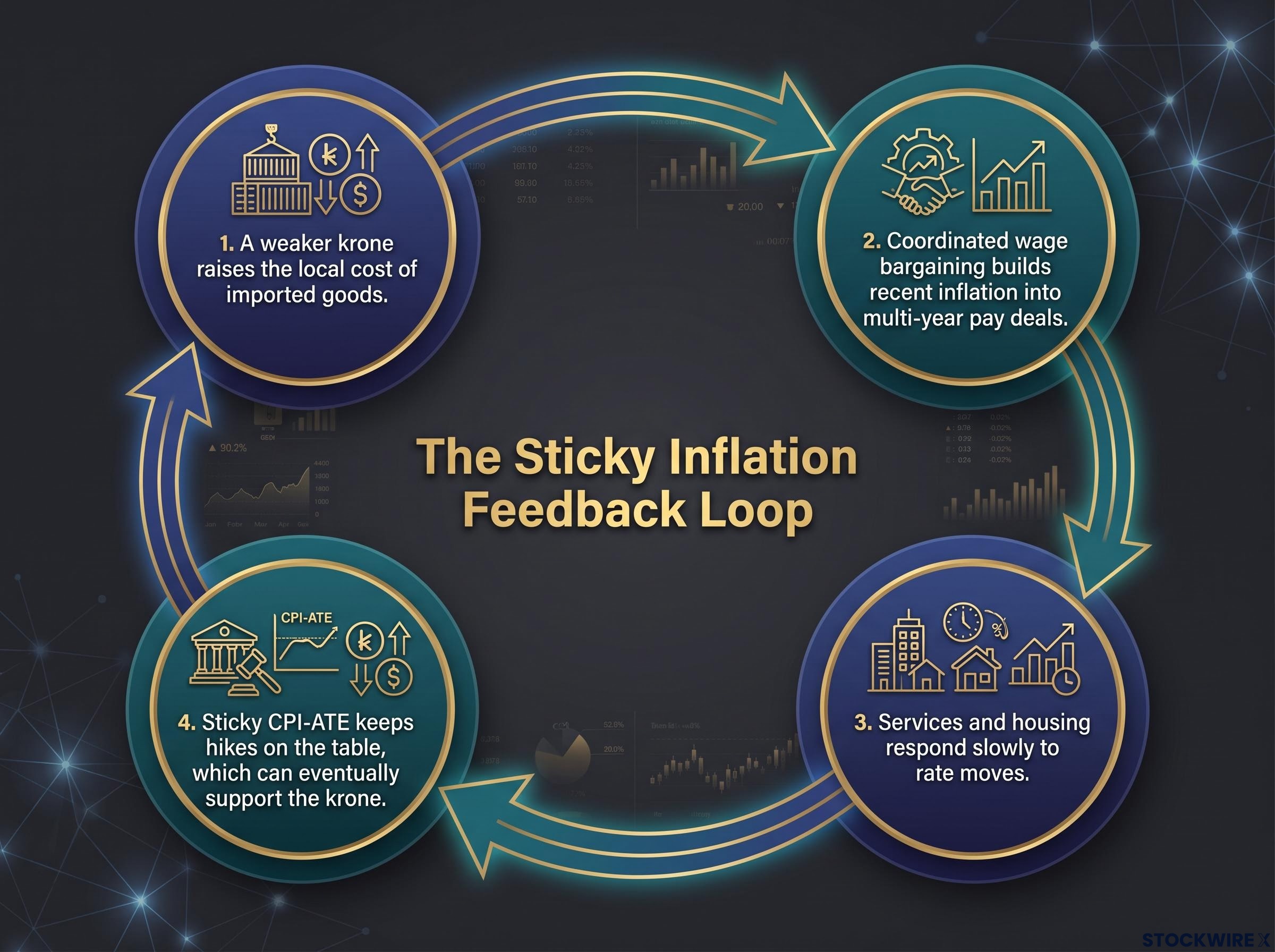
The sticky inflation feedback loop
Domestic forces make this loop self-reinforcing:
- A weaker krone raises the local cost of imported goods.
- Coordinated wage bargaining builds recent inflation into multi-year pay deals.
- Services and housing, a large share of CPI-ATE, respond slowly to rate moves.
- Sticky CPI-ATE keeps hikes on the table, which can eventually support the krone.
For you, this means oil headlines alone are an unreliable krone signal. Watch rate expectations first, then use crude as the amplifier or the brake.
What could undo the hiking case
The hawkish reading built so far rests on data that has barely a month to prove itself. Several developments could flip it before year-end:
- Overtightening and housing strain: At 4.50%, policy is already restrictive, and more hikes would lift mortgage costs, likely cooling hike bets and softening carry support.
- Global growth slowdown: Weaker European demand would hit exports, pushing the Bank toward caution and removing a leg of krone support.
- Krone rebound: Stronger oil or risk appetite could lift NOK, cutting imported inflation and weakening the argument for another hike.
There is precedent too. The ECB, the Fed and the Bank of England have often paused once policy looked restrictive and disinflation was visible, even with core inflation above target, citing the lag before rate rises take full effect.
The Bank’s own baseline assumes gradual convergence to 2% by 2029. Faster disinflation could bring cuts forward, while renewed pressure in CPI-ATE or wage settlements could prompt more tightening.
Three signposts will test the balance:
- The next CPI release, especially CPI-ATE against the Bank’s path.
- Wage data and settlement news ahead of year-end.
- The Norges Bank decision on 5 November 2026.
Hold the hike scenario as one of two balanced outcomes. Set your own triggers, such as CPI-ATE above the Bank’s path or a weaker krone, that would move you toward the hawkish side.
Past performance does not guarantee future results. Market-implied probabilities and central bank projections are subject to change as new data arrives.
Weighing the Norwegian krone outlook into the 5 November decision
A soft headline print, a flat-to-lower official path, coin-flip swaps odds and an oil-versus-rates tug of war all point to a two-way krone rather than a one-way call.
The framework holds regardless of which side wins. Compare actual CPI-ATE with the Bank’s forecast, not with consensus. Read swaps pricing as a probability, not a promise. Weigh oil only after you have settled where rate expectations stand.
The next CPI release and the 5 November decision will tip the balance. Your edge comes from knowing in advance what result would change your view, rather than reacting to the headline when it lands.
This article is for informational purposes only and should not be considered financial advice. Investors should conduct their own research and consult with financial professionals before making investment decisions.