Two ASX directors traded shares in their own companies inside the same narrow window of Australian market history. One now faces a joint investigation by the Australian Securities and Investments Commission (ASIC) and the Australian Federal Police (AFP). The other is sitting on a 27% gain and a reputation for reading his own business correctly.
The difference between them is not luck.
Richard White sold roughly $229 million worth of WiseTech Global shares during a restricted blackout period without disclosing it to the market at the time. Steven Marks spent just over $1 million buying Guzman y Gomez shares on the open market as the stock fell more than 40%, declared the purchase publicly, and waited.
Together, these two cases compress the full spectrum of ASX director trading conduct into a single comparative frame, one that rarely appears so cleanly in Australian markets. On one end sits potential insider trading. On the other, a compliant, signal-rich conviction buy.
This gives you a working framework for telling the two apart: how to distinguish disclosed, thesis-backed director buying from the compliance failures and red flags that tend to precede regulatory action, using two real Australian cases as your reference points.
How Richard White turned a $229 million blackout sale into an ASIC and AFP investigation
To see the compliance problem clearly, follow the trades in the order a regulator would reconstruct them.
White, co-founder and former chief executive of WiseTech Global, sold shares in two distinct tranches. The first ran from 2 October to 20 December 2024, covering roughly 3.6 million shares for proceeds exceeding $440 million. Those sales were disclosed and fell outside the company’s blackout window. Nothing about them was unusual.
The second tranche is where the picture changes. The 1.87 million shares White offloaded between late December 2024 and mid-February 2025 generated proceeds of approximately $229 million, at an average sale price in the vicinity of $122 per share. Both conditions that define the compliance problem attached to this tranche: the sales took place inside WiseTech’s blackout period, and no disclosure reached the market while they were occurring.
The timing of White’s role sits at the centre of the matter. His departure from the chief executive role came in October 2024, after which the company placed him on a full-time consulting basis before he was appointed executive chairman when he formally rejoined the board in late February 2025. The undisclosed blackout-period sales fell squarely in that transition gap, after he had ceased to be chief executive and before he formally became chair.
| Tranche | Period | Shares Sold | Proceeds | Disclosed / Blackout |
|---|---|---|---|---|
| First | 2 Oct – 20 Dec 2024 | ~3.6 million | >$440 million | Disclosed / Outside blackout |
| Second | 24 Dec 2024 – 19 Feb 2025 | ~1.87 million | ~$229 million (avg ~$122/share) | Not disclosed / Within blackout |
From search warrant to share price collapse
The matter escalated sharply in October 2025. WiseTech told the market that officers of both regulators had arrived at its Sydney office with a warrant.
WiseTech ASX announcement, 28 October 2025 “Officers of ASIC and the Australian Federal Police executed a search warrant… regarding alleged trading in WiseTech shares by Richard White and three WiseTech employees.”
The market reacted immediately. WiseTech shares fell approximately 16% in a single session to $71.52. The investigation scope extends beyond White to three WiseTech employees, and as of the most recently reported date in March 2026, no charges had been laid.
ASIC’s dedicated insider trading team, established in late September 2024, was designed to compress the time between surveillance and criminal referral, and the Rodney Forrest prosecution, completed within approximately one year from investigation to custodial sentence, is the clearest demonstration that the regulator now operates at a materially faster tempo.
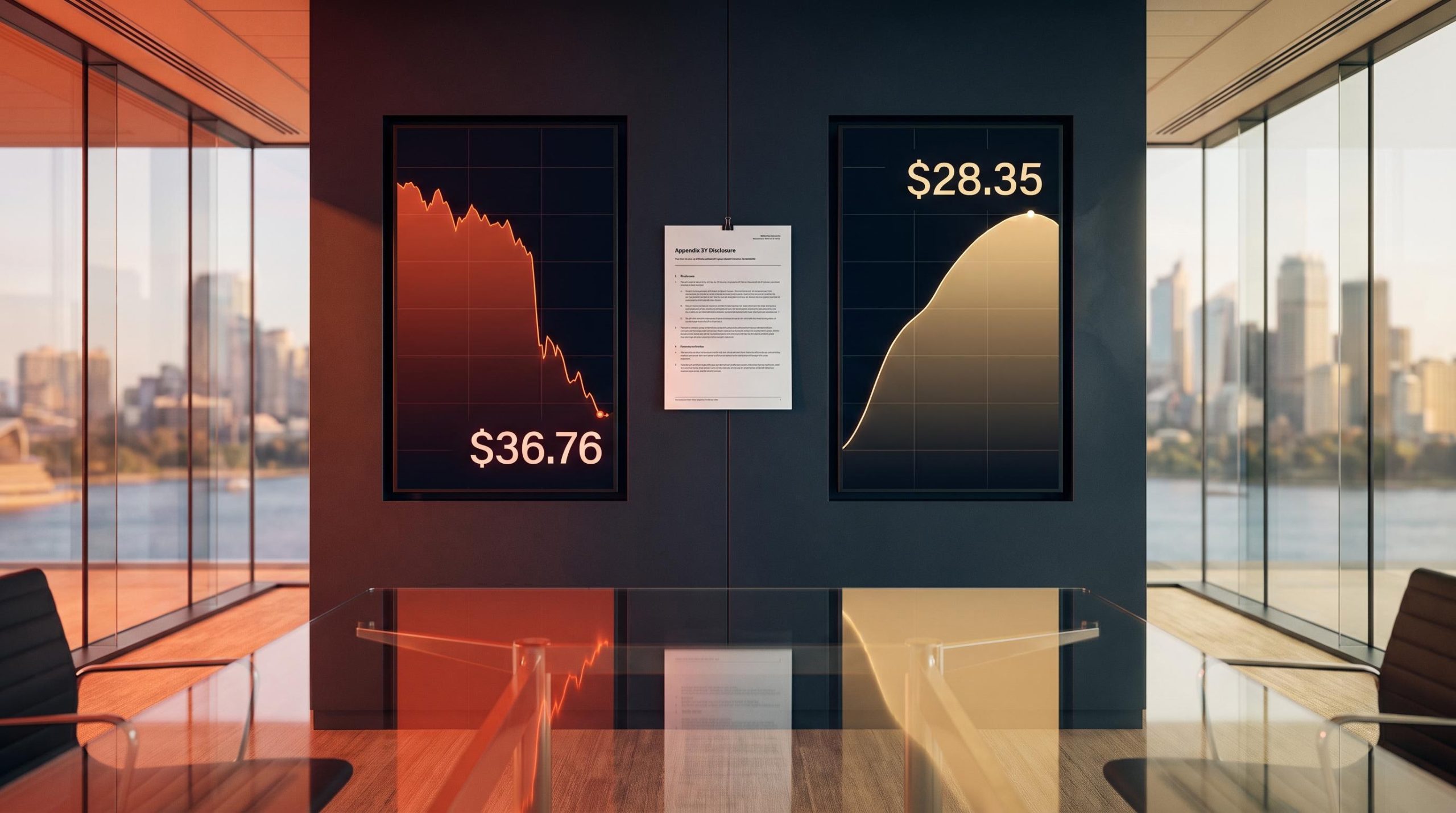
Here is the number to sit with. As of 3 September 2026, Intelligent Investor reported WiseTech trading at $36.76, less than one-third of the $122 average price at which White’s undisclosed blackout sales were executed.
That gap means whoever bought those shares during the blackout window has lost more than two-thirds of their capital. Understanding why the buyers were so badly wrong requires asking what White might have known that the market did not, which is precisely the question the regulators are now investigating.
When big ASX news breaks, our subscribers know first
What Steven Marks did differently, and why it paid off
Now run the opposite case, and let the price sequence tell the story.
Marks, co-founder and co-chief executive of GYG, deployed just over $1 million to acquire 45,000 shares at $22.35 apiece on 19 November 2025, taking his total holding to approximately 9.88 million shares. By that point, the stock had shed more than 40% of its value across the year. Rather than trade quietly, Marks made his conviction public.
Steven Marks, GYG co-CEO He stated he believed the shares were significantly undervalued, with approximately 20 years of growth potential ahead for the business.
What happened next is the part retail investors most need to absorb. The stock did not turn on his purchase. It kept falling.
The share price sank to a trough of $15.06, a further decline of roughly 33% below Marks’ buy-in. Anyone who followed his announcement at face value and sold at the bottom would have crystallised a heavy loss, not a gain.
Then the catalysts arrived. Here is the full trajectory:
- Purchase at $22.35 on 19 November 2025
- Trough at $15.06, approximately 33% below purchase
- May 2026 US market exit announced, lifting the share price up to 20% in a single session
- August 2026 FY26 results, pushing the stock above $30
- Current price of $28.35 as of 2 September 2026 (Intelligent Investor)
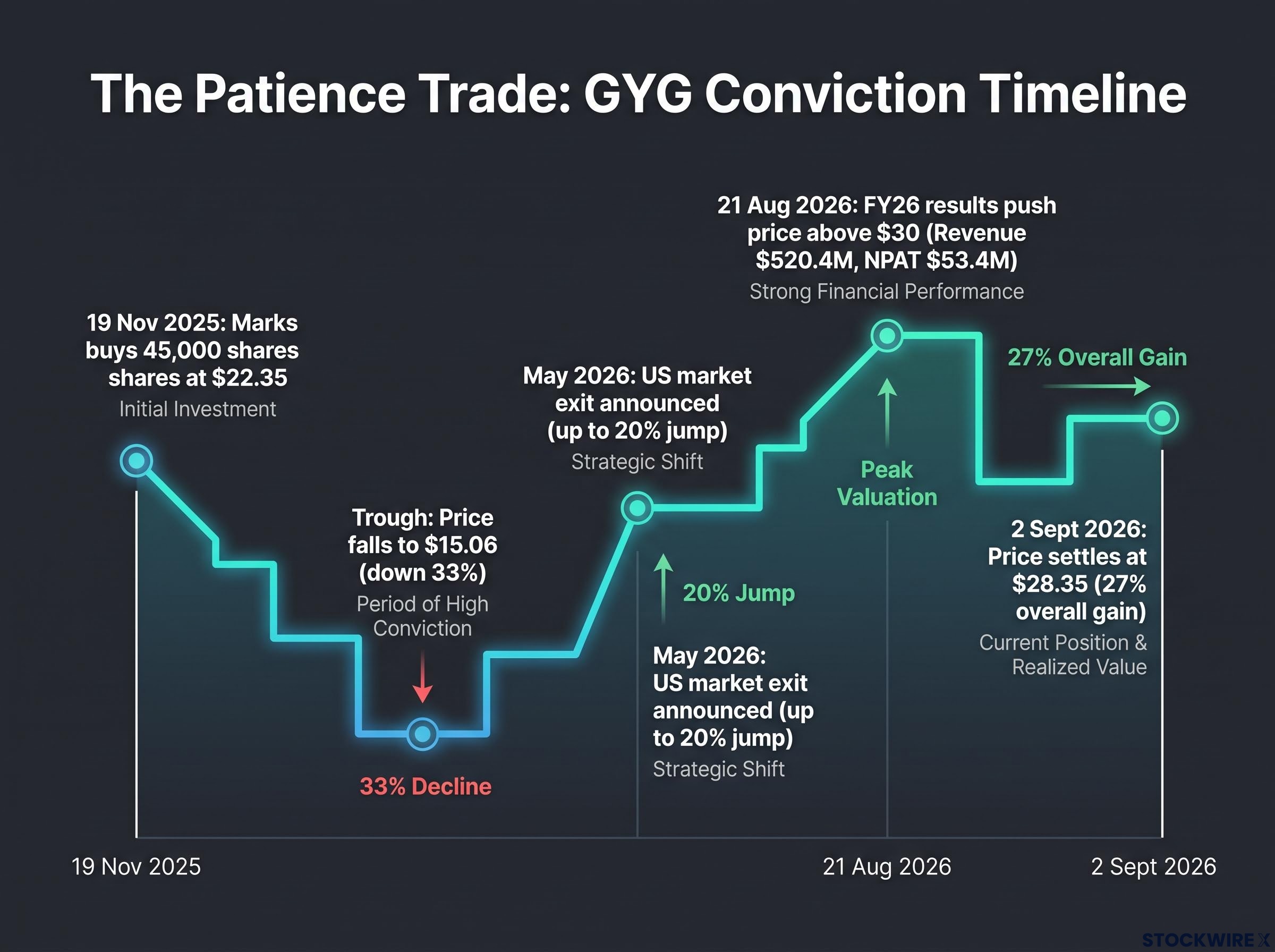
The FY26 results, released on 21 August 2026, gave the thesis its fundamental backing. Revenue reached $520.4 million, up approximately 21.8%. Underlying net profit after tax (NPAT) came in at $53.4 million, up 29.7%. The board declared a final dividend of 40.6 cents per share fully franked and announced a share buyback.
The lesson is uncomfortable but important. Following a director buy at the moment of announcement is not the same as following the director’s conviction. Marks’ eventual 27% gain required holding through a 33% drawdown first, and that patience, not timing, is what earned the return.
Why “I was just a consultant” is not a legal defence under Australian law
White’s core defence is that he traded as a consultant, not an executive or director. To see why that argument is weaker than it sounds, build it up from the law itself.
The statutory foundation is section 1043A of the Corporations Act 2001 (Cth). It prohibits any person from trading while in possession of non-public, price-sensitive information. The prohibition attaches to the information a person holds, not to their formal job title or employment status. A consultant with inside knowledge is captured just as fully as a sitting director.
Section 1043A of the Corporations Act prohibits any person, not just formal executives, from trading while in possession of non-public, price-sensitive information, and ASIC has used this provision to secure 46 criminal convictions since 2009, including against company chairs and chief executives.
Company policy then narrows the gap further. WiseTech’s own securities trading policy prohibits directors and senior managers from dealing during blackout periods, and grants the company secretary authority to extend that restriction to any other person who “possesses inside information.”
What WiseTech’s own policy says about the consultant defence
That extension clause exists for a specific reason: to stop a role-transition gap from becoming a compliance loophole. A departed executive who keeps access to confidential information does not escape the policy simply by changing their title on the corporate register.
White maintains he obtained legal advice confirming he was permitted to sell as a consultant, as reported by HRD/HCAMag on 23 March 2026. But permission under a policy is not the operative test.
Nine Entertainment reported on 7 July 2026 that the ASIC investigation “is likely to come down to whether or not the sale of shares was made using privileged information not available to other investors.” In practice, ASIC and the AFP will weigh three things:
- His formal role, or absence of one, at the time of the trades
- His ongoing access to financial data and board-level meetings
- Whether he possessed non-public, price-sensitive information when he sold
For anyone reading an Appendix 3Y filing, this reframes the question. The issue is not whether the trading director held a formal title. It is whether they had access to information the market did not, a harder and more important standard to judge from outside a boardroom.
Reading director trades as market signals: what the evidence actually supports
Start with the bullish case, because it is genuinely strong. Insiders sell for many reasons, but they typically buy for one: the belief the price will rise. Open-market director purchases, especially after a heavy price fall, are widely treated as bullish contrarian signals in both Australian and global commentary.
Now complicate it. The GYG case is a real-world stress test of that framework, and it cuts both ways. Marks was ultimately right, but an investor who bought on his announcement and sold at the $15.06 trough would have taken a 33% loss rather than his eventual 27% gain. Conviction timing and investor timing are not the same thing.
The cautionary evidence reinforces this. InsidersAlpha’s framework stresses that price-dip buying is no guarantee; a stock can keep falling after an insider buys, and insider signals work best alongside fundamentals and cluster buying. Wilson Asset Management takes the mirror position on sells, saying it is generally sceptical when board members substantially reduce their holdings, treating heavy sales as a warning sign.
The WiseTech and GYG outcomes bookend the spectrum cleanly.
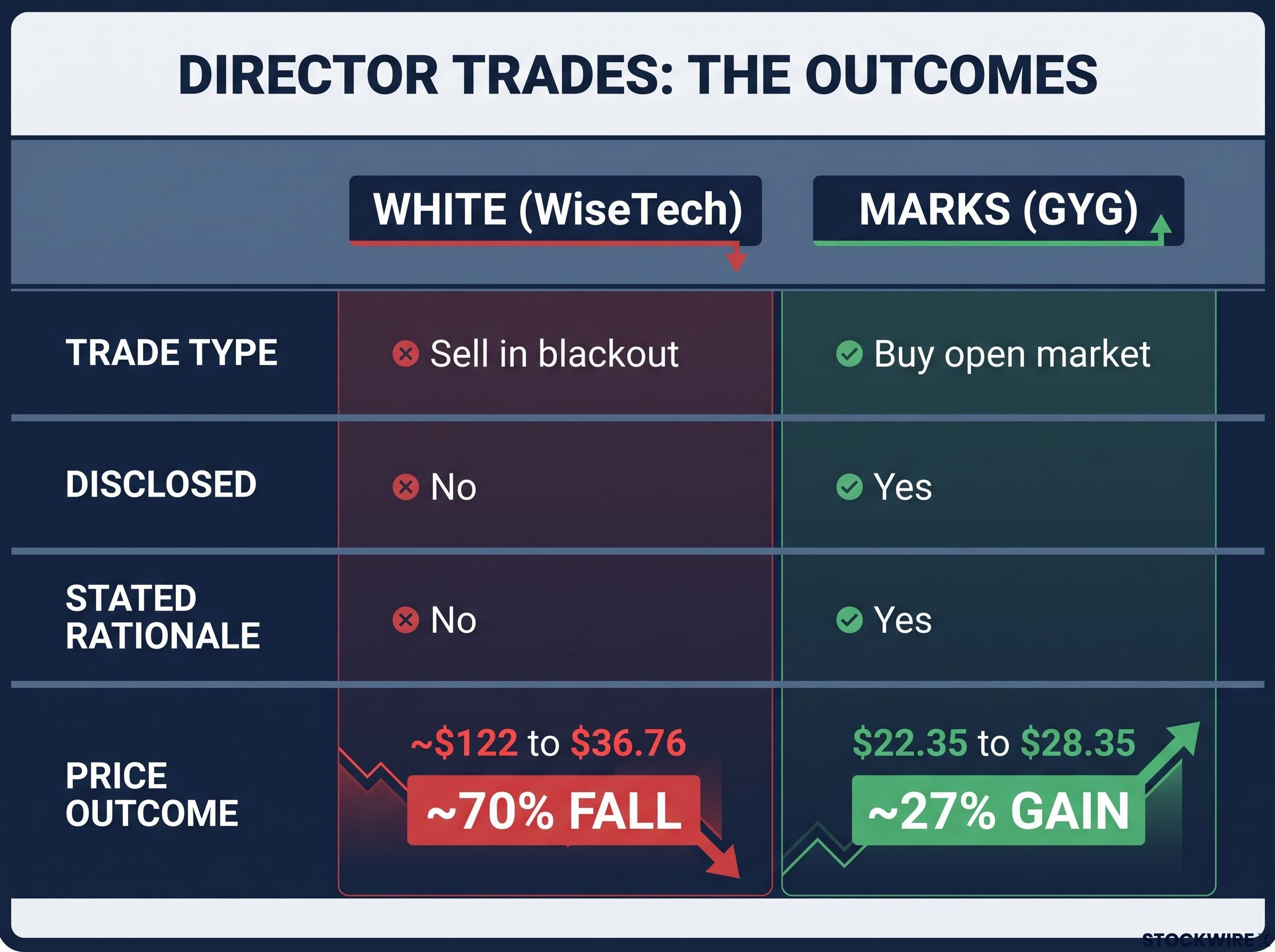
| Director / Company | Trade Type | Disclosed | Stated Rationale | Price Outcome |
|---|---|---|---|---|
| White / WiseTech | Sell (in blackout) | No | No | ~$122 to $36.76 (~70% fall) |
| Marks / GYG | Buy (open market) | Yes | Yes | $22.35 to $28.35 (~27% gain) |
When you assess a director trade, these conditions strengthen the signal:
The distinction between purchased equity versus granted equity is a governance signal that institutional investors and proxy advisers now scrutinise as standard practice, with open-market buys like Marks’ carrying stronger alignment weight than shares received as compensation because they reflect a deliberate commitment of personal capital at a specific price.
- Meaningful trade size relative to the director’s personal wealth
- An open-market purchase, not bonus shares or exercised options
- A public declaration accompanied by a stated investment thesis
- Cluster buying, where multiple insiders act together
Where a trade ticks those boxes after bad news has been fully disclosed, it sits at the high-signal end. Undisclosed sells inside a blackout sit at the red-flag end. The price outcomes in both cases reinforce, rather than contradict, that reading.
What these two cases change about how to read an Appendix 3Y
WiseTech and GYG amount to a rare natural experiment: two director trades on the same exchange, in the same market window, with opposite compliance and performance outcomes. WiseTech fell from around $122 to $36.76, a decline of roughly 70% from the sale price. GYG rose from $22.35 to $28.35, a gain of about 27%. The framework built across this article predicted the direction of both.
A structured Appendix 3Y checklist, covering sale scale, security class, direct versus indirect holdings, and boardroom-wide patterns, converts a raw filing into an informed assessment rather than an emotional trigger, which is the interpretive discipline the GYG and WiseTech cases both reward.
So the next time you open an Appendix 3Y filing, bring four questions to it:
- Was the trade disclosed promptly, or was there a delay?
- Did it occur during, or close to, a blackout period?
- Was there a publicly stated investment rationale?
- How large was the trade relative to the director’s known holding?
These answers predict outcomes more reliably than the headline trade direction alone. A disclosed buy with a thesis behind it carries very different weight from an undisclosed sell wedged into a reporting blackout.
ASIC guidance principle (2020) “Compliance with a trading policy does not remove insider-trading obligations.” Policy clearance is not a safe harbour. The operative question is always possession of non-public, price-sensitive information.
The WiseTech investigation remains unresolved as of September 2026, with no charges laid. Its outcome will help settle whether the consultant defence carries any practical legal weight in Australian insider-trading cases, which makes it worth continuing to monitor as a precedent.
This article is for informational purposes only and should not be considered financial advice. Investors should conduct their own research and consult with financial professionals before making investment decisions. Past performance does not guarantee future results.