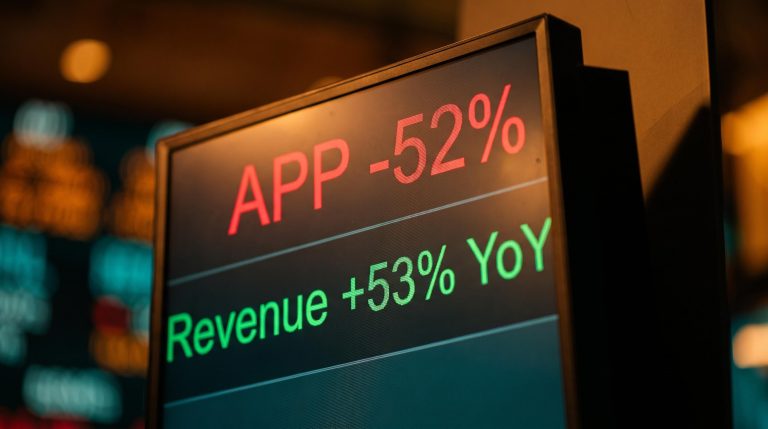
Consider a company that beat every earnings estimate for multiple quarters, pushed its adjusted EBITDA margin above 80%, and still watched roughly a quarter of its market value evaporate after one modest revenue miss. That is not a normal price reaction. It is what happens when a stock is priced so tightly that everything has to go right.
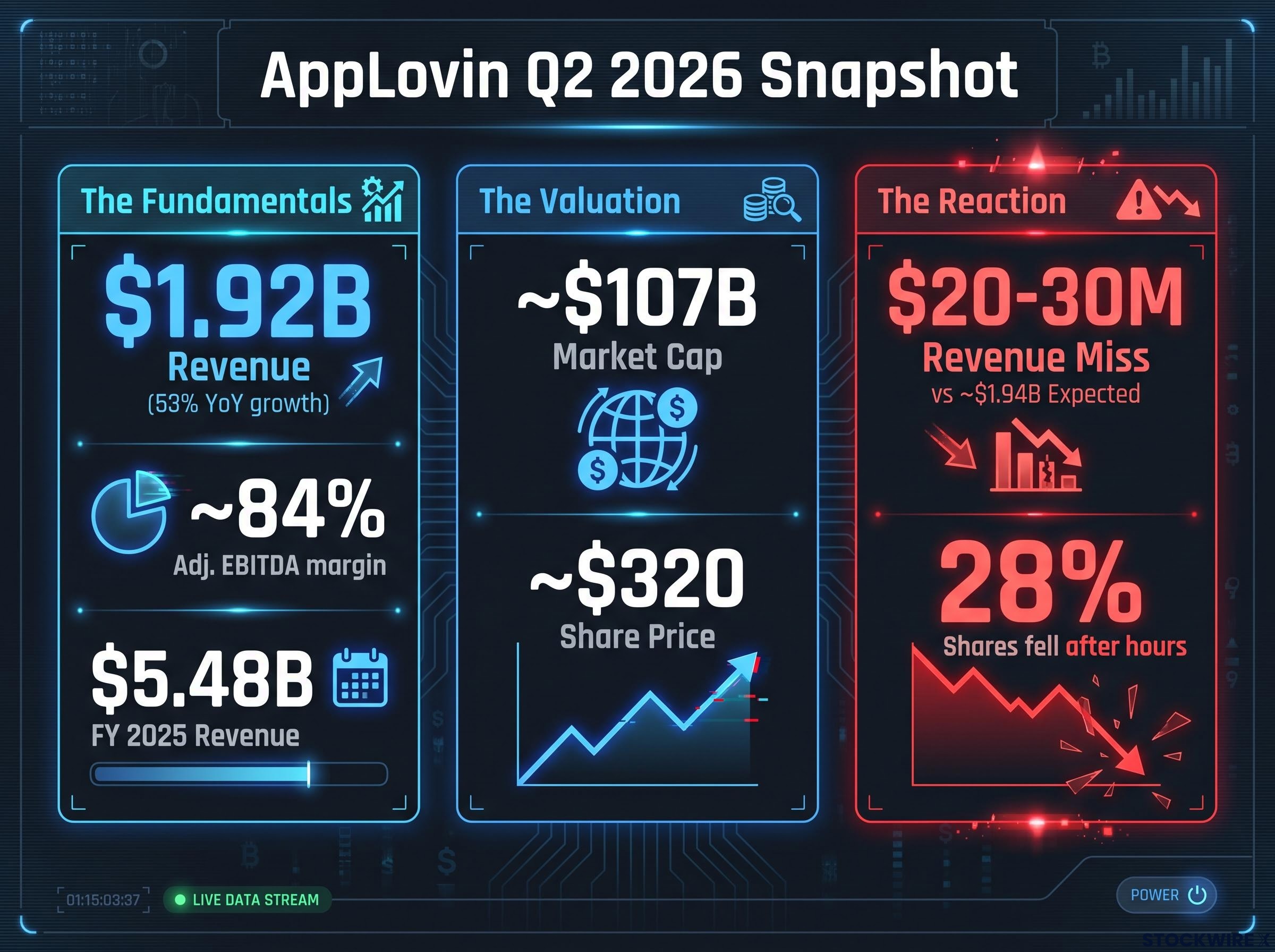
AppLovin is that company. Its shares fell about 28% after hours when it reported Q2 2026 revenue of $1.92 billion, a number that grew 53% year-over-year but landed a few tens of millions below what Wall Street wanted. When a $107 billion business loses a quarter of its value on a rounding error, the market is telling you the margin for error has been squeezed close to zero.
The pressure did not come from nowhere. Over roughly eighteen months, eight short-seller reports built a persistent narrative around how AppLovin’s AXON advertising algorithm actually works, and an SEC inquiry that followed has now closed without any enforcement action.
Here is what the evidence supports. This piece separates what the short-seller campaign actually established from what it merely alleged, explains what the SEC’s “no action” outcome does and does not resolve, and gives you a framework for monitoring the stock instead of reacting to the next report or the next quarterly miss.
Eight reports in eighteen months: what the volume of short-seller scrutiny actually signals
Eight short-seller reports on a single company over roughly eighteen months, from approximately seven distinct firms or individuals, is a concentrated campaign by any measure.
That volume matters on its own, independent of whether any single report holds up. Short sellers profit from a stock falling, so a lone report is easy to dismiss as a trade dressed up as research. Seven different sources circling the same company over a year and a half is harder to wave away.
What makes the AppLovin campaign analytically interesting is not the count but the convergence. Fuzzy Panda Research, Culper Research, Muddy Waters Research, and CapitalWatch came with different institutional affiliations, different methodologies, and different specific claims. Yet each arrived at a related concern: that AXON’s performance edge rests on how it acquires data, not purely on the strength of its AI.
The market treated these as credible, not as noise. On 26 February 2025, the Fuzzy Panda and Culper reports sent AppLovin’s shares down 13-23% intraday. Fuzzy Panda described AXON as “the foundation of a House of Cards.” A month later, on 27 March 2025, Muddy Waters published a report alleging that AppLovin was “impermissibly extracting proprietary IDs” from Meta, Snap, TikTok, Reddit, Google, and others through a technique it called “identifier bridging.” The stock fell roughly 20%.
| Source | Date | Primary allegation | Approx. stock reaction |
|---|---|---|---|
| Fuzzy Panda & Culper | 26 February 2025 | Data appropriation and app-store rule violations; AXON a “House of Cards” | Down 13-23% intraday |
| Muddy Waters | 27 March 2025 | “Identifier bridging” from Meta, Snap, TikTok, Reddit, Google; 23% advertiser churn | Down approx. 20% |
| CapitalWatch | January 2026 | Money-laundering claims (later partially retracted, report removed) | Partial retraction, Jefferies reaffirmed Buy |
Why overlapping allegations carry more weight than individual reports
When multiple independent actors, each with different institutional interests, identify the same category of alleged vulnerability, the overlap is itself informative. The AppLovin reports did not scatter across unrelated concerns. They clustered on a single theme: unauthorised data extraction and terms-of-service violations at the platform level.
That convergence lowers the odds that any one report was purely manufactured for trading profit. It does not prove the allegations true. It simply means the concern is not the invention of a single short thesis, which is the honest starting point for any risk assessment on this stock.
Short-seller campaign dynamics produce asymmetric risks for retail investors on both sides of the trade: the cost structure and timing risk that make shorting a stock like AppLovin dangerous also explain why allegations that later prove unfounded can still cause lasting valuation damage before they are resolved.
Academic research on short-seller informativeness finds that short sellers contribute to market efficiency by surfacing overpricing, with multiple studies showing that convergence across independent short theses is a stronger signal of genuine underlying risk than any single report issued in isolation.
The CapitalWatch report from January 2026, which alleged money laundering, is the clearest counter-example, and it deserves an asterisk. CapitalWatch later distanced itself from specific claims, and the original report became unavailable. AppLovin called it “rife with false, misleading, and nonsensical allegations.” But one partial retraction does not neutralise the remaining seven reports or the overlapping specificity of the data-practice allegations that preceded it.
When big ASX news breaks, our subscribers know first
What the SEC inquiry resolved, and the limit of what a “no action” outcome actually means
The SEC closure is genuinely good news for shareholders, and it deserves full weight before anything else is said.
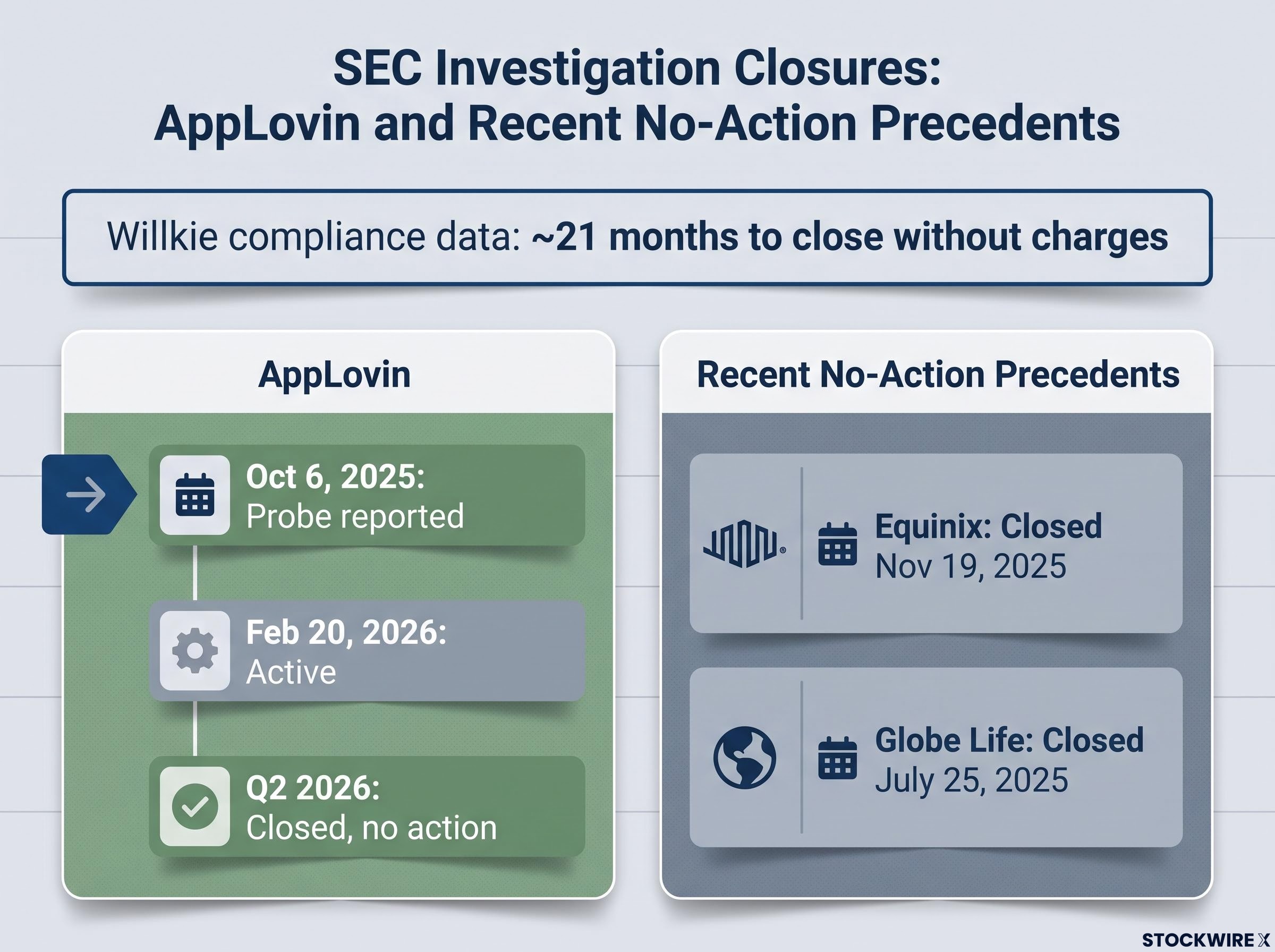
The inquiry began after Bloomberg and Reuters reported on 6 October 2025 that the SEC was probing AppLovin’s data-collection practices, triggered by a whistleblower complaint and the short-seller reports. According to JD Supra’s legal analysis, the SEC’s Cyber and Emerging Technologies Unit examined allegations including device fingerprinting and violations of platform partner agreements. As late as 20 February 2026, Reuters reported via a FOIA response that the investigation remained active.
Then it ended. On the Q2 2026 earnings call, Chief Financial Officer Matt Stumpf confirmed the outcome directly.
“The SEC has recently advised us that it concluded its inquiry with no recommended action,” said Matt Stumpf, Chief Financial Officer, adding that no enforcement action or findings of wrongdoing were issued.
That removes the most acute tail risk on the table: the possibility of regulatory fines or sanctions. And the outcome is far from unusual. Short-seller-triggered SEC probes that end quietly are common, as three reference points make clear.
- Equinix: The SEC concluded its investigation on 19 November 2025 without recommending enforcement, after a probe triggered by a short-seller report alleging stock manipulation.
- Globe Life: The SEC closed its investigation on 25 July 2025 with no enforcement action, more than a year after short sellers alleged fraudulent insurance practices.
- Willkie compliance data: SEC investigations triggered by short-seller reports take roughly 21 months to close without charges, making closure a statistically expected outcome rather than a surprise.
So where is the limit? A “no action” outcome means the SEC did not find sufficient evidence to pursue charges under its own mandate. It does not mean the underlying practices were proven compliant. And critically, it says nothing about the risk that animated the short-seller campaign in the first place.
That risk sits with the platforms, not the regulator. If AXON’s identifier-bridging practices violate the terms of service set by Apple, Google, or Meta, those companies can restrict or penalise AppLovin at will, and none of that falls within the SEC’s jurisdiction. The regulator never adjudicated it, because it was never the regulator’s question to answer.
Platform-level regulatory risk plays out differently from SEC enforcement: Alphabet’s antitrust proceedings show how a regulator can leave quarterly results intact for years while forcing structural changes to data access and distribution agreements that reshape the competitive dynamics of the entire digital advertising market.
Here is what that means for you. The distinction between regulatory clearance and business-practice vindication is not pedantic. It determines whether the core risk from the short thesis has actually dissipated or simply migrated to a venue the SEC does not police. The most acute downside scenario is off the table. The structural one is not.
The “array” discontinuation: what a company’s own product decisions reveal when short sellers cannot
Sometimes the most revealing evidence about a company comes not from its critics but from its own decisions. AppLovin’s handling of a product element known internally as “array” is the clearest example in the public record.
The sequence tells the story on its own.
- In Q4 2023, AppLovin described array as a top revenue growth driver, one of the engines pushing its results higher.
- Short-seller reports later identified array as a product allegedly used improperly, tied to the same data-practice concerns raised across the campaign.
- Shortly after those allegations became public, AppLovin discontinued elements of the product, citing economic non-viability as the reason.
A product does not usually travel from “top revenue growth driver” to “economically non-viable” in a short window. When that shift coincides with public allegations, the sequence is objectively difficult to read as coincidence, even though no wrongdoing has been established and none should be assumed.
Structural decline in ad-tech can be masked by headline revenue growth for multiple quarters before it becomes undeniable: The Trade Desk’s trajectory from 18.5% full-year growth to a guided contraction offers a case study in how quickly an advertising platform’s edge can erode when data access and inventory ownership are constrained.
What makes this hard to evaluate is that investors had no independent way to check. AppLovin’s disclosure runs to revenue, adjusted EBITDA, EPS, free cash flow, and broad Software Platform segment figures. It does not publish granular advertiser cohort metrics, install-volume trends, or per-vertical return-on-ad-spend data. Without those numbers, there was no way to track array’s performance trajectory before the discontinuation, which made management’s stated rationale impossible to verify or challenge with data.
The one number that did surface came from outside the company. Muddy Waters reported that roughly 23% of advertisers holding AXON pixels in early Q1 2025 no longer had them by late March, directly contradicting management’s claim of “no churn.” That figure was independently sourced, not drawn from any AppLovin disclosure.
Why KPI opacity amplifies short-seller risk specifically for AppLovin
The absence of granular metrics means every short-seller allegation lands without a counterweight. When a company publishes transparent, independently verifiable performance data, a false claim can be checked and dismissed. When it does not, each allegation stands unchallenged until a quarterly result either confirms or contradicts it, months later.
That gap is not a peripheral governance complaint. It is the mechanism by which internal deterioration stays invisible until it becomes undeniable, and for a stock trading at AppLovin’s premium, the delay compounds the damage when the truth finally lands.
The disclosure gap is more notable given the scale. At a market capitalisation of roughly $107 billion, AppLovin has the resources to publish a structured investor deck with granular metrics, yet it does not. Investors looking for supplementary signals can watch S&P Global’s research notes on AppLovin’s debt instruments, which sometimes carry commentary relevant to equity holders. A Q2 2026 Seeking Alpha analysis added a further concern, arguing that recent growth was “almost entirely price-driven,” with install volume falling and sequential growth decelerating to about 4%. Reported revenue stayed strong at $1.92 billion with margins near 84%, but the underlying user-acquisition dynamics may be softening beneath the headline.
Building a short-seller-informed due-diligence framework for a high-premium stock
Short-seller reports are not binary. They are neither gospel truth nor pure fabrication, and processing them as either extreme is where most investors go wrong. The useful task is narrower: identify which specific allegations are independently testable, then monitor those variables over subsequent quarters.
For AppLovin, the testable variables are already defined by the campaign itself. The Muddy Waters churn claim points to e-commerce advertiser retention. AXON’s effectiveness shows up in Software Platform sequential growth. And any move by a platform partner to restrict identifier-based targeting is the single clearest catalyst the short thesis rests on.
Here is a concrete monitoring list to run each quarter:
- E-commerce advertiser retention: Watch for any signal on churn in the newer e-commerce segment, where Fuzzy Panda and Culper allege the same data-extraction practices apply.
- Software Platform sequential growth rate: Treat this as a proxy for whether AXON’s edge is holding or eroding.
- Platform-partner policy changes: Any restriction from Apple, Google, or Meta on identifier-based targeting is a direct threat to the AXON model.
- New disclosure on install volume versus pricing: If growth is increasingly price-driven rather than volume-driven, the quality of that growth is deteriorating.
The moat debate frames why these signals matter. Bulls and bears are looking at the same engine and reaching opposite conclusions.
| Case | Core assumption | Implied outcome |
|---|---|---|
| Bull (Trefis) | AXON’s AI delivers durable superior ROAS, driving share gains from rivals like Unity | Greater than 35% long-term growth, premium valuation justified |
| Bear (Trefis) | Investigations force data-collection changes, impairing AXON effectiveness | Sharp growth deceleration, premium valuation unwinds |
Between the two sits a quantitative read on the debate.
Moat strength: 52/100 MoatScan AI rates AppLovin’s competitive moat at 52 out of 100, citing network effects and switching costs alongside the risk of imitation. A powerful engine, but not an unassailable one.
Then there is the exit framework, which matters more than the entry thesis for a stock priced this tightly. AppLovin trades near $320 with a market capitalisation around $107 billion and an adjusted EBITDA margin near 84%. It fell 28% after hours on a $20-30 million revenue miss against roughly $1.94 billion expected in Q2 2026. On 26 March 2026, it dropped about 8% even after beating Q4 2025 revenue estimates, purely on renewed short-seller competition narratives. Jefferies analyst James Heaney maintains a Buy rating with an $860 price target, while Trefis’s bear case sees data-collection changes impairing AXON and decelerating growth sharply.
That price behaviour is the whole point. A stock that sheds 28% on a rounding-error miss at a $107 billion valuation is telling you the margin for error is structurally near zero. If you do not have a pre-defined set of conditions under which your thesis breaks, you are exposed to a reaction speed the market simply will not wait for you to match. The discipline is defining what evidence would change your view before that evidence arrives.
What changes for investors after the SEC clears and the short sellers stay
The regulatory chapter is closed. The analytical one is not.
The SEC’s no-action outcome removes the most acute downside scenario, and that is real. But it does not touch platform-level risk, KPI opacity, or the unresolved question of whether AXON’s edge survives material changes to identifier-based targeting. Those risks were never within the regulator’s mandate to adjudicate.
The core tension: The SEC has cleared AppLovin of regulatory liability. Platform-level and disclosure risks, the ones the short-seller campaign actually raised, were never the SEC’s question to answer.
AppLovin’s 53% year-over-year revenue growth in Q2 2026 is genuinely impressive, and full-year 2025 revenue of $5.48 billion confirms the engine works. But combine a valuation premium, demonstrated price sensitivity, a persistent short-seller presence across roughly eight reports, and thin disclosure, and you get a specific dynamic: any growth deceleration, for any reason, is likely to be read by the market as validation of the short thesis rather than routine softening. The Equinix and Globe Life precedents show reputational scrutiny lingering in coverage well after SEC closure.
Platform partner enforcement risk materialises through channels regulators do not police: the New Mexico verdict against Meta and the pending federal trials show how platform companies face coordinated legal pressure on data and targeting practices that sits entirely outside the SEC’s mandate, mirroring the structural gap AppLovin’s post-inquiry risk profile now occupies.
So the actual decision is not whether AppLovin is a fraud, because the SEC has spoken, nor whether AXON works, because the financials confirm it does. The question is whether the current price already assumes AXON’s edge endures indefinitely without regulatory or platform disruption, and whether you are willing to hold through the volatility that will attend any signal suggesting otherwise.
The post-inquiry environment rewards neither passive holding nor reflexive selling. It rewards the investor who has already defined the financial and product signals that would confirm or refute the short thesis, and who can act on them faster than the broader market processes the narrative. The memory of eight short-seller reports and one discontinued product will remain the lens through which every future quarter gets read.
This article is for informational purposes only and should not be considered financial advice. Investors should conduct their own research and consult with financial professionals before making investment decisions.
Past performance does not guarantee future results. Financial projections and analyst price targets are subject to market conditions and various risk factors, and forward-looking scenarios discussed here are speculative and subject to change based on market developments and company performance.