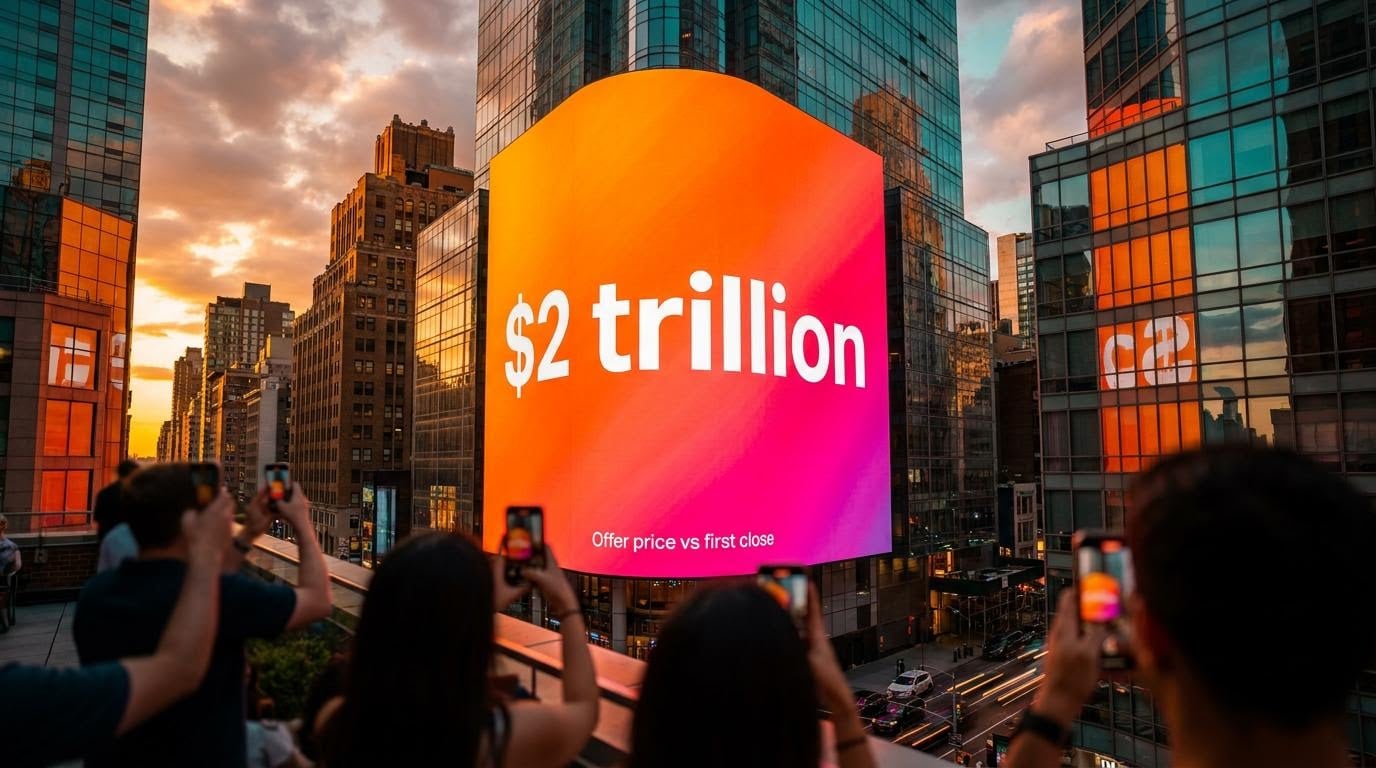
Buying an IPO on its first trading day feels like getting in early. For most ordinary investors, it is the opposite. SpaceX priced its shares at $135 in June 2026, closed its first session near $160.95, and has since slid to around $113. That is below the price institutions paid and well below where many individual buyers got in.
That gap matters as the Anthropic IPO approaches. The company reportedly filed a confidential draft S-1 in June 2026. An S-1 is the registration document a company files with the Securities and Exchange Commission (SEC) before selling shares to the public. Anthropic is reportedly targeting a Nasdaq listing in mid-November 2026 and a raise of up to about $100 billion.
As of 24 October 2026, no public S-1 has appeared on SEC EDGAR and no listing date is confirmed. Reported valuation targets run from roughly $1.5 trillion to $2 trillion.
Here is a framework for judging the price, the risks and the timing before you place an order.
Why the day-one price is not the price you get
You might assume an IPO opens its doors to everyone at a single price. It does not. There are two prices, and you almost certainly qualify for only one of them.
The offer price is set by the company and its underwriting banks before trading starts, and those shares go mostly to institutions and favoured clients. The opening price is where the stock first trades on the exchange. For hyped deals it usually sits well above the offer, and that is typically where you first get access.
No Anthropic retail allocation has been announced. SpaceX reportedly ended up with a roughly 70:30 split between institutions and individuals, but that tells you nothing certain about what Anthropic will do.
The data from Jay Ritter of the University of Florida, updated on 13 October 2026, shows what that entry point costs you.
| Measure | Average | Median | Entry point (offer vs first close) |
|---|---|---|---|
| First-day return | 18.7% | Not reported | Offer price |
| Three-year return | 38.5% | Not reported | Offer price |
| Three-year return | 21.2% | -25.7% | First close |
The median buyer at the first close lost about a quarter of their money over three years. Ritter’s longer study of U.S. IPOs from 1980-2024 found the average deal trailed the market by roughly 20.5% over three years from the first close. Renaissance Capital’s IPO basket reportedly returned 136% from September 2013 to early 2026, against 326% for the S&P 500.
Across decades of listings, newly public companies have carried a structural performance drag of roughly 3.3% a year against comparable established peers, which compounds into a meaningful gap on your original capital over five years.
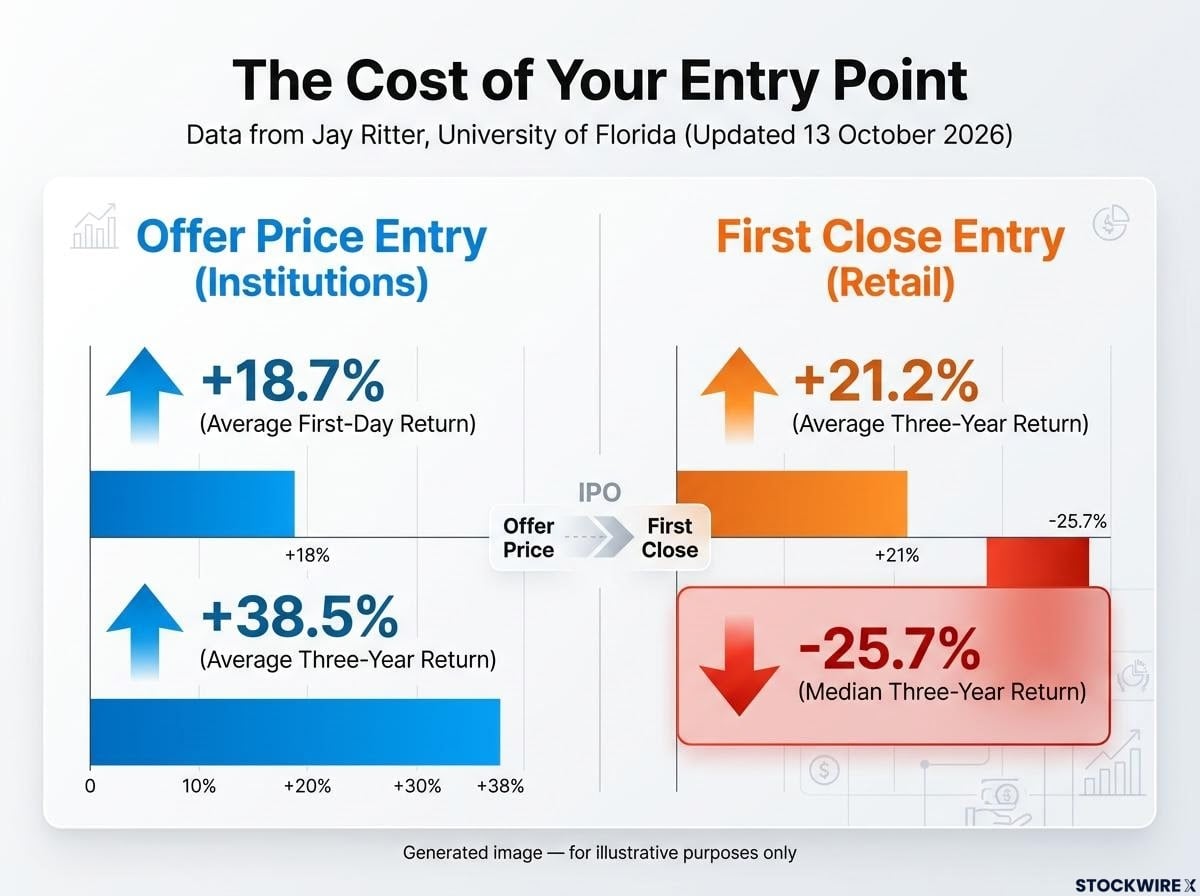
The headline pop mostly belongs to someone else. Your return starts from a higher, less forgiving base.
The takeaway: A spectacular debut does not set a durable floor under the share price.
Lessons from Snap, Facebook and SpaceX
- Snap (2017): priced at $17, opened near $24, gained about 41% on day one, then fell below its offer within months. Buying before the market has evidence is expensive.
- Facebook (2012): a flat debut, then a slide as insider shares became sellable, before a strong long-term recovery. Supply can hit even great businesses.
- SpaceX (2026): opened near $150, peaked around $225.64, then fell to roughly $113. Momentum reversed within months.
Arm and Rivian add a further warning: strategic importance does not protect a stock from valuation risk, and early enthusiasm is easy to extrapolate too far.
When big ASX news breaks, our subscribers know first
What the $80 billion loss and $450 billion in compute bills really mean
Anthropic’s reported H1 2026 net loss of roughly $80.7 billion looks alarming. Most of it is not what it seems.
Why the loss is mostly non-cash
About $72 billion of that loss is a remeasurement of convertible notes, according to Wall Street Journal reporting on the draft prospectus. A convertible note is a loan that can later turn into shares. As Anthropic’s valuation climbs, the recorded value of those notes rises, and accounting rules book that increase as a loss, even though no cash leaves the company.
Two “nearly $9 billion” figures appear in reporting, and they are not the same. One source describes it as the loss remaining after the $72 billion charge; other coverage describes it as H1 computing and infrastructure spending. Treat them as separate reported numbers.
Meanwhile the business is growing fast. H1 2026 revenue reached about $16.3 billion, against about $1.1 billion a year earlier, and Q3 2026 revenue hit roughly $16.8 billion, up 45-46% on the prior quarter. Anthropic also reported adjusted profitability and positive free cash flow for Q3.
The risks that remain
The real pressure sits in fixed obligations. Anthropic rents most of its computing power, and an earlier draft filing said about 80% of its commitments were non-cancellable or payable regardless of use.
| Commitment | Approx. figure | Note |
|---|---|---|
| Total cloud commitments | $450B | Largely non-cancellable, over about 7-10 years |
| Google Cloud | $111B | Part of cloud total |
| Amazon Web Services | $110B | Part of cloud total |
| Microsoft | $31B | Part of cloud total |
| Nscale and Lambda chip capacity | Up to $86B | Nvidia capacity arrangements |
| Broader infrastructure exposure | Above $600B | Some reports cite up to about $750B |
Think of a restaurant on a long, expensive lease with a handful of big regulars. Busy nights look great, but the rent arrives whether diners show up or not. The ongoing risks for you include:
- Convertible dilution: the notes could add shares, repayment obligations or valuation swings.
- Rising infrastructure spending: H1 computing spend was nearly four times the prior-year period.
- Decelerating growth: sequential growth of 45-46% is slower than the earlier pace of roughly 140% year on year.
- Customer concentration: about one-fifth of H1 revenue came from two customers.
The loss headline is mostly noise. Fixed compute costs and concentration are the numbers that decide whether Anthropic can absorb a demand slowdown.
Compute costs are the pressure point, and the undisclosed gross margin is the figure that would show whether each revenue dollar leaves enough cash to service those fixed obligations.
Who controls Anthropic, who is selling, and when the shares can move
Once you know what you are buying, the next question is what you are not getting.
Governance: economic exposure, little control
- Anthropic is a public benefit corporation, a company legally required to weigh a stated mission alongside shareholder returns.
- Seven co-founders jointly direct one Class F share carrying 50.1% of voting power on key matters.
- A Long-Term Benefit Trust, whose trustees own no shares, picks four of seven board seats.
- Ordinary Class A shares carry one vote each.
In a one-share-one-vote company, enough shareholders can replace directors or block a deal. Here, you would share in the economics with little ability to change who runs the company.
Insider selling and lockup expiry
Anthropic reportedly considered letting existing shareholders and employees sell part of their stakes in the offering. Early investors who came in at the $61.5 billion valuation could exit at roughly 25-32 times that level. The final mix of sellers is unconfirmed, but heavy insider selling would hand risk from low-cost holders to late buyers.
A lockup is a period after listing when insiders cannot sell, typically about 180 days. One source reports Anthropic plans longer lockups, possibly to mid-2027, but this remains a reported plan only.
Expiry matters. Field and Hanka’s study of 1,948 U.S. lockups found a roughly 1.5% negative abnormal return over the three days around expiry and a permanent 40% rise in trading volume. Owning this stock means accepting limited say and a share supply that arrives on a schedule you do not control.
What growth does the valuation require?
You can test any IPO price with a simple question: what would the company need to become for you to earn a decent return?
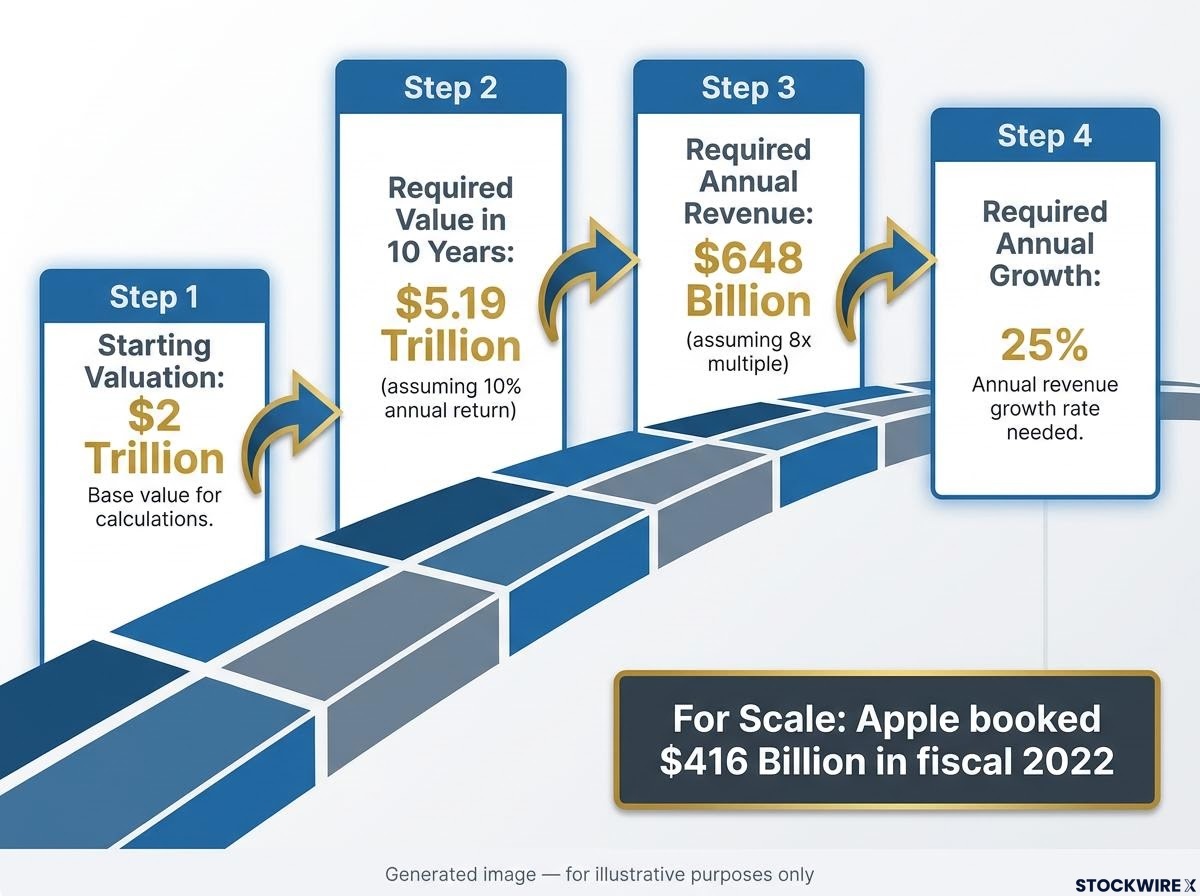
Start with a target. Say you want 10% a year for ten years. At a $2 trillion entry price, Anthropic would need to be worth about $5.19 trillion in a decade.
Next, assume a mature company trades at about 8 times its annual revenue. Divide $5.19 trillion by eight and you get roughly $648 billion in yearly revenue. Getting there from a run rate near $67 billion requires about 25% growth every year. A run rate is current revenue annualised, for example a quarter multiplied by four.
| Starting valuation | Value needed in 10 years | Revenue needed | Implied annual growth |
|---|---|---|---|
| $2T | About $5.19T | About $648B | About 25% |
| $1.5T | Not reported | About $486B | About 22% |
For scale, $648 billion exceeds the roughly $416 billion Apple booked in fiscal 2022, a figure the source cites as a record, though later years were higher. The same test applied to SpaceX required about 41% a year.
Private rounds show how quickly expectations have climbed: $61.5 billion in March 2025, $183 billion in September 2025, $380 billion in February 2026 and $965 billion in May 2026. Nasdaq Private Market marks sat near $1.44 trillion on 23 October. At $1.5-2 trillion, you would pay roughly $22-30 per dollar of run-rate revenue, against about $94 for SpaceX.
Reported targets have already moved, and the recent valuation reset from about $2 trillion toward $1.5 trillion shows how sensitive the price is to the slowdown in sequential growth, which is why the entry point matters so much.
Bull case versus bear case
Bull case
- Morningstar’s Michael Field says that at $100-120 billion of projected revenue, $2 trillion is about 18-20 times forward sales: aggressive but not impossible.
- Q3 revenue of $16.8 billion, adjusted profitability and positive free cash flow.
Bear case
- Morningstar’s Rolfes puts the multiple near 31 times annualised revenue at $2 trillion, with margins needing to rise from about 44% to about 70%.
- New Constructs, cited by the New York Times on 16 October, says $2 trillion requires about a 10% after-tax operating margin immediately, then very high growth for many years.
Two readings of one price: Morningstar sees a stretched but reachable multiple; New Constructs sees a price that leaves almost no room for error.
The conclusion is not that Anthropic will fail. Buying at these levels is a bet on 22-25% compound growth for a decade, so decide whether you hold that conviction before paying up. These projections are illustrative; past performance does not guarantee future results, and financial projections are subject to market conditions and risk factors.
A practical plan: index flows, patience and what to check after listing
You now have the risks. Here is how to turn them into a staged plan.
Index inclusion: a flow, not a verdict
| Index | Seasoning | Profit test | Near-term outlook |
|---|---|---|---|
| Nasdaq-100 (fast entry) | About 15 trading days if market cap ranks in the top 40 | Not cited in reporting | Possible within weeks |
| Nasdaq-100 (normal) | Three full calendar months | Not cited in reporting | Fallback route |
| S&P 500 | 12 months | Positive GAAP earnings, latest quarter and trailing four quarters | Very unlikely |
Under the fast-entry rule, Nasdaq evaluates after the 7th trading day, announces after the 10th and adds after the 15th. SpaceX joined within weeks. Index funds would then have to buy, so if you hold a Nasdaq-100 fund you may own Anthropic indirectly anyway. That buying is a flow effect, not proof the valuation is sound.
For readers deciding between index funds, our dedicated guide to Nasdaq-100 versus S&P 500 index entry compares the seasoning and profitability gates that decide which ETFs hold a new listing first.
What to check after listing
- Recurring revenue, not a management-reported run rate.
- Gross margin and compute cost per revenue dollar.
- Cash burn and capital expenditure.
- Utilisation of the Google, Amazon and Microsoft commitments.
- Customer concentration and retention.
- Dilution from convertibles and stock compensation.
- Final lockup terms and the selling-shareholder mix.
- Whether Nasdaq-100 inclusion happens without relying on passive-flow speculation.
The case for not waiting
Waiting can mean missing a genuine growth story. A company that went from $1.1 billion to $16.3 billion in half-year revenue may keep compounding faster than sceptics expect, and allocated SpaceX buyers banked roughly 19% on day one.
Without an allocation at the offer price, though, patience costs you little in expectation. It buys you real numbers, a settled price and the option to buy in stages.
What the evidence settles, and what only the first public quarter can answer
The growth is real and most of the loss is non-cash. But the price, the fixed compute bill, limited voting rights and future share supply all raise the bar for anyone buying on the open market.
The documents that should drive your decision are still ahead: the public S-1, a confirmed price range, any retail allocation details and the first public quarterly results. All figures here are as reported through 24 October 2026.
This article is for informational purposes only and should not be considered financial advice. Investors should conduct their own research and consult with financial professionals before making investment decisions. If you cannot answer the expectations test with conviction, let the first public quarter answer it for you.