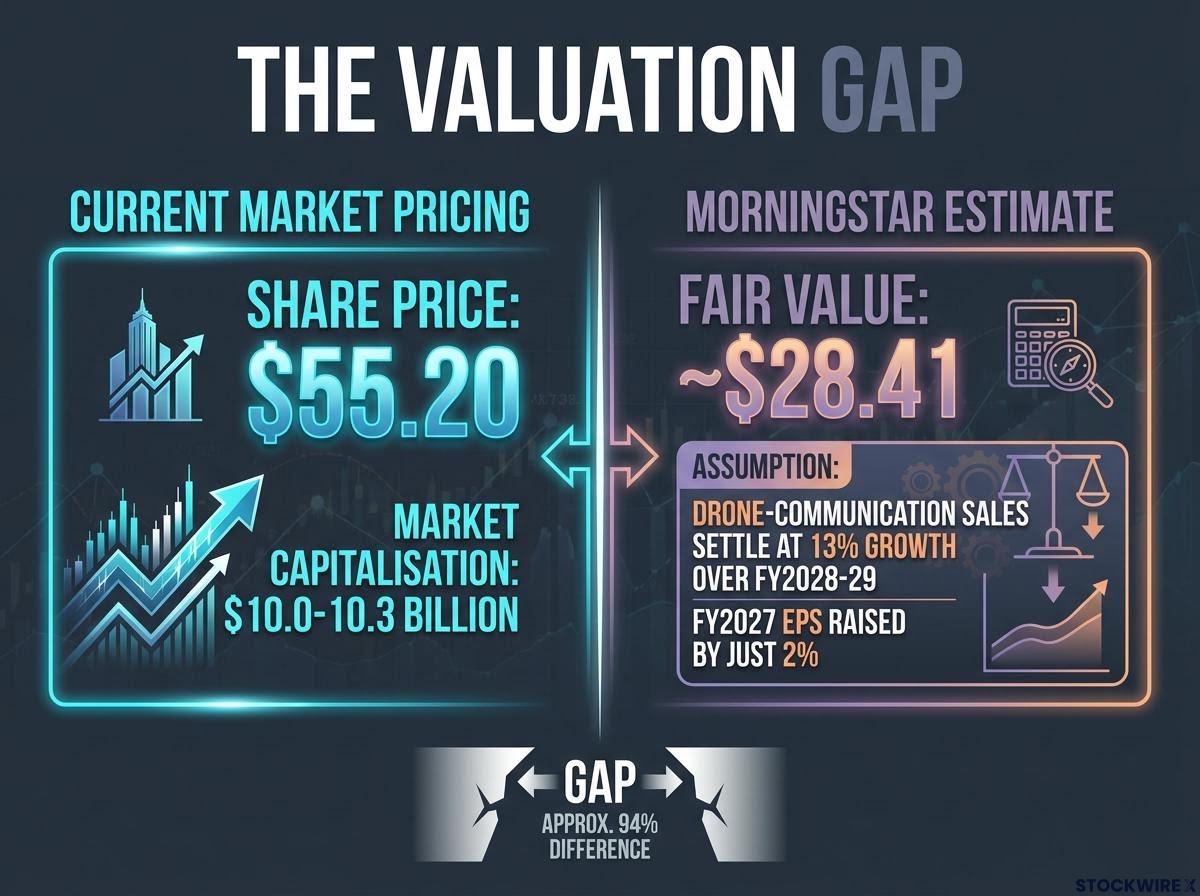
Codan lifted its first-half FY2027 Communications revenue guidance to $410-420 million at its annual general meeting on 20 October, the company’s second upgrade in about three weeks. Morningstar’s response landed two days later: the Codan share price, at $55.20, still sits at more than twice an unchanged fair value of about $28.41.
That tension is the story for Australian investors. The operating numbers keep getting better, but the valuation case has not moved. One detail explains much of the gap: roughly 50% of first-half Communications revenue is now expected to come from conflict regions, up from about 20% a year earlier.
Here is what the market appears to be pricing in, why Morningstar disagrees, and which developments over the next six months would show which side has it right.
Why does Morningstar still see Codan as overvalued after a second upgrade?
On the surface, it looks like a contradiction. Guidance has been raised twice since the FY2026 result on 20 August, profit forecasts have more than doubled year on year, and yet the analyst’s fair value estimate (its view of what the shares are worth based on future cash flows) has not budged.
The FY2026 result set the baseline for the upgrades, with record revenue, a 50% jump in the Communications order book and defence customers rising to 58% of segment revenue from 38%.
The speed of the upgrades shows how quickly expectations have shifted.
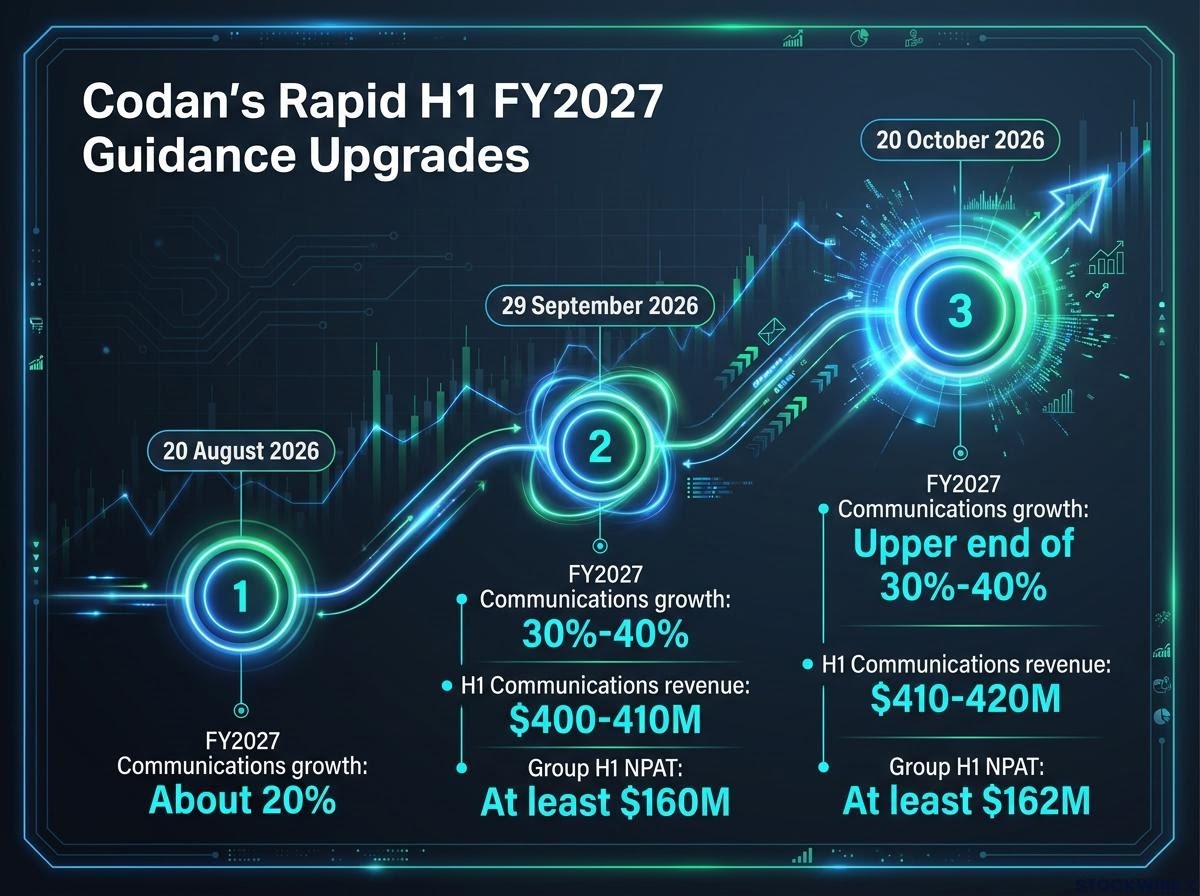
| Date | FY2027 Communications growth | H1 Communications revenue | Group H1 NPAT |
|---|---|---|---|
| 20 August 2026 | About 20% | Not specified | Not specified |
| 29 September 2026 | 30%-40% | $400-410M | At least $160M |
| 20 October 2026 | Upper end of 30%-40% | $410-420M | At least $162M |
For context, first-half Communications revenue was $221.8 million a year earlier, and group net profit after tax (NPAT) was $71.2 million. Management now expects a Communications EBIT margin (earnings before interest and tax as a share of revenue) of about 40%. The company’s own long-term growth target is just 10%-15%.
Morningstar analyst Esther Holloway is not arguing the business is weak. She remains constructive on Codan, which carries a narrow-moat rating, meaning Morningstar believes it has competitive advantages likely to last around a decade. Her objection is about duration.
Morningstar’s view: The market appears to be assuming conflicts such as the Iran and Russia-Ukraine wars will persist long term, while Morningstar expects drone-communication sales to step down over FY2028-29 and settle at 13% growth.
That explains why the upgrade barely registered. Holloway raised FY2027 adjusted earnings per share (EPS) by just 2%, with later years largely unchanged. With a market capitalisation of roughly $10.0-10.3 billion, the shares closed down 2.35% on 22 October. A price of more than twice fair value tells you the market is paying for conflict-level growth to last for years, so if you own Codan, you are implicitly betting against Morningstar’s step-down assumption.
How much of Codan’s growth is conflict-driven, and how hard is it to forecast?
The case for lasting demand is real. Codan’s FY2026 result showed group revenue up 30% to $875.0 million and NPAT up 69% to $175.2 million. Communications revenue rose 22% to $506.2 million at a segment margin of about 31%, while unmanned-sector revenue more than doubled to about $215 million. The Communications order book reached $380 million at 30 June 2026, up 50% year on year.
The drivers split into two groups:
- Structural growth: wider adoption of unmanned systems, secure radio links proven in combat, anti-jamming capability, and non-conflict US and European defence programmes, where Communications growth is running above 20%.
- Cyclical acceleration: drones lost in active combat, emergency procurement and the restocking of depleted inventories.
The distinction matters because order levels can stay high even as the growth rate cools once inventories are rebuilt.
Then comes the uncomfortable part. Half of first-half Communications revenue now sits in conflict regions, and Morningstar estimates at least half of FY2027 sales go to customers involved in conflict. Management itself has said second-half visibility in those regions is low, and that it is too early to tell whether first-half demand and margins will hold. Holloway noted that two upgrades in two months show just how hard these sales are to forecast.
For you as a holder, a 40% margin and a doubled revenue base are earnings you cannot assume carry into FY2028. The quality of those earnings matters as much as their size.
Where the precedent applies, and where it does not
Defence stocks valued for a seemingly permanent war economy were re-rated sharply after Vietnam when budgets fell. Earlier in 2026, analysts debated whether missile-defence names such as Lockheed Martin had rallied beyond sustainable earnings. The parallel for Codan is a de-rating if orders slow after restocking, not a collapse in the value of its technology.
The ASX has already shown how de-rating risk plays out, with DroneShield falling about 60% from its peak despite record earnings once the speculative premium expanded.
What would prove the bulls or the bears right from here?
Both cases rest on specific, checkable claims. Morningstar itself sets out a bull and a bear scenario, and other publications fall along the spectrum.
| Factor | Bull reading | Bear reading |
|---|---|---|
| Conflict demand | Restocking and modernisation keep orders elevated | Half of revenue depends on conflicts outside Codan’s control |
| NG911 | Upgrades widen Zetron’s addressable market | Federal funding delays could stall customer purchasing |
| Acquisitions | Cross-selling and operating leverage lift margins above the historical mid-50s gross margin | Integration and technology-development risk |
| Metal Detection | FY2026 revenue up 42% to $362.0M, margin about 44.9% | Sensitive to gold prices and consumer pullbacks |
The NG911 opportunity refers to the US shift to next-generation 911, an upgrade of emergency call centres to internet-based systems. Zetron, Codan’s public-safety arm, won a US$19 million utility contract and an £11 million UK mission-critical services contract in FY2026. Bell Potter flagged potential US federal support of about US$10-15 billion back in October 2024, but warned delays or non-approval could hold back spending.
Bears add buy-domestic procurement rules and competing technology. Codan’s $21 million Adaptive Dynamics deal, completed in July 2026, adds anti-jamming capability but also integration risk. Simply Wall St is bullish on earnings while flagging conflict concentration, Montgomery Investment Management notes the outlook depends on unusually strong demand, and Motley Fool Australia is positive without a fair-value model.
Completion of the Adaptive Dynamics deal on 31 July brought anti-jamming and APNT technology into DTC Communications, though no earnings contribution was quantified, leaving integration impact open for investors to judge.
The signals worth tracking:
- Second-half order flow in conflict regions
- The conflict-region share of Communications revenue
- NG911 funding and Zetron contract progress
- Metal Detection demand as gold prices move
That short watchlist will tell you more about the share price than any single upgrade. This article is general information only and is not personal financial advice.
What the valuation gap tells you, and what it leaves open
Codan’s operations are strong, and the latest upgrade confirms it. But the upgrade moved Morningstar’s earnings numbers by just 2%, and the current price assumes conflict-level growth persists well beyond what the analyst expects.
The next evidence arrives with the first-half FY2027 result, due after the half closes on 31 December 2026. Second-half order visibility, and whether conflict-region revenue holds its share, will matter more than the headline profit. Your decision rests on one question: do you believe today’s demand is the new base, or a peak that restocking eventually works through?
This article is for informational purposes only and should not be considered financial advice. Investors should conduct their own research and consult with financial professionals before making investment decisions. Past performance does not guarantee future results. Financial projections are subject to market conditions and various risk factors.