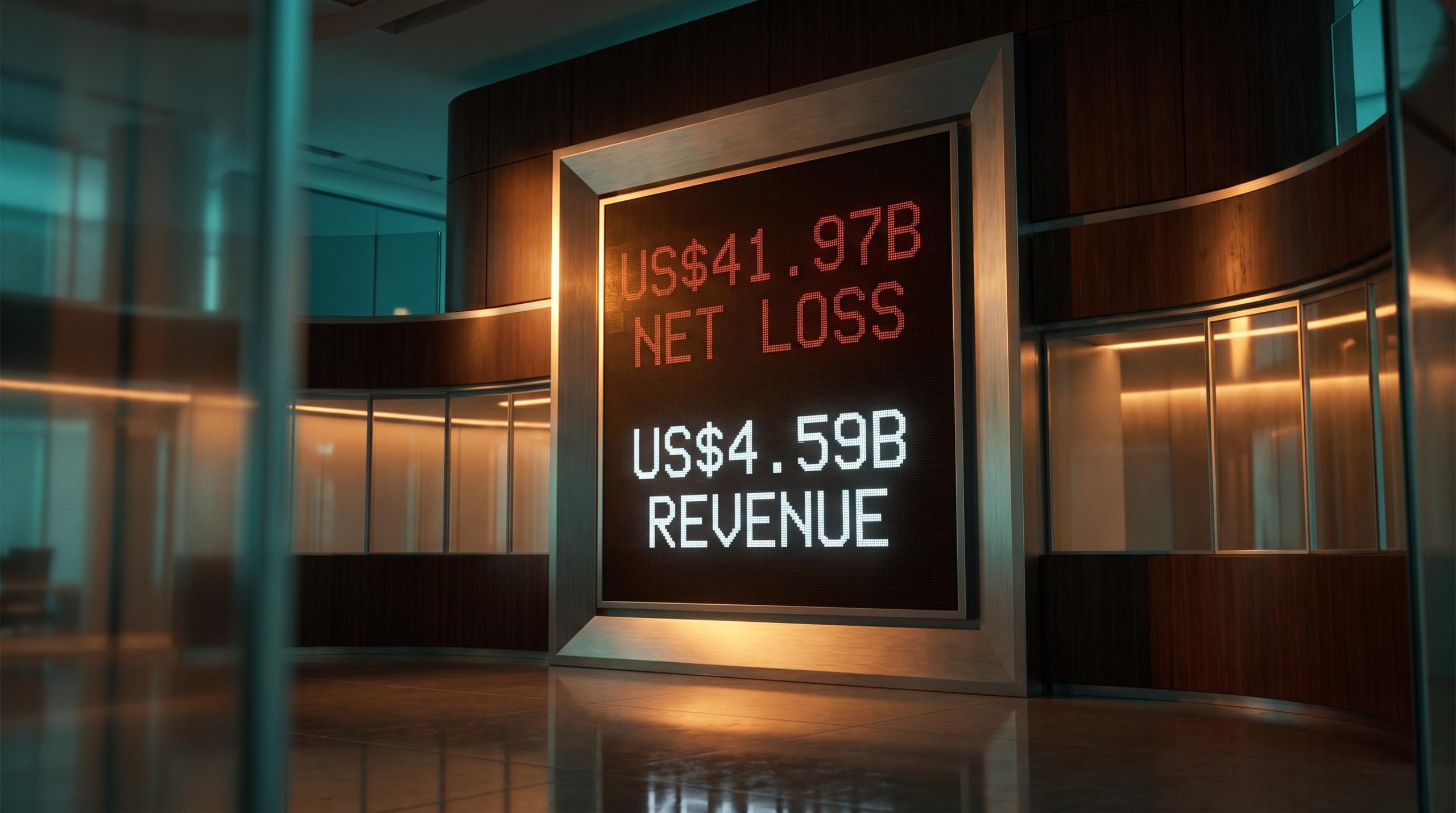
The most misleading number in Anthropic’s leaked IPO prospectus is the one every headline led with: a US$41.97 billion net loss for 2025.
That figure has already sorted readers into two camps. One dismissed Anthropic as a spectacular failure. The other accepted the loss uncritically as the cost of building frontier artificial intelligence. Both reactions miss what the document actually contains, which is a company that grew revenue twelvefold, is chasing a US$2 trillion valuation, and has committed US$518 billion to future infrastructure. Those three numbers pull in opposite directions.
This is not an exercise in hyping the listing or debunking it. Here is what the prospectus genuinely tells you about the economics underneath the headline, and the framework for deciding whether any of it justifies a two-trillion-dollar price tag.
What the prospectus actually shows: revenue growth that rewrites expectations
Start with the number that should genuinely stop you: Anthropic reported revenue of roughly US$4.59 billion for 2025, up approximately twelvefold on the prior year. That is a growth rate of around 1,088%.
Business Insider, citing Reuters, describes the 2025 figure as about twelve times the 2024 total. Growth at that pace is rare at any stage. Growth at that pace at this revenue scale is close to unprecedented among recent technology listings, where a company clearing several billion in revenue would typically be posting double-digit or low-triple-digit growth, not four-figure percentages.
Here are the core figures from the fiscal year:
- Revenue: approximately US$4.59 billion (2025)
- Operating loss: approximately US$8.06 billion, up from US$2.98 billion in 2024
- Total operating expenses: US$12.65 billion
- Burn ratio: roughly US$1.75 of operating cost for every US$1 of revenue
That last figure is where the excitement should cool. According to 36kr Europe’s breakdown, an operating loss of US$8.06 billion against revenue of US$4.59 billion means the company is spending about US$1.75 to generate each dollar it earns.
US$1.75 spent for every US$1 of revenue earned
Sit with what that tells you. A twelvefold revenue jump is exceptional by any historical standard, but the burn ratio means revenue growth alone cannot make this business profitable. To close the gap, Anthropic needs a structural shift in its cost economics, not simply more customers paying at current unit economics. The gap between the growth headline and the burn reality is precisely where most casual analysis of this listing goes wrong.
When big ASX news breaks, our subscribers know first
The US$42 billion loss is real, but it is not the number that matters
Now return to that headline loss and take it apart, because the accounting tells a very different story from the shock value.
The prospectus reports two loss figures that are almost US$34 billion apart. The GAAP net loss is roughly US$41.97 billion. The operating loss is approximately US$8.06 billion. Understanding what sits in the gap between them is the single most useful piece of accounting literacy you can bring to this filing.
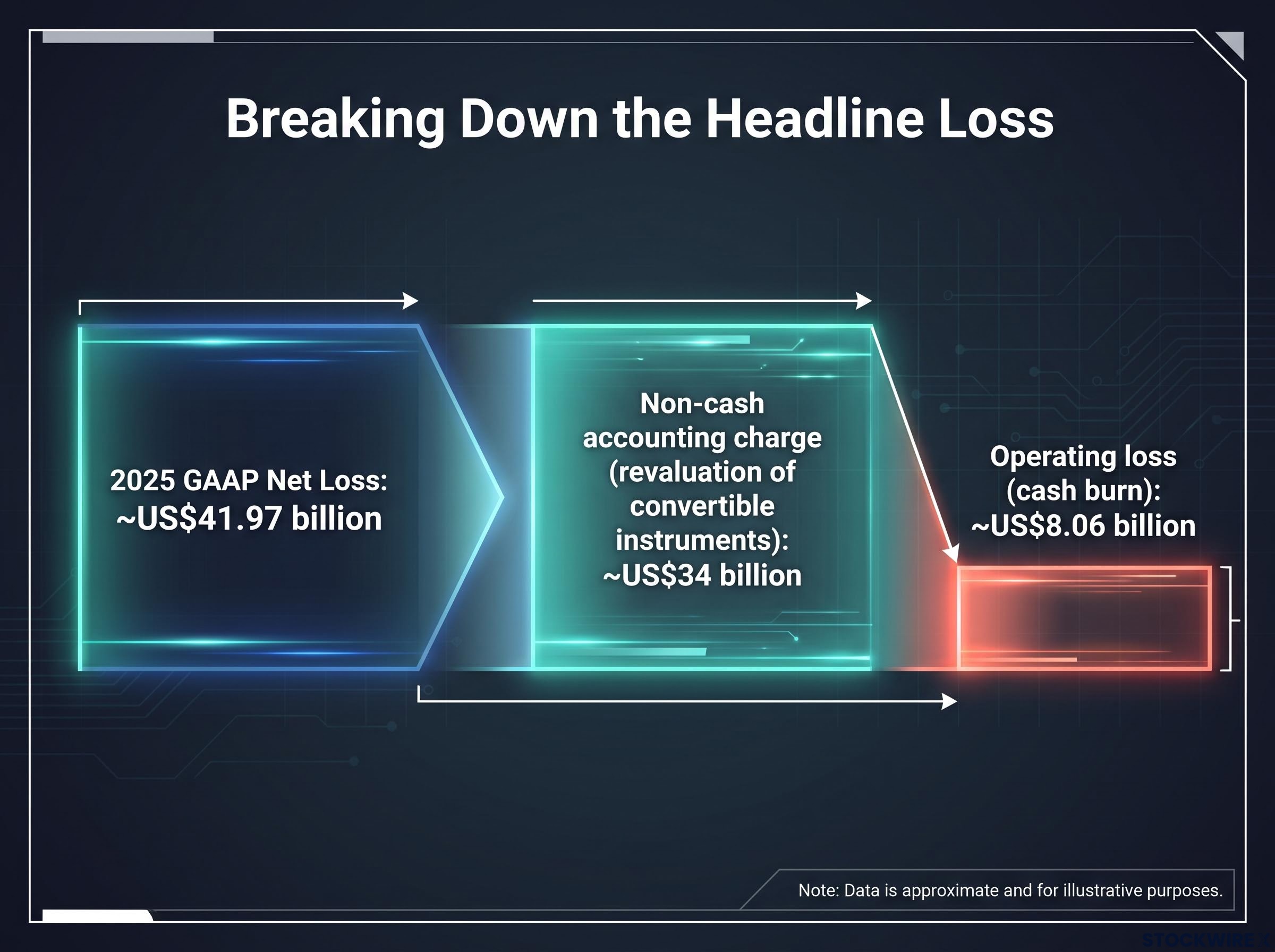
That US$34 billion difference is a non-cash accounting charge. It reflects the revaluation of convertible financing instruments from Anthropic’s earlier funding rounds, not cash consumed running the business. Business Times, Quartz, and The Next Web all flag this same distinction as essential context.
In plain terms: convertible instruments are financing arrangements that can convert into equity, and their accounting value gets marked up or down as the company’s valuation moves. When your implied valuation rockets toward two trillion dollars, the paper value of those instruments balloons too, and that swing lands on the income statement as a loss. No cash left the building.
| Metric | 2025 Figure | What it measures |
|---|---|---|
| GAAP net loss | ~US$41.97 billion | Total accounting loss, including non-cash items |
| Non-cash accounting charge | ~US$34 billion | Revaluation of convertible financing instruments |
| Operating loss (cash) | ~US$8.06 billion | Actual cash-related burn from running the business |
The US$34 billion charge is a consequence of how Anthropic raised money before it filed, not evidence of accelerating operational failure. The number that actually tells you how long the company can sustain itself is the operating loss, measured against its cash on hand. That said, do not let the accounting reframing lull you: US$8.06 billion in genuine cash burn is still an enormous figure.
Cash runway and what it tells you about near-term risk
As of 31 December 2025, Anthropic held US$20.28 billion in cash, cash equivalents, and short-term investments. Set that against annual cash burn of US$8.06 billion, and you get an implied runway of roughly 2.5 years at the current pace, before any capital raised through the IPO itself.
That is a meaningful buffer, but it comes with a caveat that reframes everything. The US$518 billion in future cloud and infrastructure commitments dwarfs the current cash position by a factor of more than twenty-five. What that tells you is that Anthropic is structurally dependent on continued access to capital. This listing is not a one-off top-up; it is one step in an ongoing funding requirement that the balance sheet cannot cover on its own.
AI infrastructure spending by Amazon, Microsoft, Alphabet, and Meta reached a combined US$130 billion in Q1 2026 alone, establishing the competitive cost environment into which Anthropic’s US$518 billion in future obligations must eventually compete, and providing a benchmark for whether that commitment is unusual or simply the entry price for operating at frontier scale.
A US$2 trillion valuation on US$4.6 billion in revenue: how does the arithmetic work?
Here is the arithmetic that makes this listing so contentious. A US$2 trillion valuation on US$4.59 billion of revenue implies a price-to-sales multiple of around 435 times 2025 revenue.
A US$2 trillion valuation on US$4.59 billion in revenue implies a price-to-sales multiple of approximately 435 times
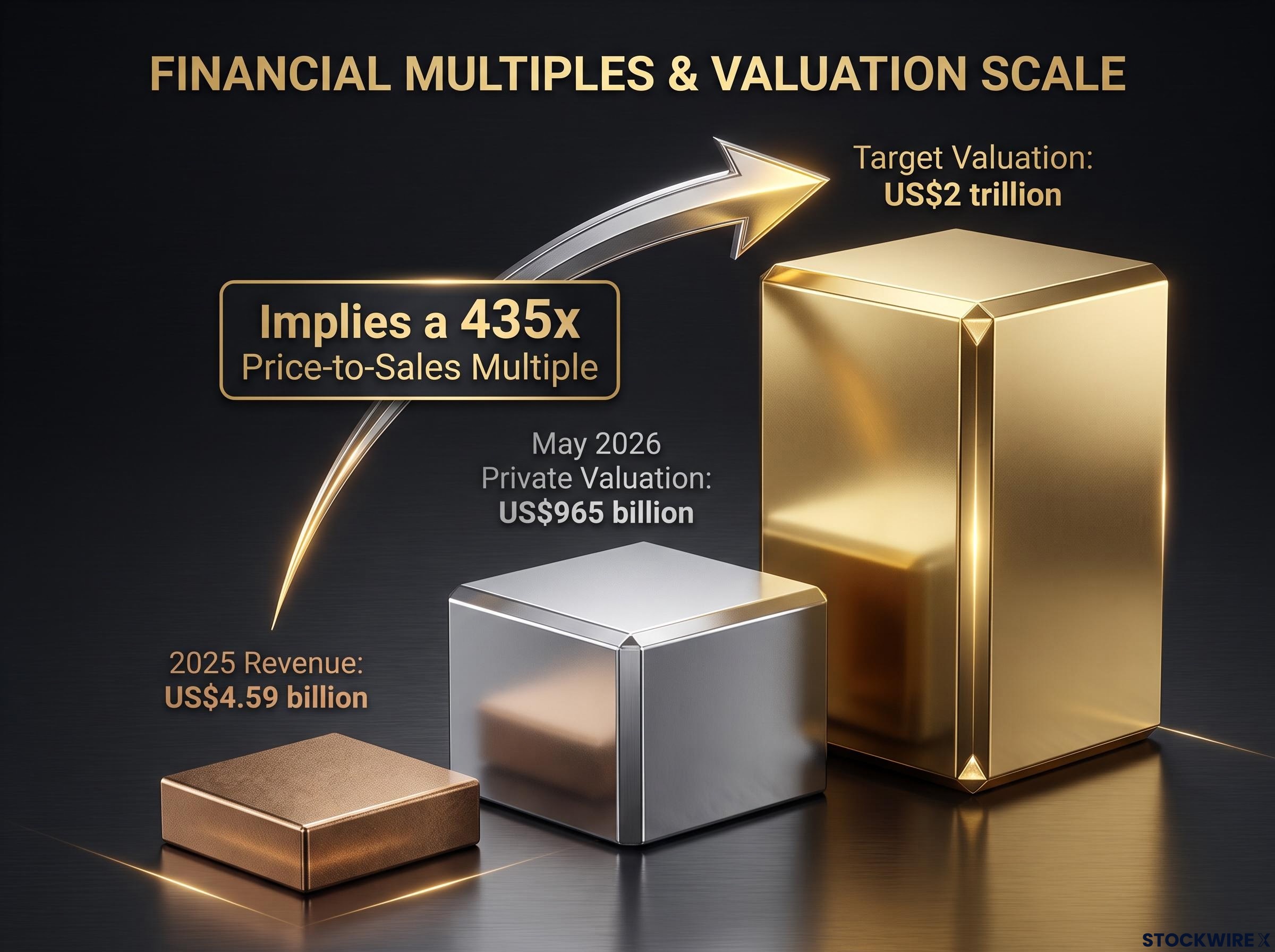
Price-to-sales simply divides the company’s value by its annual revenue. For context, mature software listings often trade in the single digits to low tens on this measure. A multiple of 435 is in a different universe, and it more than doubles Anthropic’s own US$965 billion private valuation from May 2026. So how do sophisticated participants defend it?
The same tension between implied forward multiples and undisclosed unit economics runs through the broader AI IPO valuation debate, where Anthropic’s private round at US$965 billion and OpenAI’s US$852 billion close combine for nearly US$1.8 trillion in private market pricing with no public financial disclosures from either company.
The bull case:
- Twelvefold revenue growth in a single year is a trajectory that, extrapolated, can support very large forward multiples.
- Pre-IPO derivative contracts have held near a US$2 trillion implied valuation even after the prospectus leaked, per CryptoTimes, suggesting informed traders are comfortable with the pricing.
- The US$34 billion non-cash charge overstates the economic loss; the operating picture is materially better than the headline.
- A US$20.28 billion cash pile provides real near-term breathing room.
The bear case:
- US$518 billion in future infrastructure obligations locks in an extraordinary cost base.
- Compute and infrastructure spending hit US$7.33 billion, or 58% of operating expenses, up 190% year on year, and nearly equal to total revenue. There is no margin of safety at the operating level.
- Reporting suggests two customers accounted for roughly 24% of 2025 revenue, with many large clients lacking long-term contracts. This concentration figure has not been independently confirmed and should be treated with caution.
- Gross margin, the one figure that would settle the debate, is undisclosed.
The market has already voted with real money in one place. When news of the filing broke, Salesforce rose 10% in a single session as investors re-rated its Anthropic stake to roughly US$5 billion. That is a concrete signal that the market takes the valuation seriously.
The honest read is that 435 times revenue is not self-evidently absurd given the growth rate, but it becomes very hard to defend without knowing the gross margin. That single number is what would tell you whether Anthropic’s services business can ever throw off the cash flows this price demands.
The five variables that will determine whether this valuation holds
You do not need a Wall Street terminal to evaluate a listing like this. You need a repeatable checklist. Here are the five variables that, taken together, will decide whether this valuation holds, ordered so each builds on the last.
- Gross margin, the decisive undisclosed figure
- Burn per dollar of revenue, the comparability shorthand
- Compute intensity, the structural cost question
- GAAP versus operating loss, the accounting-literacy filter
- Infrastructure commitment risk, the locked-in cost base
| Analytical variable | Anthropic’s current position | Why it matters |
|---|---|---|
| Gross margin | Undisclosed | Determines whether serving customers is fundamentally profitable |
| Burn per dollar of revenue | ~US$1.75 | Measures distance from operational breakeven versus peers |
| Compute intensity | 58% of opex (US$7.33 billion) | Shows how sensitive the model is to compute pricing |
| GAAP vs operating loss | US$41.97 billion vs US$8.06 billion | Separates accounting noise from real cash economics |
| Infrastructure commitment risk | US$518 billion in obligations | Locks in the cost base regardless of near-term revenue |
Reuters’ VIEW column is blunt about the first variable: gross margin will either validate or collapse the entire narrative the private markets have priced for three years. Gross margin is the profit left after the direct cost of delivering a product. Until Anthropic discloses it, any conviction-level view on the valuation is guesswork.
The burn ratio of US$1.75 per dollar of revenue is your quick comparability tool. It lets you line Anthropic up against other high-growth, loss-making technology companies without wading through full financial statements.
Gross margin and compute costs: the two variables that interact
Gross margin and compute intensity are not separate concerns; they are linked. If compute costs sit inside the cost of delivering the service, a weak gross margin signals that serving each customer is itself unprofitable, no matter how efficient the rest of the business becomes. With compute already at 58% of operating expenses, that interaction is the crux of the entire investment question.
Compute cost pressures extend beyond Anthropic’s balance sheet into the broader hardware supply chain, where major suppliers sold out 2026 production capacity and enterprise hardware prices surged up to 60%, creating an upstream cost environment that directly shapes the gross margin trajectory the prospectus has not yet disclosed.
The remaining two variables are structural. The GAAP-versus-operating distinction is a skill you can carry to any AI or technology IPO built on convertible financing, where headline losses routinely overstate cash reality. And the US$518 billion commitment tells you Anthropic’s cost base is locked in regardless of how revenue performs next year, which means continued capital dependency is baked in.
What the prospectus does not say, and why that matters most
Run through everything above and one honest conclusion survives: the number that would let you form real conviction on this valuation is missing from public disclosures entirely.
Gross margin is that absence. Reuters identifies it as the decisive unknown, and its omission is not a minor gap. It is the difference between judging whether Anthropic’s services business is fundamentally sound and being forced to extrapolate from a growth rate. History suggests growth-rate extrapolation alone has been a thin foundation for trillion-dollar valuations to hold.
None of this means the bulls are wrong. Twelvefold growth is genuinely exceptional, and pre-IPO derivative markets sustaining a near US$2 trillion implied valuation through the leak tells you sophisticated participants are making a considered bet, not committing an obvious error.
The question that matters now is forward-looking: what would move a prospective investor from informed uncertainty to informed conviction, in either direction? Here is what to watch for as the process unfolds toward the late-September 2026 prospectus and the confidential S-1 first filed in June 2026:
- A gross margin breakdown for the core AI services business
- The trend in compute costs as a share of revenue, showing whether efficiency improves with scale
- Contract duration and customer concentration metrics
- Any disclosed timeline to profitability
Knowing what you do not yet know, and knowing exactly what would change your mind, is a sharper position than false certainty in either direction.
For investors approaching this filing without prior experience of large technology listings, our full explainer on how IPO investing works covers the structural mechanics that consistently favour institutional allocations over retail participants, including why secondary-market entry typically means absorbing the first-day premium rather than benefiting from it.
This article is for informational purposes only and should not be considered financial advice. Investors should conduct their own research and consult with financial professionals before making investment decisions.
Past performance does not guarantee future results, and financial projections are subject to market conditions and various risk factors. Statements about future disclosures and valuation outcomes are speculative and subject to change based on market developments and company performance.